

Understanding Commonsense Inference Aptitude of Deep Contextual Representations
Open accessThe DOI matches its Crossref record; 35 of the 35 references it cites were found in a registry or an index.
Abstract
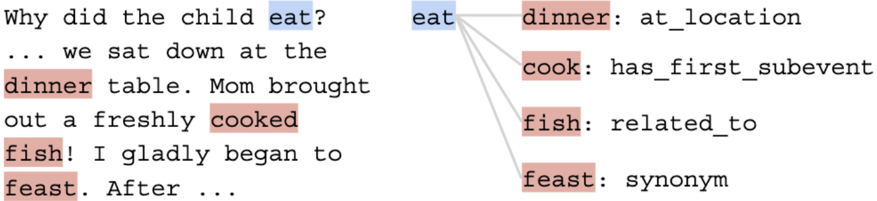
Pretrained deep contextual representations have advanced the state-of-the-art on various commonsense NLP tasks, but we lack a concrete understanding of the capability of these models.Thus, we investigate and challenge several aspects of BERT's commonsense representation abilities.First, we probe BERT's ability to classify various object attributes, demonstrating that BERT shows a strong ability in encoding various commonsense features in its embedding space, but is still deficient in many areas.Next, we show that, by augmenting BERT's pretraining data with additional data related to the deficient attributes, we are able to improve performance on a downstream commonsense reasoning task while using a minimal amount of data.Finally, we develop a method of fine-tuning knowledge graphs embeddings alongside BERT and show the continued importance of explicit knowledge graphs.
Overview
The claims and statistics of this paper haven’t been checked yet.
Free: it reads the open-access text and checks the first 5 claims that cite a source we can check. Create a free account to check every claim.
Integrity signals
Registry
Cites
Statistics
Figures
Verification
Claims the paper makes
The claims and statistics of this paper haven’t been checked yet.
Free: it reads the open-access text and checks the first 5 claims that cite a source we can check. Create a free account to check every claim.
Claims other papers make about this one
Each is checked against this paper’s own text: does it say what the citing paper says it does?
The source backs part of the claim, not all of it — or backs it for a different population, condition or comparison.
In the citing paper
“These studies have tended to be more positive than those which are based on question answering tasks, often reporting results that suggest the LLMs perform well above baseline, though still below humans.”
From Symbols and grounding in large language models (2023) · cites this paper as [95]
Experimental — accuracy not yet measured
Self-check
Percentages, sums and reported differences re-computed from the paper’s own numbers.
The self-check needs the paper’s full text.
Citations
Cites
BERT: Pre-training of Deep Bidirectional Transformers for Language Understanding
Devlin, J., Chang, M.-W., Lee, K., & Toutanova, K. (2018) · arXiv · doi:10.48550/arxiv.1810.04805 · Cited by 73,173 · cited 8×
“We do this since we need to build a classification layer for the specific task, as noted in Devlin et al. (2019).”
BackgroundMethodInfluentialBERT: Pre-training of Deep Bidirectional Transformers for Language Understanding
Devlin, J., Chang, M.-W., Lee, K., & Toutanova, K. (2019) · Proceedings of the 2019 Conference of the North American Chapter of the Association for Computational Linguistics: Human Language Technologies, Volume 1 (Long and Short Papers) · doi:10.18653/v1/n19-1423 · Cited by 54,325 · cited 8×
“We do this since we need to build a classification layer for the specific task, as noted in Devlin et al. (2019).”
BackgroundMethodInfluentialGlove: Global Vectors for Word Representation
Pennington, J., Socher, R., & Manning, C. (2014) · Proceedings of the 2014 Conference on Empirical Methods in Natural Language Processing (EMNLP) · doi:10.3115/v1/d14-1162 · Cited by 34,071 · cited 1×
“We propose a method to evaluate BERT’s representations and compare to previous non-contextual GloVe (Pennington et al., 2014) baselines, using simple logistic classifiers.”
MethodRoBERTa: A Robustly Optimized BERT Pretraining Approach
Liu, Y., Ott, M., Goyal, N., Du, J., Joshi, M., Chen, D., Levy, O., Lewis, M., Zettlemoyer, L., & Stoyanov, V. (2019) · arXiv · doi:10.48550/arxiv.1907.11692 · Cited by 16,515 · cited 4×
“Several works have improved on BERT’s language objectives (Yang et al., 2019; Liu et al., 2019b), but we keep the language objectives in BERT intact for comparison.”
BackgroundResultInfluentialDeep Contextualized Word Representations
Peters, M., Neumann, M., Iyyer, M., Gardner, M., Clark, C., Lee, K., & Zettlemoyer, L. (2018) · Proceedings of the 2018 Conference of the North American Chapter of the Association for Computational Linguistics: Human Language Technologies, Volume 1 (Long Papers) · doi:10.18653/v1/n18-1202 · Cited by 11,983 · cited 1×
“On the other hand, NLP systems have recently improved dramatically with contextualized word representations in a wide range of tasks (Peters et al., 2018; Radford et al., 2018; Devlin et al., 2019).”
BackgroundBioBERT: a pre-trained biomedical language representation model for biomedical text mining
Lee, J., Yoon, W., Kim, S., Kim, D., Kim, S., So, C. H., & Kang, J. (2020) · Bioinformatics · doi:10.1093/bioinformatics/btz682 · Cited by 7,218 · cited 1×
“Other work extends BERT to domains where its original training data does not suffice (Beltagy et al., 2019; Lee et al., 2019).”
BackgroundXLNet: Generalized Autoregressive Pretraining for Language Understanding
Yang, Z., Dai, Z., Yang, Y., Carbonell, J., Salakhutdinov, R., & Le, Q. V. (2019) · arXiv · doi:10.48550/arxiv.1906.08237 · Cited by 6,687 · cited 2×
“Several works have improved on BERT’s language objectives (Yang et al., 2019; Liu et al., 2019b), but we keep the language objectives in BERT intact for comparison.”
BackgroundHow to Fine-Tune BERT for Text Classification?
Sun, C., Qiu, X., Xu, Y., & Huang, X. (2019) · Lecture Notes in Computer Science · doi:10.1007/978-3-030-32381-3_16 · Cited by 1,534
ERNIE: Enhanced Language Representation with Informative Entities
Zhang, Z., Han, X., Liu, Z., Jiang, X., Sun, M., & Liu, Q. (2019) · Proceedings of the 57th Annual Meeting of the Association for Computational Linguistics · doi:10.18653/v1/p19-1139 · Cited by 1,482 · cited 1×
“Explicitly, ERNIE, Zhang et al. (2019) introduces information to contextual representations during pretraining.”
BackgroundRACE: Large-scale ReAding Comprehension Dataset From Examinations
Lai, G., Xie, Q., Liu, H., Yang, Y., & Hovy, E. (2017) · Proceedings of the 2017 Conference on Empirical Methods in Natural Language Processing · doi:10.18653/v1/d17-1082 · Cited by 1,044 · cited 6×
“(2019) explores fine-tuning on indomain data, similarly to our fine-tuning on the RACE dataset (Lai et al., 2017).”
BackgroundMethodInfluential
Research works printed but not linked: 5
- Elia Bruni, Gemma Boleda, Marco Baroni, and Nam- Khanh Tran. 2012. Distributional semantics in tech- nicolor. In Proc. of ACL.
- Matthew Peters, Mark Neumann, Mohit Iyyer, Matt Gardner, Christopher Clark, Kenton Lee, and Luke Zettlemoyer. 2018. Deep contextualized word rep- resentations. In Proc. of NAACL-HLT.
- Melissa Roemmele, Cosmin Adrian Bejan, and An- drew S. Gordon. 2011. Choice of plausible alter- natives: An evaluation of commonsense causal rea- soning. In AAAI 2011 Spring Symposium.
- Lenhart Schubert. 2015. What kinds of knowledge are needed for genuine understanding? In Proc of Cog- nitum.
- Zhengyan Zhang, Xu Han, Zhiyuan Liu, Xin Jiang, Maosong Sun, and Qun Liu. 2019. ERNIE: En- hanced language representation with informative en- tities. In Proc. of ACL, Florence, Italy. Association for Computational Linguistics.
Cited by
A primer in BERTology: What we know about how BERT works
Rogers, A., Kovaleva, O., & Rumshisky, A. (2020) · Transactions of the Association for Computational Linguistics · doi:10.1162/tacl_a_00349 · Cited by 1,552
Pre-trained models: Past, present and future
Han, X., Zhang, Z., Ding, N., Gu, Y., Liu, X., Huo, Y., Qiu, J., Yao, Y., Zhang, A., Zhang, L., et al. (2021) · AI Open · doi:10.1016/j.aiopen.2021.08.002 · Cited by 994
Measuring and improving consistency in pretrained language models
Elazar, Y., Kassner, N., Ravfogel, S., Ravichander, A., Hovy, E., Schütze, H., & Goldberg, Y. (2021) · Transactions of the Association for Computational Linguistics · doi:10.1162/tacl_a_00410 · Cited by 220
“This definition is in the spirit of the RTE definition (Dagan et al., 2005), which similarly supports a more flexible use of the notion of entailment.”
BackgroundSymbols and grounding in large language models
Pavlick, E. (2023) · Philosophical Transactions of the Royal Society A: Mathematical, Physical and Engineering Sciences · doi:10.1098/rsta.2022.0041 · Cited by 95
“[95] perform similar analyses.”
Semantic Structure in Deep Learning
Pavlick, E. (2022) · Annual Review of Linguistics · doi:10.1146/annurev-linguistics-031120-122924 · Cited by 66
Metadata
- Authors
- Da, J., & Kasai, J.
- Affiliations
- University of Washington (US)
- ORCID
- Kasai, Jungo
- Venue
- Proceedings of the First Workshop on Commonsense Inference in Natural Language Processing
- Published
- 2019
- Pages
- 1-12
- OpenAlex
- W2985797697
- Cited by
- 22
- References
- 34
- Citations by year
- 2024: 1 · 2023: 2 · 2022: 2 · 2021: 13 · 2020: 4
- FWCI
- 1.82
- Type
- conference paper
- Language
- en
- Open access
- gold
- doi.org
- Licence
- cc-by
- Funders
- National Science Foundation
- Topics
- Physical Sciences › Computer Science › Artificial Intelligence › Topic Modeling
- Physical Sciences › Computer Science › Computer Vision and Pattern Recognition › Multimodal Machine Learning Applications
- Physical Sciences › Computer Science › Artificial Intelligence › Natural Language Processing Techniques
- Keywords
- commonsense reasoning, BERT, pre-trained language models, context representation, knowledge graph embedding, fine-tuning, embedding space analysis
About these checks
Registry, retraction, Cites and statistics results are computed, not judged, with one exception: a printed reference that no index lists is read once by a model before it counts as a citation error. Claims are extracted by a model and kept only when their quote appears verbatim in the text; each cited source is then checked, with a model’s help, for whether it says what the claim relies on. Those verdicts can be wrong — read the claim’s quote and the cited source before relying on one.
Statistics and arithmetic are recomputed, not judged.
Confidence bands are shown only for fields calibrated on our annotated test set. None is calibrated yet, so no band is shown.
What counts as a claim ›How we measure confidence ›How we check this ›
Are you an author, or do you see a problem with this page? Request a review
Data sources
Bibliographic data: Semantic Scholar, OpenAlex, Crossref.
Contains information from the Semantic Scholar Academic Graph Datasets, made available under the ODC Attribution License (ODC-BY 1.0).
Semantic Scholar’s data is described in: Kinney, R., et al. (2023). The Semantic Scholar Open Data Platform. arXiv:2301.10140.
