

Multi-Task, Multi-Channel, Multi-Input Learning for Mental Illness Detection using Social Media Text
Open accessThe DOI matches its Crossref record; 35 of the 36 references it cites were found in a registry or an index.
Abstract
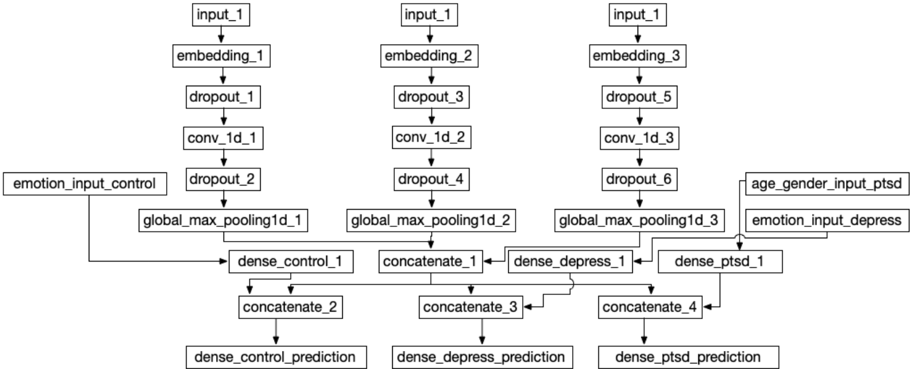
We investigate the impact of using emotional patterns identified by the clinical practitioners and computational linguists to enhance the prediction capabilities of a mental illness detection (in our case depression and posttraumatic stress disorder) model built using a deep neural network architecture.Over the years, deep learning methods have been successfully used in natural language processing tasks, including a few in the domain of mental illness and suicide ideation detection.We illustrate the effectiveness of using multitask learning with a multi-channel convolutional neural network as the shared representation and use additional inputs identified by researchers as indicatives in detecting mental disorders to enhance the model predictability.Given the limited amount of unstructured data available for training, we managed to obtain a task-specific AUC higher than 0.90.In comparison to methods such as multi-class classification, we identified multi-task learning with multi-channel convolution neural network and multiple-inputs to be effective in detecting mental disorders.
Overview
The claims and statistics of this paper haven’t been checked yet.
Free: it reads the open-access text and checks the first 5 claims that cite a source we can check. Create a free account to check every claim.
Integrity signals
Registry
Cites
Statistics
Figures
Verification
Claims the paper makes
The claims and statistics of this paper haven’t been checked yet.
Free: it reads the open-access text and checks the first 5 claims that cite a source we can check. Create a free account to check every claim.
Claims other papers make about this one
Each is checked against this paper’s own text: does it say what the citing paper says it does?
The source backs part of the claim, not all of it — or backs it for a different population, condition or comparison.
In the citing paper
“The first 2 studies leverage social media data and rely on selfreported PTSD diagnoses, which may contribute to their higher AUC values.”
From Linguistic markers for identifying post-traumatic stress disorder and associated symptoms: a systematic literature review (2025) · cites this paper as [84]
Experimental — accuracy not yet measuredThe cited source says what the claim attributes to it.
In the citing paper
“Some 42,61,84,88 were unclear about their analysis because they used uninterpretable features or did not use methods like SHAP to suggest interpretations, and they limited their results to classification performance.”
From Linguistic markers for identifying post-traumatic stress disorder and associated symptoms: a systematic literature review (2025) · cites this paper as [84]
The cited source says what the claim attributes to it.
In the citing paper
“From the forest plot highlights studies with notably higher AUC scores, particularly Reece et al, 52 Kirinde Gamaarachchige and Inkpen, 84 and Schultebraucks et al. 43”
From Linguistic markers for identifying post-traumatic stress disorder and associated symptoms: a systematic literature review (2025) · cites this paper as [84]
The cited source says what the claim attributes to it.
In the citing paper
“Studies 42,61,84,88 reporting only classification performances or using deep learning methods without methods to interpret had very low clinical impact.”
From Linguistic markers for identifying post-traumatic stress disorder and associated symptoms: a systematic literature review (2025) · cites this paper as [84]
Self-check
Percentages, sums and reported differences re-computed from the paper’s own numbers.
The self-check needs the paper’s full text.
Citations
Cites
Adam: A Method for Stochastic Optimization
Kingma, D. P., & Ba, J. (2014) · arXiv · doi:10.48550/arxiv.1412.6980 · Cited by 98,946 · cited 1×
“The Adam optimizer (Kingma and Ba, 2014) was used when training both the models with the default learning rate of 0.001.”
MethodInfluential(2014) · Cited by 33,419
Enriching Word Vectors with Subword Information
Bojanowski, P., Grave, E., Joulin, A., & Mikolov, T. (2017) · Transactions of the Association for Computational Linguistics · doi:10.1162/tacl_a_00051 · Cited by 9,645 · cited 1×
“We decided to use fastText because given the unstructured nature of the twitter messages we could obtain a more meaningful representation by expressing a word as a vector constructed out of the sum of several vectors for different parts of the word (Bojanowski et al., 2017).”
MethodCaruana, R. (1997) · Machine Learning · doi:10.1023/a:1007379606734 · Cited by 6,636 · cited 1×
“Learning a shared representation so that individual tasks can benefit from one another (Caruana, 1997) can be considered as one of the most appropriate architectures when trying to detect multiple mental illnesses.”
BackgroundBag of Tricks for Efficient Text Classification
Joulin, A., Grave, E., Bojanowski, P., & Mikolov, T. (2017) · Proceedings of the 15th Conference of the European Chapter of the Association for Computational Linguistics: Volume 2, Short Papers · doi:10.18653/v1/e17-2068 · Cited by 4,545
Bag of Tricks for Efficient Text Classification
Joulin, A., Grave, E., Bojanowski, P., & Mikolov, T. (2016) · arXiv · doi:10.48550/arxiv.1607.01759 · Cited by 4,542 · cited 2×
“Even though our best results were obtained by instantiating the embedding layer weights with random numbers (refer Table 4), we conducted several preliminary experiments using word embeddings trained on the fastText (Joulin et al., 2017)”
MethodQuantifying Mental Health Signals in Twitter
Coppersmith, G., Dredze, M., & Harman, C. (2014) · Proceedings of the Workshop on Computational Linguistics and Clinical Psychology: From Linguistic Signal to Clinical Reality · doi:10.3115/v1/w14-3207 · Cited by 722 · cited 2×
“Social media text was used to classify users with insomnia and distress (Jamison-Powell et al., 2012; Lehrman et al., 2012), postpartum depression (De Choudhury et al., 2013a,b, 2014), depression (Resnik et al., 2015a, 2013, 2015b; Schwartz et al., 2014; Tsugawa et al., 2015), Post-Traumatic Stress Disorder (Coppersmi…”
BackgroundPredicting postpartum changes in emotion and behavior via social media
De Choudhury, M., Counts, S., & Horvitz, E. (2013) · Proceedings of the SIGCHI Conference on Human Factors in Computing Systems · doi:10.1145/2470654.2466447 · Cited by 462 · cited 1×
“…media text was used to classify users with insomnia and distress (Jamison-Powell et al., 2012; Lehrman et al., 2012), postpartum depression (De Choudhury et al., 2013a,b, 2014), depression (Resnik et al., 2015a, 2013, 2015b; Schwartz et al., 2014; Tsugawa et al., 2015), Post-Traumatic Stress…”
MethodCharacterizing and predicting postpartum depression from shared facebook data
De Choudhury, M., Counts, S., Horvitz, E. J., & Hoff, A. (2014) · Proceedings of the 17th ACM conference on Computer supported cooperative work & social computing · doi:10.1145/2531602.2531675 · Cited by 379
Recognizing Depression from Twitter Activity
Tsugawa, S., Kikuchi, Y., Kishino, F., Nakajima, K., Itoh, Y., & Ohsaki, H. (2015) · Proceedings of the 33rd Annual ACM Conference on Human Factors in Computing Systems · doi:10.1145/2702123.2702280 · Cited by 334 · cited 1×
“…et al., 2012), postpartum depression (De Choudhury et al., 2013a,b, 2014), depression (Resnik et al., 2015a, 2013, 2015b; Schwartz et al., 2014; Tsugawa et al., 2015), Post-Traumatic Stress Disorder (Coppersmith et al., 2014a,b), schizophrenia (Loveys et al., 2017) and many other mental…”
Background
Research works printed but not linked: 1
- [28]28. Umashanthi Pavalanathan and Munmun De Choud- hury. 2015. Identity Management and Mental Health Discourse in Social Media Identity in Online Communities. In WWW'15 Companion: 24th Inter- national World Wide Web Conference, pages 18-22.
Cited by
Mental Health Analysis in Social Media Posts: A Survey
Garg, M. (2023) · Archives of Computational Methods in Engineering · doi:10.1007/s11831-022-09863-z · Cited by 200
Malhotra, A., & Jindal, R. (2022) · Applied Soft Computing · doi:10.1016/j.asoc.2022.109713 · Cited by 125
Schizophrenia Detection Using Machine Learning Approach from Social Media Content
Bae, Y. J., Shim, M., & Lee, W. H. (2021) · Sensors · doi:10.3390/s21175924 · Cited by 96
Cost-Sensitive Boosting Pruning Trees for Depression Detection on Twitter
Tong, L., Liu, Z., Jiang, Z., Zhou, F., Chen, L., Lyu, J., Zhang, X., Zhang, Q., Sadka, A. H., Wang, Y., et al. (2022) · IEEE Transactions on Affective Computing · doi:10.1109/taffc.2022.3145634 · Cited by 85
Tahir, W. B., Khalid, S., Almutairi, S. S., Abohashrh, M., Memon, S. A., & Khan, J. (2025) · IEEE Access · doi:10.1109/access.2025.3530862 · Cited by 80
“The aim is to strip down the text to its most relevant components, making it easier for models to focus on meaningful content [14], [66], [69], [78], [87]. is useful for rare or compound words.”
InfluentialDo Models of Mental Health Based on Social Media Data Generalize?
Harrigian, K., Aguirre, C., & Dredze, M. H. (2020) · Findings of the Association for Computational Linguistics: EMNLP (Findings of EMNLP) · doi:10.18653/v1/2020.findings-emnlp.337 · Cited by 99
“Datasets were selected based on their common adoption in the literature (Preot¸iuc-Pietro et al., 2015; Gamaarachchige and Inkpen, 2019) and their use of proxy-based annotations (Coppersmith et al., 2014).”
MethodAbdullah, M., & Negied, N. K. (2024) · IEEE Access · doi:10.1109/access.2024.3406469 · Cited by 51
“Buddhitha and Inkpen [12] in 2019 also studied the detection of depression and posttraumatic stress disorder (PTSD) from social media posts but this time using deep learning approaches.”
BackgroundUsing Twitter Social Media for Depression Detection in the Canadian Population
Skaik, R., & Inkpen, D. Z. (2020) · Artificial Intelligence and Cloud Computing Conference (AICCC) · doi:10.1145/3442536.3442553 · Cited by 39
“Analysis of social media for predicting mental disorders can be done on post-level using explicit or implicit attributes of the post [6, 9], user-level by aggregating multiple posts as a single document or analysing behavioral changes over time [12, 13, 15, 20, 22, 25, 30] or finally at population-level [2, 3, 5, 7, 1…”
BackgroundSelf-citationReview of Advancements in Depression Detection Using Social Media Data
Dalal, S., Jain, S., & Dave, M. (2024) · IEEE Transactions on Computational Social Systems · doi:10.1109/tcss.2024.3448624 · Cited by 35
Multi-task learning to detect suicide ideation and mental disorders among social media users
Buddhitha, P., & Inkpen, D. Z. (2023) · Frontiers in Research Metrics and Analytics · doi:10.3389/frma.2023.1152535 · Cited by 31
“For example, Husseini Orabi et al. (2018) and Buddhitha and Inkpen (2019) have demonstrated the effectiveness of using CNN over RNNbased architectures when predicting users for mental disorders, and Cohan et al. (2018) and Shing et al. (2018) used a CNN architecture for their preliminary…”
MethodSelf-citationQin, R., Yang, K., Abbasi, A., Dobolyi, D. G., Seyedi, S. S., Griner, E. L., Kwon, H., Cotes, R. O., Jiang, Z., Clifford, G. D., et al. (2025) · ACM Transactions on Management Information Systems · doi:10.1145/3673906 · Cited by 33
“Gamaarachchige et al. [25] used a multi-channel CNN with filter sizes of 1–3 as a shared layer within multi-task learning architecture and achieved an F1=0.83 on depression prediction.”
InfluentialMental illness detection through harvesting social media: a comprehensive literature review
Shah, S. M., Aljawarneh, M. M., Saleem, M. A., & Jawarneh, M. S. (2024) · PeerJ Computer Science · doi:10.7717/peerj-cs.2296 · Cited by 18
Dalal, S., Jain, S., & Dave, M. (2023) · New Generation Computing · doi:10.1007/s00354-023-00237-y · Cited by 10
“They have not leveraged bigger n-grams; only a few works experimented with different window sizes (or value of n in n-grams) [13].”
Aich, A., Quynh, A., Badal, V. D., Pinkham, A. E., Harvey, P. D., Depp, C. A., & Parde, N. (2022) · Findings of the Association for Computational Linguistics: EMNLP (Findings of EMNLP) · doi:10.18653/v1/2022.findings-emnlp.208 · Cited by 19
“Twitter has been used for the detection of depression and post-traumatic stress disorder (Amir et al., 2019; Kirinde Gamaarachchige and Inkpen, 2019), schizophrenia (Ernala et al., 2019), anti-social behavior (Singh et al., 2020), suicidal ideation (Wang et al., 2016a; Shahreen et al., 2018), and…”
MethodDepression Intensity Classification from Tweets Using FastText Based Weighted Soft Voting Ensemble
Rizwan, M., Mushtaq, M. F., Rafiq, M., Mehmood, A., Díez, I. D. L. T., Villar, M. G., Garay, H., & Ashraf, I. (2024) · Computers, materials & continua/Computers, materials & continua (Print) · doi:10.32604/cmc.2024.037347 · Cited by 12
“Furthermore, people are highly expressive about their depression or depressive thoughts, such as loneliness and tiredness, on social media platforms such as Twitter and Facebook [7].”
BackgroundQuantifying the Suicidal Tendency on Social Media: A SurveyPreprint
Garg, M. (2021) · arXiv (Cornell University) · doi:10.48550/arxiv.2110.03663 · Cited by 15
“Quantifying Mental Health on Social Media: A Survey.”
MethodInfluentialDeep multi-task learning based detection of correlated mental disorders using audio modality
Gupta, R. K., & Sinha, R. (2024) · Computer Speech & Language · doi:10.1016/j.csl.2024.101710 · Cited by 8
An Investigation of Data Requirements for the Detection of Depression from Social Media Posts
Dalal, S., Jain, S., & Dave, M. (2022) · Recent Patents on Engineering · doi:10.2174/1872212117666220812110956 · Cited by 3
Quillivic, R., Auxéméry, Y., Gayraud, F., Dayan, J., & Mesmoudi, S. (2025) · Journal of the American Medical Informatics Association · doi:10.1093/jamia/ocaf075 · Cited by 3
Kulkarni, A., Hengle, A., Kulkarni, P., & Marathe, M. V. (2021) · Cited by 2
Song, H., Shin, J., Lee, H., & Park, J. (2023) · Proceedings of the conference - Association for Computational Linguistics. Meeting · doi:10.18653/v1/2023.acl-long.681 · Cited by 12
Rohei, M. S., Varathan, K. D., Shivakumara, P., & Anuar, N. B. (2026) · PeerJ Computer Science · doi:10.7717/peerj-cs.3559 · Cited by 2
Natural language processing for mental health assessment: a survey and comparative evaluation
Cao, Y., Xiao, G. G., Xi, P., Okuhara, S., Fan, Y., & Liu, Z. (2026) · International Journal of Data Science and Analytics · doi:10.1007/s41060-026-01146-1 · Cited by 2
“Furthermore, deep learning techniques such as transfer learning [107– 109] and multitask learning [110, 111] are frequently applied alongside RNNs to improve generalization and address data scarcity in mental health assessment.”
Estimating Mental Health Using Human-generated Big Data and Machine Learning
Fukazawa, Y. (2022) · The Brain & Neural Networks · doi:10.3902/jnns.29.78 · Cited by 2
Emotion Categorization on Multiclass Textual Data Using ML and Ensemble Techniques
Kannan, S., Suryamritha, M., Balaji, V., & Venugoapalan, M. (2024) · IEEE Recent Advances in Intelligent Computational Systems · doi:10.1109/raics61201.2024.10689961 · Cited by 1
“Another study [11] explored leveraging social media text for mental illness detection, demonstrating efficacy in identifying users with diverse mental disorders and suicide ideation.”
BackgroundUnderstanding and Predicting Software Developer Expertise in Stack Overflow and GitHub
Vadlamani, S. (2021) · Carleton University's Institutional Repository (MacOdrum Library, Carleton University) · doi:10.22215/etd/2021-14475
Ramasamy, T., & Jagannathan, J. (2023) · AIP conference proceedings · doi:10.1063/5.0167317
Social Media-Based Depressive Disorder Severity Estimation
Anandarao, S., Anusha, K., Reddy, G. A., & Reddy, D. S. (2024) · Lecture notes in networks and systems · doi:10.1007/978-981-97-6318-4_36
Metadata
- Authors
- Kirinde Gamaarachchige, P., & Inkpen, D.
- Affiliations
- University of Ottawa (CA)
- Corresponding author
- Inkpen, Diana
- ORCID
- Inkpen, Diana
- Venue
- Proceedings of the Tenth International Workshop on Health Text Mining and Information Analysis (LOUHI 2019)
- Published
- 2019
- Pages
- 54-64
- OpenAlex
- W2983910710
- Semantic Scholar
- f63e347e336b744852bbb7d74663300c2d94bcd7
- Cited by
- 28
- References
- 36
- Citations by year
- 2026: 2 · 2025: 2 · 2024: 8 · 2023: 5 · 2022: 5 · 2021: 4 · 2020: 2
- FWCI
- 4.55
- Type
- conference paper
- Language
- en
- Open access
- hybrid
- doi.org
- Licence
- cc-by
- Locations
- International Workshop on Health Text Mining and Information Analysis (LOUHI) (publishedVersion, cc-by)
- Topics
- Social Sciences › Psychology › Social Psychology › Mental Health via Writing
- Physical Sciences › Computer Science › Artificial Intelligence › Sentiment Analysis and Opinion Mining
- Physical Sciences › Computer Science › Artificial Intelligence › Emotion and Mood Recognition
- Keywords
- mental disorder detection, depression detection, post-traumatic stress disorder, social media text, multi-task learning, multi-channel convolutional neural network, emotional patterns, suicidal ideation, shared representations
About these checks
Registry, retraction, Cites and statistics results are computed, not judged, with one exception: a printed reference that no index lists is read once by a model before it counts as a citation error. Claims are extracted by a model and kept only when their quote appears verbatim in the text; each cited source is then checked, with a model’s help, for whether it says what the claim relies on. Those verdicts can be wrong — read the claim’s quote and the cited source before relying on one.
Statistics and arithmetic are recomputed, not judged.
Confidence bands are shown only for fields calibrated on our annotated test set. None is calibrated yet, so no band is shown.
What counts as a claim ›How we measure confidence ›How we check this ›
Are you an author, or do you see a problem with this page? Request a review
Data sources
Bibliographic data: Semantic Scholar, OpenAlex, Crossref.
Contains information from the Semantic Scholar Academic Graph Datasets, made available under the ODC Attribution License (ODC-BY 1.0).
Semantic Scholar’s data is described in: Kinney, R., et al. (2023). The Semantic Scholar Open Data Platform. arXiv:2301.10140.
