

Deep Contextualized Word Representations
Open accessThe DOI matches its Crossref record; 71 of the 71 references it cites were found in a registry or an index; 10 of the 21 sources its claims cite were checked for support.
Abstract
Matthew E. Peters, Mark Neumann, Mohit Iyyer, Matt Gardner, Christopher Clark, Kenton Lee, Luke Zettlemoyer. Proceedings of the 2018 Conference of the North American Chapter of the Association for Computational Linguistics: Human Language Technologies, Volume 1 (Long Papers). 2018.
Overview
CoChat Summary
TL;DR
ELMo introduces deep contextualized word representations computed as task-specific linear combinations of internal states from a pretrained two-layer bidirectional LSTM language model. Adding ELMo to existing models improves the state of the art across six NLP benchmarks, with relative error reductions up to 20%.
Key findings
- ELMo improved every considered task: SQuAD F1 81.1→85.8 (4.7 absolute, 24.9% relative), SNLI 88.0→88.7 ± 0.17 (0.7 / 5.8%), SRL 81.4→84.6 (3.2 / 17.2%), Coref 67.2→70.4 (3.2 / 9.8%), NER 90.15→92.22 ± 0.10 (2.06 / 21%), and SST-5 51.4→54.7 ± 0.5 (3.3 / 6.8%).
- Using all biLM layers outperforms using only the top layer: for SQuAD, the last biLM layer improves development F1 by 3.9% over baseline, averaging all layers adds another 0.3%, and learned layer weights add another 0.2%.
- Intrinsic evaluations show layer-specific information: biLM top-layer WSD F1 is 69.0 versus 67.4 for the first layer, while POS tagging accuracy is higher at the first layer (97.3) than the top layer (96.8).
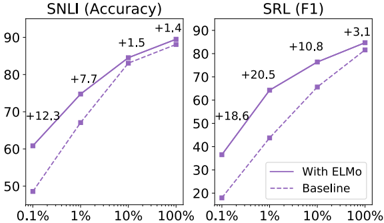
- ELMo increases sample efficiency: the SRL model reaches maximum development F1 after 486 epochs without ELMo, but with ELMo exceeds the baseline maximum at epoch 10, a 98% relative decrease in updates; ELMo with 1% of the training set performs about the same as the baseline with 10%.
Methods
- ELMo is built on a pretrained biLM with two biLSTM layers, 4096 units, 512-dimensional projections, and a residual connection; the context-insensitive type representation uses 2048 character n-gram convolutional filters, two highway layers, and a linear projection to 512 dimensions. The biLM was trained for 10 epochs on the 1B Word Benchmark (approximately 30 million sentences), with average forward/backward perplexity 39.7.
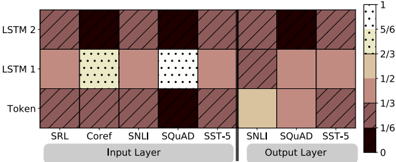
- For downstream tasks, the biLM weights are frozen; all layer representations are recorded, and the task model learns a softmax-normalized linear combination of them. ELMo is concatenated with token embeddings and sometimes also added at the output of the task biRNN, with dropout and sometimes L2 regularization on ELMo weights.
- Evaluation covers six benchmarks—SQuAD, SNLI, SRL, coreference resolution, NER, and SST-5—plus intrinsic WSD on SemCor and POS tagging on PTB.
Limitations
- The paper states no limitations section; no limitations are stated in the paper.
- Evident from the text: evaluation is limited to six benchmark NLP tasks and intrinsic WSD/POS tagging; no other languages or domains are tested.
- Evident from the text: the method depends on a large-scale pretrained biLM and task-specific layer weighting; the paper notes balancing language model perplexity with model size and computational requirements for downstream tasks.
Model-written summary. Check it against the paper before relying on it.
Integrity signals
Registry
Cites
Statistics
Figures
Verification
Claims the paper makes
8 Valid · 3 Not valid · 6 Not checked · 73 Own results and interpretations
Every source the paper cites for this claim was checked and supports it.
In the paper
“For tasks where direct comparisons are possible, ELMo outperforms CoVe (McCann et al., 2017), which computes contextualized representations using a neural machine translation encoder.”
§ Deep contextualized word representations > 1 Introduction
What the sources say
- Supportedcites McCann et al., 2017 matched to “Learned in Translation: Contextualized Word Vectors” (2017) source
The citation identifies CoVe and its method, not the citing authors’ comparison with ELMo. The Abstract (p. 1) describes CoVe as contextualized word vectors produced using an encoder trained for machine translation; Section 4 (p. 4) identifies the encoder’s outputs as context vectors. (LLM, conf=0.90)
plainstates a cause- Asserted: passes — The authors put it forward as true.
- Checkable: passes — It can be checked against evidence.
- Load-bearing: unclear — It is unclear whether the paper’s conclusions depend on it.
- Based: passes — The paper gives a reason why it holds.
- Supported
Every source the paper cites for this claim was checked and supports it.
In the paper
“Unlike most widely used word embeddings (Pennington et al., 2014), ELMo word representations are functions of the entire input sentence, as described in this section.”
§ Deep contextualized word representations > 3 ELMo: Embeddings from Language Models
What the sources say
- Supportedcites Pennington et al., 2014 matched to “Glove: Global Vectors for Word Representation” (2014) source
The citation is offered as an example of the static word embeddings contrasted with ELMo, and our copy of GloVe fits that identification: the Introduction (p. 1) states that semantic vector space models 'represent each word with a real-valued vector' used as features across applications, and the abstract/Introduction describe GloVe as a model that 'trains on global word-word co-occurrence counts' to produce a fixed word vector space (with released trained vectors), i.e. one context-independent vector per word rather than a function of the input sentence. Nothing in our copy makes GloVe representations sentence-dependent, so the contrast the citing sentence draws holds for this source. (LLM, conf=0.85)
plainstates a cause- Asserted: passes — The authors put it forward as true.
- Checkable: passes — It can be checked against evidence.
- Load-bearing: passes — The paper’s conclusions depend on it.
- Based: passes — The paper gives a reason why it holds.
- Supported
The cited sources support only part of this claim — read each source’s verdict below.
In the paper
“However, unlike WSD, accuracies using the first biLM layer are higher than the top layer, consistent with results from deep biL-STMs in multi-task training (Søgaard and Goldberg, 2016;Hashimoto et al., 2017) and MT (Belinkov et al., 2017).”
§ Deep contextualized word representations > POS tagging
What the sources say
- Partly supportedcites Søgaard and Goldberg, 2016 matched to “Deep multi-task learning with low level tasks supervised at lower layers” (2016) sourceExperimental — accuracy not yet measured
Our copy of Søgaard & Goldberg (2016) supports the general direction of the claim: the Experiments and Results section states that 'POS supervision at the lower layer is consistently better than standard MTL' (POS feeding off the inner/1st layer, higher-level task off the outer/3rd), and the Introduction frames the main contribution as 'better performance by having POS task supervision at a lower layer' with supervision of all tasks at the outermost level being 'often suboptimal'. But the accuracy gain the paper reports and quantifies is for the higher-level tasks (CHUNKS F1, CCG supertagging) plus a Rademacher-complexity analysis; no passage in our copy states that POS tagging accuracy itself is higher from the first layer than from the top layer. So the 'lower layer beats top layer' part is supported while the specific attribution to POS-tagging accuracy is not stated in the text we hold. (LLM, conf=0.68)
- Partly supportedcites Hashimoto et al., 2017 matched to “A Joint Many-Task Model: Growing a Neural Network for Multiple NLP Tasks” (2017) sourceExperimental — accuracy not yet measured
Section 2.2 assigns POS tagging to the first bi-LSTM layer, and Section 6 says the model can be used as a POS tagger with only that layer. The paper does not compare POS accuracies from its first and top layers, so it supports the lower-layer connection but not the claimed accuracy advantage. (LLM, conf=0.82)
- Supportedcites Belinkov et al., 2017 matched to “What do Neural Machine Translation Models Learn about Morphology?” (2017) source
The citation is offered for the MT comparison, not as evidence that Belinkov et al. studied biLMs. Section 4.2 reports that first-layer NMT encoder representations outperform second-layer representations on POS tagging, matching the cited comparison. (LLM, conf=0.92)
plainstates an association- Asserted: passes — The authors put it forward as true.
- Checkable: passes — It can be checked against evidence.
- Load-bearing: passes — The paper’s conclusions depend on it.
- Based: passes — The paper gives a reason why it holds.
- Partly supported
The cited sources support only part of this claim — read each source’s verdict below.
In the paper
“The increase of 4.7% with ELMo is also significantly larger then the 1.8% improvement from adding CoVe to a baseline model (McCann et al., 2017).”
§ Deep contextualized word representations > 4 Evaluation
What the sources say
- Partly supportedcites McCann et al., 2017 matched to “Learned in Translation: Contextualized Word Vectors” (2017) sourceExperimental — accuracy not yet measured
The SQuAD results (p. 8, Table 3) support that adding CoVe improved validation performance, but they do not show a 1.8% gain: the listed scores differ by 5.9 points in exact match and 4.3 points in F1. The paper does not compare that gain with ELMo or establish that the difference is significant. (LLM, conf=0.84)
plain- Asserted: passes — The authors put it forward as true.
- Checkable: passes — It can be checked against evidence.
- Load-bearing: passes — The paper’s conclusions depend on it.
- Based: passes — The paper gives a reason why it holds.
- Partly supported
The cited sources support only part of this claim — read each source’s verdict below.
In the paper
“This is competitive with a state-of-the-art WSD-specific supervised model using hand crafted features (Iacobacci et al., 2016) and a task specific biLSTM that is also trained with auxiliary coarse-grained semantic labels and POS tags (Raganato et al., 2017a).”
§ Deep contextualized word representations > 5.3 What information is captured by the biLM's representations?
What the sources say
- Supportedcites Iacobacci et al., 2016 matched to “Embeddings for Word Sense Disambiguation: An Evaluation Study” (2016) source
The Iacobacci et al. citation attaches to the supervised WSD model using hand-crafted features, not to the biLSTM attributed to Raganato et al. Section 4.1 describes the supervised IMS system and its standard POS, context-word, and collocation features; the Conclusions call the standard-feature system state-of-the-art. Page numbers are not supplied in our copy's passages. (LLM, conf=0.92)
- Not matchedcites Raganato et al., 2017a
More than one paper fits this citation.
plain- Asserted: passes — The authors put it forward as true.
- Checkable: passes — It can be checked against evidence.
- Load-bearing: passes — The paper’s conclusions depend on it.
- Based: passes — The paper gives a reason why it holds.
- Supported
51 more claims
Create a free account to see all 90 claims and to verify the 6 references still open.
- It may state two separate claims as one. 23
- Probably not a substantial claim. 13
Claims other papers make about this one
Each is checked against this paper’s own text: does it say what the citing paper says it does?
The source backs part of the claim, not all of it — or backs it for a different population, condition or comparison.
In the citing paper
“In stark contrast, our approach harnesses the potential of Large Language Models (LLMs), particularly their underlying transformer architecture. This modern method enables a more nuanced and contextually aware extraction of meanings at both the word and sentence levels”
From ChatGPT and Deepseek: Can They Predict the Stock Market and Macroeconomy? (2025) · cites this paper as Peters et al., 2018
Experimental — accuracy not yet measuredThe source backs part of the claim, not all of it — or backs it for a different population, condition or comparison.
In the citing paper
“This structure can capture intricate word features, such as synonyms and polysemy, across different linguistic contexts.”
From A Survey of Deep Learning-Based Multimodal Emotion Recognition: Speech, Text, and Face (2023) · cites this paper as [62]
Experimental — accuracy not yet measuredThe source backs part of the claim, not all of it — or backs it for a different population, condition or comparison.
In the citing paper
“we can utilize the technique of fine-tuning pre-trained language models32–35 with family-specific sequences to further improve ProGen’s ability to capture the distribution of local sequence neighborhoods corresponding to the protein family.”
From Large language models generate functional protein sequences across diverse families (2023) · cites this paper as [32]
Experimental — accuracy not yet measuredThe source backs part of the claim, not all of it — or backs it for a different population, condition or comparison.
In the citing paper
“These practical applications of language technology are increasingly reliant on approaches based on trained Large Language Models (LLMs) [23, 41, 104, 111], whereby models are first exposed to as large and varied a collection of language data as possible with the aim of extracting 'general' properties of a language of interest.”
From Data Governance in the Age of Large-Scale Data-Driven Language Technology (2022) · cites this paper as [104]
Experimental — accuracy not yet measuredThe source backs part of the claim, not all of it — or backs it for a different population, condition or comparison.
In the citing paper
“Preliminary work that applied the transfer learning paradigm of pre-training and fine-tuning all of the model's parameters to NLP problems used a causal language modeling objective for pre-training (Dai and Le, 2015; Peters et al., 2018; Radford et al., 2018; Howard and Ruder, 2018).”
From Exploring the Limits of Transfer Learning with a Unified Text-to-Text Transformer (2019) · cites this paper as Peters et al., 2018
Experimental — accuracy not yet measured
17 more claims about this paper
Create a free account to see every claim other papers make about this one.
Self-check
Percentages, sums and reported differences re-computed from the paper’s own numbers.
Each contradiction between two passages listed here was confirmed by an independent check.
Rated minor: it would not touch a result — a value no result rests on, a p-value that stays on the same side of the significance level, or a conflict that is clerical, resolved elsewhere in the paper, or outside its own findings.
In the paper
§ Deep contextualized word representations > 5.6 Contextual vs. sub-word information
“Table 7 summarizes the results for SQuAD, SNLI and SNLI.”
§ Deep contextualized word representations > 6 Conclusion
“Table: 7 Table 7 : Development set ablation analysis for SQuAD, SNLI and SRL comparing different choices for the context-independent type representation and contextual representation.”
Rated minor: it would not touch a result — a value no result rests on, a p-value that stays on the same side of the significance level, or a conflict that is clerical, resolved elsewhere in the paper, or outside its own findings.
In the paper
§ Deep contextualized word representations > 4 Evaluation
“with relative error reductions ranging from 6 -20% over strong base models.”
§ Deep contextualized word representations > 4 Evaluation
“After adding ELMo to the baseline model, test set F 1 improved by 4.7% from 81.1% to 85.8%, a 24.9% relative error reduction over the baseline”
Citations
Cites
Hochreiter, S., & Schmidhuber, J. (1997) · Neural Computation · doi:10.1162/neco.1997.9.8.1735 · Cited by 102,318 · cited 2×
“, 2016) uses a bidirectional Long Short Term Memory (LSTM; Hochreiter and Schmidhuber, 1997) to encode the context around a pivot word.”
MethodAdam: A Method for Stochastic Optimization
Kingma, D. P., & Ba, J. (2014) · arXiv · doi:10.48550/arxiv.1412.6980 · Cited by 98,946
Glove: Global Vectors for Word Representation
Pennington, J., Socher, R., & Manning, C. (2014) · Proceedings of the 2014 Conference on Empirical Methods in Natural Language Processing (EMNLP) · doi:10.3115/v1/d14-1162 · Cited by 34,071
(2014) · Cited by 33,419
Distributed Representations of Words and Phrases and their Compositionality
Mikolov, T., Sutskever, I., Chen, K., Corrado, G., & Dean, J. (2013) · arXiv · doi:10.48550/arxiv.1310.4546 · Cited by 24,533 · cited 3×
“Due to their ability to capture syntactic and semantic information of words from large scale unlabeled text, pretrained word vectors (Turian et al., 2010; Mikolov et al., 2013; Pennington et al., 2014) are a standard component of most state-ofthe-art NLP architectures, including for question answering (Liu et al.”
BackgroundEnriching Word Vectors with Subword Information
Bojanowski, P., Grave, E., Joulin, A., & Mikolov, T. (2017) · Transactions of the Association for Computational Linguistics · doi:10.1162/tacl_a_00051 · Cited by 9,645 · cited 2×
“Previously proposed methods overcome some of the shortcomings of traditional word vectors by either enriching them with subword information (e.g., Wieting et al., 2016; Bojanowski et al., 2017) or learning separate vectors for each word sense (e.”
MethodBuilding a Large Annotated Corpus of English: The Penn Treebank
Marcus, M. (1993) · doi:10.21236/ada273556 · Cited by 7,405
On the Properties of Neural Machine Translation: Encoder–Decoder Approaches
Cho, K., van Merrienboer, B., Bahdanau, D., & Bengio, Y. (2014) · Proceedings of SSST-8, Eighth Workshop on Syntax, Semantics and Structure in Statistical Translation · doi:10.3115/v1/w14-4012 · Cited by 7,099
Recursive Deep Models for Semantic Compositionality Over a Sentiment Treebank
Socher, R., Perelygin, A., Wu, J., Chuang, J., Manning, C. D., Ng, A., & Potts, C. (2013) · Proceedings of the 2013 Conference on Empirical Methods in Natural Language Processing · doi:10.18653/v1/d13-1170 · Cited by 6,878
SQuAD: 100,000+ Questions for Machine Comprehension of Text
Rajpurkar, P., Zhang, J., Lopyrev, K., & Liang, P. (2016) · Proceedings of the 2016 Conference on Empirical Methods in Natural Language Processing · doi:10.18653/v1/d16-1264 · Cited by 6,208 · cited 2×
“Question answering The Stanford Question Answering Dataset (SQuAD) (Rajpurkar et al., 2016) contains 100K+ crowd sourced question-answer pairs where the answer is a span in a given Wikipedia paragraph.”
Background
Research works printed but not linked: 4
- [2]2. Yonatan Belinkov, Nadir Durrani, Fahim Dalvi, Has- san Sajjad, and James R. Glass. 2017. What do neu- ral machine translation models learn about morphol- ogy? In ACL.
- [4]4. Samuel R. Bowman, Gabor Angeli, Christopher Potts, and Christopher D. Manning. 2015. A large an- notated corpus for learning natural language infer- ence. In Proceedings of the 2015 Conference on Empirical Methods in Natural Language Processing (EMNLP). Association for Computational Linguis- tics.
- [36]36. Tomas Mikolov, Ilya Sutskever, Kai Chen, Greg S Cor- rado, and Jeff Dean. 2013. Distributed representa- tions of words and phrases and their compositional- ity. In NIPS.
- [48]48. Prajit Ramachandran, Peter Liu, and Quoc Le. 2017. Improving sequence to sequence learning with unla- beled data. In EMNLP.
Cited by
Items 2,801–2,900 of 12,015
CAiRE_HKUST at SemEval-2019 Task 3: Hierarchical Attention for Dialogue Emotion Classification
Winata, G. I., Madotto, A., Lin, Z., Shin, J., Xu, Y., Xu, P., & Fung, P. (2019) · International Workshop on Semantic Evaluation (SemEval) · doi:10.18653/v1/s19-2021 · Cited by 34
Clause-Wise and Recursive Decoding for Complex and Cross-Domain Text-to-SQL Generation
Lee, D. (2019) · Conference on Empirical Methods in Natural Language Processing (EMNLP) · doi:10.18653/v1/d19-1624 · Cited by 41
Language Features Matter: Effective Language Representations for Vision-Language Tasks
Burns, A., Tan, R., Saenko, K., Sclaroff, S., & Plummer, B. A. (2019) · IEEE/CVF International Conference on Computer Vision (ICCV) · doi:10.1109/iccv.2019.00757 · Cited by 32
ner and pos when nothing is capitalized
Mayhew, S., Tsygankova, T., & Roth, D. (2019) · Conference on Empirical Methods in Natural Language Processing (EMNLP) · doi:10.18653/v1/d19-1650 · Cited by 50
Evaluation Benchmarks and Learning Criteria for Discourse-Aware Sentence Representations
Chen, M., Chu, Z., & Gimpel, K. (2019) · Conference on Empirical Methods in Natural Language Processing (EMNLP) · doi:10.18653/v1/d19-1060 · Cited by 54
Cross-Lingual Lemmatization and Morphology Tagging with Two-Stage Multilingual BERT Fine-Tuning
Kondratyuk, D. (2019) · SIGMORPHON Workshop on Computational Research in Phonetics, Phonology, and Morphology (SIGMORPHON) · doi:10.18653/v1/w19-4203 · Cited by 45
Siamese networks for large-scale author identification
Saedi, C., & Dras, M. (2021) · Computer Speech & Language · doi:10.1016/j.csl.2021.101241 · Cited by 44
Language Independent Sentiment Analysis
Shakeel, M. H., Faizullah, S., Alghamidi, T., & Khan, I. (2020) · International Conference on Advances in the Emerging Computing Technologies (AECT) · doi:10.1109/aect47998.2020.9194186 · Cited by 29
Li, P., Mao, K., Xu, Y., Li, Q., & Zhang, J. (2020) · Knowledge-Based Systems · doi:10.1016/j.knosys.2019.105436 · Cited by 36
DICE: Deep Intelligent Contextual Embedding for Twitter Sentiment Analysis
Naseem, U., & Musiał, K. (2019) · IAPR International Conference on Document Analysis and Recognition (ICDAR) · doi:10.1109/icdar.2019.00157 · Cited by 36
Stacked Residual Recurrent Neural Networks With Cross-Layer Attention for Text Classification
Lan, Y., Hao, Y., Xia, K., Qian, B., & Li, C. (2020) · IEEE Access · doi:10.1109/access.2020.2987101 · Cited by 32
DLI-IT: a deep learning approach to drug label identification through image and text embedding
Liu, X., Meehan, J., Tong, W., Wu, L., Xu, X., & Xu, J. (2020) · BMC Medical Informatics and Decision Making · doi:10.1186/s12911-020-1078-3 · Cited by 40
The Unstoppable Rise of Computational Linguistics in Deep Learning
Henderson, J. (2020) · Proceedings of the conference - Association for Computational Linguistics. Meeting · doi:10.18653/v1/2020.acl-main.561 · Cited by 37
End-to-End Transition-Based Online Dialogue Disentanglement
Liu, H., Shi, Z., Gu, J.-C., Liu, Q., Wei, S., & Zhu, X. (2020) · International Joint Conference on Artificial Intelligence · doi:10.24963/ijcai.2020/535 · Cited by 29
Probing Linguistic Features of Sentence-Level Representations in Relation Extraction
Alt, C., Gabryszak, A., & Hennig, L. (2020) · Proceedings of the conference - Association for Computational Linguistics. Meeting · doi:10.18653/v1/2020.acl-main.140 · Cited by 47
Wang, L., Wang, Q., Bai, H., Liu, C., Liu, W., Zhang, Y., Jiang, L., Xu, H., Wang, K., & Zhou, Y. (2020) · Frontiers in Genetics · doi:10.3389/fgene.2020.00630 · Cited by 30
A Promising Path Towards Autoformalization and General Artificial Intelligence
Szegedy, C. (2020) · Lecture Notes in Computer Science · doi:10.1007/978-3-030-53518-6_1 · Cited by 29
Interpretable duplicate question detection models based on attention mechanism
Zhou, Q., Liu, X., & Wang, Q. (2020) · Information Sciences · doi:10.1016/j.ins.2020.07.048 · Cited by 32
TermInformer: unsupervised term mining and analysis in biomedical literature
Tiwari, P., Uprety, S., Dehdashti, S., & Hossain, M. S. (2020) · Neural Computing and Applications · doi:10.1007/s00521-020-05335-2 · Cited by 33
Agosti, M., Marchesin, S., & Silvello, G. (2020) · ACM Transactions on Information Systems · doi:10.1145/3417996 · Cited by 42
FarsTail: a Persian natural language inference dataset
Amirkhani, H., AzariJafari, M., Faridan-Jahromi, S., Kouhkan, Z., Pourjafari, Z., & Amirak, A. (2023) · Soft Computing · doi:10.1007/s00500-023-08959-3 · Cited by 54
Ma, Y., Hiraoka, T., & Okazaki, N. (2022) · Journal of Natural Language Processing · doi:10.5715/jnlp.29.187 · Cited by 37
Domain Divergences: A Survey and Empirical Analysis
Kashyap, A. R., Hazarika, D., Kan, M., & Zimmermann, R. (2021) · Conference of the North American Chapter of the Association for Computational Linguistics: Human Language Technologies (NAACL-HLT) · doi:10.18653/v1/2021.naacl-main.147 · Cited by 57
TopicBERT for Energy Efficient Document Classification
Chaudhary, Y., Gupta, P., Saxena, K., Kulkarni, V., Runkler, T. A., & Schütze, H. (2020) · Findings of the Association for Computational Linguistics: EMNLP (Findings of EMNLP) · doi:10.18653/v1/2020.findings-emnlp.152 · Cited by 37
Infusing Finetuning with Semantic Dependencies
Wu, Z., Peng, H., & Smith, N. A. (2021) · Transactions of the Association for Computational Linguistics · doi:10.1162/tacl_a_00363 · Cited by 39
MZET: Memory Augmented Zero-Shot Fine-grained Named Entity Typing
Zhang, T., Xia, C., Lu, C.-T., & Yu, P. S. (2020) · International Conference on Computational Linguistics · doi:10.18653/v1/2020.coling-main.7 · Cited by 35
A Quantum Spatial Graph Convolutional Network for Text Classification
Shah, S. M. A., Ge, H., Haider, S. A., Irshad, M., Noman, S. M., Arshad, J., Ahmad, A., & Younas, T. (2021) · Computer Systems Science and Engineering · doi:10.32604/csse.2021.014234 · Cited by 31
Semantic Similarity Computing Model Based on Multi Model Fine-Grained Nonlinear Fusion
Zhang, P., Huang, X., Wang, Y., Jiang, C., He, S., & Wang, H. (2021) · IEEE Access · doi:10.1109/access.2021.3049378 · Cited by 32
Syntax-type-aware graph convolutional networks for natural language understanding
Du, C., Wang, J., Sun, H., Qi, Q., & Liao, J. (2021) · Applied Soft Computing · doi:10.1016/j.asoc.2021.107080 · Cited by 30
Leng, X.-L., Miao, X.-A., & Liu, T. (2021) · Multimedia Tools and Applications · doi:10.1007/s11042-020-10336-3 · Cited by 38
POP-ON: Prediction of Process Using One-Way Language Model Based on NLP Approach
Moon, J., Park, G., & Jeong, J. (2021) · Applied Sciences · doi:10.3390/app11020864 · Cited by 37
Vashishth, S., Newman-Griffis, D. R., Joshi, R., Dutt, R., & Rosé, C. P. (2021) · Journal of Biomedical Informatics · doi:10.1016/j.jbi.2021.103880 · Cited by 62
Relatedness in the era of machine learning
Tacchella, A., Zaccaria, A., Miccheli, M., & Pietronero, L. (2023) · Chaos Solitons & Fractals · doi:10.1016/j.chaos.2023.114071 · Cited by 47
Joint extraction of entities and overlapping relations using source-target entity labeling
Hang, T., Feng, J. H., Wu, Y., Yan, L., & Wang, Y. (2021) · Expert Systems with Applications · doi:10.1016/j.eswa.2021.114853 · Cited by 33
Stylianou, N., & Vlahavas, I. P. (2021) · Journal of Biomedical Informatics · doi:10.1016/j.jbi.2021.103767 · Cited by 39
A Few Topical Tweets are Enough for Effective User Stance Detection
Samih, Y., & Darwish, K. M. (2021) · Conference of the European Chapter of the Association for Computational Linguistics · doi:10.18653/v1/2021.eacl-main.227 · Cited by 52
Dual-path CNN with Max Gated block for text-based person re-identification
Ma, T., Yang, M., Rong, H., Qian, Y., Tian, Y., & Al-Nabhan, N. (2021) · Image and Vision Computing · doi:10.1016/j.imavis.2021.104168 · Cited by 29
Named Entity Aware Transfer Learning for Biomedical Factoid Question Answering
Peng, K., Yin, C., Rong, W., Lin, C., Zhou, D., & Xiong, Z. (2021) · IEEE Transactions on Computational Biology and Bioinformatics · doi:10.1109/tcbb.2021.3079339 · Cited by 34
Adaptive Adapters: An Efficient Way to Incorporate BERT Into Neural Machine Translation
Guo, J., Zhang, Z., Xu, L., Chen, B., & Chen, E. (2021) · IEEE/ACM Transactions on Audio Speech and Language Processing · doi:10.1109/taslp.2021.3076863 · Cited by 41
Adversarial Learning for Discourse Rhetorical Structure Parsing
Zhang, L., Kong, F., & Zhou, G. (2021) · doi:10.18653/v1/2021.acl-long.305 · Cited by 47
A sequence labeling model for catchphrase identification from legal case documents
Mandal, A., Ghosh, K., Ghosh, S., & Mandal, S. (2021) · Artificial Intelligence and Law · doi:10.1007/s10506-021-09296-2 · Cited by 36
A Multi-Layer Network for Aspect-Based Cross-Lingual Sentiment Classification
Sattar, K., Umer, Q., Vasbieva, D. G., Chung, S., Latif, Z., & Lee, C. (2021) · IEEE Access · doi:10.1109/access.2021.3116053 · Cited by 34
PSSL: Self-supervised Learning for Personalized Search with Contrastive Sampling
Zhou, Y.-J., Dou, Z., Zhu, Y.-T., & Wen, J.-R. (2021) · International Conference on Information and Knowledge Management · doi:10.1145/3459637.3482379 · Cited by 39
proScript: Partially Ordered Scripts Generation
Sakaguchi, K., Bhagavatula, C., Bras, R. J. L., Tandon, N., Clark, P. E., & Choi, Y. (2021) · Findings of the Association for Computational Linguistics: EMNLP (Findings of EMNLP) · doi:10.18653/v1/2021.findings-emnlp.184 · Cited by 66
Does aggression lead to hate? Detecting and reasoning offensive traits in hinglish code-mixed texts
Sengupta, A., Bhattacharjee, S. K., Akhtar, M. S., & Chakraborty, T. (2021) · Neurocomputing · doi:10.1016/j.neucom.2021.11.053 · Cited by 28
ZoKa: a fake news detection method using edge-weighted graph attention network with transfer models
İnan, E. (2022) · Neural Computing and Applications · doi:10.1007/s00521-022-07057-z · Cited by 34
MoEBERT: from BERT to Mixture-of-Experts via Importance-Guided Adaptation
Zuo, S., Zhang, Q., Chen, L., He, P., Zhao, T., & Chen, W. (2022) · Conference of the North American Chapter of the Association for Computational Linguistics: Human Language Technologies (NAACL-HLT) · doi:10.18653/v1/2022.naacl-main.116 · Cited by 54
Muaad, A. Y. M., Davanagere, H. J., Guru, D. S., Benifa, J. V. B., Chola, C., AlSalman, H., Gumaei, A., & Al–antari, M. A. (2022) · Mathematical Problems in Engineering · doi:10.1155/2022/3720358 · Cited by 47
Monolingual and Multilingual Reduction of Gender Bias in Contextualized Representations
Liang, S., Dufter, P., & Schütze, H. (2020) · Proceedings of the 28th International Conference on Computational Linguistics · doi:10.18653/v1/2020.coling-main.446 · Cited by 29
Introduction to Neural Transfer Learning With Transformers for Social Science Text Analysis
Wankmüller, S. (2022) · Sociological Methods & Research · doi:10.1177/00491241221134527 · Cited by 49
Hu, Z., Wang, Z., Wang, Y., & Tan, A. (2023) · Expert Systems with Applications · doi:10.1016/j.eswa.2022.119492 · Cited by 31
How to detect propaganda from social media? Exploitation of semantic and fine-tuned language models
Malik, M. S. I., Imran, T., & Jamjoom, M. M. (2023) · PeerJ Computer Science · doi:10.7717/peerj-cs.1248 · Cited by 38
Automated event extraction of CVE descriptions
Wei, Y., Bo, L., Sun, X., Li, B., Zhang, T., & Tao, C. (2023) · Information and Software Technology · doi:10.1016/j.infsof.2023.107178 · Cited by 35
Preston, S., Wei, M., Rao, R., Tinn, R., Usuyama, N., LUCAS, M. A., 池谷, 裕., Weerasinghe, R. K., Lee, S., Piening, B., et al. (2023) · Patterns · doi:10.1016/j.patter.2023.100726 · Cited by 43
ADEPT: A DEbiasing PrompT Framework
Yang, K., Yu, C., Fung, Y. R., Li, M., & Ji, H. (2023) · Proceedings of the AAAI Conference on Artificial Intelligence · doi:10.1609/aaai.v37i9.26279 · Cited by 87
TaSbeeb: A judicial decision support system based on deep learning framework
Almuzaini, H. A., & Azmi, A. M. (2023) · Journal of King Saud University - Computer and Information Sciences · doi:10.1016/j.jksuci.2023.101695 · Cited by 47
R-Trans: RNN Transformer Network for Chinese Machine Reading Comprehension
Liu, S., Zhang, S., Zhang, X., & Wang, H. (2019) · IEEE Access · doi:10.1109/access.2019.2901547 · Cited by 33
Li, K., Xian, X., Wang, J., & Yu, N. (2018) · Applied Surface Science · doi:10.1016/j.apsusc.2018.11.214 · Cited by 32
Zhao, H., Luo, Z., Feng, C., Zheng, A., & Liu, X. (2019) · Conference on Empirical Methods in Natural Language Processing (EMNLP) · doi:10.18653/v1/d19-1524 · Cited by 49
Yang, J., Liu, Y., Minghui, Q., Guan, C., & Yuan, X. (2019) · Applied Sciences · doi:10.3390/app9183658 · Cited by 34
Syntax grounded graph convolutional network for joint entity and event extraction
Zhang, J., He, Q., & Zhang, Y. (2020) · Neurocomputing · doi:10.1016/j.neucom.2020.09.044 · Cited by 33
Applying Distilled BERT for Question Answering on ASRS Reports
Kierszbaum, S., & Lapasset, L. (2020) · New Trends in Civil Aviation (NTCA) · doi:10.23919/ntca50409.2020.9291241 · Cited by 31
GLoMo: Unsupervisedly Learned Relational Graphs as Transferable Representations
Yang, Z., Zhao, J., Dhingra, B., He, K., Cohen, W. W., Salakhutdinov, R., & LeCun, Y. (2018) · neural information processing systems · doi:10.48550/arxiv.1806.05662 · Cited by 58
A Fine-Grained Sentiment Dataset for NorwegianPreprint
Øvrelid, L., Mæhlum, P., Barnes, J., & Velldal, E. (2019) · arXiv (Cornell University) · doi:10.48550/arxiv.1911.12722 · Cited by 50
Investigating the Limitations of Transformers with Simple Arithmetic Tasks
Nogueira, R., Jiang, Z., & Lin, J. (2021) · arXiv · doi:10.48550/arxiv.2102.13019 · Cited by 29
ChatGPT and Deepseek: Can They Predict the Stock Market and Macroeconomy?Preprint
Chen, J., Tang, G., Zhou, G., & Zhu, W. Y. (2023) · SSRN Electronic Journal · doi:10.2139/ssrn.4660148 · Cited by 32
BLiMP: the benchmark of linguistic minimal pairs for English
Warstadt, A., Parrish, A., Liu, H., Mohananey, A., Peng, W., Wang, S.-F., & Bowman, S. R. (2020) · Transactions of the Association for Computational Linguistics · doi:10.1162/tacl_a_00321 · Cited by 28
“Recently, variants of neural language modeling have been shown to be a strong pretraining task for natural language processing tasks (Howard and Ruder, 2018; Peters et al., 2018; Radford et al., 2018; Devlin et al., 2019).”
Diverse Distributions of Self-Supervised Tasks for Meta-Learning in NLP
Bansal, T., Gunasekaran, K. P., Wang, T., Munkhdalai, T., & McCallum, A. (2021) · Conference on Empirical Methods in Natural Language Processing (EMNLP) · doi:10.18653/v1/2021.emnlp-main.469 · Cited by 32
Wu, C., Cao, L., Ge, Y., Liu, Y., Zhang, M., & Su, J. (2022) · Proceedings of the AAAI Conference on Artificial Intelligence · doi:10.1609/aaai.v36i10.21401 · Cited by 46
LegalBert-pt: A Pretrained Language Model for the Brazilian Portuguese Legal Domain
Silveira, R., Ponte, C., Almeida, V. M. S. S. D., Pinheiro, V. C. M., & Furtado, V. (2023) · Lecture notes in computer science · doi:10.1007/978-3-031-45392-2_18 · Cited by 45
Zou, S., Huang, X., & Shen, X. (2023) · ACM International Conference on Multimedia (ACM MM) · doi:10.1145/3581783.3611805 · Cited by 51
Aspect-based sentiment analysis: approaches, applications, challenges and trends
Nath, D., & Dwivedi, S. K. (2024) · Knowledge and Information Systems · doi:10.1007/s10115-024-02200-9 · Cited by 42
A survey on knowledge-enhanced multimodal learning
Lymperaiou, M., & Stamou, G. B. (2024) · Artificial Intelligence Review · doi:10.1007/s10462-024-10825-z · Cited by 59
Disney at IEST 2018: Predicting Emotions using an Ensemble
Witoń, W., Colombo, P., Modi, A., & Kapadia, M. (2018) · Workshop on Computational Approaches to Subjectivity, Sentiment and Social Media Analysis (WASSA) · doi:10.18653/v1/w18-6236 · Cited by 28
Unsupervised Multilingual Word Embedding with Limited Resources using Neural Language Models
Wada, T., Iwata, T., & Matsumoto, Y. (2019) · Proceedings of the conference - Association for Computational Linguistics. Meeting · doi:10.18653/v1/p19-1300 · Cited by 37
Strong and Simple Baselines for Multimodal Utterance Embeddings
Liang, P. P., Lim, Y. C., Tsai, Y.-H. H., Salakhutdinov, R., & Morency, L.-P. (2019) · Proceedings of the 2019 Conference of the North · doi:10.18653/v1/n19-1267 · Cited by 27
The Use of Deep Learning Distributed Representations in the Identification of Abusive Text
Chen, H., McKeever, S., & Delany, S. J. (2019) · Proceedings of the International AAAI Conference on Web and Social Media · doi:10.1609/icwsm.v13i01.3215 · Cited by 35
Transfer Learning from Audio-Visual Grounding to Speech Recognition
Hsu, W.-N., Harwath, D. F., & Glass, J. R. (2019) · Interspeech (USB) · doi:10.21437/interspeech.2019-1227 · Cited by 32
Multimodal Deep Networks for Text and Image-Based Document Classification
Audebert, N., Herold, C., Slimani, K., & Vidal, C. (2020) · Communications in computer and information science · doi:10.1007/978-3-030-43823-4_35 · Cited by 62
Zero-shot Dependency Parsing with Pre-trained Multilingual Sentence Representations
Tran, K. M., & Bisazza, A. (2019) · Workshop on Deep Learning Approaches for Low-Resource NLP (DeepLo) · doi:10.18653/v1/d19-6132 · Cited by 41
Configuration-Based Smart Customization Service: A Multitask Learning Approach
Wang, Y., Xiang, L., & Tsung, F. (2020) · IEEE Transactions on Automation Science and Engineering · doi:10.1109/tase.2020.2986774 · Cited by 30
Liu, F., Zheng, L., & Zheng, J. (2020) · Neurocomputing · doi:10.1016/j.neucom.2020.04.084 · Cited by 32
Autoencoding Keyword Correlation Graph for Document Clustering
Chiu, B., Sahu, S. K., Thomas, D., Sengupta, N., & Mahdy, M. (2020) · Proceedings of the conference - Association for Computational Linguistics. Meeting · doi:10.18653/v1/2020.acl-main.366 · Cited by 29
Hierarchical Transformer Network for Utterance-Level Emotion Recognition
Li, Q., Wu, C., Wang, Z., & Zheng, K. (2020) · Applied Sciences · doi:10.3390/app10134447 · Cited by 38
Process and Content in Decisions From Memory
Zhao, W. J., Richie, R., & Bhatia, S. (2022) · Psychological Review · doi:10.1037/rev0000318 · Cited by 28
Linguistically-Enriched and Context-AwareZero-shot Slot Filling
Siddique, A. B., Jamour, F., & Hristidis, V. (2021) · International World Wide Web Conference (WWW) · doi:10.1145/3442381.3449870 · Cited by 44
LOME: Large Ontology Multilingual Extraction
Xia, P., Qin, G., Vashishtha, S., Chen, Y., Chen, T., May, C., Harman, C., Rawlins, K., White, A. S., & Durme, B. V. (2021) · Conference of the European Chapter of the Association for Computational Linguistics · doi:10.18653/v1/2021.eacl-demos.19 · Cited by 67
Tong, Y., Chen, Y., & Shi, X. (2021) · Findings of the Association for Computational Linguistics: ACL (Findings of ACL) · doi:10.18653/v1/2021.findings-acl.424 · Cited by 37
Contextualized Knowledge-aware Attentive Neural Network: Enhancing Answer Selection with Knowledge
Deng, Y., Xie, Y., Li, Y., Yang, M., Lam, W. P., & Shen, Y. (2021) · ACM Transactions on Information Systems · doi:10.1145/3457533 · Cited by 34
A segment enhanced span-based model for nested named entity recognition
Li, F., Wang, Z., Hui, S. C., Liao, L., Zhu, X., & Huang, H. (2021) · Neurocomputing · doi:10.1016/j.neucom.2021.08.094 · Cited by 30
EVIL: Exploiting Software via Natural Language
Liguori, P., Al-Hossami, E., Orbinato, V., Natella, R., Shaikh, S., Cotroneo, D., & Čukić, B. (2021) · Proceedings/Proceedings - International Symposium on Software Reliability Engineering · doi:10.1109/issre52982.2021.00042 · Cited by 39
Temporal Relation Extraction in Clinical Texts: A Systematic Review
Gumiel, Y. B., Silva e Oliveira, L. E., Claveau, V., Grabar, N., Paraiso, E. C., Moro, C., & Carvalho, D. R. (2022) · ACM Computing Surveys · doi:10.1145/3462475 · Cited by 31
Word Acquisition in Neural Language Models
Chang, T. A., & Bergen, B. K. (2022) · Transactions of the Association for Computational Linguistics · doi:10.1162/tacl_a_00444 · Cited by 26
Neural representations for modeling variation in speech
Bartelds, M., de Vries, W., Sanal, F., Richter, C., Liberman, M., & Wieling, M. B. (2022) · Journal of Phonetics · doi:10.1016/j.wocn.2022.101137 · Cited by 59
Qiu, Q., Xie, Z., Wang, S., Zhu, Y., Lv, H., & Sun, K. (2022) · Trans. GIS · doi:10.1111/tgis.12902 · Cited by 33
Effects of Physiological Signals in Different Types of Multimodal Sentiment Estimation
Katada, S., Okada, S., & Komatani, K. (2022) · IEEE Transactions on Affective Computing · doi:10.1109/taffc.2022.3155604 · Cited by 44
Warikoo, N., Chang, Y., & Hsu, W. (2020) · Bioinformatics · doi:10.1093/bioinformatics/btaa721 · Cited by 29
Tailored text augmentation for sentiment analysis
Feng, Z., Zhou, H., Zhu, Z., & Mao, K. (2022) · Expert Systems with Applications · doi:10.1016/j.eswa.2022.117605 · Cited by 32
A semantic analysis-driven customer requirements mining method for product conceptual design
Wu, X., Hong, Z., Feng, Y., Li, M.-D., Lou, S., & Tan, J. (2022) · Scientific Reports · doi:10.1038/s41598-022-14396-3 · Cited by 39
Metadata
- Authors
- Peters, M., Neumann, M., Iyyer, M., Gardner, M., Clark, C., Lee, K., & Zettlemoyer, L.
- Affiliations
- Allen Institute for Artificial Intelligence (US)
- University of Washington (US)
- Venue
- Proceedings of the 2018 Conference of the North American Chapter of the Association for Computational Linguistics: Human Language Technologies, Volume 1 (Long Papers)
- Published
- 2018
- Pages
- 2227-2237
- OpenAlex
- W2787560479
- Semantic Scholar
- 3febb2bed8865945e7fddc99efd791887bb7e14f
- Cited by
- 11,983
- References
- 53
- Citations by year
- 2026: 193 · 2025: 554 · 2024: 783 · 2023: 1395 · 2022: 1667 · 2021: 2573 · 2020: 2552 · 2019: 1977 · 2018: 284
- FWCI
- 754.67
- Type
- conference paper
- Language
- en
- Open access
- hybrid
- doi.org
- Licence
- cc-by
- Locations
- Conference of the North American Chapter of the Association for Computational Linguistics: Human Language Technologies (NAACL-HLT) (publishedVersion, cc-by)
- arXiv (Cornell University) (submittedVersion)
- arXiv (Cornell University)
- Topics
- Physical Sciences › Computer Science › Artificial Intelligence › Topic Modeling
- Physical Sciences › Computer Science › Artificial Intelligence › Natural Language Processing Techniques
- Physical Sciences › Computer Science › Artificial Intelligence › Sentiment Analysis and Opinion Mining
- Keywords
- contextualized word representations, word embeddings, word sense disambiguation
About these checks
Registry, retraction, Cites and statistics results are computed, not judged, with one exception: a printed reference that no index lists is read once by a model before it counts as a citation error. Claims are extracted by a model and kept only when their quote appears verbatim in the text; each cited source is then checked, with a model’s help, for whether it says what the claim relies on. Those verdicts can be wrong — read the claim’s quote and the cited source before relying on one.
The claim verdicts this report counts are experimental: their accuracy is not yet measured.
A language model drew the claims from the paper on 2026-10-23, under version 3 of the claim definition (model deepseek-v4.1-flash, prompt extract-v3).
A second model labelled each claim on 2026-10-23 (model jev-1.13-20260917, definition revision gold-guideline-v0.2).
Cited sources are checked with a language model’s help (gpt-6-sol and qwen3.8-omni-flash).
Statistics and arithmetic are recomputed, not judged.
Confidence bands are shown only for fields calibrated on our annotated test set. None is calibrated yet, so no band is shown.
What counts as a claim ›How we measure confidence ›How we check this ›
Are you an author, or do you see a problem with this page? Request a review
Data sources
Bibliographic data: Semantic Scholar, OpenAlex, Crossref.
Contains information from the Semantic Scholar Academic Graph Datasets, made available under the ODC Attribution License (ODC-BY 1.0).
Semantic Scholar’s data is described in: Kinney, R., et al. (2023). The Semantic Scholar Open Data Platform. arXiv:2301.10140.
