

Deep Contextualized Word Representations
Open accessThe DOI matches its Crossref record; 71 of the 71 references it cites were found in a registry or an index; 10 of the 21 sources its claims cite were checked for support.
Abstract
Matthew E. Peters, Mark Neumann, Mohit Iyyer, Matt Gardner, Christopher Clark, Kenton Lee, Luke Zettlemoyer. Proceedings of the 2018 Conference of the North American Chapter of the Association for Computational Linguistics: Human Language Technologies, Volume 1 (Long Papers). 2018.
Overview
CoChat Summary
TL;DR
ELMo introduces deep contextualized word representations computed as task-specific linear combinations of internal states from a pretrained two-layer bidirectional LSTM language model. Adding ELMo to existing models improves the state of the art across six NLP benchmarks, with relative error reductions up to 20%.
Key findings
- ELMo improved every considered task: SQuAD F1 81.1→85.8 (4.7 absolute, 24.9% relative), SNLI 88.0→88.7 ± 0.17 (0.7 / 5.8%), SRL 81.4→84.6 (3.2 / 17.2%), Coref 67.2→70.4 (3.2 / 9.8%), NER 90.15→92.22 ± 0.10 (2.06 / 21%), and SST-5 51.4→54.7 ± 0.5 (3.3 / 6.8%).
- Using all biLM layers outperforms using only the top layer: for SQuAD, the last biLM layer improves development F1 by 3.9% over baseline, averaging all layers adds another 0.3%, and learned layer weights add another 0.2%.
- Intrinsic evaluations show layer-specific information: biLM top-layer WSD F1 is 69.0 versus 67.4 for the first layer, while POS tagging accuracy is higher at the first layer (97.3) than the top layer (96.8).
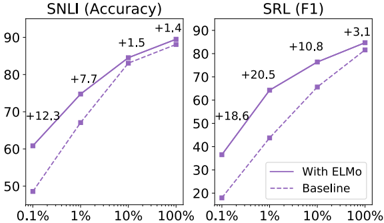
- ELMo increases sample efficiency: the SRL model reaches maximum development F1 after 486 epochs without ELMo, but with ELMo exceeds the baseline maximum at epoch 10, a 98% relative decrease in updates; ELMo with 1% of the training set performs about the same as the baseline with 10%.
Methods
- ELMo is built on a pretrained biLM with two biLSTM layers, 4096 units, 512-dimensional projections, and a residual connection; the context-insensitive type representation uses 2048 character n-gram convolutional filters, two highway layers, and a linear projection to 512 dimensions. The biLM was trained for 10 epochs on the 1B Word Benchmark (approximately 30 million sentences), with average forward/backward perplexity 39.7.
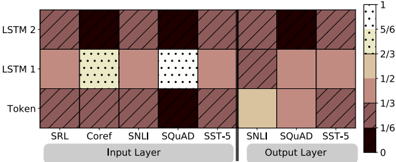
- For downstream tasks, the biLM weights are frozen; all layer representations are recorded, and the task model learns a softmax-normalized linear combination of them. ELMo is concatenated with token embeddings and sometimes also added at the output of the task biRNN, with dropout and sometimes L2 regularization on ELMo weights.
- Evaluation covers six benchmarks—SQuAD, SNLI, SRL, coreference resolution, NER, and SST-5—plus intrinsic WSD on SemCor and POS tagging on PTB.
Limitations
- The paper states no limitations section; no limitations are stated in the paper.
- Evident from the text: evaluation is limited to six benchmark NLP tasks and intrinsic WSD/POS tagging; no other languages or domains are tested.
- Evident from the text: the method depends on a large-scale pretrained biLM and task-specific layer weighting; the paper notes balancing language model perplexity with model size and computational requirements for downstream tasks.
Model-written summary. Check it against the paper before relying on it.
Integrity signals
Registry
Cites
Statistics
Figures
Verification
Claims the paper makes
8 Valid · 3 Not valid · 6 Not checked · 73 Own results and interpretations
Every source the paper cites for this claim was checked and supports it.
In the paper
“For tasks where direct comparisons are possible, ELMo outperforms CoVe (McCann et al., 2017), which computes contextualized representations using a neural machine translation encoder.”
§ Deep contextualized word representations > 1 Introduction
What the sources say
- Supportedcites McCann et al., 2017 matched to “Learned in Translation: Contextualized Word Vectors” (2017) source
The citation identifies CoVe and its method, not the citing authors’ comparison with ELMo. The Abstract (p. 1) describes CoVe as contextualized word vectors produced using an encoder trained for machine translation; Section 4 (p. 4) identifies the encoder’s outputs as context vectors. (LLM, conf=0.90)
plainstates a cause- Asserted: passes — The authors put it forward as true.
- Checkable: passes — It can be checked against evidence.
- Load-bearing: unclear — It is unclear whether the paper’s conclusions depend on it.
- Based: passes — The paper gives a reason why it holds.
- Supported
Every source the paper cites for this claim was checked and supports it.
In the paper
“Unlike most widely used word embeddings (Pennington et al., 2014), ELMo word representations are functions of the entire input sentence, as described in this section.”
§ Deep contextualized word representations > 3 ELMo: Embeddings from Language Models
What the sources say
- Supportedcites Pennington et al., 2014 matched to “Glove: Global Vectors for Word Representation” (2014) source
The citation is offered as an example of the static word embeddings contrasted with ELMo, and our copy of GloVe fits that identification: the Introduction (p. 1) states that semantic vector space models 'represent each word with a real-valued vector' used as features across applications, and the abstract/Introduction describe GloVe as a model that 'trains on global word-word co-occurrence counts' to produce a fixed word vector space (with released trained vectors), i.e. one context-independent vector per word rather than a function of the input sentence. Nothing in our copy makes GloVe representations sentence-dependent, so the contrast the citing sentence draws holds for this source. (LLM, conf=0.85)
plainstates a cause- Asserted: passes — The authors put it forward as true.
- Checkable: passes — It can be checked against evidence.
- Load-bearing: passes — The paper’s conclusions depend on it.
- Based: passes — The paper gives a reason why it holds.
- Supported
The cited sources support only part of this claim — read each source’s verdict below.
In the paper
“However, unlike WSD, accuracies using the first biLM layer are higher than the top layer, consistent with results from deep biL-STMs in multi-task training (Søgaard and Goldberg, 2016;Hashimoto et al., 2017) and MT (Belinkov et al., 2017).”
§ Deep contextualized word representations > POS tagging
What the sources say
- Partly supportedcites Søgaard and Goldberg, 2016 matched to “Deep multi-task learning with low level tasks supervised at lower layers” (2016) sourceExperimental — accuracy not yet measured
Our copy of Søgaard & Goldberg (2016) supports the general direction of the claim: the Experiments and Results section states that 'POS supervision at the lower layer is consistently better than standard MTL' (POS feeding off the inner/1st layer, higher-level task off the outer/3rd), and the Introduction frames the main contribution as 'better performance by having POS task supervision at a lower layer' with supervision of all tasks at the outermost level being 'often suboptimal'. But the accuracy gain the paper reports and quantifies is for the higher-level tasks (CHUNKS F1, CCG supertagging) plus a Rademacher-complexity analysis; no passage in our copy states that POS tagging accuracy itself is higher from the first layer than from the top layer. So the 'lower layer beats top layer' part is supported while the specific attribution to POS-tagging accuracy is not stated in the text we hold. (LLM, conf=0.68)
- Partly supportedcites Hashimoto et al., 2017 matched to “A Joint Many-Task Model: Growing a Neural Network for Multiple NLP Tasks” (2017) sourceExperimental — accuracy not yet measured
Section 2.2 assigns POS tagging to the first bi-LSTM layer, and Section 6 says the model can be used as a POS tagger with only that layer. The paper does not compare POS accuracies from its first and top layers, so it supports the lower-layer connection but not the claimed accuracy advantage. (LLM, conf=0.82)
- Supportedcites Belinkov et al., 2017 matched to “What do Neural Machine Translation Models Learn about Morphology?” (2017) source
The citation is offered for the MT comparison, not as evidence that Belinkov et al. studied biLMs. Section 4.2 reports that first-layer NMT encoder representations outperform second-layer representations on POS tagging, matching the cited comparison. (LLM, conf=0.92)
plainstates an association- Asserted: passes — The authors put it forward as true.
- Checkable: passes — It can be checked against evidence.
- Load-bearing: passes — The paper’s conclusions depend on it.
- Based: passes — The paper gives a reason why it holds.
- Partly supported
The cited sources support only part of this claim — read each source’s verdict below.
In the paper
“The increase of 4.7% with ELMo is also significantly larger then the 1.8% improvement from adding CoVe to a baseline model (McCann et al., 2017).”
§ Deep contextualized word representations > 4 Evaluation
What the sources say
- Partly supportedcites McCann et al., 2017 matched to “Learned in Translation: Contextualized Word Vectors” (2017) sourceExperimental — accuracy not yet measured
The SQuAD results (p. 8, Table 3) support that adding CoVe improved validation performance, but they do not show a 1.8% gain: the listed scores differ by 5.9 points in exact match and 4.3 points in F1. The paper does not compare that gain with ELMo or establish that the difference is significant. (LLM, conf=0.84)
plain- Asserted: passes — The authors put it forward as true.
- Checkable: passes — It can be checked against evidence.
- Load-bearing: passes — The paper’s conclusions depend on it.
- Based: passes — The paper gives a reason why it holds.
- Partly supported
The cited sources support only part of this claim — read each source’s verdict below.
In the paper
“This is competitive with a state-of-the-art WSD-specific supervised model using hand crafted features (Iacobacci et al., 2016) and a task specific biLSTM that is also trained with auxiliary coarse-grained semantic labels and POS tags (Raganato et al., 2017a).”
§ Deep contextualized word representations > 5.3 What information is captured by the biLM's representations?
What the sources say
- Supportedcites Iacobacci et al., 2016 matched to “Embeddings for Word Sense Disambiguation: An Evaluation Study” (2016) source
The Iacobacci et al. citation attaches to the supervised WSD model using hand-crafted features, not to the biLSTM attributed to Raganato et al. Section 4.1 describes the supervised IMS system and its standard POS, context-word, and collocation features; the Conclusions call the standard-feature system state-of-the-art. Page numbers are not supplied in our copy's passages. (LLM, conf=0.92)
- Not matchedcites Raganato et al., 2017a
More than one paper fits this citation.
plain- Asserted: passes — The authors put it forward as true.
- Checkable: passes — It can be checked against evidence.
- Load-bearing: passes — The paper’s conclusions depend on it.
- Based: passes — The paper gives a reason why it holds.
- Supported
51 more claims
Create a free account to see all 90 claims and to verify the 6 references still open.
- It may state two separate claims as one. 23
- Probably not a substantial claim. 13
Claims other papers make about this one
Each is checked against this paper’s own text: does it say what the citing paper says it does?
The source backs part of the claim, not all of it — or backs it for a different population, condition or comparison.
In the citing paper
“In stark contrast, our approach harnesses the potential of Large Language Models (LLMs), particularly their underlying transformer architecture. This modern method enables a more nuanced and contextually aware extraction of meanings at both the word and sentence levels”
From ChatGPT and Deepseek: Can They Predict the Stock Market and Macroeconomy? (2025) · cites this paper as Peters et al., 2018
Experimental — accuracy not yet measuredThe source backs part of the claim, not all of it — or backs it for a different population, condition or comparison.
In the citing paper
“This structure can capture intricate word features, such as synonyms and polysemy, across different linguistic contexts.”
From A Survey of Deep Learning-Based Multimodal Emotion Recognition: Speech, Text, and Face (2023) · cites this paper as [62]
Experimental — accuracy not yet measuredThe source backs part of the claim, not all of it — or backs it for a different population, condition or comparison.
In the citing paper
“we can utilize the technique of fine-tuning pre-trained language models32–35 with family-specific sequences to further improve ProGen’s ability to capture the distribution of local sequence neighborhoods corresponding to the protein family.”
From Large language models generate functional protein sequences across diverse families (2023) · cites this paper as [32]
Experimental — accuracy not yet measuredThe source backs part of the claim, not all of it — or backs it for a different population, condition or comparison.
In the citing paper
“These practical applications of language technology are increasingly reliant on approaches based on trained Large Language Models (LLMs) [23, 41, 104, 111], whereby models are first exposed to as large and varied a collection of language data as possible with the aim of extracting 'general' properties of a language of interest.”
From Data Governance in the Age of Large-Scale Data-Driven Language Technology (2022) · cites this paper as [104]
Experimental — accuracy not yet measuredThe source backs part of the claim, not all of it — or backs it for a different population, condition or comparison.
In the citing paper
“Preliminary work that applied the transfer learning paradigm of pre-training and fine-tuning all of the model's parameters to NLP problems used a causal language modeling objective for pre-training (Dai and Le, 2015; Peters et al., 2018; Radford et al., 2018; Howard and Ruder, 2018).”
From Exploring the Limits of Transfer Learning with a Unified Text-to-Text Transformer (2019) · cites this paper as Peters et al., 2018
Experimental — accuracy not yet measured
17 more claims about this paper
Create a free account to see every claim other papers make about this one.
Self-check
Percentages, sums and reported differences re-computed from the paper’s own numbers.
Each contradiction between two passages listed here was confirmed by an independent check.
Rated minor: it would not touch a result — a value no result rests on, a p-value that stays on the same side of the significance level, or a conflict that is clerical, resolved elsewhere in the paper, or outside its own findings.
In the paper
§ Deep contextualized word representations > 5.6 Contextual vs. sub-word information
“Table 7 summarizes the results for SQuAD, SNLI and SNLI.”
§ Deep contextualized word representations > 6 Conclusion
“Table: 7 Table 7 : Development set ablation analysis for SQuAD, SNLI and SRL comparing different choices for the context-independent type representation and contextual representation.”
Rated minor: it would not touch a result — a value no result rests on, a p-value that stays on the same side of the significance level, or a conflict that is clerical, resolved elsewhere in the paper, or outside its own findings.
In the paper
§ Deep contextualized word representations > 4 Evaluation
“with relative error reductions ranging from 6 -20% over strong base models.”
§ Deep contextualized word representations > 4 Evaluation
“After adding ELMo to the baseline model, test set F 1 improved by 4.7% from 81.1% to 85.8%, a 24.9% relative error reduction over the baseline”
Citations
Cites
Hochreiter, S., & Schmidhuber, J. (1997) · Neural Computation · doi:10.1162/neco.1997.9.8.1735 · Cited by 102,318 · cited 2×
“, 2016) uses a bidirectional Long Short Term Memory (LSTM; Hochreiter and Schmidhuber, 1997) to encode the context around a pivot word.”
MethodAdam: A Method for Stochastic Optimization
Kingma, D. P., & Ba, J. (2014) · arXiv · doi:10.48550/arxiv.1412.6980 · Cited by 98,946
Glove: Global Vectors for Word Representation
Pennington, J., Socher, R., & Manning, C. (2014) · Proceedings of the 2014 Conference on Empirical Methods in Natural Language Processing (EMNLP) · doi:10.3115/v1/d14-1162 · Cited by 34,071
(2014) · Cited by 33,419
Distributed Representations of Words and Phrases and their Compositionality
Mikolov, T., Sutskever, I., Chen, K., Corrado, G., & Dean, J. (2013) · arXiv · doi:10.48550/arxiv.1310.4546 · Cited by 24,533 · cited 3×
“Due to their ability to capture syntactic and semantic information of words from large scale unlabeled text, pretrained word vectors (Turian et al., 2010; Mikolov et al., 2013; Pennington et al., 2014) are a standard component of most state-ofthe-art NLP architectures, including for question answering (Liu et al.”
BackgroundEnriching Word Vectors with Subword Information
Bojanowski, P., Grave, E., Joulin, A., & Mikolov, T. (2017) · Transactions of the Association for Computational Linguistics · doi:10.1162/tacl_a_00051 · Cited by 9,645 · cited 2×
“Previously proposed methods overcome some of the shortcomings of traditional word vectors by either enriching them with subword information (e.g., Wieting et al., 2016; Bojanowski et al., 2017) or learning separate vectors for each word sense (e.”
MethodBuilding a Large Annotated Corpus of English: The Penn Treebank
Marcus, M. (1993) · doi:10.21236/ada273556 · Cited by 7,405
On the Properties of Neural Machine Translation: Encoder–Decoder Approaches
Cho, K., van Merrienboer, B., Bahdanau, D., & Bengio, Y. (2014) · Proceedings of SSST-8, Eighth Workshop on Syntax, Semantics and Structure in Statistical Translation · doi:10.3115/v1/w14-4012 · Cited by 7,099
Recursive Deep Models for Semantic Compositionality Over a Sentiment Treebank
Socher, R., Perelygin, A., Wu, J., Chuang, J., Manning, C. D., Ng, A., & Potts, C. (2013) · Proceedings of the 2013 Conference on Empirical Methods in Natural Language Processing · doi:10.18653/v1/d13-1170 · Cited by 6,878
SQuAD: 100,000+ Questions for Machine Comprehension of Text
Rajpurkar, P., Zhang, J., Lopyrev, K., & Liang, P. (2016) · Proceedings of the 2016 Conference on Empirical Methods in Natural Language Processing · doi:10.18653/v1/d16-1264 · Cited by 6,208 · cited 2×
“Question answering The Stanford Question Answering Dataset (SQuAD) (Rajpurkar et al., 2016) contains 100K+ crowd sourced question-answer pairs where the answer is a span in a given Wikipedia paragraph.”
Background
Research works printed but not linked: 4
- [2]2. Yonatan Belinkov, Nadir Durrani, Fahim Dalvi, Has- san Sajjad, and James R. Glass. 2017. What do neu- ral machine translation models learn about morphol- ogy? In ACL.
- [4]4. Samuel R. Bowman, Gabor Angeli, Christopher Potts, and Christopher D. Manning. 2015. A large an- notated corpus for learning natural language infer- ence. In Proceedings of the 2015 Conference on Empirical Methods in Natural Language Processing (EMNLP). Association for Computational Linguis- tics.
- [36]36. Tomas Mikolov, Ilya Sutskever, Kai Chen, Greg S Cor- rado, and Jeff Dean. 2013. Distributed representa- tions of words and phrases and their compositional- ity. In NIPS.
- [48]48. Prajit Ramachandran, Peter Liu, and Quoc Le. 2017. Improving sequence to sequence learning with unla- beled data. In EMNLP.
Cited by
Items 3,101–3,200 of 12,015
Dependency-based syntax-aware word representations
Zhang, M., Li, Z., Fu, G., & Zhang, M. (2020) · Artificial Intelligence · doi:10.1016/j.artint.2020.103427 · Cited by 26
SemEval-2020 Task 3: Graded Word Similarity in Context
Armendariz, C. S., Purver, M., Pollak, S., Ljubešić, N., Ulčar, M., Vulić, I., & Pilehvar, M. T. (2020) · International Workshop on Semantic Evaluation (SemEval) · doi:10.18653/v1/2020.semeval-1.3 · Cited by 42
PoD: Positional Dependency-Based Word Embedding for Aspect Term Extraction
Yin, Y., Wang, C., & Zhang, M. (2020) · International Conference on Computational Linguistics · doi:10.18653/v1/2020.coling-main.150 · Cited by 27
Improved biomedical word embeddings in the transformer era
Noh, J., & Kavuluru, R. (2021) · Journal of Biomedical Informatics · doi:10.1016/j.jbi.2021.103867 · Cited by 34
A Geometry-Inspired Attack for Generating Natural Language Adversarial Examples
Zhao, M., & Wattenhofer, R. P. (2020) · International Conference on Computational Linguistics · doi:10.18653/v1/2020.coling-main.585 · Cited by 44
Building Interpretable Interaction Trees for Deep NLP Models
Zhang, D., Zhang, H., Zhou, H., Bao, X., Huo, D., Chen, R., Xu, C., Wu, M., & Zhang, Q. (2021) · Proceedings of the AAAI Conference on Artificial Intelligence · doi:10.1609/aaai.v35i16.17685 · Cited by 46
Reducing energy consumption of Neural Architecture Search: An inference latency prediction framework
Lu, L., & Lyu, B. (2021) · Sustainable Cities and Society · doi:10.1016/j.scs.2021.102747 · Cited by 26
News-driven stock prediction via noisy equity state representation
Huang, H., Liu, X., Zhang, Y., & Feng, C. (2021) · Neurocomputing · doi:10.1016/j.neucom.2021.10.092 · Cited by 28
Utility-Preserving Privacy Protection of Textual Documents via Word Embeddings
Hassan, F., Sánchez, D., & Domingo‐Ferrer, J. (2021) · IEEE Transactions on Knowledge and Data Engineering · doi:10.1109/tkde.2021.3076632 · Cited by 42
LMMS reloaded: Transformer-based sense embeddings for disambiguation and beyond
Loureiro, D., Jorge, A., & Camacho-Collados, J. (2022) · Artificial Intelligence · doi:10.1016/j.artint.2022.103661 · Cited by 43
DialTest: automated testing for recurrent-neural-network-driven dialogue systems
Liu, Z., Feng, Y., & Chen, Z. (2021) · ACM SIGSOFT International Symposium on Software Testing and Analysis (ISSTA) · doi:10.1145/3460319.3464829 · Cited by 40
Ramírez‐Cifuentes, D., Largeron, C., Tissier, J., Baeza-Yates, R. A., & Freire, A. (2021) · IEEE Access · doi:10.1109/access.2021.3112102 · Cited by 27
Distilling Linguistic Context for Language Model Compression
Park, G., Kim, G., & Yang, E. (2021) · Conference on Empirical Methods in Natural Language Processing (EMNLP) · doi:10.18653/v1/2021.emnlp-main.30 · Cited by 54
BERT-Based Transformers for Early Detection of Mental Health Illnesses
Martínez-Castaño, R., Htait, A., Azzopardi, L. A., & Moshfeghi, Y. (2021) · Lecture notes in computer science · doi:10.1007/978-3-030-85251-1_15 · Cited by 37
Multi-granular Legal Topic Classification on Greek Legislation
Papaloukas, C., Chalkidis, I., Athinaios, K., Pantazi, D.-A., & Koubarakis, M. (2021) · Natural Legal Language Processing Workshop (NLLP) · doi:10.18653/v1/2021.nllp-1.6 · Cited by 44
Alturayeif, N., & Luqman, H. (2021) · Applied Sciences · doi:10.3390/app112210694 · Cited by 31
ArabGlossBERT: Fine-Tuning BERT on Context-Gloss Pairs for WSD
Al-Hajj, M., & Jarrar, M. (2021) · International conference Recent advances in natural language processing · doi:10.26615/978-954-452-072-4_005 · Cited by 27
Greedy Optimization Method for Extractive Summarization of Scientific Articles
Akhmetov, I., Gelbukh, A. F., & Mussabayev, R. (2021) · IEEE Access · doi:10.1109/access.2021.3136302 · Cited by 29
ICDBigBird: A Contextual Embedding Model for ICD Code Classification
Michalopoulos, G., Malyska, M., Sahar, N., Wong, A. M., & Chen, H. (2022) · Workshop on Biomedical Language Processing (BioNLP) · doi:10.18653/v1/2022.bionlp-1.32 · Cited by 41
Representing Context in FrameNet: A Multidimensional, Multimodal Approach
Torrent, T. T., Matos, E. E. D. S., Belcavello, F., Viridiano, M., Gamonal, M. A., da Costa, A. D., & Marim, M. C. (2022) · Frontiers in Psychology · doi:10.3389/fpsyg.2022.838441 · Cited by 50
Using Context-to-Vector with Graph Retrofitting to Improve Word Embeddings
Zheng, J., Wang, Y., Wang, G., Xia, J., Huang, Y., Zhao, G., Zhang, Y., & Li, S. Z. (2022) · Proceedings of the conference - Association for Computational Linguistics. Meeting · doi:10.18653/v1/2022.acl-long.561 · Cited by 25
Natural language processing (NLP) aided qualitative method in health research
Cheligeer, C., Yang, L., Nandi, T., Doktorchik, C. T. A., Quan, H., Zeng, Y., & Singh, S. (2022) · Journal of Integrated Design and Process Science · doi:10.3233/jid-220013 · Cited by 31
Multi-Aspect co-Attentional Collaborative Filtering for extreme multi-label text classification
Wang, J.-Y., Chen, Z.-J., Qin, Y., He, D.-B., & Lin, F.-Z. (2022) · Knowledge-Based Systems · doi:10.1016/j.knosys.2022.110110 · Cited by 22
Meaney, C. A., Escobar, M. D., Stukel, T. A., Austin, P. C., & Jaakkimainen, L. (2022) · JMIR Medical Informatics · doi:10.2196/40102 · Cited by 35
MRBERT: Pre-Training of Melody and Rhythm for Automatic Music Generation
Li, S., & Sung, Y. (2023) · Mathematics · doi:10.3390/math11040798 · Cited by 37
OptimStore: In-Storage Optimization of Large Scale DNNs with On-Die Processing
Kim, J., Kang, M., Han, Y., Kim, Y.-G., & Kim, L. (2023) · IEEE International Symposium on High-Performance Computer Architecture (HPCA) · doi:10.1109/hpca56546.2023.10071024 · Cited by 40
Deep learning for predicting patent application outcome: The fusion of text and network embeddings
Jiang, H., Fan, S., Zhang, N., & Zhu, B. (2023) · Journal of Informetrics · doi:10.1016/j.joi.2023.101402 · Cited by 38
Prior-Aware Cross Modality Augmentation Learning for Continuous Sign Language Recognition
Hu, H., Pu, J., Zhou, W., Fang, H., & Li, H. (2023) · IEEE Transactions on Multimedia · doi:10.1109/tmm.2023.3268368 · Cited by 32
Tuarob, S., Satravisut, M., Sangtunchai, P., Nunthavanich, S., & Noraset, T. (2023) · Information Processing & Management · doi:10.1016/j.ipm.2023.103381 · Cited by 33
Developing an Open Domain Arabic Question Answering System Using a Deep Learning Technique
Alkhurayyif, Y., & Sait, A. R. W. (2023) · IEEE Access · doi:10.1109/access.2023.3292190 · Cited by 30
Straka, M., Straková, J., & Hajič, J. (2019) · SIGMORPHON Workshop on Computational Research in Phonetics, Phonology, and Morphology (SIGMORPHON) · doi:10.18653/v1/w19-4212 · Cited by 55
The Evaluation of Word Embedding Models and Deep Learning Algorithms for Turkish Text Classification
Kilimci, Z. H., & Akyokuş, S. (2019) · International Conference on Computer Science and Engineering (UBMK) · doi:10.1109/ubmk.2019.8907027 · Cited by 28
Speech to Text Adaptation: Towards an Efficient Cross-Modal Distillation
Cho, W. I., Kwak, D., Yoon, J. W., & Kim, N. S. (2020) · Interspeech (USB) · doi:10.21437/interspeech.2020-1246 · Cited by 29
Efficiency Implications of Term Weighting for Passage Retrieval
Mackenzie, J., Dai, Z., Gallagher, L., & Callan, J. (2020) · International ACM SIGIR Conference on Research and Development in Information Retrieval (SIGIR) · doi:10.1145/3397271.3401263 · Cited by 33
Towards Causality Extraction from Requirements
Fischbach, J., Hauptmann, B., Konwitschny, L., Spies, D., & Vogelsang, A. (2020) · IEEE International Requirements Engineering Conference (RE) · doi:10.1109/re48521.2020.00053 · Cited by 36
Exploring the Privacy-Preserving Properties of Word Embeddings: Algorithmic Validation Study
Abdalla, M., Abdalla, M., Hirst, G., & Rudzicz, F. (2020) · Journal of Medical Internet Research · doi:10.2196/18055 · Cited by 32
Cross-Modal Deep Networks For Document Image Classification
Bakkali, S., Ming, Z., Coustaty, M., & Rusiñol, M. (2020) · Proceedings - International Conference on Image Processing · doi:10.1109/icip40778.2020.9191268 · Cited by 25
A comprehensive review on feature set used for anaphora resolution
Lata, K., Singh, P., & Dutta, K. (2020) · Artificial Intelligence Review · doi:10.1007/s10462-020-09917-3 · Cited by 35
Predicting Subjective Features from Questions on QA Websites using BERT
Annamoradnejad, I., Fazli, M., & Habibi, J. (2020) · International Conference on Web Research (ICWR) · doi:10.1109/icwr49608.2020.9122318 · Cited by 28
Interpreting Predictions of NLP Models
Wallace, E., Gardner, M., & Singh, S. (2020) · Conference on Empirical Methods in Natural Language Processing · doi:10.18653/v1/2020.emnlp-tutorials.3 · Cited by 44
Self-citationCLiMP: A Benchmark for Chinese Language Model Evaluation
Xiang, B., Yang, C., Li, Y., Warstadt, A., & Kann, K. (2021) · Conference of the European Chapter of the Association for Computational Linguistics · doi:10.18653/v1/2021.eacl-main.242 · Cited by 87
Artificial Canaries: Early Warning Signs for Anticipatory and Democratic Governance of AI.
Cremer, C. Z., & Whittlestone, J. (2021) · International Journal of Interactive Multimedia and Artificial Intelligence · doi:10.9781/ijimai.2021.02.011 · Cited by 34
Data-Driven Methods for Solving Algebra Word ProblemsPreprint
Robaidek, B., Koncel-Kedziorski, R., & Hajishirzi, H. (2018) · arXiv (Cornell University) · doi:10.48550/arxiv.1804.10718 · Cited by 28
Transfer Learning in Multilingual Neural Machine Translation with Dynamic VocabularyPreprint
Lakew, S. M., Erofeeva, A., Negri, M., Federico, M., & Turchi, M. (2018) · arXiv (Cornell University) · doi:10.48550/arxiv.1811.01137 · Cited by 57
Towards Transfer Learning for End-to-End Speech Synthesis from Deep Pre-Trained Language ModelsPreprint
Fang, W., Chung, Y.-A., & Glass, J. R. (2019) · arXiv (Cornell University) · doi:10.48550/arxiv.1906.07307 · Cited by 39
EmotionX-KU: BERT-Max based Contextual Emotion ClassifierPreprint
Yang, K., Lee, D., Whang, T., Lee, S., & Lim, H. (2019) · arXiv (Cornell University) · doi:10.48550/arxiv.1906.11565 · Cited by 31
Unifying Question Answering, Text Classification, and Regression via Span ExtractionPreprint
Keskar, N. S., McCann, B., Xiong, C., & Socher, R. (2019) · arXiv (Cornell University) · doi:10.48550/arxiv.1904.09286 · Cited by 67
A Neural Topic-Attention Model for Medical Term Abbreviation DisambiguationPreprint
Li, I., Yasunaga, M., Nuzumlalı, M. Y., Caraballo, C., Mahajan, S., Krumholz, H. M., & Radev, D. (2019) · arXiv (Cornell University) · doi:10.48550/arxiv.1910.14076 · Cited by 33
Improving Sequence Tagging for Vietnamese Text Using Transformer-based Neural ModelsPreprint
Bui, V. T., Thi, O. T., & Le-Hong, P. (2020) · arXiv (Cornell University) · doi:10.48550/arxiv.2006.15994 · Cited by 34
Unsupervised Cross-lingual Adaptation for Sequence Tagging and BeyondPreprint
Li, X., Bing, L., Zhang, W., Li, Z., & Lam, W. (2020) · arXiv.org · doi:10.48550/arxiv.2010.12405 · Cited by 37
Fused Acoustic and Text Encoding for Multimodal Bilingual Pretraining and Speech Translation
Zheng, R., Chen, J., Ma, M., & Huang, L. (2021) · International Conference on Machine Learning · doi:10.48550/arxiv.2102.05766 · Cited by 78
Wang, J., Chen, X., Zhang, Y., Zhang, Y., Wen, J., Lin, H., Yang, Z., & Wang, X. (2020) · JMIR Medical Informatics · doi:10.2196/17638 · Cited by 24
“Peters et al [14] proposed deep contextualized word representations called ELMo based on a deep bidirectional language model.”
BackgroundHuman-in-the-loop AI in government: a case study
Benedikt, L., Joshi, C., Nolan, L., Henstra-Hill, R., Shaw, L., & Hook, S. (2020) · Proceedings of the 25th International Conference on Intelligent User Interfaces · doi:10.1145/3377325.3377489 · Cited by 24
CitePrompt: Using Prompts to Identify Citation Intent in Scientific Papers
Lahiri, A., Sanyal, D. K., & Mukherjee, I. (2023) · 2023 ACM/IEEE Joint Conference on Digital Libraries (JCDL) · doi:10.1109/jcdl57899.2023.00017 · Cited by 24
“[5] use a multitask learning framework containing BiLSTM with attention and utilizes ELMo embeddings [20].”
MethodIncremental accumulation of linguistic context in artificial and biological neural networks
Tikochinski, R., Goldstein, A., Meiri, Y., Hasson, U., & Reichart, R. (2025) · Nature Communications · doi:10.1038/s41467-025-56162-9 · Cited by 24
Toy, T. (2023) · AI & Society · doi:10.1007/s00146-023-01786-y · Cited by 31
Marshan, A., Almutairi, A. N., Ioannou, A., Bell, D., Monaghan, A., & Arzoky, M. (2024) · Frontiers in Big Data · doi:10.3389/fdata.2024.1371680 · Cited by 34
Towards Semi-Supervised Learning for Deep Semantic Role Labeling
Mehta, S. V., Lee, J. Y., & Carbonell, J. (2018) · Conference on Empirical Methods in Natural Language Processing (EMNLP) · doi:10.18653/v1/d18-1538 · Cited by 24
Reliability-aware Dynamic Feature Composition for Name Tagging
Lin, Y., Liu, L., Ji, H., Yu, D., & Han, J. (2019) · Proceedings of the conference - Association for Computational Linguistics. Meeting · doi:10.18653/v1/p19-1016 · Cited by 32
Relating Simple Sentence Representations in Deep Neural Networks and the Brain
Jat, S., Tang, H., Talukdar, P. P., & Mitchell, T. M. (2019) · Proceedings of the conference - Association for Computational Linguistics. Meeting · doi:10.18653/v1/p19-1507 · Cited by 30
Deep Learning for Natural Language Inference
Bowman, S. R., & Zhu, X. (2019) · doi:10.18653/v1/n19-5002 · Cited by 23
Czech Text Processing with Contextual Embeddings: POS Tagging, Lemmatization, Parsing and NER
Straka, M., Straková, J., & Hajič, J. (2019) · Lecture notes in computer science · doi:10.1007/978-3-030-27947-9_12 · Cited by 26
The Feasibility of Embedding Based Automatic Evaluation for Single Document Summarization
Sun, S., & Nenkova, A. (2019) · Conference on Empirical Methods in Natural Language Processing (EMNLP) · doi:10.18653/v1/d19-1116 · Cited by 33
Low-Resource Parsing with Crosslingual Contextualized Representations
Mulcaire, P., Kasai, J., & Smith, N. A. (2019) · Conference on Computational Natural Language Learning · doi:10.18653/v1/k19-1029 · Cited by 28
CSI: A Coarse Sense Inventory for 85% Word Sense Disambiguation
Lacerra, C., Bevilacqua, M., Pasini, T., & Navigli, R. (2020) · Proceedings of the AAAI Conference on Artificial Intelligence · doi:10.1609/aaai.v34i05.6324 · Cited by 35
Enhanced attentive convolutional neural networks for sentence pair modeling
Xu, S., Shijia, E., & Xiang, Y. (2020) · Expert Systems with Applications · doi:10.1016/j.eswa.2020.113384 · Cited by 29
Harnessing the linguistic signal to predict scalar inferences
Schuster, S., Chen, Y., & Degen, J. (2020) · Proceedings of the conference - Association for Computational Linguistics. Meeting · doi:10.18653/v1/2020.acl-main.479 · Cited by 38
Contrastive Multi-document Question Generation
Cho, W. S., Zhang, Y., Rao, S., Celikyilmaz, A., Xiong, C., Gao, J., Wang, M., & Dolan, B. (2021) · Proceedings of the 16th Conference of the European Chapter of the Association for Computational Linguistics: Main Volume · doi:10.18653/v1/2021.eacl-main.2 · Cited by 22
Detecting Perceived Emotions in Hurricane Disasters
Desai, S., Caragea, C., & Li, J. J. (2020) · Proceedings of the conference - Association for Computational Linguistics. Meeting · doi:10.18653/v1/2020.acl-main.471 · Cited by 29
Drug-Drug Interaction Extraction from Biomedical Texts via Relation BERT
Nguyen, D. P., & Ho, T. B. (2020) · RIVF International Conference on Computing and Communication Technologies (RIVF) · doi:10.1109/rivf48685.2020.9140783 · Cited by 31
Adversarial active learning for the identification of medical concepts and annotation inconsistency
Yu, G., Yang, Y., Wang, X., Zhen, H., He, G., Li, Z., Zhao, Y., Shu, Q., & Shu, L. (2020) · Journal of Biomedical Informatics · doi:10.1016/j.jbi.2020.103481 · Cited by 31
Exploring the Linear Subspace Hypothesis in Gender Bias Mitigation
Vargas, F., & Cotterell, R. (2020) · Conference on Empirical Methods in Natural Language Processing (EMNLP) · doi:10.18653/v1/2020.emnlp-main.232 · Cited by 44
BERT-Based Named Entity Recognition in Chinese Twenty-Four Histories
Yu, P., & Wang, X. (2020) · Lecture notes in computer science · doi:10.1007/978-3-030-60029-7_27 · Cited by 36
Gómez-Pérez, J. M., & Ortega, R. (2020) · Conference on Empirical Methods in Natural Language Processing (EMNLP) · doi:10.18653/v1/2020.emnlp-main.441 · Cited by 37
Attention-Based LSTM with Filter Mechanism for Entity Relation Classification
Jin, Y., Wu, D., & Guo, W. (2020) · Symmetry · doi:10.3390/sym12101729 · Cited by 29
RuSemShift: a dataset of historical lexical semantic change in Russian
Rodina, J., & Kutuzov, A. (2020) · International Conference on Computational Linguistics · doi:10.18653/v1/2020.coling-main.90 · Cited by 25
Portuguese word embeddings for the oil and gas industry: Development and evaluation
Gomes, D. D. S. M., Cordeiro, F. C., Consoli, B. S., Santos, N. L., Moreira, V. P., Vieira, R. L. R., Moraes, S., & Evsukoff, A. G. (2020) · Computers in Industry · doi:10.1016/j.compind.2020.103347 · Cited by 36
Bridging the Gap in Multilingual Semantic Role Labeling: a Language-Agnostic Approach
Conia, S., & Navigli, R. (2020) · International Conference on Computational Linguistics · doi:10.18653/v1/2020.coling-main.120 · Cited by 46
Edwards, A., Camacho-Collados, J., de Ribaupierre, H., & Preece, A. D. (2020) · International Conference on Computational Linguistics · doi:10.18653/v1/2020.coling-main.481 · Cited by 36
Multi-Task Attentive Residual Networks for Argument Mining
Galassi, A., Lippi, M., & Torroni, P. (2023) · IEEE/ACM Transactions on Audio Speech and Language Processing · doi:10.1109/taslp.2023.3275040 · Cited by 37
A comprehensive EHR timeseries pre-training benchmark
McDermott, M., Nestor, B., Kim, E., Zhang, W., Goldenberg, A., Szolovits, P., & Ghassemi, M. (2021) · Proceedings of the Conference on Health, Inference, and Learning · doi:10.1145/3450439.3451877 · Cited by 24
Zhang, C., Zhang, Q., Yu, S., Yu, J. J. Q., & Song, X. (2021) · IEEE Transactions on Computational Social Systems · doi:10.1109/tcss.2021.3061702 · Cited by 25
Towards More Fine-grained and Reliable NLP Performance Prediction
Ye, Z., Liu, P., Fu, J., & Neubig, G. (2021) · Conference of the European Chapter of the Association for Computational Linguistics · doi:10.18653/v1/2021.eacl-main.324 · Cited by 47
Contrastive Cross-Modal Pre-Training: A General Strategy for Small Sample Medical Imaging
Liang, G., Greenwell, C., Zhang, Y., Xing, X., Wang, X., Kavuluru, R., & Jacobs, N. (2021) · IEEE Journal of Biomedical and Health Informatics · doi:10.1109/jbhi.2021.3110805 · Cited by 32
EventPlus: A Temporal Event Understanding Pipeline
Ma, M. D., Sun, J., Yang, M., Huang, K.-H., Wen, N., Singh, S., Han, R., & Peng, N. (2021) · doi:10.18653/v1/2021.naacl-demos.7 · Cited by 45
Li, C., & Goldwasser, D. (2021) · Findings of the Association for Computational Linguistics: ACL (Findings of ACL) · doi:10.18653/v1/2021.findings-acl.401 · Cited by 36
Are Larger Pretrained Language Models Uniformly Better? Comparing Performance at the Instance Level
Zhong, R., Ghosh, D., Klein, D., & Steinhardt, J. (2021) · Findings of the Association for Computational Linguistics: ACL (Findings of ACL) · doi:10.18653/v1/2021.findings-acl.334 · Cited by 37
Inventor group identification approach for selecting university-industry collaboration partners
Chung, J., Ko, N., & Yoon, J. (2021) · Technological Forecasting and Social Change · doi:10.1016/j.techfore.2021.120988 · Cited by 30
Amalia, P. R., & Winarko, E. (2021) · IJCCS (Indonesian Journal of Computing and Cybernetics Systems) · doi:10.22146/ijccs.67306 · Cited by 38
Peng, W., Hu, Y., Yu, J., Xing, L., & Xie, Y. (2021) · Knowledge-Based Systems · doi:10.1016/j.knosys.2021.107364 · Cited by 30
Segura-Bédmar, I., Camino-Perdones, D., & Guerrero‐Aspizua, S. (2022) · BMC Bioinformatics · doi:10.1186/s12859-022-04810-y · Cited by 36
An Isotropy Analysis in the Multilingual BERT Embedding Space
Rajaee, S., & Pilehvar, M. T. (2022) · Findings of the Association for Computational Linguistics: ACL (Findings of ACL) · doi:10.18653/v1/2022.findings-acl.103 · Cited by 56
THQuAD: Turkish Historic Question Answering Dataset for Reading Comprehension
Soygazi, F., Çiftçi, O., Kok, U., & Cengiz, S. (2021) · International Conference on Computer Science and Engineering (UBMK) · doi:10.1109/ubmk52708.2021.9559013 · Cited by 38
Multi-view informed attention-based model for Irony and Satire detection in Spanish variants
Bueno, R. O., Rosso, P., & Pagóla, J. E. M. (2021) · Knowledge-Based Systems · doi:10.1016/j.knosys.2021.107597 · Cited by 30
Narrative and computational text analysis in business and economic history
Ferguson‐Cradler, G. (2021) · Scandinavian Economic History Review · doi:10.1080/03585522.2021.1984299 · Cited by 32
Multiple weak supervision for short text classification
Chen, L.-M., Xiu, B., & Ding, Z. (2022) · Applied Intelligence · doi:10.1007/s10489-021-02958-3 · Cited by 31
EvidenceNet: Evidence Fusion Network for Fact Verification
Chen, Z., Hui, S. C., Zhuang, F., Liao, L., Li, F., Jia, M., & Li, J. (2022) · International World Wide Web Conference (WWW) · doi:10.1145/3485447.3512135 · Cited by 41
Ethical Challenges in the Use of Digital Technologies: AI and Big Data
Wylde, V., Prakash, E., Hewage, C. T. E. R., & Platts, J. (2023) · Advanced sciences and technologies for security applications · doi:10.1007/978-3-031-09691-4_3 · Cited by 32
A Hybrid Model for Depression Detection With Transformer and Bi-directional Long Short-Term Memory
Zhang, Y., He, Y. H., Rong, L., & Ding, Y. (2022) · IEEE International Conference on Bioinformatics and Biomedicine (BIBM) · doi:10.1109/bibm55620.2022.9995184 · Cited by 32
A Light Bug Triage Framework for Applying Large Pre-trained Language Model
Lee, J., Han, K.-R., & Yu, H. (2022) · International Conference on Automated Software Engineering · doi:10.1145/3551349.3556898 · Cited by 30
Metadata
- Authors
- Peters, M., Neumann, M., Iyyer, M., Gardner, M., Clark, C., Lee, K., & Zettlemoyer, L.
- Affiliations
- Allen Institute for Artificial Intelligence (US)
- University of Washington (US)
- Venue
- Proceedings of the 2018 Conference of the North American Chapter of the Association for Computational Linguistics: Human Language Technologies, Volume 1 (Long Papers)
- Published
- 2018
- Pages
- 2227-2237
- OpenAlex
- W2787560479
- Semantic Scholar
- 3febb2bed8865945e7fddc99efd791887bb7e14f
- Cited by
- 11,983
- References
- 53
- Citations by year
- 2026: 193 · 2025: 554 · 2024: 783 · 2023: 1395 · 2022: 1667 · 2021: 2573 · 2020: 2552 · 2019: 1977 · 2018: 284
- FWCI
- 754.67
- Type
- conference paper
- Language
- en
- Open access
- hybrid
- doi.org
- Licence
- cc-by
- Locations
- Conference of the North American Chapter of the Association for Computational Linguistics: Human Language Technologies (NAACL-HLT) (publishedVersion, cc-by)
- arXiv (Cornell University) (submittedVersion)
- arXiv (Cornell University)
- Topics
- Physical Sciences › Computer Science › Artificial Intelligence › Topic Modeling
- Physical Sciences › Computer Science › Artificial Intelligence › Natural Language Processing Techniques
- Physical Sciences › Computer Science › Artificial Intelligence › Sentiment Analysis and Opinion Mining
- Keywords
- contextualized word representations, word embeddings, word sense disambiguation
About these checks
Registry, retraction, Cites and statistics results are computed, not judged, with one exception: a printed reference that no index lists is read once by a model before it counts as a citation error. Claims are extracted by a model and kept only when their quote appears verbatim in the text; each cited source is then checked, with a model’s help, for whether it says what the claim relies on. Those verdicts can be wrong — read the claim’s quote and the cited source before relying on one.
The claim verdicts this report counts are experimental: their accuracy is not yet measured.
A language model drew the claims from the paper on 2026-10-23, under version 3 of the claim definition (model deepseek-v4.1-flash, prompt extract-v3).
A second model labelled each claim on 2026-10-23 (model jev-1.13-20260917, definition revision gold-guideline-v0.2).
Cited sources are checked with a language model’s help (gpt-6-sol and qwen3.8-omni-flash).
Statistics and arithmetic are recomputed, not judged.
Confidence bands are shown only for fields calibrated on our annotated test set. None is calibrated yet, so no band is shown.
What counts as a claim ›How we measure confidence ›How we check this ›
Are you an author, or do you see a problem with this page? Request a review
Data sources
Bibliographic data: Semantic Scholar, OpenAlex, Crossref.
Contains information from the Semantic Scholar Academic Graph Datasets, made available under the ODC Attribution License (ODC-BY 1.0).
Semantic Scholar’s data is described in: Kinney, R., et al. (2023). The Semantic Scholar Open Data Platform. arXiv:2301.10140.
