

Learning Language Games through Interaction
Open accessThe DOI matches its Crossref record; 29 of the 29 references it cites were found in a registry or an index.
Abstract
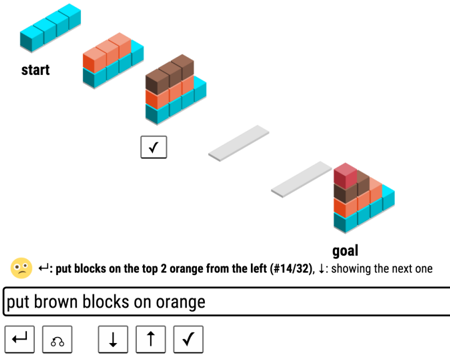
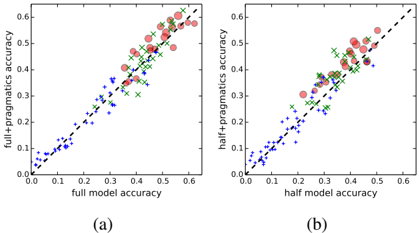
We introduce a new language learning setting relevant to building adaptive natural language interfaces.It is inspired by Wittgenstein's language games: a human wishes to accomplish some task (e.g., achieving a certain configuration of blocks), but can only communicate with a computer, who performs the actual actions (e.g., removing all red blocks).The computer initially knows nothing about language and therefore must learn it from scratch through interaction, while the human adapts to the computer's capabilities.We created a game called SHRDLURN in a blocks world and collected interactions from 100 people playing it.First, we analyze the humans' strategies, showing that using compositionality and avoiding synonyms correlates positively with task performance.Second, we compare computer strategies, showing that modeling pragmatics on a semantic parsing model accelerates learning for more strategic players.
Overview
The claims and statistics of this paper haven’t been checked yet.
Free: it reads the open-access text and checks the first 5 claims that cite a source we can check. Create a free account to check every claim.
Integrity signals
Registry
Cites
Statistics
Figures
Verification
Claims the paper makes
The claims and statistics of this paper haven’t been checked yet.
Free: it reads the open-access text and checks the first 5 claims that cite a source we can check. Create a free account to check every claim.
Claims other papers make about this one
Each is checked against this paper’s own text: does it say what the citing paper says it does?
The cited source says what the claim attributes to it.
In the citing paper
“How users adapt to systems over time is of interest for not only HCI researchers but also NLP researchers [59,60].”
From CoAuthor: Designing a Human-AI Collaborative Writing Dataset for Exploring Language Model Capabilities (2022) · cites this paper as [60]
Self-check
Percentages, sums and reported differences re-computed from the paper’s own numbers.
The self-check needs the paper’s full text.
Citations
Cites
Prediction, Learning, and Games
Cesa-Bianchi, N., & Lugosi, G. (2006) · Cambridge University Press eBooks · doi:10.1017/cbo9780511546921 · Cited by 3,162
Understanding natural language
Winograd, T. (1972) · Cognitive Psychology · doi:10.1016/0010-0285(72)90002-3 · Cited by 2,799
Children's use of mutual exclusivity to constrain the meanings of words
Markman, E. M., & Wachtel, G. F. (1988) · Cognitive Psychology · doi:10.1016/0010-0285(88)90017-5 · Cited by 1,337
Predicting pragmatic reasoning in language games
Frank, M. C., & Goodman, N. D. (2012) · Science · doi:10.1126/science.1218633 · Cited by 868 · cited 4×
“To speed up learning, we leverage computational models of pragmatics (Jäger, 2008; Golland et al., 2010; Frank and Goodman, 2012; Smith et al., 2013; Vogel et al., 2013).”
MethodInfluentialZettlemoyer, L., & Collins, M. (2012) · arXiv (Cornell University) · doi:10.48550/arxiv.1207.1420 · Cited by 728
Understanding Natural Language Commands for Robotic Navigation and Mobile Manipulation
Tellex, S., Kollar, T., Dickerson, S., Walter, M., Banerjee, A., Teller, S., & Roy, N. (2011) · Proceedings of the AAAI Conference on Artificial Intelligence · doi:10.1609/aaai.v25i1.7979 · Cited by 650
Learning Dependency-Based Compositional Semantics
Liang, P., Jordan, M. I., & Klein, D. (2013) · Computational Linguistics · doi:10.1162/coli_a_00127 · Cited by 546
Self-citationCommunication Accommodation Theory
Gallois, C., & Giles, H. (2015) · The International Encyclopedia of Language and Social Interaction · doi:10.1002/9781118611463.wbielsi066 · Cited by 544
Language Style Matching Predicts Relationship Initiation and Stability
Ireland, M. E., Slatcher, R. B., Eastwick, P. W., Scissors, L. E., Finkel, E. J., & Pennebaker, J. W. (2011) · Psychological Science · doi:10.1177/0956797610392928 · Cited by 529
Learning to Interpret Natural Language Navigation Instructions from Observations
Chen, D., & Mooney, R. (2011) · Proceedings of the AAAI Conference on Artificial Intelligence · doi:10.1609/aaai.v25i1.7974 · Cited by 426
Research works printed but not linked: 6
- J. Berant, A. Chou, R. Frostig, and P. Liang. 2013. Semantic parsing on Freebase from question- answer pairs. In Empirical Methods in Natural Language Processing (EMNLP).
- N. Cesa-Bianchi and G. Lugosi. 2006. Predic- tion, learning, and games. Cambridge Univer- sity Press.
- J. Duchi, E. Hazan, and Y. Singer. 2010. Adap- tive subgradient methods for online learning and stochastic optimization. In Conference on Learning Theory (COLT).
- D. Golland, P. Liang, and D. Klein. 2010. A game- theoretic approach to generating spatial descrip- tions. In Empirical Methods in Natural Lan- guage Processing (EMNLP).
- N. Goodman and D. Lassiter. 2015. Probabilistic Semantics and Pragmatics: Uncertainty in Lan- guage and Thought. The Handbook of Contem- porary Semantic Theory, 2nd Edition Wiley- Blackwell.
- T. Kwiatkowski, L. Zettlemoyer, S. Goldwater, and M. Steedman. 2010. Inducing probabilistic CCG grammars from logical form with higher- order unification. In Empirical Methods in Natural Language Processing (EMNLP). pages 1223-1233.
Cited by
Deep reinforcement learning from human preferences
Christiano, P., Leike, J., Brown, T. B., Martic, M., Legg, S., & Amodei, D. (2017) · arXiv · doi:10.48550/arxiv.1706.03741 · Cited by 1,058
“…reinforcement learning from human ratings or rankings, including Akrour et al. (2011), Pilarski et al. (2011), Akrour et al. (2012), Wilson et al. (2012), Sugiyama et al. (2012), Wirth and Fürnkranz (2013), Daniel et al. (2015), El Asri et al. (2016), Wang et al. (2016), and Wirth et al. (2016).”
BackgroundDeep Reinforcement Learning: An Overview
Li, Y. (2017) · arXiv · doi:10.48550/arxiv.1701.07274 · Cited by 762
“One merit of Value Iteration Network, as well as Dueling Network(Wang et al., 2016b), is that they design novel deep neural networks architectures for reinforcement learning problems.”
BackgroundMethodInfluentialDo As I Can, Not As I Say: Grounding Language in Robotic Affordances
Ahn, M., Brohan, A., Brown, N., Chebotar, Y., Cortes, O., David, B., Finn, C., Fu, C., Gopalakrishnan, K., Hausman, K., et al. (2022) · arXiv · doi:10.48550/arxiv.2204.01691 · Cited by 624
Beyond the Imitation Game: Quantifying and extrapolating the capabilities of language models
Srivastava, A., Rastogi, A., Rao, A., Shoeb, A. A. M., Abid, A., Fisch, A., Brown, A. R., Santoro, A., Gupta, A., Garriga-Alonso, A., et al. (2022) · arXiv · doi:10.48550/arxiv.2206.04615 · Cited by 569
Self-citationAccuracy and Reliability of Chatbot Responses to Physician Questions
Goodman, R. S., Patrinely, J. R., Stone, C. A., Zimmerman, E., Donald, R. R., Chang, S. S., Berkowitz, S. T., Finn, A. P., Jahangir, E., Scoville, E. A., et al. (2023) · JAMA Network Open · doi:10.1001/jamanetworkopen.2023.36483 · Cited by 484
Metadata
- Authors
- Wang, S. I., Liang, P., & Manning, C. D.
- Affiliations
- Stanford University (US)
- Venue
- Proceedings of the 54th Annual Meeting of the Association for Computational Linguistics (Volume 1: Long Papers)
- Published
- 2016
- Pages
- 2368-2378
- ISSN
- 0736-587X (ISSN-L)
- OpenAlex
- W2410540304
- Cited by
- 132
- References
- 27
- Citations by year
- 2026: 2 · 2024: 2 · 2023: 5 · 2022: 16 · 2021: 20 · 2020: 23 · 2019: 21 · 2018: 23 · 2017: 18 · 2016: 2
- FWCI
- 11.50
- Type
- conference paper
- Language
- en
- Open access
- hybrid
- doi.org
- Licence
- cc-by
- Locations
- Proceedings of the conference - Association for Computational Linguistics. Meeting (publishedVersion, cc-by)
- arXiv (Cornell University) (submittedVersion)
- arXiv (Cornell University)
- Funders
- Defense Advanced Research Projects Agency
- Natural Sciences and Engineering Research Council of Canada
- Army Research Office (W911NF-15-1-, W911NF)
- Topics
- Physical Sciences › Computer Science › Artificial Intelligence › Speech and dialogue systems
- Physical Sciences › Computer Science › Artificial Intelligence › Natural Language Processing Techniques
- Social Sciences › Arts and Humanities › Language and Linguistics › Syntax, Semantics, Linguistic Variation
- Keywords
- language games, Wittgenstein, natural language interfaces, blocks world, human-computer interaction, compositionality, pragmatics, semantic parsing, task performance, human strategies
About these checks
Registry, retraction, Cites and statistics results are computed, not judged, with one exception: a printed reference that no index lists is read once by a model before it counts as a citation error. Claims are extracted by a model and kept only when their quote appears verbatim in the text; each cited source is then checked, with a model’s help, for whether it says what the claim relies on. Those verdicts can be wrong — read the claim’s quote and the cited source before relying on one.
Statistics and arithmetic are recomputed, not judged.
Confidence bands are shown only for fields calibrated on our annotated test set. None is calibrated yet, so no band is shown.
What counts as a claim ›How we measure confidence ›How we check this ›
Are you an author, or do you see a problem with this page? Request a review
How to cite
Cite CoChat for the checks on this page, and the paper for its own findings.
- This page
- CoChat. (2026). Citation check: Learning Language Games through Interaction. https://app.cochat.ai/papers/10.18653/v1/p16-1224
- The paper
- Wang, S. I., Liang, P., & Manning, C. D. (2016). Learning Language Games through Interaction. Proceedings of the 54th Annual Meeting of the Association for Computational Linguistics (Volume 1: Long Papers). https://doi.org/10.18653/v1/p16-1224
Data sources
Bibliographic data: Semantic Scholar, OpenAlex, Crossref.
Contains information from the Semantic Scholar Academic Graph Datasets, made available under the ODC Attribution License (ODC-BY 1.0).
Semantic Scholar’s data is described in: Kinney, R., et al. (2023). The Semantic Scholar Open Data Platform. arXiv:2301.10140.
