

Learning Language Games through Interaction
Open accessThe DOI matches its Crossref record; 30 of the 30 references it cites were found in a registry or an index.
Abstract
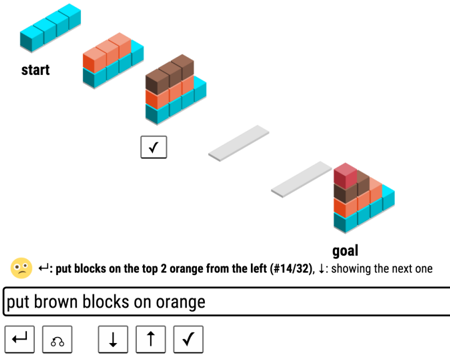
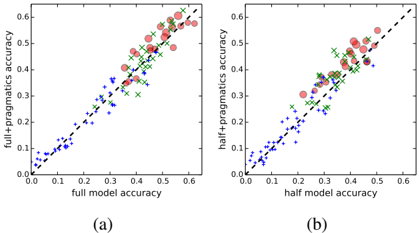
We introduce a new language learning setting relevant to building adaptive natural language interfaces.It is inspired by Wittgenstein's language games: a human wishes to accomplish some task (e.g., achieving a certain configuration of blocks), but can only communicate with a computer, who performs the actual actions (e.g., removing all red blocks).The computer initially knows nothing about language and therefore must learn it from scratch through interaction, while the human adapts to the computer's capabilities.We created a game called SHRDLURN in a blocks world and collected interactions from 100 people playing it.First, we analyze the humans' strategies, showing that using compositionality and avoiding synonyms correlates positively with task performance.Second, we compare computer strategies, showing that modeling pragmatics on a semantic parsing model accelerates learning for more strategic players.
Overview
The claims and statistics of this paper haven’t been checked yet.
Free: it reads the open-access text and checks the first 5 claims that cite a source we can check. Create a free account to check every claim.
Integrity signals
Registry
Cites
Statistics
Figures
Verification
Claims the paper makes
The claims and statistics of this paper haven’t been checked yet.
Free: it reads the open-access text and checks the first 5 claims that cite a source we can check. Create a free account to check every claim.
Claims other papers make about this one
Each is checked against this paper’s own text: does it say what the citing paper says it does?
The cited source says what the claim attributes to it.
In the citing paper
“How users adapt to systems over time is of interest for not only HCI researchers but also NLP researchers [59,60].”
From CoAuthor: Designing a Human-AI Collaborative Writing Dataset for Exploring Language Model Capabilities (2022) · cites this paper as [60]
Self-check
Percentages, sums and reported differences re-computed from the paper’s own numbers.
The self-check needs the paper’s full text.
Citations
Cites
Prediction, Learning, and Games
Cesa-Bianchi, N., & Lugosi, G. (2006) · Cambridge University Press eBooks · doi:10.1017/cbo9780511546921 · Cited by 3,162 · cited 2×
“While online gradient descent is frequently used, for example in semantic parsing (Zettlemoyer and Collins, 2007; Chen, 2012), we using it in a truly online setting, taking one pass over the data and measuring online accuracy (Cesa-Bianchi and Lugosi, 2006).”
MethodUnderstanding natural language
Winograd, T. (1972) · Cognitive Psychology · doi:10.1016/0010-0285(72)90002-3 · Cited by 2,799 · cited 1×
“Specifically, we created a game called SHRDLURN,1 in homage to the seminal work of Winograd (1972). As shown in Figure 1, the objective is to transform a start state into a goal state, but the only action the human can take is entering an utterance.”
MethodChildren's use of mutual exclusivity to constrain the meanings of words
Markman, E. M., & Wachtel, G. F. (1988) · Cognitive Psychology · doi:10.1016/0010-0285(88)90017-5 · Cited by 1,337 · cited 6×
“This phenomenon, mutual exclusivity, was studied by Markman and Wachtel (1988).”
BackgroundMethodInfluentialPredicting pragmatic reasoning in language games
Frank, M. C., & Goodman, N. D. (2012) · Science · doi:10.1126/science.1218633 · Cited by 868 · cited 4×
“To speed up learning, we leverage computational models of pragmatics (Jäger, 2008; Golland et al., 2010; Frank and Goodman, 2012; Smith et al., 2013; Vogel et al., 2013).”
MethodInfluentialZettlemoyer, L., & Collins, M. (2012) · arXiv (Cornell University) · doi:10.48550/arxiv.1207.1420 · Cited by 728 · cited 4×
“…alignment or derivation compositionally connecting the utter-ance and the logical form, in contrast to most traditional work in semantic parsing (Zettlemoyer and Collins, 2005; Wong and Mooney, 2007; Liang et al., 2011; Kwiatkowski et al., 2010; Berant et al., 2013), instead following a…”
BackgroundMethodResultInfluentialUnderstanding Natural Language Commands for Robotic Navigation and Mobile Manipulation
Tellex, S., Kollar, T., Dickerson, S., Walter, M., Banerjee, A., Teller, S., & Roy, N. (2011) · Proceedings of the AAAI Conference on Artificial Intelligence · doi:10.1609/aaai.v25i1.7979 · Cited by 650 · cited 1×
“Examples include playing games (Branavan et al., 2009, 2010; Reckman et al., 2010) interacting with robotics (Tellex et al., 2011, 2014), and following instructions (Vogel and Jurafsky, 2010; Chen and Mooney, 2011; Artzi and Zettlemoyer, 2013) Semantic parsing utterances to logical forms, which we…”
BackgroundLearning Dependency-Based Compositional Semantics
Liang, P., Jordan, M. I., & Klein, D. (2013) · Computational Linguistics · doi:10.1162/coli_a_00127 · Cited by 546 · cited 2×
“ance and the logical form, in contrast to most traditional work in semantic parsing (Zettlemoyer and Collins, 2005; Wong and Mooney, 2007; Liang et al., 2011; Kwiatkowski et al., 2010; Berant et al., 2013), instead following a looser model of semantics similar to (Pasupat and Liang, 2015).”
BackgroundResultSelf-citationCommunication Accommodation Theory
Gallois, C., & Giles, H. (2015) · The International Encyclopedia of Language and Social Interaction · doi:10.1002/9781118611463.wbielsi066 · Cited by 544 · cited 1×
“programming language—a good human player will choose to use utterances that the computer is more likely to learn quickly. In the parlance of communication theory, the human accommodates the computer (Giles, 2008; Ireland et al., 2011). Using Amazon Mechanical Turk, we collected and analyzed around 10k utterances from…”
MethodLanguage Style Matching Predicts Relationship Initiation and Stability
Ireland, M. E., Slatcher, R. B., Eastwick, P. W., Scissors, L. E., Finkel, E. J., & Pennebaker, J. W. (2011) · Psychological Science · doi:10.1177/0956797610392928 · Cited by 529 · cited 1×
“In the parlance of communication theory, the human accommodates the computer (Giles, 2008; Ireland et al., 2011).”
BackgroundCompositional Semantic Parsing on Semi-Structured Tables
Pasupat, P., & Liang, P. (2015) · Proceedings of the 53rd Annual Meeting of the Association for Computational Linguistics and the 7th International Joint Conference on Natural Language Processing (Volume 1: Long Papers) · doi:10.3115/v1/p15-1142 · Cited by 514 · cited 2×
“…utter-ance and the logical form, in contrast to most traditional work in semantic parsing (Zettlemoyer and Collins, 2005; Wong and Mooney, 2007; Liang et al., 2011; Kwiatkowski et al., 2010; Berant et al., 2013), instead following a looser model of semantics similar to (Pasupat and Liang, 2015).”
BackgroundSelf-citation
Research works printed but not linked: 6
- J. Berant, A. Chou, R. Frostig, and P. Liang. 2013. Semantic parsing on Freebase from question- answer pairs. In Empirical Methods in Natural Language Processing (EMNLP).
- N. Cesa-Bianchi and G. Lugosi. 2006. Predic- tion, learning, and games. Cambridge Univer- sity Press.
- J. Duchi, E. Hazan, and Y. Singer. 2010. Adap- tive subgradient methods for online learning and stochastic optimization. In Conference on Learning Theory (COLT).
- D. Golland, P. Liang, and D. Klein. 2010. A game- theoretic approach to generating spatial descrip- tions. In Empirical Methods in Natural Lan- guage Processing (EMNLP).
- N. Goodman and D. Lassiter. 2015. Probabilistic Semantics and Pragmatics: Uncertainty in Lan- guage and Thought. The Handbook of Contem- porary Semantic Theory, 2nd Edition Wiley- Blackwell.
- T. Kwiatkowski, L. Zettlemoyer, S. Goldwater, and M. Steedman. 2010. Inducing probabilistic CCG grammars from logical form with higher- order unification. In Empirical Methods in Natural Language Processing (EMNLP). pages 1223-1233.
Cited by
Deep reinforcement learning from human preferences
Christiano, P., Leike, J., Brown, T. B., Martic, M., Legg, S., & Amodei, D. (2017) · arXiv · doi:10.48550/arxiv.1706.03741 · Cited by 1,058
“…reinforcement learning from human ratings or rankings, including Akrour et al. (2011), Pilarski et al. (2011), Akrour et al. (2012), Wilson et al. (2012), Sugiyama et al. (2012), Wirth and Fürnkranz (2013), Daniel et al. (2015), El Asri et al. (2016), Wang et al. (2016), and Wirth et al. (2016).”
BackgroundDeep Reinforcement Learning: An Overview
Li, Y. (2017) · arXiv · doi:10.48550/arxiv.1701.07274 · Cited by 762
“One merit of Value Iteration Network, as well as Dueling Network(Wang et al., 2016b), is that they design novel deep neural networks architectures for reinforcement learning problems.”
BackgroundMethodInfluentialDo As I Can, Not As I Say: Grounding Language in Robotic Affordances
Ahn, M., Brohan, A., Brown, N., Chebotar, Y., Cortes, O., David, B., Finn, C., Fu, C., Gopalakrishnan, K., Hausman, K., et al. (2022) · arXiv · doi:10.48550/arxiv.2204.01691 · Cited by 624
“Ideas such as combining robot planning and language [85], using language models as a pre-training mechanism for policies [44] and many other ways of combining language and interaction [21, 22, 38, 86] are exciting avenues for future research.”
Beyond the Imitation Game: Quantifying and extrapolating the capabilities of language models
Srivastava, A., Rastogi, A., Rao, A., Shoeb, A. A. M., Abid, A., Fisch, A., Brown, A. R., Santoro, A., Gupta, A., Garriga-Alonso, A., et al. (2022) · arXiv · doi:10.48550/arxiv.2206.04615 · Cited by 569
Self-citationAccuracy and Reliability of Chatbot Responses to Physician Questions
Goodman, R. S., Patrinely, J. R., Stone, C. A., Zimmerman, E., Donald, R. R., Chang, S. S., Berkowitz, S. T., Finn, A. P., Jahangir, E., Scoville, E. A., et al. (2023) · JAMA Network Open · doi:10.1001/jamanetworkopen.2023.36483 · Cited by 484
Emergence of grounded compositional language in multi-agent populations
Mordatch, I., & Abbeel, P. (2018) · Proceedings of the AAAI Conference on Artificial Intelligence · doi:10.1609/aaai.v32i1.11492 · Cited by 440
Das, A., Datta, S., Gkioxari, G., Lee, S., Parikh, D., & Batra, D. (2018) · 2018 IEEE/CVF Conference on Computer Vision and Pattern Recognition · doi:10.1109/cvpr.2018.00008 · Cited by 410
Lee, M., Liang, P., & Yang, Q. (2022) · CHI Conference on Human Factors in Computing Systems · doi:10.1145/3491102.3502030 · Cited by 345
Self-citationLearning a Neural Semantic Parser from User Feedback
Iyer, S., Konstas, I., Cheung, A., Krishnamurthy, J., & Zettlemoyer, L. (2017) · Proceedings of the 55th Annual Meeting of the Association for Computational Linguistics (Volume 1: Long Papers) · doi:10.18653/v1/p17-1089 · Cited by 330
“…paraphrases (often gathered through crowdsourcing (Wang et al., 2015)), data augmentation (e.g. based on manually engineered semantic grammars (Jia and Liang, 2016)) and learning through direct interaction with users (e.g., where a single user teaches the model new concepts (Wang et al., 2016)).”
BackgroundSemantic memory: A review of methods, models, and current challenges
Kumar, A. A. (2021) · Psychonomic Bulletin & Review · doi:10.3758/s13423-020-01792-x · Cited by 314
Das, A., Datta, S., Gkioxari, G., Lee, S., Parikh, D., & Batra, D. (2018) · 2018 IEEE/CVF Conference on Computer Vision and Pattern Recognition Workshops (CVPRW) · doi:10.1109/cvprw.2018.00279 · Cited by 288
“The form and structure of these goal specifications range from declarative programs [26], to simple templated commands [27,28], to free-form natural language instructions [29, 30].”
BackgroundGrounded Language Learning in a Simulated 3D World
Hermann, K. M., Hill, F., Green, S., Wang, F., Faulkner, R., Soyer, H., Szepesvári, D., Czarnecki, W. M., Jaderberg, M., Teplyashin, D., et al. (2017) · arXiv (Cornell University) · doi:10.48550/arxiv.1706.06551 · Cited by 132
“Other related work focuses on language grounding from the perspective of human-machine communication (Thomason et al., 2015; Wang et al., 2016; Arumugam et al., 2017).”
BackgroundA Survey of Reinforcement Learning Informed by Natural Language
Luketina, J., Nardelli, N., Farquhar, G., Foerster, J., Andreas, J., Grefenstette, E., Whiteson, S., & Rocktäschel, T. (2019) · Proceedings of the Twenty-Eighth International Joint Conference on Artificial Intelligence · doi:10.24963/ijcai.2019/880 · Cited by 188
Li, C. (2019) · Reinforcement Learning for Cyber-Physical Systems · doi:10.1201/9781351006620-6 · Cited by 188
Learning to Speak and Act in a Fantasy Text Adventure Game
Urbanek, J., Fan, A., Karamcheti, S., Jain, S., Humeau, S., Dinan, E., Rocktäschel, T., Kiela, D., Szlam, A., & Weston, J. (2019) · Proceedings of the 2019 Conference on Empirical Methods in Natural Language Processing and the 9th International Joint Conference on Natural Language Processing (EMNLP-IJCNLP) · doi:10.18653/v1/d19-1062 · Cited by 156
“…are instruction-following in the Neverwinter Nights game (Fleischman and Roy, 2005), dialogue about soccer videogames (Pa-sunuru and Bansal, 2018), placing blocks appropriately given a final plan (Wang et al., 2016) and a more open ended building task using a grid of voxels (Wang et al., 2017).”
BackgroundMethodInfluentialShared Autonomy via Deep Reinforcement Learning
Reddy, S., Dragan, A., & Levine, S. (2018) · Robotics: Science and Systems XIV · doi:10.15607/rss.2018.xiv.005 · Cited by 175
Natural language does not emerge ‘naturally’ in multi-agent dialog
Kottur, S., Moura, J., Lee, S., & Batra, D. (2017) · Proceedings of the 2017 Conference on Empirical Methods in Natural Language Processing · doi:10.18653/v1/d17-1321 · Cited by 164
“An alternative paradigm that has a long history (Winograd, 1971; Kirby et al., 2014) and is witnessing a recent resurgence (Wang et al., 2016; Fo-erster et al., 2016; Sukhbaatar et al., 2016; Jorge et al., 2016; Lazaridou et al., 2017; Havrylov and Titov, 2017; Mordatch and Abbeel, 2017; Das et…”
BackgroundLifelong Machine Learning, Second Edition
Chen, Z., & Liu, B. (2018) · Synthesis lectures on artificial intelligence and machine learning · doi:10.2200/s00832ed1v01y201802aim037 · Cited by 405
Iris: A Conversational Agent for Complex Tasks
Fast, E., Chen, B., Mendelsohn, J., Bassen, J., & Bernstein, M. S. (2018) · Proceedings of the 2018 CHI Conference on Human Factors in Computing Systems · doi:10.1145/3173574.3174047 · Cited by 108
“A related class of methods such as semantic parsing or deep LSTMs also enable atomic command composition [45].”
MethodContext-Aware Captions from Context-Agnostic Supervision
Vedantam, R., Bengio, S., Murphy, K., Parikh, D., & Chechik, G. (2017) · 2017 IEEE Conference on Computer Vision and Pattern Recognition (CVPR) · doi:10.1109/cvpr.2017.120 · Cited by 113
BabyAI: A Platform to Study the Sample Efficiency of Grounded Language Learning
Chevalier-Boisvert, M., Bahdanau, D., Lahlou, S., Willems, L., Saharia, C., Nguyen, T. H., & Bengio, Y. (2018) · arXiv · doi:10.48550/arxiv.1810.08272 · Cited by 104
“Finally, Wang et al. (2016) presented a system that interactively learned language from a human.”
BackgroundHuman Instruction-Following with Deep Reinforcement Learning via Transfer-Learning from Text
Hill, F., Mokrá, S., Wong, N., & Harley, T. (2020) · arXiv (Cornell University) · doi:10.48550/arxiv.2005.09382 · Cited by 31
“…pipeline-based approaches use learning algorithms to map language to a program that can then interface with a planner [Chen and Mooney, 2011, Matuszek et al., 2013, Wang et al., 2016], and/or a controller, both of which may have priviledged information about how the world connects to the program.”
MethodLearning through Dialogue Interactions by Asking Questions
Li, J., Miller, A., Chopra, S., Ranzato, M., & Weston, J. (2016) · arXiv (Cornell University) · doi:10.48550/arxiv.1612.04936 · Cited by 74
“The direction of interactive language learning through language games has been explored in the early seminal work of Winograd (Winograd, 1972), and in the recent SHRD-LURN system (Wang et al., 2016).”
Never-Ending Learning for Open-Domain Question Answering over Knowledge Bases
Abujabal, A., Roy, R. S., Yahya, M., & Weikum, G. (2018) · International World Wide Web Conference (WWW) · doi:10.1145/3178876.3186004 · Cited by 92
“[51], an end user teaches the model new concepts through direct interaction.”
BackgroundCoDraw: Collaborative Drawing as a Testbed for Grounded Goal-driven Communication
Kim, J.-H., Kitaev, N., Chen, X., Rohrbach, M., Zhang, B.-T., Tian, Y., Batra, D., & Parikh, D. (2019) · Proceedings of the 57th Annual Meeting of the Association for Computational Linguistics · doi:10.18653/v1/p19-1651 · Cited by 53
“Learning language games in a grounded environment has been studied recently (Wang et al., 2016, 2017).”
BackgroundCognitive Architectures for Language Agents
Sumers, T. R., Yao, S., Narasimhan, K., & Griffiths, T. L. (2023) · arXiv · doi:10.48550/arxiv.2309.02427 · Cited by 798
“Classic linguistic interactions allow the agent to accept instructions (Winograd, 1972; Tellex et al., 2011; Chen and Mooney, 2011; Bisk et al., 2016) or learn from people (Nguyen et al., 2021; Sumers et al., 2022; 2021; Wang et al., 2016).”
BackgroundA Survey on Human Preference Learning for Aligning Large Language Models
Jiang, R., Chen, K., Bai, X., He, Z., Li, J., Yang, M., Zhao, T., Nie, L., & Zhang, M. (2025) · ACM Computing Surveys · doi:10.1145/3773279 · Cited by 85
“Feedback texts are qualitative feedback formats used to criticize or refine the model outputs based on human preferences in natural language [41, 110, 148, 188].”
Do explanations make VQA models more predictable to a human?
Chandrasekaran, A., Prabhu, V., Yadav, D., Chattopadhyay, P., & Parikh, D. (2018) · Proceedings of the 2018 Conference on Empirical Methods in Natural Language Processing · doi:10.18653/v1/d18-1128 · Cited by 55
“Wang et al. (2016) and Pelikan and Broth (2016) observe humans’ strategies while adapting to the limited capabilities of an AI in interactive language games.”
BackgroundUnified Pragmatic Models for Generating and Following Instructions
Fried, D., Andreas, J., & Klein, D. (2018) · Proceedings of the 2018 Conference of the North American Chapter of the Association for Computational Linguistics: Human Language Technologies, Volume 1 (Long Papers) · doi:10.18653/v1/n18-1177 · Cited by 64
“The language learning model of Wang et al. (2016) also features a structured output space and uses pragmatics to improve online predictions for a semantic parsing model.”
BackgroundExecuting Instructions in Situated Collaborative Interactions
Suhr, A., Yan, C., Schluger, J., Yu, S., Khader, H., Mouallem, M., Zhang, I., & Artzi, Y. (2019) · Proceedings of the 2019 Conference on Empirical Methods in Natural Language Processing and the 9th International Joint Conference on Natural Language Processing (EMNLP-IJCNLP) · doi:10.18653/v1/d19-1218 · Cited by 55
“Interactions were also used for semantic parser induction (Artzi and Zettlemoyer, 2011; Thomason et al., 2015; Wang et al., 2016).”
MethodMemory-assisted prompt editing to improve GPT-3 after deployment
Madaan, A., Tandon, N., Clark, P., & Yang, Y. (2022) · Proceedings of the 2022 Conference on Empirical Methods in Natural Language Processing · doi:10.18653/v1/2022.emnlp-main.183 · Cited by 60
It Takes Two to Tango: Towards Theory of AI's Mind
Chandrasekaran, A., Yadav, D., Chattopadhyay, P., Prabhu, V., & Parikh, D. (2017) · arXiv (Cornell University) · doi:10.48550/arxiv.1704.00717 · Cited by 28
“A few works [59, 44] observe human strategies while adapting to the limited capabilities of an AI agent in interactive language games.”
BackgroundLearning Language-Conditioned Robot Behavior from Offline Data and Crowd-Sourced AnnotationPreprint
Nair, S., Mitchell, E., Chen, K., Ichter, B., Savarese, S., & Finn, C. (2021) · arXiv (Cornell University) · doi:10.48550/arxiv.2109.01115 · Cited by 86
“Many prior works have studied this problem in the context of instruction following, where an agent aims to complete a task specified by formal language/programs [13, 14, 15, 16, 17, 18] or natural language [10, 11, 19, 20].”
BackgroundNaturalizing a Programming Language via Interactive Learning
Wang, S. I., Ginn, S., Liang, P., & Manning, C. D. (2017) · Proceedings of the 55th Annual Meeting of the Association for Computational Linguistics (Volume 1: Long Papers) · doi:10.18653/v1/p17-1086 · Cited by 59
“Compared to interactive language learning with weak denotational supervision (Wang et al., 2016), definitions are critical for learning complex ac-”
BackgroundMethodInfluentialSelf-citationRTFM: Generalising to Novel Environment Dynamics via Reading
Zhong, V., Rocktäschel, T., & Grefenstette, E. (2019) · arXiv · doi:10.48550/arxiv.1910.08210
“Examples of such context include images (Barnard & Forsyth, 2001), games (Chen & Mooney, 2008; Wang et al., 2016), robot control (Kollar et al., 2010; Tellex et al., 2011), and navigation (Anderson et al., 2018).”
BackgroundAccelerating Reinforcement Learning using EEG-based implicit human feedback
Xu, D., Agarwal, M., Gupta, E., Fekri, F., & Sivakumar, R. (2021) · Neurocomputing · doi:10.1016/j.neucom.2021.06.064 · Cited by 66
“Recently, there is a long line of papers studying reinforcement learning from human feedback, such as [21], [22], [62], [66], [19].”
BackgroundGuiding Policies with Language via Meta-LearningPreprint
Co-Reyes, J. D., Gupta, A., Sanjeev, S., Altieri, N., Andreas, J., DeNero, J., Abbeel, P., & Levine, S. (2018) · arXiv (Cornell University) · doi:10.48550/arxiv.1811.07882 · Cited by 55
Inferring Rewards from Language in Context
Lin, J., Fried, D., Klein, D., & Dragan, A. D. (2022) · Proceedings of the conference - Association for Computational Linguistics. Meeting · doi:10.18653/v1/2022.acl-long.585 · Cited by 63
How young children integrate information sources to infer the meaning of words
Bohn, M., Tessler, M. H., Merrick, M., & Frank, M. C. (2021) · Nature Human Behaviour · doi:10.1038/s41562-021-01145-1 · Cited by 57
Jointly Improving Parsing and Perception for Natural Language Commands through Human-Robot Dialog
Thomason, J., Padmakumar, A., Sinapov, J., Walker, N., Jiang, Y., Yedidsion, H., Hart, J., Stone, P., & Mooney, R. (2020) · Journal of Artificial Intelligence Research · doi:10.1613/jair.1.11485 · Cited by 43
Virtual Embodiment: A Scalable Long-Term Strategy for Artificial Intelligence Research
Kiela, D., Bulat, L., Verő, A. L., & Clark, S. C. (2016) · arXiv (Cornell University) · doi:10.48550/arxiv.1610.07432 · Cited by 22
“The particular problem of language features in these proposals to a varying extent, but we take it to be a core piece of any path toward artificial general intelligence, in line with recent attempts to make machines genuinely understand human language [34, 35].”
Toward Training Superintelligent Software Agents through Self-Play SWE-RLPreprint
Wei, Y., Sun, Z., McMilin, E., Gehring, J., Zhang, D., Synnaeve, G., Fried, D., Zhang, L., & Wang, S. I. (2025) · arXiv (Cornell University) · doi:10.48550/arxiv.2512.18552 · Cited by 45
Self-citationEmergence of Communication in an Interactive World with Consistent SpeakersPreprint
Bogin, B., Geva, M., & Berant, J. (2018) · arXiv (Cornell University) · doi:10.48550/arxiv.1809.00549 · Cited by 44
“…language understanding systems, in which an agent is trained to complete a task in an interactive environment given some linguistic input (Siskind, 1994; Roy and Pentland, 2002; Chen and Mooney, 2008; Wang et al., 2016; Gauthier and Mordatch, 2016; Hermann et al., 2017; Misra et al., 2017).”
BackgroundDo Explanations make VQA Models more Predictable to a Human?Preprint
Chandrasekaran, A., Prabhu, V., Yadav, D., Chattopadhyay, P., & Parikh, D. (2018) · arXiv (Cornell University) · doi:10.48550/arxiv.1810.12366 · Cited by 42
“Wang et al. (2016) and Pelikan and Broth (2016) observe humans’ strategies while adapting to the limited capabilities of an AI in interactive language games.”
BackgroundWorld of Bits: An Open-Domain Platform for Web-Based Agents
Shi, T., Karpathy, A., Fan, L., Hernandez, J., & Liang, P. (2017) · International Conference on Machine Learning · Cited by 388
Self-citationSemi-automated protocol disambiguation and code generation
Yen, J., Lévai, T., Ye, Q., Ren, X., Govindan, R., & Raghavan, B. (2021) · ACM SIGCOMM Conference (SIGCOMM) · doi:10.1145/3452296.3472910 · Cited by 39
“Apart from the application to question answering, semantic parsing has also been successful in navigating robots [77], understanding instructions [15], and playing language games [81].”
BackgroundTuringAdvice: A Generative and Dynamic Evaluation of Language Use
Zellers, R., Holtzman, A., Clark, E., Qin, L., Farhadi, A., & Choi, Y. (2021) · Proceedings of the 2021 Conference of the North American Chapter of the Association for Computational Linguistics: Human Language Technologies · doi:10.18653/v1/2021.naacl-main.386 · Cited by 13
“For example, Wang et al. (2016) study a blocks world where humans give commands to a block-placing machine.”
BackgroundLifelong and Continual Learning Dialogue Systems: Learning during Conversation
Liu, B., & Mazumder, S. (2021) · Proceedings of the AAAI Conference on Artificial Intelligence · doi:10.1609/aaai.v35i17.17768 · Cited by 34
Tandon, N., Madaan, A., Clark, P., & Yang, Y. (2022) · Findings of the Association for Computational Linguistics: NAACL · doi:10.18653/v1/2022.findings-naacl.26 · Cited by 52
“(2) Marking/scoring the system’s answer(s): In SHRDLURN, the user provides feedback by identifying which of the system’s alternative interpretations of a user command is correct (Wang et al., 2016).”
Zhan, H., Tao, F., & Cao, Y. (2021) · IEEE Robotics and Automation Letters · doi:10.1109/lra.2021.3063927 · Cited by 40
“, [11], [12], [13], [14], [15] and [16]).”
Scones: towards conversational authoring of sketches
Huang, F., Schoop, E., Ha, D., & Canny, J. (2020) · ACM International Conference on Intelligent User Interfaces (IUI) · doi:10.1145/3377325.3377485 · Cited by 35
“language captions [5], and algorithmic approaches have been used for searching within videos [21]. Adaptive interfaces can also draw correspondence between language and visual block manipulationtasks[32].Fashioninterfaceswhichrecommenditems from natural language specifications [27] or by connecting users to styliststh…”
MethodTowards a Continuous Knowledge Learning Engine for Chatbots
Mazumder, S., Ma, N., & Liu, B. (2018) · arXiv (Cornell University) · doi:10.48550/arxiv.1802.06024 · Cited by 23
“Our work is related to interactive language learning (ILL) (Wang et al., 2016b, 2017), but these are not about KB completion.”
BackgroundMethodA Paradigm for Situated and Goal-Driven Language LearningPreprint
Gauthier, J., & Mordatch, I. (2016) · arXiv (Cornell University) · doi:10.48550/arxiv.1610.03585 · Cited by 36
A Study of AI Population Dynamics with Million-agent Reinforcement Learning
Yang, Y., Yu, L., Bai, Y., Wen, Y., Zhang, W., & Wang, J. (2018) · Adaptive Agents and Multi-Agents Systems · doi:10.65109/jkpb8439 · Cited by 35
“For example, the studies [8, 25, 34, 49] have shown that with di erent multi-agent cooperative learning environments, the compositional language naturally emerges.”
BackgroundResultContinual Adaptation for Efficient Machine Communication
Hawkins, R., Kwon, M., Sadigh, D., & Goodman, N. D. (2020) · Conference on Computational Natural Language Learning · doi:10.18653/v1/2020.conll-1.33 · Cited by 42
Pragmatics in Language Grounding: Phenomena, Tasks, and Modeling Approaches
Fried, D., Tomlin, N., Hu, J. C. W., Patel, R., & Nematzadeh, A. (2023) · Findings of the Association for Computational Linguistics: EMNLP (Findings of EMNLP) · doi:10.18653/v1/2023.findings-emnlp.840 · Cited by 64
“…(e.g., A DD (L EFTMOST (W ITH (B ROWN )), O RANGE ), to specify add an orange block to the left-most brown block in the block-stacking setting of Wang et al. 2016), sequences of discrete movements (e.g., be-tween nodes in a navigation graph in Chen et al. 2019; Ku et al. 2020), or continuous…”
BackgroundFLIN: A Flexible Natural Language Interface for Web Navigation
Mazumder, S., & Riva, O. (2021) · Conference of the North American Chapter of the Association for Computational Linguistics: Human Language Technologies (NAACL-HLT) · doi:10.18653/v1/2021.naacl-main.222 · Cited by 36
Communicating Natural Programs to Humans and Machines
Acquaviva, S., Pu, Y., Kryven, M., Sechopoulos, T., Wong, C., Ecanow, G., Nye, M., Tessler, M. H., & Tenenbaum, J. B. (2022) · neural information processing systems · doi:10.52202/068431-0270 · Cited by 71
Learning Rewards From Linguistic Feedback
Sumers, T. R., Ho, M. K., Hawkins, R. D., Narasimhan, K., & Griffiths, T. L. (2021) · AAAI Publications (The Association for the Advancement of Artificial Intelligence (AAAI)) · doi:10.1609/aaai.v35i7.16749 · Cited by 32
Natural Language Interfaces with Fine-Grained User Interaction: A Case Study on Web APIs
Su, Y., Awadallah, A. H., Wang, M., & White, R. W. (2018) · International ACM SIGIR Conference on Research and Development in Information Retrieval (SIGIR) · doi:10.1145/3209978.3210013 · Cited by 40
“Natural language interfaces that can seek feedback from users to improve prediction accuracy have also received signicant recent aention [16, 20, 29, 33].”
BackgroundFew-shot Language Coordination by Modeling Theory of MindPreprint
Zhu, H., Neubig, G., & Bisk, Y. (2021) · arXiv (Cornell University) · doi:10.48550/arxiv.2107.05697 · Cited by 54
“Wang et al. (2016) show that humans have the ability to adapt to the machine’s capability in language games.”
BackgroundAn Imitation Game for Learning Semantic Parsers from User Interaction
Yao, Z., Tang, Y., Yih, W.-T., Sun, H., & Su, Y. (2020) · Conference on Empirical Methods in Natural Language Processing (EMNLP) · doi:10.18653/v1/2020.emnlp-main.559 · Cited by 38
Lifelong and Interactive Learning of Factual Knowledge in Dialogues
Mazumder, S., Liu, B., Wang, S., & Ma, N. (2019) · Annual Meeting of the Special Interest Group on Discourse and Dialogue · doi:10.18653/v1/w19-5903 · Cited by 30
“CILK is related to interactive language learning (Wang et al., 2016, 2017), which is mainly about language grounding, not about knowledge learning.”
Self-citationLearning Adaptive Language Interfaces through Decomposition
Karamcheti, S., Sadigh, D., & Liang, P. (2020) · doi:10.18653/v1/2020.intexsempar-1.4 · Cited by 34
Self-citationInteractive Classification by Asking Informative Questions
Yu, L., Chen, H., Wang, S. I., Lei, T., & Artzi, Y. (2020) · Proceedings of the conference - Association for Computational Linguistics. Meeting · doi:10.18653/v1/2020.acl-main.237 · Cited by 35
Self-citationPredicting pragmatic cue integration in adults’ and children’s inferences about novel word meanings.
Bohn, M., Tessler, M. H., Merrick, M., & Frank, M. C. (2022) · Journal of Experimental Psychology General · doi:10.1037/xge0001216 · Cited by 34
Lifelong Knowledge Learning in Rule-based Dialogue SystemsPreprint
Liu, B., & Mei, C. (2020) · arXiv (Cornell University) · doi:10.48550/arxiv.2011.09811 · Cited by 27
“in (Otsuka et al., 2013; Ono et al., 2017) asks the user whether the system’s prediction of category of a term is correct or not. KAD is also remotely related to interactive language learning (e.g., Wang et al., (2016) for knowledge grounding, but this work does not learn any new knowledge like KAD. 3 Proposed System…”
BackgroundWhy Build an Assistant in Minecraft?Preprint
Szlam, A. D., Gray, J., Srinet, K., Jernite, Y., Joulin, A., Synnaeve, G., Kiela, D., Yu, H., Chen, Z., Goyal, S., et al. (2019) · arXiv (Cornell University) · doi:10.48550/arxiv.1907.09273 · Cited by 29
“While there is some work in learning from dialogue in an embodied setting [17, 83] this is currently relatively unexplored, The program described in this work is related to (and has been inspired by) [89, 87].”
BackgroundReconciling truthfulness and relevance as epistemic and decision-theoretic utility.
Sumers, T. R., Ho, M. K., Griffiths, T. L., & Hawkins, R. D. (2024) · Psychological Review · doi:10.1037/rev0000437 · Cited by 39
“…1995; Fried, Andreas, & Klein, 2018; Fried et al., 2021; Fried, Hu, et al., 2018; Golland et al., 2010; Monroe & Potts, 2015; Nie et al., 2020; Shen et al., 2019; Sumers, Ho, et al., 2021; Wang et al., 2016), these applications have not themselves been used to drive general theories of speech acts.”
Mastering the Dungeon: Grounded Language Learning by Mechanical Turker DescentPreprint
Yang, Z., Zhang, S., Urbanek, J., Feng, W., Miller, A., Szlam, A. D., Kiela, D., & Weston, J. (2017) · arXiv (Cornell University) · doi:10.48550/arxiv.1711.07950 · Cited by 23
“Some works that do utilize real natural language and interaction include Wang et al. (2016), where language is learnt to solve block puzzles, and Wang et al. (2017) where language is learnt to draw voxel images, which are both quite different to our case of studying text adventure games.”
Coheur, L. (2020) · Communications in computer and information science · doi:10.1007/978-3-030-50146-4_3 · Cited by 27
“…[41] the authors propose the building of a semantic parser overnight, in which crowdsourcing is used to para-phrase canonical utterances (automatically built), into natural language questions; in [40] the computer learns, from scratch, the language used by people playing a game in the blocks world.”
BackgroundRead and Reap the Rewards: Learning to Play Atari with the Help of Instruction Manuals
Wu, Y., Fan, Y., Liang, P. P., Azaria, A., Li, Y., & Mitchell, T. M. (2023) · neural information processing systems · doi:10.52202/075280-0048 · Cited by 58
Self-citationSituated Human–Robot Collaboration: predicting intent from grounded natural language
Brawer, J., Mangin, O., Roncone, A., Widder, S., & Scassellati, B. M. (2018) · IEEE/RSJ International Conference on Intelligent Robots and Systems (IROS) · doi:10.1109/iros.2018.8593942 · Cited by 22
“Of great interest to this work is the field of pragmatic modeling, which introduces a model of the speaker’s intentions to improve interpretation of goaloriented utterances [5], [16], [20].”
BackgroundPreference-based interactive multi-document summarisation
Gao, Y., Meyer, C. M., & Gurevych, I. (2019) · Information Retrieval · doi:10.1007/s10791-019-09367-8 · Cited by 29
Executing Instructions in Situated Collaborative InteractionsPreprint
Suhr, A., Yan, C., Schluger, J., Yu, S., Khader, H., Mouallem, M., Zhang, I., & Artzi, Y. (2019) · arXiv (Cornell University) · doi:10.48550/arxiv.1910.03655 · Cited by 23
“Interactions were also used for semantic parser induction (Artzi and Zettlemoyer, 2011; Thomason et al., 2015; Wang et al., 2016).”
MethodiVISPAR — An Interactive Visual-Spatial Reasoning Benchmark for VLMs
Mayer, J., Ballout, M., Jassim, S., Nezami, F. N., & Bruni, E. (2025) · Conference on Empirical Methods in Natural Language Processing (EMNLP) · doi:10.18653/v1/2025.emnlp-main.1359 · Cited by 42
ASHA: Assistive Teleoperation via Human-in-the-Loop Reinforcement Learning
Chen, S., Gao, J., Reddy, S., Berseth, G., Dragan, A. D., & Levine, S. (2022) · Proceedings - IEEE International Conference on Robotics and Automation/Proceedings · doi:10.1109/icra46639.2022.9812442 · Cited by 28
Bender, E. M., & Lascarides, A. (2019) · Synthesis lectures on human language technologies · doi:10.2200/s00935ed1v02y201907hlt043 · Cited by 33
Tandon, N., Madaan, A., Clark, P., & Yang, Y. (2021) · arXiv · doi:10.48550/arxiv.2112.09737 · Cited by 19
“(2) Marking/scoring the system’s answer(s): In SHRDLURN, the user provides feedback by identifying which of the system’s alternative interpretations of a user command is correct (Wang et al., 2016).”
ArraMon: A Joint Navigation-Assembly Instruction Interpretation Task in Dynamic Environments
Kim, H., Zala, A., Burri, G., Tan, H. X., & Bansal, M. (2020) · Findings of the Association for Computational Linguistics: EMNLP (Findings of EMNLP) · doi:10.18653/v1/2020.findings-emnlp.348 · Cited by 19
FIXMYPOSE: Pose Correctional Captioning and Retrieval
Kim, H., Zala, A., Burri, G., & Bansal, M. (2021) · Proceedings of the AAAI Conference on Artificial Intelligence · doi:10.1609/aaai.v35i14.17555 · Cited by 23
Online perceptual learning and natural language acquisition for autonomous robots
Alomari, M., Li, F., Hogg, D. C., & Cohn, A. G. (2022) · Artificial Intelligence · doi:10.1016/j.artint.2021.103637 · Cited by 17
“Further, Wang et al. (2016) learned how to parse natural language commands by learning semantic parsing technique in a simulated world.”
BackgroundUsers, Tasks, and Conversational Agents: A Personality Study
Roy, Q., Ghafurian, M., Li, W., & Hoey, J. (2021) · International Conference on Human-Agent Interaction (HAI) · doi:10.1145/3472307.3484173 · Cited by 22
Grounding Language for Interactive Task Learning
Lindes, P., Mininger, A., Kirk, J. R., & Laird, J. E. (2017) · doi:10.18653/v1/w17-2801 · Cited by 17
“Wang et al. (2016) report on a system for learning the language needed to instruct a computer to perform certain tasks.”
BackgroundFirst Contact: Unsupervised Human-Machine Co-Adaptation Via Mutual Information Maximization
Reddy, S., Levine, S., & Dragan, A. (2022) · neural information processing systems · doi:10.52202/068431-2287 · Cited by 31
Grounding language acquisition by training semantic parsers using captioned videos
Ross, C., Barbu, A., Berzak, Y., Myanganbayar, B., & Katz, B. (2018) · Conference on Empirical Methods in Natural Language Processing (EMNLP) · doi:10.18653/v1/d18-1285 · Cited by 23
“Wang et al. (2016) create a language game to learn a parser but do not incorporate visual ambiguity or fallible perception.”
BackgroundLearning Interpretable Spatial Operations in a Rich 3D Blocks World
Bisk, Y., Shih, K., Choi, Y., & Marcu, D. (2018) · Proceedings of the AAAI Conference on Artificial Intelligence · doi:10.1609/aaai.v32i1.12026 · Cited by 53
Language Translation as a Socio-Technical System:Case-Studies of Mixed-Initiative Interactions
Santy, S., Bali, K., Choudhury, M., Dandapat, S., Ganu, T., Shukla, A., Shah, J., & Seshadri, V. (2021) · ACM SIGCAS Conference on Computing and Sustainable Societies (COMPASS) · doi:10.1145/3460112.3471954 · Cited by 20
Learning to Simulate Natural Language Feedback for Interactive Semantic Parsing
Yan, H., Srivastava, S., Tai, Y., Wang, S. I., Yih, W.-T., & Yao, Z. (2023) · Proceedings of the conference - Association for Computational Linguistics. Meeting · doi:10.18653/v1/2023.acl-long.177 · Cited by 23
Self-citationMastering emergent language: learning to guide in simulated navigationPreprint
Mul, M., Bouchacourt, D., & Bruni, E. (2019) · arXiv (Cornell University) · doi:10.48550/arxiv.1908.05135 · Cited by 17
“Relevant research includes Mei et al. (2016), Yu et al. (2018), Bahdanau et al. (2018), Wang et al. (2016) and Williams et al. (2018).”
BackgroundEvaluating Machines by their Real-World Language UsePreprint
Zellers, R., Holtzman, A., Clark, E., Qin, L., Farhadi, A., & Choi, Y. (2020) · arXiv (Cornell University) · Cited by 15
Draw Me a Flower: Processing and Grounding Abstraction in Natural Language
Lachmy, R., Pyatkin, V., Manevich, A., & Tsarfaty, R. (2022) · Transactions of the Association for Computational Linguistics · doi:10.1162/tacl_a_00522 · Cited by 36
“SHRDLURN (Wang et al., 2016) exhibits similar constructions but on an individual rather than a community effort.”
BackgroundContinual Learning for Grounded Instruction Generation by Observing Human Following Behavior
Kojima, N., Suhr, A., & Artzi, Y. (2021) · Transactions of the Association for Computational Linguistics · doi:10.1162/tacl_a_00428 · Cited by 31
“Learning from users has also been studied by asking users to rank system outputs (e.g., Wilson et al., 2012; Christiano et al., 2017), including for instruction following (Wang et al., 2016) and summarization (Stiennon et al., 2020).”
BackgroundChen, L., Krause, A., & Karbasi, A. (2017) · neural information processing systems · Cited by 32
Building and Learning Structures in a Situated Blocks World Through Deep Language Understanding
Perera, I., Allen, J. F., Teng, C. M., & Galescu, L. (2018) · doi:10.18653/v1/w18-1402 · Cited by 12
“There has been significant previous work on learning to interpret typical placement instructions (Bisk et al., 2016; Misra et al., 2017; Wang et al., 2016) or descriptions of block scenes (Bisk et al., 2018).”
BackgroundDo We Need Natural Language? Exploring Restricted Language Interfaces for Complex Domains
Mu, J., & Sarkar, A. (2019) · CHI Conference Extended Abstracts on Human Factors in Computing Systems (CHI EA) · doi:10.1145/3290607.3312975 · Cited by 16
“This serves as a proxy for the surprisal of the system [15].”
BackgroundMethodInfluentialRepresentation Learning of Logic Words by an RNN: From Word Sequences to Robot Actions
Yamada, T., Murata, S., Arie, H., & Ogata, T. (2017) · Frontiers in Neurorobotics · doi:10.3389/fnbot.2017.00070 · Cited by 15
“…agents (Steels and Kaplan, 1998; Steels and McIntyre, 1998; Steels, 2001; Kirby, 2002; Sasahara et al., 2007; Bleys et al., 2009; Schueller and Oudeyer, 2015; Spranger, 2015; Sukhbaatar et al., 2016; Wang et al., 2016; Havrylov and Titov, 2017; Lazaridou et al., 2017; Mordatch and Abbeel, 2017).”
BackgroundContinual Learning for Instruction Following from Realtime Feedback
Suhr, A., & Artzi, Y. (2023) · neural information processing systems · doi:10.52202/075280-1404 · Cited by 30
Continual Learning Dialogue Systems - Learning during Conversation
Mazumder, S., & Liu, B. (2022) · International ACM SIGIR Conference on Research and Development in Information Retrieval (SIGIR) · doi:10.1145/3477495.3532677 · Cited by 11
Learning Autocomplete Systems as a Communication GamePreprint
Lee, M., Hashimoto, T., & Liang, P. (2019) · arXiv (Cornell University) · doi:10.48550/arxiv.1911.06964 · Cited by 11
“One approach to learn such schemes is to collect a supervised dataset of keywords-sentence pairs as a training set, but (i) it would be expensive to collect such data from users, and (ii) a static dataset would not capture a real user’s natural predilection to adapt to the system [34].”
Self-citation
Metadata
- Authors
- Wang, S. I., Liang, P., & Manning, C. D.
- Affiliations
- Stanford University (US)
- Venue
- Proceedings of the 54th Annual Meeting of the Association for Computational Linguistics (Volume 1: Long Papers)
- Published
- 2016
- Pages
- 2368-2378
- ISSN
- 0736-587X (ISSN-L)
- OpenAlex
- W2410540304
- Cited by
- 132
- References
- 27
- Citations by year
- 2026: 2 · 2024: 2 · 2023: 5 · 2022: 16 · 2021: 20 · 2020: 23 · 2019: 21 · 2018: 23 · 2017: 18 · 2016: 2
- FWCI
- 11.50
- Type
- conference paper
- Language
- en
- Open access
- hybrid
- doi.org
- Licence
- cc-by
- Locations
- Proceedings of the conference - Association for Computational Linguistics. Meeting (publishedVersion, cc-by)
- arXiv (Cornell University) (submittedVersion)
- arXiv (Cornell University)
- Funders
- Defense Advanced Research Projects Agency
- Natural Sciences and Engineering Research Council of Canada
- Army Research Office (W911NF-15-1-, W911NF)
- Topics
- Physical Sciences › Computer Science › Artificial Intelligence › Speech and dialogue systems
- Physical Sciences › Computer Science › Artificial Intelligence › Natural Language Processing Techniques
- Social Sciences › Arts and Humanities › Language and Linguistics › Syntax, Semantics, Linguistic Variation
- Keywords
- language games, Wittgenstein, natural language interfaces, blocks world, human-computer interaction, compositionality, pragmatics, semantic parsing, task performance, human strategies
About these checks
Registry, retraction, Cites and statistics results are computed, not judged, with one exception: a printed reference that no index lists is read once by a model before it counts as a citation error. Claims are extracted by a model and kept only when their quote appears verbatim in the text; each cited source is then checked, with a model’s help, for whether it says what the claim relies on. Those verdicts can be wrong — read the claim’s quote and the cited source before relying on one.
Statistics and arithmetic are recomputed, not judged.
Confidence bands are shown only for fields calibrated on our annotated test set. None is calibrated yet, so no band is shown.
What counts as a claim ›How we measure confidence ›How we check this ›
Are you an author, or do you see a problem with this page? Request a review
Data sources
Bibliographic data: Semantic Scholar, OpenAlex, Crossref.
Contains information from the Semantic Scholar Academic Graph Datasets, made available under the ODC Attribution License (ODC-BY 1.0).
Semantic Scholar’s data is described in: Kinney, R., et al. (2023). The Semantic Scholar Open Data Platform. arXiv:2301.10140.
