

Learning Language Games through Interaction
Open accessThe DOI matches its Crossref record; 30 of the 30 references it cites were found in a registry or an index.
Abstract
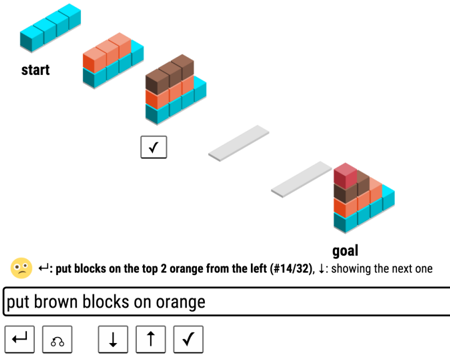
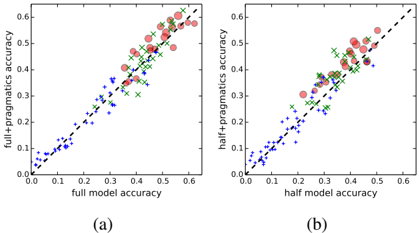
We introduce a new language learning setting relevant to building adaptive natural language interfaces.It is inspired by Wittgenstein's language games: a human wishes to accomplish some task (e.g., achieving a certain configuration of blocks), but can only communicate with a computer, who performs the actual actions (e.g., removing all red blocks).The computer initially knows nothing about language and therefore must learn it from scratch through interaction, while the human adapts to the computer's capabilities.We created a game called SHRDLURN in a blocks world and collected interactions from 100 people playing it.First, we analyze the humans' strategies, showing that using compositionality and avoiding synonyms correlates positively with task performance.Second, we compare computer strategies, showing that modeling pragmatics on a semantic parsing model accelerates learning for more strategic players.
Overview
The claims and statistics of this paper haven’t been checked yet.
Free: it reads the open-access text and checks the first 5 claims that cite a source we can check. Create a free account to check every claim.
Integrity signals
Registry
Cites
Statistics
Figures
Verification
Claims the paper makes
The claims and statistics of this paper haven’t been checked yet.
Free: it reads the open-access text and checks the first 5 claims that cite a source we can check. Create a free account to check every claim.
Claims other papers make about this one
Each is checked against this paper’s own text: does it say what the citing paper says it does?
The cited source says what the claim attributes to it.
In the citing paper
“How users adapt to systems over time is of interest for not only HCI researchers but also NLP researchers [59,60].”
From CoAuthor: Designing a Human-AI Collaborative Writing Dataset for Exploring Language Model Capabilities (2022) · cites this paper as [60]
Self-check
Percentages, sums and reported differences re-computed from the paper’s own numbers.
The self-check needs the paper’s full text.
Citations
Cites
Prediction, Learning, and Games
Cesa-Bianchi, N., & Lugosi, G. (2006) · Cambridge University Press eBooks · doi:10.1017/cbo9780511546921 · Cited by 3,162 · cited 2×
“While online gradient descent is frequently used, for example in semantic parsing (Zettlemoyer and Collins, 2007; Chen, 2012), we using it in a truly online setting, taking one pass over the data and measuring online accuracy (Cesa-Bianchi and Lugosi, 2006).”
MethodUnderstanding natural language
Winograd, T. (1972) · Cognitive Psychology · doi:10.1016/0010-0285(72)90002-3 · Cited by 2,799 · cited 1×
“Specifically, we created a game called SHRDLURN,1 in homage to the seminal work of Winograd (1972). As shown in Figure 1, the objective is to transform a start state into a goal state, but the only action the human can take is entering an utterance.”
MethodChildren's use of mutual exclusivity to constrain the meanings of words
Markman, E. M., & Wachtel, G. F. (1988) · Cognitive Psychology · doi:10.1016/0010-0285(88)90017-5 · Cited by 1,337 · cited 6×
“This phenomenon, mutual exclusivity, was studied by Markman and Wachtel (1988).”
BackgroundMethodInfluentialPredicting pragmatic reasoning in language games
Frank, M. C., & Goodman, N. D. (2012) · Science · doi:10.1126/science.1218633 · Cited by 868 · cited 4×
“To speed up learning, we leverage computational models of pragmatics (Jäger, 2008; Golland et al., 2010; Frank and Goodman, 2012; Smith et al., 2013; Vogel et al., 2013).”
MethodInfluentialZettlemoyer, L., & Collins, M. (2012) · arXiv (Cornell University) · doi:10.48550/arxiv.1207.1420 · Cited by 728 · cited 4×
“…alignment or derivation compositionally connecting the utter-ance and the logical form, in contrast to most traditional work in semantic parsing (Zettlemoyer and Collins, 2005; Wong and Mooney, 2007; Liang et al., 2011; Kwiatkowski et al., 2010; Berant et al., 2013), instead following a…”
BackgroundMethodResultInfluentialUnderstanding Natural Language Commands for Robotic Navigation and Mobile Manipulation
Tellex, S., Kollar, T., Dickerson, S., Walter, M., Banerjee, A., Teller, S., & Roy, N. (2011) · Proceedings of the AAAI Conference on Artificial Intelligence · doi:10.1609/aaai.v25i1.7979 · Cited by 650 · cited 1×
“Examples include playing games (Branavan et al., 2009, 2010; Reckman et al., 2010) interacting with robotics (Tellex et al., 2011, 2014), and following instructions (Vogel and Jurafsky, 2010; Chen and Mooney, 2011; Artzi and Zettlemoyer, 2013) Semantic parsing utterances to logical forms, which we…”
BackgroundLearning Dependency-Based Compositional Semantics
Liang, P., Jordan, M. I., & Klein, D. (2013) · Computational Linguistics · doi:10.1162/coli_a_00127 · Cited by 546 · cited 2×
“ance and the logical form, in contrast to most traditional work in semantic parsing (Zettlemoyer and Collins, 2005; Wong and Mooney, 2007; Liang et al., 2011; Kwiatkowski et al., 2010; Berant et al., 2013), instead following a looser model of semantics similar to (Pasupat and Liang, 2015).”
BackgroundResultSelf-citationCommunication Accommodation Theory
Gallois, C., & Giles, H. (2015) · The International Encyclopedia of Language and Social Interaction · doi:10.1002/9781118611463.wbielsi066 · Cited by 544 · cited 1×
“programming language—a good human player will choose to use utterances that the computer is more likely to learn quickly. In the parlance of communication theory, the human accommodates the computer (Giles, 2008; Ireland et al., 2011). Using Amazon Mechanical Turk, we collected and analyzed around 10k utterances from…”
MethodLanguage Style Matching Predicts Relationship Initiation and Stability
Ireland, M. E., Slatcher, R. B., Eastwick, P. W., Scissors, L. E., Finkel, E. J., & Pennebaker, J. W. (2011) · Psychological Science · doi:10.1177/0956797610392928 · Cited by 529 · cited 1×
“In the parlance of communication theory, the human accommodates the computer (Giles, 2008; Ireland et al., 2011).”
BackgroundCompositional Semantic Parsing on Semi-Structured Tables
Pasupat, P., & Liang, P. (2015) · Proceedings of the 53rd Annual Meeting of the Association for Computational Linguistics and the 7th International Joint Conference on Natural Language Processing (Volume 1: Long Papers) · doi:10.3115/v1/p15-1142 · Cited by 514 · cited 2×
“…utter-ance and the logical form, in contrast to most traditional work in semantic parsing (Zettlemoyer and Collins, 2005; Wong and Mooney, 2007; Liang et al., 2011; Kwiatkowski et al., 2010; Berant et al., 2013), instead following a looser model of semantics similar to (Pasupat and Liang, 2015).”
BackgroundSelf-citation
Research works printed but not linked: 6
- J. Berant, A. Chou, R. Frostig, and P. Liang. 2013. Semantic parsing on Freebase from question- answer pairs. In Empirical Methods in Natural Language Processing (EMNLP).
- N. Cesa-Bianchi and G. Lugosi. 2006. Predic- tion, learning, and games. Cambridge Univer- sity Press.
- J. Duchi, E. Hazan, and Y. Singer. 2010. Adap- tive subgradient methods for online learning and stochastic optimization. In Conference on Learning Theory (COLT).
- D. Golland, P. Liang, and D. Klein. 2010. A game- theoretic approach to generating spatial descrip- tions. In Empirical Methods in Natural Lan- guage Processing (EMNLP).
- N. Goodman and D. Lassiter. 2015. Probabilistic Semantics and Pragmatics: Uncertainty in Lan- guage and Thought. The Handbook of Contem- porary Semantic Theory, 2nd Edition Wiley- Blackwell.
- T. Kwiatkowski, L. Zettlemoyer, S. Goldwater, and M. Steedman. 2010. Inducing probabilistic CCG grammars from logical form with higher- order unification. In Empirical Methods in Natural Language Processing (EMNLP). pages 1223-1233.
Cited by
Items 101–159 of 159
Program Synthesis with Pragmatic CommunicationPreprint
Pu, Y., Ellis, K., Kryven, M., Tenenbaum, J. B., & Solar-Lezama, A. (2020) · arXiv (Cornell University) · doi:10.48550/arxiv.2007.05060 · Cited by 28
“In this regard, our work is most similar to SHRDLURN [23], where a pragmatic semantic parser was able to translate natural language utterances into a desirable program without being trained first on human annotated data.”
Continually Improving Extractive QA via Human Feedback
Gao, G., Chen, H., Artzi, Y., & Choi, E. (2023) · Conference on Empirical Methods in Natural Language Processing (EMNLP) · doi:10.18653/v1/2023.emnlp-main.27 · Cited by 19
CraftAssist Instruction Parsing: Semantic Parsing for a Voxel-World Assistant
Srinet, K., Jernite, Y., Gray, J., & Szlam, A. D. (2020) · Proceedings of the conference - Association for Computational Linguistics. Meeting · doi:10.18653/v1/2020.acl-main.427 · Cited by 10
“This can be considered a basic version of the self-improvement capabilities in (Kollar et al., 2013; Thomason et al., 2015; Wang et al., 2016, 2017).”
BackgroundCraftAssist Instruction Parsing: Semantic Parsing for a Minecraft AssistantPreprint
Jernite, Y., Srinet, K., Gray, J., & Szlam, A. D. (2019) · arXiv (Cornell University) · doi:10.48550/arxiv.1905.01978 · Cited by 10
“This can be considered a basic version of the self-improvement capabilities in (Kollar et al., 2013; Thomason et al., 2015; Wang et al., 2016, 2017).”
BackgroundInteractive Learning from Activity DescriptionPreprint
Nguyen, K., Misra, D., Schapire, R., Dudík, M., & Shafto, P. (2021) · International Conference on Machine Learning · doi:10.48550/arxiv.2102.07024 · Cited by 37
“…2019; Sumers et al., 2020), learning to ground language to actions (Chen & Mooney, 2011; Misra et al., 2014; Bisk et al., 2016; Liu et al., 2016; Wang et al., 2016; Li et al., 2017; 2020a;b), or devising EM-based algo-Interactive rithms to parse language into logical forms (Matuszek et al.,…”
BackgroundDesigning an Automatic Agent for Repeated Language–based Persuasion Games
Raifer, M., Rotman, G., Apel, R., Tennenholtz, M., & Reichart, R. (2022) · Transactions of the Association for Computational Linguistics · doi:10.1162/tacl_a_00462 · Cited by 12
“Another line of work designs agents for games inspired by Wittgenstein (1953)’s language games (Wang et al., 2016), where a human aims to accomplish a task (e.”
BackgroundCounterfactual Explanations for Natural Language Interfaces
Tolkachev, G., Mell, S., Zdancewic, S. A., & Bastani, O. (2022) · Proceedings of the conference - Association for Computational Linguistics. Meeting · doi:10.18653/v1/2022.acl-short.14 · Cited by 16
Preference-Based Image Generation
Kazemi, H., Taherkhani, F., & Nasrabadi, N. M. (2020) · IEEE Winter Conference on Applications of Computer Vision · doi:10.1109/wacv45572.2020.9093406 · Cited by 14
“In recent past, extensive research has been conducted to address this problem proposing different techniques to learn from human judgments [1, 11, 36, 38, 30].”
BackgroundPre-Learning Environment Representations for Data-Efficient Neural Instruction Following
Gaddy, D., & Klein, D. (2019) · Proceedings of the conference - Association for Computational Linguistics. Meeting · doi:10.18653/v1/p19-1188 · Cited by 8
“Following the original work for this dataset (Wang et al., 2016), we adopt an online learning setup and metric.”
MethodResultInfluentialA Domain-Specific Modelling Language for Adventure Educational Games and Flow Theory
Zahari, A. S., Rahim, L. A., Nurhadi, N. A., & Aslam, M. (2020) · International Journal on Advanced Science Engineering and Information Technology · doi:10.18517/ijaseit.10.3.10173 · Cited by 9
“Games, specifically computer games, offer players a lot of interactive and engaging activities [6], [7].”
BackgroundLearning Effective Value Function Factorization via Attentional Communication
Wu, B., Xiao-ya, Y., Sun, C., Wang, R., Hu, X., & Hu, Y. (2020) · Conference proceedings/Conference proceedings - IEEE International Conference on Systems, Man, and Cybernetics · doi:10.1109/smc42975.2020.9283355 · Cited by 10
The Computer Game as an Alternative Artistic Discourse
Pozharytska, O., Morozova, I., Miliutina, K., Gusieva, G., & Олегівна, Л. О. (2023) · Theory and Practice in Language Studies · doi:10.17507/tpls.1302.05 · Cited by 8
Learning concepts through conversations in spoken dialogue systems
Jia, R., Heck, L. P., Hakkani-Tür, D. Z., & Nikolov, G. (2017) · IEEE International Conference on Acoustics Speech and Signal Processing · doi:10.1109/icassp.2017.7953253 · Cited by 8
“SHRDLURN [12] learns a semantic parser from scratch given user inputs and feedback about correct denotations.”
Best, A., Narang, S., & Manocha, D. (2020) · IEEE Conference on Virtual Reality and 3D User Interfaces (VR) · doi:10.1109/vr46266.2020.00030 · Cited by 9
Towards an Engine for Lifelong Interactive Knowledge Learning in Human-Machine ConversationsPreprint
Mazumder, S., Ma, N., & Liu, B. (2018) · arXiv (Cornell University) · Cited by 8
The Usability of Pragmatic Communication in Regular Expression SynthesisPreprint
Vaithilingam, P., Pu, Y., & Glassman, E. L. (2023) · arXiv (Cornell University) · doi:10.48550/arxiv.2308.06656 · Cited by 11
“The RSA algorithm has already been adopted in the field of natural language processing, where language descriptions were used to pragmatically infer a target referent, either from a set of categorical outcomes [4, 34] or from a small set of programs [54].”
MethodInteractive Data Analytics for the Humanities
Gurevych, I., Meyer, C. M., Binnig, C., Fürnkranz, J., Kersting, K., Roth, S., & Simpson, E. (2018) · Lecture notes in computer science · doi:10.1007/978-3-319-77113-7_41 · Cited by 7
“Despite image segmentation [29,86,37], there is recent work on natural language generation [55] and natural language understanding [104].”
BackgroundInteractive Language Acquisition with One-shot Visual Concept Learning through a Conversational Game
Zhang, H., Yu, H., & Xu, W. (2018) · Proceedings of the conference - Association for Computational Linguistics. Meeting · doi:10.18653/v1/p18-1243 · Cited by 9
“This makes our game distinct from other seemingly relevant games, in which the agent cannot speak (Wang et al., 2016) or “speaks” by selecting a candidate from a provided set (He et al., 2016; Weston, 2016; Li et al., 2017) rather than generating sentences by itself, or games mainly focus on slow…”
BackgroundInteractive task learning via embodied corrective feedback
Appelgren, M., & Lascarides, A. (2020) · Autonomous Agents and Multi-Agent Systems · doi:10.1007/s10458-020-09481-8 · Cited by 13
“First, it is necessary to map NL strings into formal semantic representations or logical forms that support inference (e.g., [63, 67]).”
BackgroundAdversarial Language Games for Advanced Natural Language Intelligence
Yao, Y., Zhong, H., Zhang, Z., Han, X., Wang, X., Zhang, K., Xiao, C., Zeng, G., Liu, Z., & Sun, M. (2021) · Proceedings of the AAAI Conference on Artificial Intelligence · doi:10.1609/aaai.v35i16.17676 · Cited by 13
Ekila, J. B., Verheyen, L., Nevens, J., Beuls, K., & Eecke, P. V. (2026) · Transactions of the Association for Computational Linguistics · doi:10.1162/tacl.a.799 · Cited by 6
“Further experiments have also modelled the grounding of predefined concepts in perceptual data (Spranger and Beuls, 2016; Wang et al., 2016; Nevens et al., 2020).”
A Visuospatial Dataset for Naturalistic Verb LearningPreprint
Ebert, D., & Pavlick, E. (2020) · arXiv (Cornell University) · doi:10.48550/arxiv.2010.15225 · Cited by 7
“…acquisition (MacWhin-ney, 2013), has trained AI agents to learn language from scratch by interacting with humans and/or each other in simulated environments or games (Wang et al., 2016; Mirowski et al., 2016; Urbanek et al., 2019; Beattie et al., 2016; Hill et al., 2018; Mirowski et al., 2016),”
X2T: Training an X-to-Text Typing Interface with Online Learning from User FeedbackPreprint
Gao, J., Reddy, S., Berseth, G., Hardy, N. F., Natraj, N., Ganguly, K., Dragan, A. D., & Levine, S. (2022) · arXiv (Cornell University) · doi:10.48550/arxiv.2203.02072 · Cited by 7
“These methods tend to either assume access to ground-truth action labels from the user (Anumanchipalli et al., 2019; Wang et al., 2016; Karamcheti et al., 2020), or assume the user always intends to take the optimal action (Gilja et al., 2012; Dangi et al., 2013; 2014; Merel et al., 2015).”
MethodImproving Neural Model Performance through Natural Language Feedback on Their ExplanationsPreprint
Madaan, A., Tandon, N., Rajagopal, D., Yang, Y.-M., Clark, P., Sakaguchi, K., & Hovy, E. (2021) · arXiv.org · doi:10.48550/arxiv.2104.08765 · Cited by 6
“In language-based interactions, controlled settings (Mehta and Goldwasser, 2019; Wang et al., 2016) give a better handle and are easy to evaluate.”
BackgroundRepresentational Alignment Supports Effective Machine TeachingPreprint
Sucholutsky, I., Collins, K. M., Malaviya, M., Jacoby, N., Liu, W., Sumers, T. R., Korakakis, M., Bhatt, U., Ho, M. K., Tenenbaum, J. B., et al. (2024) · arXiv (Cornell University) · doi:10.48550/arxiv.2406.04302 · Cited by 5
Wibowo, S. E. (2024) · Journal of Electrical Systems · doi:10.52783/jes.2153 · Cited by 4
“The theories used are language games in learning [10], [11], [12].”
BackgroundIDAT: A Multi-Modal Dataset and Toolkit for Building and Evaluating Interactive Task-Solving Agents
Mohanty, S., Arabzadeh, N., Tupini, A., Sun, Y., Skrynnik, A., Zholus, A., Côté, M.-A., & Kiseleva, J. (2025) · International ACM SIGIR Conference on Research and Development in Information Retrieval (SIGIR) · doi:10.1145/3726302.3730300 · Cited by 5
Grounding Language by Continuous Observation of Instruction Following
Han, T., & Schlangen, D. (2017) · Conference of the European Chapter of the Association for Computational Linguistics · doi:10.18653/v1/e17-2079 · Cited by 4
“That such signals are also useful for machine learning of meaning has been shown by some recent work ( inter alia (Chen and Mooney, 2011; Wang et al., 2016)).”
BackgroundMost NLG is Low-Resource: here’s what we can do about it
Howcroft, D. M., & Gkatzia, D. (2022) · Workshop on Generation, Evaluation and Metrics (GEM) · doi:10.18653/v1/2022.gem-1.29 · Cited by 9
“More research in this area, might be useful to endow models with new capabilities as in the frameworks proposed by Gkatzia and Belvedere (2021) and Wang et al. (2016).”
MethodBuilding an Application Independent Natural Language InterfacePreprint
Mazumder, S., Liu, B., Wang, S., & Esmaeilpour, S. (2019) · arXiv (Cornell University) · doi:10.48550/arxiv.1910.14084 · Cited by 5
“games (Wang et al., 2016) and discovering commands in multimodal interfaces (Srinivasan et al.”
BackgroundSelf-citationGesturing Toward Abstraction: Multimodal Convention Formation in Collaborative Physical Tasks
Maeda, K., McCarthy, W. P., Tsai, C.-Y., Mu, J., Wang, H., Hawkins, R., Fan, J. E., & Abtahi, P. (2026) · CHI Conference on Human Factors in Computing Systems · doi:10.1145/3772318.3790618 · Cited by 4
Learning Plans by Acquiring Grounded Linguistic Meanings from Corrections
Appelgren, M., & Lascarides, A. (2019) · Adaptive Agents and Multi-Agents Systems · doi:10.65109/uyna6565 · Cited by 3
“Another significant difference from other tasks is the one mentioned earlier: that learning to ground linguistic terms involves adapting the domain model to include newly discovered and un-foreseen concepts, rather than simply mapping terms to already known domain concepts (as in [13, 27]).”
BackgroundLearning to Ask for Conversational Machine Learning
Srivastava, S., Labutov, I., & Mitchell, T. M. (2019) · Conference on Empirical Methods in Natural Language Processing (EMNLP) · doi:10.18653/v1/d19-1426 · Cited by 3
“rating natural language supervision in models of machine intelligence (Narasimhan et al., 2015; Elhoseiny et al., 2013; Goldwasser and Roth, 2014; Andreas et al., 2018; Fried et al., 2018; Wang et al., 2016).”
BackgroundLearning Web-based Procedures by Reasoning over Explanations and Demonstrations in Context
Srivastava, S., Polozov, O., Jojić, N., & Meek, C. (2020) · Proceedings of the conference - Association for Computational Linguistics. Meeting · doi:10.18653/v1/2020.acl-main.684 · Cited by 7
“(2015)’s work is similar to ours in motivation in learning user-specified recipes, but has no aspects of grounding or demonstrations.(Wang et al., 2016) explore interactive parser training through language games in context of block-world environments.”
BackgroundBootstrapping Adaptive Human-Machine Interfaces with Offline Reinforcement Learning
Gao, J., Reddy, S., Berseth, G., Dragan, A. D., & Levine, S. (2023) · IEEE/RSJ International Conference on Intelligent Robots and Systems (IROS) · doi:10.1109/iros55552.2023.10341779 · Cited by 2
“The literature on learning-based assistive interfaces spans several fields, including brain-computer interfaces [24]–[29], natural language interfaces [30]–[32], speech interfaces [33], [34], electronic musical instruments [35], and robotic teleoperation interfaces [36]–[41].”
BackgroundInteractive Symbol Grounding with Complex Referential Expressions
Rubavicius, R., & Lascarides, A. (2022) · Conference of the North American Chapter of the Association for Computational Linguistics: Human Language Technologies (NAACL-HLT) · doi:10.18653/v1/2022.naacl-main.358 · Cited by 3
“…grammar induction from image-caption pairs (Shi et al., 2019; Zhao and Titov, 2020), or as learning (neural) semantic parsers from a reward signal (Williams, 1992) in VQA (Mao et al., 2019; Yi et al., 2018) or in planning (Azaria et al., 2016; Wang et al., 2016, 2017; Karamcheti et al., 2020).”
MethodTowards Democratizing Data Science with Natural Language Interfaces
Su, Y. (2018) · eScholarship (California Digital Library) · Cited by 3
On the Limits of Evaluating Embodied Agent Model Generalization Using Validation Sets
Kim, H., Padmakumar, A., Jin, D., Bansal, M., & Hakkani-Tür, D. Z. (2022) · Workshop on Insights from Negative Results in NLP (Insights) · doi:10.18653/v1/2022.insights-1.15 · Cited by 1
Chumakov, J., Galimzhanov, T., Khajikhanov, S., Yelenov, A., Al-Farabi, Z., Seitzhanov, A., & Kappassov, Z. (2025) · Lecture notes in networks and systems · doi:10.1007/978-3-032-09427-8_15 · Cited by 1
STARS: extending interactive task learning with large language models
Kirk, J. R., Wray, R. E., & Laird, J. E. (2026) · Frontiers in Computer Science · doi:10.3389/fcomp.2026.1848830 · Cited by 3
The Fast and the Flexible: Training Neural Networks to Learn to Follow Instructions from Small Data
Leonandya, R. A., Hupkes, D., Bruni, E., & Kruszewski, G. (2019) · International Conference on Computational Semantics (IWCS) · doi:10.18653/v1/w19-0419 · Cited by 6
“itive data. A way of giving the models a powerful inductive bias is by hand-coding features or operations that are specific to the given domain where the instructions must be interpreted. For example, Wang et al. (2016) propose a log-linear semantic parser which crucially relies on a set of hand-coded functional primit…”
BackgroundMethodInfluentialInteractive reinforcement learning and error-related potential classification for implicit feedback
Choo, S., & Nam, C. S. (2022) · Elsevier eBooks · doi:10.1016/b978-0-323-85648-5.00005-0 · Cited by 1
Argumentative Reward Learning: Reasoning About Human PreferencesPreprint
Ward, F. R., Belardinelli, F., & Toni, F. (2022) · arXiv (Cornell University) · doi:10.48550/arxiv.2209.14010 · Cited by 1
“RLHF is the focus of a rich literature (Christiano et al., 2017; Wilson et al., 2012; Akrour et al., 2011; Frye & Feige, 2019; Akrour et al., 2012; Wang et al., 2016; Rahtz et al., 2019) and has become, in recent years, a standard training regime, particularly for large language models (Ziegler et al.”
BackgroundScaffolding Networks: Incremental Learning and Teaching Through QuestioningPreprint
Çelikyılmaz, A., Deng, L., Li, L. C., & Wang, C. (2017) · arXiv (Cornell University) · doi:10.48550/arxiv.1702.08653 · Cited by 3
100 Things You Always Wanted to Know about Semantics & Pragmatics But Were Afraid to Ask
Bender, E. M. (2018) · doi:10.18653/v1/p18-5001 · Cited by 1
Hermes: A Natural Language Interface Model for Software Transformation
Chagas, M. W., Farias, K., Gonçales, L. J., Kupssinskü, L. S., & Gluz, J. C. (2019) · Anais do Simpósio Brasileiro de Sistemas de Informação (SBSI) · doi:10.1145/3330204.3330253 · Cited by 1
“O conjunto de ferramentas do CoreNLP de Stanford proposto por Manning et al. [9] é capaz de efetuar o parse de uma sentença e 1https://openmrs.org Tabela 1: Quadro comparativo dos trabalhos relacionados Trabalhos Gera Software Altera Software Suporte a conversação Utiliza ontologias como base Tipo de abordagem de pars…”
BackgroundMethodInfluentialBahdanau, D. (2020) · doi:10.71781/10363 · Cited by 1
Symbol Grounding and Task Learning from Imperfect Corrections
Appelgren, M., & Lascarides, A. (2021) · doi:10.18653/v1/2021.splurobonlp-1.1
“More extended NL phrases must map to semantic representations or logical forms that support inference (eg, Wang et al., 2016; Zettlemoyer and Collins, 2007).”
BackgroundSHAPELURN: An Interactive Language Learning Game with Logical Inference
Stein, K., Harter, L., & Geiger, L. (2021) · doi:10.18653/v1/2021.internlp-1.3 · Cited by 3
“We planned to follow Wang et al. (2016) and count how often the user needs to click ”NEXT” i.e. how far down the ranked parses the correct solution is.”
BackgroundMethodResultInfluentialApple Core-dination: Linguistic Feedback and Learning in a Speech-to-Action Shared World Game
Boy, S., Brown, A., & Wixted, M. (2021) · doi:10.18653/v1/2021.internlp-1.2
“The interaction can result in user language becoming “more consistent, less verbose, and more precise” as users adapt to the perceived abilities of the computer (Wang et al., 2016).”
BackgroundA POMDP Dialogue Policy with 3-way Grounding and Adaptive Sensing for Learning through Communication
Zare, M., Wagner, A. R., & Passonneau, R. J. (2022) · Findings of the Association for Computational Linguistics: EMNLP (Findings of EMNLP) · doi:10.18653/v1/2022.findings-emnlp.504
“Extensive work has been done on learning to ground language, including words for objects or actions (Lindes et al., 2017; Goldwasser and Roth, 2014; Matuszek et al., 2012; Wang et al., 2016).”
BackgroundEkila, J. B. (2024) · VUBIR (Vrije Universiteit Brussel)
Inference and Task Planning over Spatially Complex Problems
Cuellar, A. (2022) · DSpace@MIT (Massachusetts Institute of Technology)
Beyond the Imitation Game: Quantifying and extrapolating the capabilities of language models
Srivastava, A., Rastogi, A., Rao, A., Shoeb, A. A. M., Abid, A., Fisch, A., Brown, A. R., Santoro, A., Gupta, A., Garriga-Alonso, A., et al. (2022) · UCL Discovery (University College London) · Cited by 241
Self-citationBeyond the Imitation Game: Quantifying and extrapolating the capabilities of language models
Srivastava, A., Rastogi, A., Rao, A., A., M. S. A., Abid, A., Fisch, A., Brown, A. R., Santoro, A., Gupta, A., Garriga-Alonso, A., et al. (2023) · BOA (University of Milano-Bicocca) · Cited by 741
Self-citationImproving Cooperation in Multi-agent Deep Reinforcement Learning for Mobile Robotics
Toquebiau, M. (2024) · theses.fr (ABES) · doi:10.70675/3385d0bbzc66cz4fceza9e0z8696ff61ff4e
Consensus from Ambiguity: Language Emergence in Guessing Games
Joseph, A. G., & Kumar, V. (2026) · Autonomous Agents and Multi-Agent Systems · doi:10.1007/s10458-026-09762-8
Bae, J., & Misaki, D. (2026) · ACM Symposium on User Interface Software and Technology (UIST) · doi:10.1145/3830397.3841836
Metadata
- Authors
- Wang, S. I., Liang, P., & Manning, C. D.
- Affiliations
- Stanford University (US)
- Venue
- Proceedings of the 54th Annual Meeting of the Association for Computational Linguistics (Volume 1: Long Papers)
- Published
- 2016
- Pages
- 2368-2378
- ISSN
- 0736-587X (ISSN-L)
- OpenAlex
- W2410540304
- Cited by
- 132
- References
- 27
- Citations by year
- 2026: 2 · 2024: 2 · 2023: 5 · 2022: 16 · 2021: 20 · 2020: 23 · 2019: 21 · 2018: 23 · 2017: 18 · 2016: 2
- FWCI
- 11.50
- Type
- conference paper
- Language
- en
- Open access
- hybrid
- doi.org
- Licence
- cc-by
- Locations
- Proceedings of the conference - Association for Computational Linguistics. Meeting (publishedVersion, cc-by)
- arXiv (Cornell University) (submittedVersion)
- arXiv (Cornell University)
- Funders
- Defense Advanced Research Projects Agency
- Natural Sciences and Engineering Research Council of Canada
- Army Research Office (W911NF-15-1-, W911NF)
- Topics
- Physical Sciences › Computer Science › Artificial Intelligence › Speech and dialogue systems
- Physical Sciences › Computer Science › Artificial Intelligence › Natural Language Processing Techniques
- Social Sciences › Arts and Humanities › Language and Linguistics › Syntax, Semantics, Linguistic Variation
- Keywords
- language games, Wittgenstein, natural language interfaces, blocks world, human-computer interaction, compositionality, pragmatics, semantic parsing, task performance, human strategies
About these checks
Registry, retraction, Cites and statistics results are computed, not judged, with one exception: a printed reference that no index lists is read once by a model before it counts as a citation error. Claims are extracted by a model and kept only when their quote appears verbatim in the text; each cited source is then checked, with a model’s help, for whether it says what the claim relies on. Those verdicts can be wrong — read the claim’s quote and the cited source before relying on one.
Statistics and arithmetic are recomputed, not judged.
Confidence bands are shown only for fields calibrated on our annotated test set. None is calibrated yet, so no band is shown.
What counts as a claim ›How we measure confidence ›How we check this ›
Are you an author, or do you see a problem with this page? Request a review
Data sources
Bibliographic data: Semantic Scholar, OpenAlex, Crossref.
Contains information from the Semantic Scholar Academic Graph Datasets, made available under the ODC Attribution License (ODC-BY 1.0).
Semantic Scholar’s data is described in: Kinney, R., et al. (2023). The Semantic Scholar Open Data Platform. arXiv:2301.10140.
