

Enhancing Pre-Trained Language Representations with Rich Knowledge for Machine Reading Comprehension
Open accessThe DOI matches its Crossref record; 47 of the 47 references it cites were found in a registry or an index.
Abstract
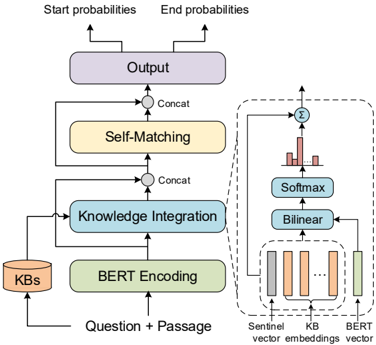
Machine reading comprehension (MRC) is a crucial and challenging task in NLP.Recently, pre-trained language models (LMs), especially BERT, have achieved remarkable success, presenting new state-of-the-art results in MRC.In this work, we investigate the potential of leveraging external knowledge bases (KBs) to further improve BERT for MRC.We introduce KT-NET, which employs an attention mechanism to adaptively select desired knowledge from KBs, and then fuses selected knowledge with BERT to enable context-and knowledgeaware predictions.We believe this would combine the merits of both deep LMs and curated KBs towards better MRC.Experimental results indicate that KT-NET offers significant and consistent improvements over BERT, outperforming competitive baselines on ReCoRD and SQuAD1.1 benchmarks.Notably, it ranks the 1st place on the ReCoRD leaderboard, and is also the best single model on the SQuAD1.1 leaderboard at the time of submission (March 4th, 2019). 1
Overview
The claims and statistics of this paper haven’t been checked yet.
Free: it reads the open-access text and checks the first 5 claims that cite a source we can check. Create a free account to check every claim.
Integrity signals
Registry
Cites
Statistics
Figures
Verification
Claims the paper makes
The claims and statistics of this paper haven’t been checked yet.
Free: it reads the open-access text and checks the first 5 claims that cite a source we can check. Create a free account to check every claim.
Claims other papers make about this one
Each is checked against this paper’s own text: does it say what the citing paper says it does?
In the citing paper
“Besides, Tenney et al. [122] analyzed the roles of BERT's layers in di erent tasks and found that BERT solves tasks in a similar order to that in NLP pipelines.”
From Pre-trained models for natural language processing: A survey (2020) · cites this paper as [122]
Self-check
Percentages, sums and reported differences re-computed from the paper’s own numbers.
The self-check needs the paper’s full text.
Citations
Cites
Vaswani, A., Shazeer, N., Parmar, N., Uszkoreit, J., Jones, L., Gomez, A. N., Kaiser, L., & Polosukhin, I. (2017) · arXiv · doi:10.48550/arxiv.1706.03762 · Cited by 120,404
Adam: A Method for Stochastic Optimization
Kingma, D. P., & Ba, J. (2014) · arXiv · doi:10.48550/arxiv.1412.6980 · Cited by 98,946
Exploiting Generative AI to Scale up Intelligent Tutoring Systems
Jakubův, J., Chvalovský, K., Goertzel, Z., Kaliszyk, C., Olšák, M., Piotrowski, B., Schulz, S., Suda, M., & Urban, J. (2023) · DROPS (Schloss Dagstuhl – Leibniz Center for Informatics) · doi:10.4230/lipics.itp.2023.19 · Cited by 76,658
BERT: Pre-training of Deep Bidirectional Transformers for Language Understanding
Devlin, J., Chang, M.-W., Lee, K., & Toutanova, K. (2018) · arXiv · doi:10.48550/arxiv.1810.04805 · Cited by 73,173
BERT: Pre-training of Deep Bidirectional Transformers for Language Understanding
Devlin, J., Chang, M.-W., Lee, K., & Toutanova, K. (2019) · Proceedings of the 2019 Conference of the North American Chapter of the Association for Computational Linguistics: Human Language Technologies, Volume 1 (Long and Short Papers) · doi:10.18653/v1/n19-1423 · Cited by 54,325
WordNet: a lexical database for English
Miller, G. A. (1995) · Communications of the ACM · doi:10.1145/219717.219748 · Cited by 14,015 · cited 3×
“We use two KBs: WordNet and NELL.”
MethodDeep Contextualized Word Representations
Peters, M., Neumann, M., Iyyer, M., Gardner, M., Clark, C., Lee, K., & Zettlemoyer, L. (2018) · Proceedings of the 2018 Conference of the North American Chapter of the Association for Computational Linguistics: Human Language Technologies, Volume 1 (Long Papers) · doi:10.18653/v1/n18-1202 · Cited by 11,983
The Stanford CoreNLP Natural Language Processing Toolkit
Manning, C., Surdeanu, M., Bauer, J., Finkel, J., Bethard, S., & McClosky, D. (2014) · Proceedings of 52nd Annual Meeting of the Association for Computational Linguistics: System Demonstrations · doi:10.3115/v1/p14-5010 · Cited by 7,037
SQuAD: 100,000+ Questions for Machine Comprehension of Text
Rajpurkar, P., Zhang, J., Lopyrev, K., & Liang, P. (2016) · Proceedings of the 2016 Conference on Empirical Methods in Natural Language Processing · doi:10.18653/v1/d16-1264 · Cited by 6,208 · cited 4×
“1 (Rajpurkar et al., 2016) is a well-known extractive MRC dataset that consists of questions created by crowdworkers for Wikipedia articles.”
BackgroundMethodInfluentialNLTK: the Natural Language Toolkit
Loper, E., & Bird, S. (2002) · Proceedings of the ACL-02 Workshop on Effective tools and methodologies for teaching natural language processing and computational linguistics - · doi:10.3115/1118108.1118117 · Cited by 3,218
Research works printed but not linked: 1
- Matthew Peters, Mark Neumann, Mohit Iyyer, Matt Gardner, Christopher Clark, Kenton Lee, and Luke Zettlemoyer. 2018a. Deep contextualized word rep- resentations. In Proceedings of the 2018 Conference of the North American Chapter of the Association for Computational Linguistics: Human Language Technologies, Volume 1 (Long Papers), pages 2227- 2237. Association for Computational Linguistics.
Cited by
Pre-trained models for natural language processing: A survey
Qiu, X., Sun, T., Xu, Y., Shao, Y., Dai, N., & Huang, X. (2020) · Science China Technological Sciences · doi:10.1007/s11431-020-1647-3 · Cited by 1,591
“ows injecting factual knowledge during fine-tuning on downstream tasks. Guan et al. [52] employed commonsense knowledge bases, ConceptNet and ATOMIC, to enhance GPT-2 for story generation. Yang et al. [207] proposed a knowledge-text fusion model to acquire related linguistic and factual knowledge for machine reading co…”
BackgroundKnowledge Enhanced Contextual Word Representations
Peters, M. E., Neumann, M., Logan, R., Schwartz, R., Joshi, V., Singh, S., & Smith, N. A. (2019) · Proceedings of the 2019 Conference on Empirical Methods in Natural Language Processing and the 9th International Joint Conference on Natural Language Processing (EMNLP-IJCNLP) · doi:10.18653/v1/d19-1005 · Cited by 661
“Task-specific KB architectures Other work has focused on integrating KBs into neural architectures for specific downstream tasks (Yang and Mitchell, 2017; Sun et al., 2018; Chen et al., 2018; Bauer et al., 2018; Mihaylov and Frank, 2018; Wang and Jiang, 2019; Yang et al., 2019).”
BackgroundQA-GNN: Reasoning with Language Models and Knowledge Graphs for Question Answering
Yasunaga, M., Ren, H., Bosselut, A., Liang, P., & Leskovec, J. (2021) · Proceedings of the 2021 Conference of the North American Chapter of the Association for Computational Linguistics: Human Language Technologies · doi:10.18653/v1/2021.naacl-main.45 · Cited by 522
Domain-specific knowledge graphs: A survey
Abu-Salih, B. (2021) · Journal of Network and Computer Applications · doi:10.1016/j.jnca.2021.103076 · Cited by 379
Large language models (LLMs): survey, technical frameworks, and future challenges
Kumar, P. (2024) · Artificial Intelligence Review · doi:10.1007/s10462-024-10888-y · Cited by 395
Metadata
- Authors
- Yang, A., Wang, Q., Liu, J., Liu, K., Lyu, Y., Wu, H., She, Q., & Li, S.
- Affiliations
- Baidu (China) (CN)
- Peking University (CN)
- Venue
- Proceedings of the 57th Annual Meeting of the Association for Computational Linguistics
- Published
- 2019
- Pages
- 2346-2357
- ISSN
- 0736-587X (ISSN-L)
- OpenAlex
- W2951561177
- Cited by
- 155
- References
- 45
- Citations by year
- 2026: 3 · 2025: 5 · 2024: 16 · 2023: 22 · 2022: 24 · 2021: 47 · 2020: 29 · 2019: 9
- FWCI
- 10.43
- Type
- conference paper
- Language
- en
- Open access
- hybrid
- doi.org
- Licence
- cc-by
- Locations
- Proceedings of the conference - Association for Computational Linguistics. Meeting (publishedVersion, cc-by)
- Funders
- Baidu
- National Natural Science Foundation of China (61876009, 61533018, 61876223)
- Peking University
- Topics
- Physical Sciences › Computer Science › Artificial Intelligence › Topic Modeling
- Physical Sciences › Computer Science › Computer Vision and Pattern Recognition › Multimodal Machine Learning Applications
- Physical Sciences › Computer Science › Artificial Intelligence › Natural Language Processing Techniques
- Keywords
- machine reading comprehension, pre-trained language models, BERT, knowledge base, external knowledge integration, knowledge fusion, records
About these checks
Registry, retraction, Cites and statistics results are computed, not judged, with one exception: a printed reference that no index lists is read once by a model before it counts as a citation error. Claims are extracted by a model and kept only when their quote appears verbatim in the text; each cited source is then checked, with a model’s help, for whether it says what the claim relies on. Those verdicts can be wrong — read the claim’s quote and the cited source before relying on one.
Statistics and arithmetic are recomputed, not judged.
Confidence bands are shown only for fields calibrated on our annotated test set. None is calibrated yet, so no band is shown.
What counts as a claim ›How we measure confidence ›How we check this ›
Are you an author, or do you see a problem with this page? Request a review
How to cite
Cite CoChat for the checks on this page, and the paper for its own findings.
- This page
- CoChat. (2026). Citation check: Enhancing Pre-Trained Language Representations with Rich Knowledge for Machine Reading Comprehension. https://app.cochat.ai/papers/10.18653/v1/p19-1226
- The paper
- Yang, A., Wang, Q., Liu, J., Liu, K., Lyu, Y., Wu, H., She, Q., & Li, S. (2019). Enhancing Pre-Trained Language Representations with Rich Knowledge for Machine Reading Comprehension. Proceedings of the 57th Annual Meeting of the Association for Computational Linguistics. https://doi.org/10.18653/v1/p19-1226
Data sources
Bibliographic data: Semantic Scholar, OpenAlex, Crossref.
Contains information from the Semantic Scholar Academic Graph Datasets, made available under the ODC Attribution License (ODC-BY 1.0).
Semantic Scholar’s data is described in: Kinney, R., et al. (2023). The Semantic Scholar Open Data Platform. arXiv:2301.10140.
