

Enhancing Pre-Trained Language Representations with Rich Knowledge for Machine Reading Comprehension
Open accessThe DOI matches its Crossref record; 47 of the 47 references it cites were found in a registry or an index.
Abstract
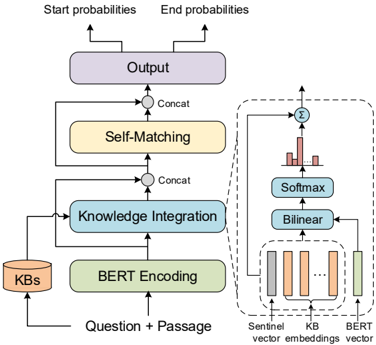
Machine reading comprehension (MRC) is a crucial and challenging task in NLP.Recently, pre-trained language models (LMs), especially BERT, have achieved remarkable success, presenting new state-of-the-art results in MRC.In this work, we investigate the potential of leveraging external knowledge bases (KBs) to further improve BERT for MRC.We introduce KT-NET, which employs an attention mechanism to adaptively select desired knowledge from KBs, and then fuses selected knowledge with BERT to enable context-and knowledgeaware predictions.We believe this would combine the merits of both deep LMs and curated KBs towards better MRC.Experimental results indicate that KT-NET offers significant and consistent improvements over BERT, outperforming competitive baselines on ReCoRD and SQuAD1.1 benchmarks.Notably, it ranks the 1st place on the ReCoRD leaderboard, and is also the best single model on the SQuAD1.1 leaderboard at the time of submission (March 4th, 2019). 1
Overview
The claims and statistics of this paper haven’t been checked yet.
Free: it reads the open-access text and checks the first 5 claims that cite a source we can check. Create a free account to check every claim.
Integrity signals
Registry
Cites
Statistics
Figures
Verification
Claims the paper makes
The claims and statistics of this paper haven’t been checked yet.
Free: it reads the open-access text and checks the first 5 claims that cite a source we can check. Create a free account to check every claim.
Claims other papers make about this one
Each is checked against this paper’s own text: does it say what the citing paper says it does?
In the citing paper
“Besides, Tenney et al. [122] analyzed the roles of BERT's layers in di erent tasks and found that BERT solves tasks in a similar order to that in NLP pipelines.”
From Pre-trained models for natural language processing: A survey (2020) · cites this paper as [122]
Self-check
Percentages, sums and reported differences re-computed from the paper’s own numbers.
The self-check needs the paper’s full text.
Citations
Cites
Vaswani, A., Shazeer, N., Parmar, N., Uszkoreit, J., Jones, L., Gomez, A. N., Kaiser, L., & Polosukhin, I. (2017) · arXiv · doi:10.48550/arxiv.1706.03762 · Cited by 120,404 · cited 2×
“We refer readers to (Devlin et al., 2018; Vaswani et al., 2017) for details.”
MethodAdam: A Method for Stochastic Optimization
Kingma, D. P., & Ba, J. (2014) · arXiv · doi:10.48550/arxiv.1412.6980 · Cited by 98,946 · cited 1×
“We use the Adam optimizer (Kingma and Ba, 2015) with a learning rate of 3e-5 and a batch size of 24.”
MethodExploiting Generative AI to Scale up Intelligent Tutoring Systems
Jakubův, J., Chvalovský, K., Goertzel, Z., Kaliszyk, C., Olšák, M., Piotrowski, B., Schulz, S., Suda, M., & Urban, J. (2023) · DROPS (Schloss Dagstuhl – Leibniz Center for Informatics) · doi:10.4230/lipics.itp.2023.19 · Cited by 76,658
BERT: Pre-training of Deep Bidirectional Transformers for Language Understanding
Devlin, J., Chang, M.-W., Lee, K., & Toutanova, K. (2018) · arXiv · doi:10.48550/arxiv.1810.04805 · Cited by 73,173 · cited 6×
“Finally, we follow Devlin et al. (2018) and use the FullTokenizer built in BERT to segment words into wordpieces.”
MethodInfluentialBERT: Pre-training of Deep Bidirectional Transformers for Language Understanding
Devlin, J., Chang, M.-W., Lee, K., & Toutanova, K. (2019) · Proceedings of the 2019 Conference of the North American Chapter of the Association for Computational Linguistics: Human Language Technologies, Volume 1 (Long and Short Papers) · doi:10.18653/v1/n19-1423 · Cited by 54,325 · cited 6×
“Finally, we follow Devlin et al. (2018) and use the FullTokenizer built in BERT to segment words into wordpieces.”
MethodInfluentialWordNet: a lexical database for English
Miller, G. A. (1995) · Communications of the ACM · doi:10.1145/219717.219748 · Cited by 14,015 · cited 3×
“We use two KBs: WordNet and NELL.”
MethodDeep Contextualized Word Representations
Peters, M., Neumann, M., Iyyer, M., Gardner, M., Clark, C., Lee, K., & Zettlemoyer, L. (2018) · Proceedings of the 2018 Conference of the North American Chapter of the Association for Computational Linguistics: Human Language Technologies, Volume 1 (Long Papers) · doi:10.18653/v1/n18-1202 · Cited by 11,983 · cited 3×
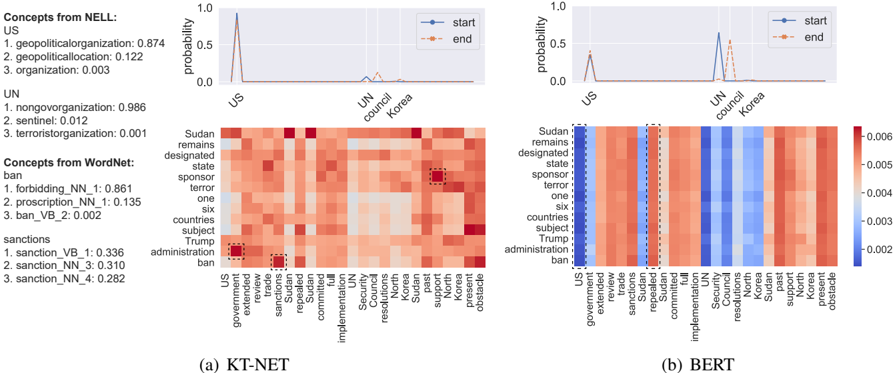
“…government has extended its review into whether trade sanctions against Sudan should be repealed. are pre-trained on unlabeled text and then applied to MRC, in either a feature-based (Peters et al., 2018a) or a fine-tuning (Radford et al., 2018) manner, both offering substantial performance boosts.”
BackgroundMethodThe Stanford CoreNLP Natural Language Processing Toolkit
Manning, C., Surdeanu, M., Bauer, J., Finkel, J., Bethard, S., & McClosky, D. (2014) · Proceedings of 52nd Annual Meeting of the Association for Computational Linguistics: System Demonstrations · doi:10.3115/v1/p14-5010 · Cited by 7,037 · cited 1×
“Entity mentions are given as answer candidates on ReCoRD, and recognized by Stanford CoreNLP (Manning et al., 2014) on SQuAD1.”
MethodSQuAD: 100,000+ Questions for Machine Comprehension of Text
Rajpurkar, P., Zhang, J., Lopyrev, K., & Liang, P. (2016) · Proceedings of the 2016 Conference on Empirical Methods in Natural Language Processing · doi:10.18653/v1/d16-1264 · Cited by 6,208 · cited 4×
“1 (Rajpurkar et al., 2016) is a well-known extractive MRC dataset that consists of questions created by crowdworkers for Wikipedia articles.”
BackgroundMethodInfluentialNLTK: the Natural Language Toolkit
Loper, E., & Bird, S. (2002) · Proceedings of the ACL-02 Workshop on Effective tools and methodologies for teaching natural language processing and computational linguistics - · doi:10.3115/1118108.1118117 · Cited by 3,218
Research works printed but not linked: 1
- Matthew Peters, Mark Neumann, Mohit Iyyer, Matt Gardner, Christopher Clark, Kenton Lee, and Luke Zettlemoyer. 2018a. Deep contextualized word rep- resentations. In Proceedings of the 2018 Conference of the North American Chapter of the Association for Computational Linguistics: Human Language Technologies, Volume 1 (Long Papers), pages 2227- 2237. Association for Computational Linguistics.
Cited by
Pre-trained models for natural language processing: A survey
Qiu, X., Sun, T., Xu, Y., Shao, Y., Dai, N., & Huang, X. (2020) · Science China Technological Sciences · doi:10.1007/s11431-020-1647-3 · Cited by 1,591
“ows injecting factual knowledge during fine-tuning on downstream tasks. Guan et al. [52] employed commonsense knowledge bases, ConceptNet and ATOMIC, to enhance GPT-2 for story generation. Yang et al. [207] proposed a knowledge-text fusion model to acquire related linguistic and factual knowledge for machine reading co…”
BackgroundKnowledge Enhanced Contextual Word Representations
Peters, M. E., Neumann, M., Logan, R., Schwartz, R., Joshi, V., Singh, S., & Smith, N. A. (2019) · Proceedings of the 2019 Conference on Empirical Methods in Natural Language Processing and the 9th International Joint Conference on Natural Language Processing (EMNLP-IJCNLP) · doi:10.18653/v1/d19-1005 · Cited by 661
“Task-specific KB architectures Other work has focused on integrating KBs into neural architectures for specific downstream tasks (Yang and Mitchell, 2017; Sun et al., 2018; Chen et al., 2018; Bauer et al., 2018; Mihaylov and Frank, 2018; Wang and Jiang, 2019; Yang et al., 2019).”
BackgroundQA-GNN: Reasoning with Language Models and Knowledge Graphs for Question Answering
Yasunaga, M., Ren, H., Bosselut, A., Liang, P., & Leskovec, J. (2021) · Proceedings of the 2021 Conference of the North American Chapter of the Association for Computational Linguistics: Human Language Technologies · doi:10.18653/v1/2021.naacl-main.45 · Cited by 522
Large language models (LLMs): survey, technical frameworks, and future challenges
Kumar, P. (2024) · Artificial Intelligence Review · doi:10.1007/s10462-024-10888-y · Cited by 395
Domain-specific knowledge graphs: A survey
Abu-Salih, B. (2021) · Journal of Network and Computer Applications · doi:10.1016/j.jnca.2021.103076 · Cited by 379
Knowledgeable Prompt-tuning: Incorporating Knowledge into Prompt Verbalizer for Text Classification
Hu, S., Ding, N., Wang, H., Liu, Z., Wang, J., Li, J., Wu, W., & Sun, M. (2022) · Proceedings of the 60th Annual Meeting of the Association for Computational Linguistics (Volume 1: Long Papers) · doi:10.18653/v1/2022.acl-long.158 · Cited by 265
A Knowledge-Enhanced Pretraining Model for Commonsense Story Generation
Guan, J., Huang, F., Zhao, Z., Zhu, X., & Huang, M. (2020) · Transactions of the Association for Computational Linguistics · doi:10.1162/tacl_a_00302 · Cited by 228
Scalable Multi-Hop Relational Reasoning for Knowledge-Aware Question Answering
Feng, Y., Chen, X., Lin, B. Y., Wang, P., Yan, J., & Ren, X. (2020) · Proceedings of the 2020 Conference on Empirical Methods in Natural Language Processing (EMNLP) · doi:10.18653/v1/2020.emnlp-main.99 · Cited by 207
StructBERT: Incorporating Language Structures into Pre-training for Deep Language Understanding
Wang, W., Bi, B., Yan, M., Wu, C., Bao, Z., Xia, J., Peng, L., & Si, L. (2019) · arXiv (Cornell University) · doi:10.48550/arxiv.1908.04577 · Cited by 91
“Table 2: Accuracy (%) on the SNLI dataset. 5 System Dev set Test set EM F1 EM F1 Human - - 82.3 91.2 XLNet(single+DA) [32] 88.9 94.5 89.9 85.0 BERT(ensemble+DA) [6] 86.2 92.2 87.4 93.2 KT-NET(single) [31] 85.1 81.7 85.9 92.4 BERT(single+DA) [6] 84.2 91.1 85.1 91.8 QANet(ensemble+DA) [33] - - 84.5 90.5 StructBERTLarge…”
InfluentialBiomedical knowledge graph-optimized prompt generation for large language models
Soman, K., Rose, P. W., Morris, J. H., Akbas, R. E., Smith, B., Peetoom, B., Villouta-Reyes, C., Cerono, G., Shi, Y., Rizk-Jackson, A., et al. (2024) · Bioinformatics · doi:10.1093/bioinformatics/btae560 · Cited by 135
“To address such knowledge-intensive tasks, an alternative approach that integrates knowledge graphs (KG) with language models was recently introduced (Lin et al. 2019, Yang et al. 2019, Wang et al. 2019, Feng et al. 2020, Lv et al. 2020, Yasunaga et al. 2021, Yasunaga et al. 2022).”
MethodA Survey on Machine Reading Comprehension Systems
Baradaran, R., Ghiasi, R., & Amirkhani, H. (2022) · Natural Language Engineering · doi:10.1017/s1351324921000395 · Cited by 143
Fake news detection via knowledgeable prompt learning
Jiang, G., Liu, S., Zhao, Y., Sun, Y., & Zhang, M. (2022) · Information Processing & Management · doi:10.1016/j.ipm.2022.103029 · Cited by 95
Dynamic Anticipation and Completion for Multi-Hop Reasoning over Sparse Knowledge Graph
Lv, X., Han, X., Hou, L., Li, J., Liu, Z., Zhang, W., Zhang, Y., Kong, H., & Wu, S. (2020) · Conference on Empirical Methods in Natural Language Processing (EMNLP) · doi:10.18653/v1/2020.emnlp-main.459 · Cited by 104
CoKE: Contextualized Knowledge Graph Embedding
Wang, Q., Huang, P., Wang, H., Dai, S., Jiang, W., Liu, J., Lyu, Y., Zhu, Y., & Wu, H. (2019) · arXiv · doi:10.48550/arxiv.1911.02168
“, 2013) and question answering (Bordes et al., 2014; Yang et al., 2019).”
BackgroundSelf-citationGenerating risk response measures for subway construction by fusion of knowledge and deep learning
Zhou, H. M., Tang, S., Huang, W. T., & Zhao, X. (2023) · Automation in Construction · doi:10.1016/j.autcon.2023.104951 · Cited by 67
Self-Supervised Knowledge Triplet Learning for Zero-Shot Question Answering
Banerjee, P., & Baral, C. R. (2020) · Conference on Empirical Methods in Natural Language Processing (EMNLP) · doi:10.18653/v1/2020.emnlp-main.11 · Cited by 75
QA-GNN: Reasoning with Language Models and Knowledge Graphs for Question AnsweringPreprint
Yasunaga, M., Ren, H., Bosselut, A., Liang, P., & Leskovec, J. (2021) · North American Chapter of the Association for Computational Linguistics · doi:10.48550/arxiv.2104.06378 · Cited by 943
“To provide more explicit and interpretable knowledge, several works integrate structured knowledge (KGs) into LMs (Mihaylov and Frank, 2018; Lin et al., 2019; Wang et al., 2019a; Yang et al., 2019; Wang et al., 2020b; Bosselut et al., 2021).”
BackgroundBenchmarking Knowledge-Enhanced Commonsense Question Answering via Knowledge-to-Text Transformation
Bian, N., Han, X., Chen, B., & Sun, L. (2021) · Proceedings of the AAAI Conference on Artificial Intelligence · doi:10.1609/aaai.v35i14.17490 · Cited by 48
Meng, X., Bai, L., Hu, J., & Zhu, L. (2023) · Information Processing & Management · doi:10.1016/j.ipm.2023.103605 · Cited by 47
Automatic Story Generation: Challenges and Attempts
Alabdulkarim, A., Li, S., & Peng, X. (2021) · doi:10.18653/v1/2021.nuse-1.8 · Cited by 81
Self-citationGenericsKB: A Knowledge Base of Generic StatementsPreprint
Bhakthavatsalam, S., Anastasiades, C., & Clark, P. E. (2020) · arXiv (Cornell University) · doi:10.48550/arxiv.2005.00660 · Cited by 74
“, (Icarte et al., 2017; Wang et al., 2018; Yang et al., 2019; Peters et al., 2019; Liu et al., 2019; Paul and Frank, 2019).”
BackgroundTowards Medical Machine Reading Comprehension with Structural Knowledge and Plain Text
Li, D., Hu, B., Chen, Q., Peng, W., & Wang, A. (2020) · Conference on Empirical Methods in Natural Language Processing (EMNLP) · doi:10.18653/v1/2020.emnlp-main.111 · Cited by 45
“Once the knowledge is determined, we can choose the appropriate integration mechanism for further knowledge injection, such as attention mechanism (Sun et al., 2018; Yang et al., 2019; Ma et al., 2019), pre-training tasks (He et al.”
BackgroundMethodKALA: Knowledge-Augmented Language Model Adaptation
Kang, M., Baek, J., & Hwang, S. J. (2022) · Proceedings of the 2022 Conference of the North American Chapter of the Association for Computational Linguistics: Human Language Technologies · doi:10.18653/v1/2022.naacl-main.379 · Cited by 36
Xie, Y., Yang, K., Sun, C., Liu, B., & Ji, Z. (2021) · Findings of the Association for Computational Linguistics: EMNLP (Findings of EMNLP) · doi:10.18653/v1/2021.findings-emnlp.245 · Cited by 43
“We first use a XLNet-based encoder that computes context- and dependency-aware represen- tations for utterances (Sec.”
BackgroundMethodInfluentialDeep learning-based question answering: a survey
Abdel-Nabi, H., Awajan, A., & Ali, M. Z. (2022) · Knowledge and Information Systems · doi:10.1007/s10115-022-01783-5 · Cited by 54
BIC: Twitter Bot Detection with Text-Graph Interaction and Semantic Consistency
Lei, Z., Wan, H., Zhang, W., Feng, S., Chen, Z., Li, J., Zheng, Q., & Luo, M. (2023) · Proceedings of the conference - Association for Computational Linguistics. Meeting · doi:10.18653/v1/2023.acl-long.575 · Cited by 68
Lu, H., Hu, H., & Lin, X. S. (2022) · Neurocomputing · doi:10.1016/j.neucom.2021.12.079 · Cited by 55
“Knowledge graphs (KGs) are a vital component of a wide range of downstream applications, such as machine reasoning, information retrieval and knowledge-guided natural language processing (Ji et al., 2020; Zhang et al., 2019b; Yang et al., 2019; Lin et al., 2019).”
BackgroundLarge Knowledge Model: Perspectives and Challenges
Chen, H. (2024) · Data Intelligence · doi:10.3724/2096-7004.di.2024.0001 · Cited by 111
“…linking technologies, structure correlations among concepts and entities in the KG can be used to expand and enhance CoT in natural language forms, making the textual CoT more in line with human thinking patterns based on associations,thereby enhancing their effectiveness in guiding AI reasoning.”
Evaluating the Calibration of Knowledge Graph Embeddings for Trustworthy Link Prediction
Safavi, T., Koutra, D., & Meij, E. (2020) · Conference on Empirical Methods in Natural Language Processing (EMNLP) · doi:10.18653/v1/2020.emnlp-main.667 · Cited by 55
“, 2019) uses TransE embeddings, and the machine reading system in (Yang et al., 2019) uses DistMult embeddings.”
BackgroundMethodInfluentialHow Additional Knowledge can Improve Natural Language Commonsense Question Answering?Preprint
Mitra, A., Banerjee, P., Pal, K. K., Mishra, S. R., & Baral, C. R. (2019) · arXiv (Cornell University) · doi:10.48550/arxiv.1909.08855 · Cited by 63
“External Knowledge: Models that integrate external knowledge have been introduced in (Mihaylov and Frank, 2018; Chen et al., 2018; Yang et al., 2019; Wang and Jiang, 2019).”
BackgroundLiu, B., Lin, T., & Li, M. (2023) · Knowledge-Based Systems · doi:10.1016/j.knosys.2023.110339 · Cited by 30
Conditional Text Generation for Harmonious Human-Machine Interaction
Guo, B., Wang, H., Ding, Y., Wu, W., Hao, S., Sun, Y., & Yu, Z. (2021) · ACM Transactions on Intelligent Systems and Technology · doi:10.1145/3439816 · Cited by 42
“Yang et al. [143] fuse external knowledge into topic-to-essay-generation systems to provide background information for essay generation.”
BackgroundA Survey of Knowledge Enhanced Pre-trained ModelsPreprint
Yang, J., Xiao, G., Shen, Y.-L., Jiang, W., Hu, X., Zhang, Y., & Peng, J. (2021) · arXiv.org · doi:10.48550/arxiv.2110.00269 · Cited by 64
Proceedings of the Third Workshop on Narrative Understanding
(2021) · doi:10.18653/v1/2021.nuse-1 · Cited by 69
Li, R., Jiang, Z., Wang, L., Lu, X., Zhao, M., & Chen, D. (2021) · Knowledge-Based Systems · doi:10.1016/j.knosys.2021.106936 · Cited by 28
Scalable Multi-Hop Relational Reasoning for Knowledge-Aware Question AnsweringPreprint
Feng, Y., Chen, X., Lin, B. Y., Wang, P., Yan, J., & Ren, X. (2020) · arXiv (Cornell University) · doi:10.48550/arxiv.2005.00646 · Cited by 25
“C L ] 1 M ay 2 02 0 this kind of questions (Mihaylov and Frank, 2018; Lin et al., 2019; Wang et al., 2019; Yang et al., 2019).”
BackgroundKnowledge Enhanced Pretrained Language Models: A Compreshensive SurveyPreprint
Wei, X., Wang, S., Zhang, D., Bhatia, P., & Arnold, A. O. (2021) · arXiv (Cornell University) · doi:10.48550/arxiv.2110.08455 · Cited by 72
“Such knowledge integration mechanism have successfully enhance existing PLMs’ knowledge awareness, and lead to improved performance on a variety of tasks, including but not limited to entity typing [100], question answering [101][45], story generation [22] and knowledge graph completion [102].”
BackgroundKnowledge Guided Metric Learning for Few-Shot Text Classification
Sui, D., Chen, Y., Mao, B., Qiu, D., Liu, K., & Zhao, J. (2021) · Conference of the North American Chapter of the Association for Computational Linguistics: Human Language Technologies (NAACL-HLT) · doi:10.18653/v1/2021.naacl-main.261 · Cited by 30
Self-citationCKGG: A Chinese Knowledge Graph for High-School Geography Education and Beyond
Shen, Y., Chen, Z., Cheng, G., & Qu, Y. (2021) · Lecture notes in computer science · doi:10.1007/978-3-030-88361-4_25 · Cited by 32
Learning to Tag OOV Tokens by Integrating Contextual Representation and Background Knowledge
He, K., Yan, Y., & Xu, W. (2020) · Proceedings of the conference - Association for Computational Linguistics. Meeting · doi:10.18653/v1/2020.acl-main.58 · Cited by 28
“Different from (Yang and Mitchell, 2017; Yang et al., 2019), for a word xi, we first return its synsets as the first-level candidate set C(xi) of KB concepts.”
BackgroundKnowledge Fusion and Semantic Knowledge Ranking for Open Domain Question AnsweringPreprint
Banerjee, P., & Baral, C. R. (2020) · arXiv (Cornell University) · doi:10.48550/arxiv.2004.03101 · Cited by 24
“Other models such as in the work of (Mi-haylov and Frank, 2018; Chen et al., 2018; Yang et al., 2019; Wang and Jiang, 2019) embed syntactic or semantic knowledge into knowledge enriched embeddings.”
BackgroundContextualized Representations Using Textual Encyclopedic KnowledgePreprint
Joshi, M., Lee, K., Luan, Y., & Toutanova, K. (2020) · arXiv · doi:10.48550/arxiv.2004.12006 · Cited by 35
“Recent work focuses on refining pretrained contextualized representations using entity or triple embeddings from structured knowledge graphs (KGs) (Peters et al., 2019; Yang et al., 2019; Zhang et al., 2019).”
BackgroundMethodInfluentialTowards Knowledge Enhanced Language Model for Machine Reading Comprehension
Gong, P., Liu, J., Yang, Y., & He, H. (2020) · IEEE Access · doi:10.1109/access.2020.3044308 · Cited by 24
“Yang et al. [35] proposed KT-NET, which employs an attention mechanism to adaptively select desired knowledge from KBs, and then fuses selected knowledge with BERT to enable context-and knowledge-aware predictions.”
Self-citationAre we there yet? Exploring clinical domain knowledge of BERT models
Sushil, M., Šuster, S., & Daelemans, W. M. P. (2021) · Workshop on Biomedical Language Processing (BioNLP) · doi:10.18653/v1/2021.bionlp-1.5 · Cited by 28
“…of NLP tasks (Devlin et al., 2019), several efforts have been extended towards improving them by more efficient training strategies (Liu et al., 2019; Yang et al., 2019b; Sanh et al., 2019; Lan et al., 2019), training them for different domains (Beltagy et al., 2019; Lee et al., 2019a; Lee and…”
BackgroundAttention-based exploitation and exploration strategy for multi-hop knowledge graph reasoning
Shang, B., Zhao, Y., Liu, Y., & Wang, C. (2023) · Information Sciences · doi:10.1016/j.ins.2023.119787 · Cited by 19
Wu, Z., & Xu, H. (2020) · Knowledge-Based Systems · doi:10.1016/j.knosys.2020.106075 · Cited by 21
Lu, Y., Lu, H., Fu, G., & Liu, Q. (2021) · arXiv (Cornell University) · doi:10.48550/arxiv.2109.04223 · Cited by 41
“Several works (Qiu et al., 2019; Yang et al., 2019) concentrate on injecting external knowledge based on fine-tuning PLM on downstream tasks, which is much easier to change the injected KGs and adapt to relevant domain tasks.”
BackgroundMethodInfluentialKhalifa, M., Abdul-Mageed, M., & Shaalan, K. F. (2021) · Conference of the European Chapter of the Association for Computational Linguistics · doi:10.18653/v1/2021.eacl-main.65 · Cited by 28
A Knowledge-Enhanced Pretraining Model for Commonsense Story GenerationPreprint
Guan, J., Huang, F., Zhao, Z., Zhu, X., & Huang, M. (2020) · arXiv (Cornell University) · doi:10.48550/arxiv.2001.05139 · Cited by 18
FiTs: Fine-Grained Two-Stage Training for Knowledge-Aware Question Answering
Ye, Q., Cao, B., Chen, N., Xu, W., & Zou, Y. (2023) · Proceedings of the AAAI Conference on Artificial Intelligence · doi:10.1609/aaai.v37i11.26629 · Cited by 27
SDT: An integrated model for open-world knowledge graph reasoning
Chen, X., Jia, S., Ding, L., Shen, H., & Xiang, Y. (2020) · Expert Systems with Applications · doi:10.1016/j.eswa.2020.113889 · Cited by 20
Knowledge-Enhanced Natural Language Inference Based on Knowledge Graphs
Wang, Z., Li, L., & Zeng, D. D. (2020) · International Conference on Computational Linguistics · doi:10.18653/v1/2020.coling-main.571 · Cited by 24
Incorporating prior knowledge from counterfactuals into knowledge graph reasoning
Wang, Z., Li, L., Zeng, D. D., & Wu, X. (2021) · Knowledge-Based Systems · doi:10.1016/j.knosys.2021.107035 · Cited by 18
Sense-aware BERT and Multi-task Fine-tuning for Multimodal Sentiment Analysis
Fang, L., Liu, G., & Zhang, R. (2022) · International Joint Conference on Neural Networks (IJCNN) · doi:10.1109/ijcnn55064.2022.9892116 · Cited by 20
“A new trend in recent years is fine-tuning the pre-trained BERT model with external resources, such as knowledge graphs [23], [24], semantic role label [25] and characters [26].”
BackgroundKnowledge Enhanced Contextual Word RepresentationsPreprint
Peters, M. E., Neumann, M., Logan, R. L., Schwartz, R., Joshi, V., Singh, S., & Smith, N. A. (2019) · arXiv · doi:10.48550/arxiv.1909.04164 · Cited by 151
“Task-specific KB architectures Other work has focused on integrating KBs into neural architectures for specific downstream tasks (Yang and Mitchell, 2017; Sun et al., 2018; Chen et al., 2018; Bauer et al., 2018; Mihaylov and Frank, 2018; Wang and Jiang, 2019; Yang et al., 2019).”
BackgroundSRGCN: Graph-based multi-hop reasoning on knowledge graphs
Wang, Z., Li, L., & Zeng, D. D. (2021) · Neurocomputing · doi:10.1016/j.neucom.2021.05.016 · Cited by 18
Huang, Y., Liu, J., & Lv, C. (2023) · Applied Sciences · doi:10.3390/app13052924 · Cited by 18
Self-citationYu, J., Zhang, X., Xu, Y., Lei, X., Guan, X., Zhang, J., Hou, L., Li, J., & Tang, J. (2022) · ACM SIGKDD Conference on Knowledge Discovery and Data Mining (KDD) · doi:10.1145/3534678.3539135 · Cited by 29
“Foundation model is the subject of a paradigm shift, claimed by a group of experienced scientists recently [2], suggesting that various AI-driven systems in the future tend to directly build upon or heavily integrate large-scale pre-trained language models (PLMs) such as GPT [3], BERT [6], and T5 [22], because such bi…”
BackgroundGraph-based Multilingual Product Retrieval in E-Commerce Search
Lu, H., Hu, Y., Zhao, T., Wu, T., Song, Y., & Yin, B. (2021) · Conference of the North American Chapter of the Association for Computational Linguistics: Human Language Technologies (NAACL-HLT) · doi:10.18653/v1/2021.naacl-industry.19 · Cited by 23
Bridging Subword Gaps in Pretrain-Finetune Paradigm for Natural Language Generation
Liu, X., Yang, B., Liu, D., Zhang, H., Luo, W., Zhang, M., Zhang, H., & Su, J. (2021) · doi:10.18653/v1/2021.acl-long.468 · Cited by 23
“Due to its simplicity yet impressive performance, pretrain-finetune paradigm becomes the undoubtedly dominant solution for building state-of-the-art models in many natural language understanding tasks (Xu et al., 2019; Yang et al., 2019a; Liu et al., 2020b).”
BackgroundMICO: A Multi-alternative Contrastive Learning Framework for Commonsense Knowledge Representation
Su, Y., Wang, Z., Fang, T., Zhang, H., Song, Y., & Zhang, T. (2022) · Findings of the Association for Computational Linguistics: EMNLP (Findings of EMNLP) · doi:10.18653/v1/2022.findings-emnlp.96 · Cited by 27
Enhancing pretrained language models with structured commonsense knowledge for textual inference
Du, L., Ding, X., Xiong, K., Liu, T., & Qin, B. (2022) · Knowledge-Based Systems · doi:10.1016/j.knosys.2022.109488 · Cited by 17
SKR-QA: Semantic ranking and knowledge revise for multi-choice question answering
Ren, M., Huang, H., & Gao, Y. (2021) · Neurocomputing · doi:10.1016/j.neucom.2021.06.076 · Cited by 12
Measuring associational thinking through word embeddings
Periñán-Pascual, C. (2021) · Artificial Intelligence Review · doi:10.1007/s10462-021-10056-6 · Cited by 17
“Yang et al. (2019a) devised a memory-aug-mented neural model with adversarial training to incorporate knowledge from ConceptNet into an automatic topic-to-essay generation system.”
MethodSentence Extraction-Based Machine Reading Comprehension for Vietnamese
Nguyen-Thuan, P., Nguyen, N. D., Huynh, T. V., Nguyen, K. V., Nguyen, A. G.-T., & Nguyen, N. L.-T. (2021) · Lecture notes in computer science · doi:10.1007/978-3-030-82147-0_42 · Cited by 23
Improving Machine Reading Comprehension with Contextualized Commonsense Knowledge
Sun, K., Yu, D., Chen, J., Yu, D., & Cardie, C. (2022) · Proceedings of the conference - Association for Computational Linguistics. Meeting · doi:10.18653/v1/2022.acl-long.598 · Cited by 12
GROVE: A Retrieval-augmented Complex Story Generation Framework with A Forest of Evidence
Wen, Z., Tian, Z., Wu, W., Yang, Y., Shi, Y., Huang, Z., & Li, D. (2023) · Findings of the Association for Computational Linguistics: EMNLP (Findings of EMNLP) · doi:10.18653/v1/2023.findings-emnlp.262 · Cited by 41
Improving Machine Reading Comprehension via Adversarial TrainingPreprint
Yang, Z., Cui, Y., Che, W., Liu, T., Wang, S., & Hu, G. (2019) · arXiv (Cornell University) · doi:10.48550/arxiv.1911.03614 · Cited by 15
“(Yang et al., 2019b) 89.0 94.5 89.9 95.1 RoBERTa (Liu et al., 2019) 89”
InfluentialOverview of indoor scene recognition and representation methods based on multimodal knowledge graphs
Li, J., Si, G., Tian, P., An, Z., & Zhou, F. (2023) · Applied Intelligence · doi:10.1007/s10489-023-05235-7 · Cited by 13
“For example, Kt-net [20] incorporates knowledge graphs into the fine-tuning phase by integrating BERT Vector (BERT Vector [21]) and Knowledge Base Embedding (KB Embedding[22])usinganattentionmechanism.”
Dynamic Knowledge Integration for Natural Language Inference
Guo, M., Chen, Y., Xu, J., & Zhang, Y. (2022) · 2022 4th International Conference on Natural Language Processing (ICNLP) · doi:10.1109/icnlp55136.2022.00066 · Cited by 11
DensE: An Enhanced Non-Abelian Group Representation for Knowledge Graph Embedding.Preprint
Lu, H., & Hu, H. (2020) · arXiv (Cornell University) · Cited by 9
REPT: Bridging Language Models and Machine Reading Comprehension via Retrieval-Based Pre-training
Jiao, F., Guo, Y., Niu, Y., Ji, F., Li, F.-L., & Nie, L. (2021) · Findings of the Association for Computational Linguistics: ACL (Findings of ACL) · doi:10.18653/v1/2021.findings-acl.13 · Cited by 10
Gao, P., Gao, F., Ni, J., Wang, Y., Wang, F., & Zhang, Q. (2024) · CAAI Transactions on Intelligence Technology · doi:10.1049/cit2.12332 · Cited by 14
“Leveraging external knowledge bases (KBs) is one way to enable context-and knowledge-aware for MRC and question answering (QA) [16, 17, 18], which could contribute to DDI predictions.”
BackgroundCommonsense Inference in Natural Language Processing (COIN) - Shared Task Report
Ostermann, S., Zhang, S., Roth, M., & Clark, P. E. (2019) · doi:10.18653/v1/d19-6007 · Cited by 12
“• PSH–SJTU (Li et al., 2019) participated in both tasks with a Transformer model based on XLNet (Yang et al., 2019b).”
BackgroundMethodInfluentialKnowledge-Enabled Diagnosis Assistant Based on Obstetric EMRs and Knowledge Graph
Zhang, K., Zhao, X., Zhuang, L., Xie, Q., & Zan, H. (2020) · Lecture notes in computer science · doi:10.1007/978-3-030-63031-7_32 · Cited by 8
Unifying Structure Reasoning and Language Pre-Training for Complex Reasoning Tasks
Wang, S., Wei, Z., Xu, J., Li, T., & Fan, Z. (2023) · IEEE/ACM Transactions on Audio Speech and Language Processing · doi:10.1109/taslp.2023.3325973 · Cited by 24
“Another line of related work is on incorporating structured knowledge from external sources into PLMs to provide extra clues for reasoning [35], [39], [40], [41].”
BackgroundHe, K., Yan, Y., & Xu, W. (2021) · Neurocomputing · doi:10.1016/j.neucom.2021.01.134 · Cited by 12
Automating Mobile App Review User Feedback with Aspect-Based Sentiment Analysis
Ballas, V., Michalakis, K., Alexandridis, G., & Caridakis, G. (2024) · Lecture notes in computer science · doi:10.1007/978-3-031-60487-4_14 · Cited by 9
Improved GPT2 Event Extraction Method Based on Mixed Attention Collaborative Layer Vector
Jia, R., Zhang, Z., Jia, Y., Παπαδοπούλου, Μ., & Roche, C. (2024) · IEEE Access · doi:10.1109/access.2024.3487836 · Cited by 7
“So, we designed a multi-layer perceptron (MLP) for token-level classification, which is similar to the techniques used in machine reading comprehension tasks [21].”
MethodDiversified Query Generation Guided by Knowledge Graph
Shen, X., Chen, J., Chen, J., Zeng, C. Y., & Xiao, Y. (2022) · ACM International Conference on Web Search and Data Mining (WSDM) · doi:10.1145/3488560.3498431 · Cited by 11
“[36] investigate the potential of leveraging external knowledge bases (KBs) to further improve BERT for machine reading comprehension (MRC).”
BackgroundZero-resource Multi-dialectal Arabic Natural Language Understanding
Khalifa, M., Hassan, H., & Fahmy, A. (2021) · International Journal of Advanced Computer Science and Applications · doi:10.14569/ijacsa.2021.0120369 · Cited by 9
Automatic Story Generation: Challenges and Attempts
Alabdulkarim, A., Li, S., & Peng, X. (2021) · arXiv (Cornell University) · doi:10.48550/arxiv.2102.12634 · Cited by 7
“Yang et al. (2019) integrates external commonsense knowledge to BERT (Devlin et al., 2019) to enhance language representation for reading comprehension.”
BackgroundSelf-citationArQuAD: An Expert-Annotated Arabic Machine Reading Comprehension Dataset
Obeidat, R., Al-Harbi, M., Al‐Ayyoub, M., & Alawneh, L. M. (2024) · Cognitive Computation · doi:10.1007/s12559-024-10248-6 · Cited by 13
An empirical study on the potential of word embedding techniques in bug report management tasks
Chen, B., Zou, W., Cai, B., Meng, Q., Liu, W., Li, P., & Chen, L. (2024) · Empirical Software Engineering · doi:10.1007/s10664-024-10510-3 · Cited by 6
“The advantages of pre-trained models have made them find numerous important applications in the real world (Yang et al. 2019; Zhou et al. 2020).”
Incremental BERT with commonsense representations for multi-choice reading comprehension
Li, R., Wang, L., Jiang, Z., Liu, D., Zhao, M., & Lu, X. (2021) · Multimedia Tools and Applications · doi:10.1007/s11042-021-11197-0 · Cited by 7
“Xiong et al. [40] retrieve the corresponding entities and relation from text to aggregate answer evidence from an incomplete KB. Yang et al. [41] take BERT as encoder and employ an attention mechanism similar to Yang et al. [42] to fuse globally pre-trained knowledge downstream.”
BackgroundMethodA Re-Ranking Framework for Knowledge Graph Completion
Wang, Z., Li, L., & Zeng, D. D. (2020) · International Joint Conference on Neural Networks (IJCNN) · doi:10.1109/ijcnn48605.2020.9207439 · Cited by 4
“It provides knowledge foundation for a variety of artificial intelligence applications, such as language modeling[1], question answering[2] and machine reading comprehension[3].”
BackgroundAsk to Understand: Question Generation for Multi-hop Question Answering
Li, J., Ren, M., Gao, Y., & Yang, Y. (2023) · Lecture notes in computer science · doi:10.1007/978-981-99-6207-5_2 · Cited by 7
Knowledge Graph based Mutual Attention for Machine Reading Comprehension over Anti-Terrorism Corpus
Gao, F., Hou, J., Gu, J., & Zhang, L. (2023) · Data Intelligence · doi:10.1162/dint_a_00210 · Cited by 5
“Compared to pure corpus-based language models, knowledge-enhanced pre-training models leverage Knowledge Graphs (KGs) to provide inferencing capability for MRC [10, 11], as shown in Figure 2.”
BackgroundFoolad, S., & Kiani, K. (2023) · Neurocomputing · doi:10.1016/j.neucom.2023.126786 · Cited by 9
“Some studies such as SKG-BERT [11], KT-NET [12], and KELM [9] utilize an external KG such as WordNet, ConceptNet and NELL and BERT-large as a base model.”
MethodInfluentialVerb-driven machine reading comprehension with dual-graph neural network
Zhang, H., & Jiang, C. (2023) · Pattern Recognition Letters · doi:10.1016/j.patrec.2023.11.008 · Cited by 5
The Graph Reasoning Approach Based on the Dynamic Knowledge Auxiliary for Complex Fact Verification
Wang, Y., Xia, C., Si, C., Zhang, C., & Wang, T. (2020) · Electronics · doi:10.3390/electronics9091472 · Cited by 4
BiEAF: An Bidirectional Enhanced Attention Flow Model for Question Answering Task
Yihan, Y. (2021) · International Conference on Information Science and Education (ICISE-IE) · doi:10.1109/icise-ie53922.2021.00086 · Cited by 5
Meng, X., Song, Y., Bai, Q., & Wang, T. (2023) · Knowledge-Based Systems · doi:10.1016/j.knosys.2023.110796 · Cited by 6
LDNN: Linguistic Knowledge Injectable Deep Neural Network for Group Cohesiveness Understanding
Wang, Y., Wu, J., Huang, J., Hattori, G., Takishima, Y., Wada, S., Kimura, R., Chen, J., & Kurihara, S. (2020) · INTERNATIONAL CONFERENCE ON MULTIMODAL INTERACTION · doi:10.1145/3382507.3418830 · Cited by 4
“…trans-formers (BERT) is a state-of-the-art language model for NLP, by which a pre-trained model can be fine-tuned to produce state-of-the-art results in a wide range of NLP tasks [4], such as question answering (SQuAD) [21], machine reading comprehension [30], and visual commonsense reasoning [25].”
BackgroundMasked Latent Semantic Modeling: an Efficient Pre-training Alternative to Masked Language Modeling
Berend, G. (2023) · Findings of the Association for Computational Linguistics: ACL (Findings of ACL) · doi:10.18653/v1/2023.findings-acl.876 · Cited by 16
Oh, J., Iida, R., Kloetzer, J., & Torisawa, K. (2021) · doi:10.18653/v1/2021.acl-long.164 · Cited by 7
“…sense that entity representations are integrated into TLMs via CNNs and not directly produced by the TLMs. Fine-tuning TLMs with external resources or other NNs: Yang et al. (2019a) and Liu et al. (2020) have used knowledge graphs for augmenting TLMs with entity representations during finetuning.”
AKER: Arabic Knowledge-enriched Reader for Machine Reading Comprehension
Albilali, E., Al-Twairesh, N., & Hosny, M. (2025) · ACM Transactions on Asian and Low-Resource Language Information Processing · doi:10.1145/3736164 · Cited by 3
“Instead of retrieving all related concepts from the KG or selecting concepts at random similar to previous studies [84], we employ a KGE scoring function to score and retrieve the most relevant concepts to the question and passage tokens.”
InfluentialWang, H., Du, S., Zheng, X., & Meng, L. (2022) · Natural Language Engineering · doi:10.1017/s135132492200033x · Cited by 5
“2021) into the GCN variations and using external knowledge bases (Mihaylov and Frank 2018; Lin et al. 2019a; Yang et al. 2019) to mine latent relations appear to be of interest.”
BackgroundNeighborhood aggregation based graph attention networks for open-world knowledge graph reasoning
Chen, X., Ding, L., & Xiang, Y. (2021) · Journal of Intelligent & Fuzzy Systems · doi:10.3233/jifs-211889 · Cited by 5
“They have been applied in various applications including relation extraction [29], recommender systems [5], and intelligent question answering systems [48].”
Intelligent Question Answering System Based on Knowledge Graph of Beijing Opera
Hou, W., & Cao, Y. (2021) · doi:10.1109/icnlp52887.2021.00020 · Cited by 3
Metadata
- Authors
- Yang, A., Wang, Q., Liu, J., Liu, K., Lyu, Y., Wu, H., She, Q., & Li, S.
- Affiliations
- Baidu (China) (CN)
- Peking University (CN)
- Venue
- Proceedings of the 57th Annual Meeting of the Association for Computational Linguistics
- Published
- 2019
- Pages
- 2346-2357
- ISSN
- 0736-587X (ISSN-L)
- OpenAlex
- W2951561177
- Cited by
- 155
- References
- 45
- Citations by year
- 2026: 3 · 2025: 5 · 2024: 16 · 2023: 22 · 2022: 24 · 2021: 47 · 2020: 29 · 2019: 9
- FWCI
- 10.43
- Type
- conference paper
- Language
- en
- Open access
- hybrid
- doi.org
- Licence
- cc-by
- Locations
- Proceedings of the conference - Association for Computational Linguistics. Meeting (publishedVersion, cc-by)
- Funders
- Baidu
- National Natural Science Foundation of China (61876009, 61533018, 61876223)
- Peking University
- Topics
- Physical Sciences › Computer Science › Artificial Intelligence › Topic Modeling
- Physical Sciences › Computer Science › Computer Vision and Pattern Recognition › Multimodal Machine Learning Applications
- Physical Sciences › Computer Science › Artificial Intelligence › Natural Language Processing Techniques
- Keywords
- machine reading comprehension, pre-trained language models, BERT, knowledge base, external knowledge integration, knowledge fusion, records
About these checks
Registry, retraction, Cites and statistics results are computed, not judged, with one exception: a printed reference that no index lists is read once by a model before it counts as a citation error. Claims are extracted by a model and kept only when their quote appears verbatim in the text; each cited source is then checked, with a model’s help, for whether it says what the claim relies on. Those verdicts can be wrong — read the claim’s quote and the cited source before relying on one.
Statistics and arithmetic are recomputed, not judged.
Confidence bands are shown only for fields calibrated on our annotated test set. None is calibrated yet, so no band is shown.
What counts as a claim ›How we measure confidence ›How we check this ›
Are you an author, or do you see a problem with this page? Request a review
Data sources
Bibliographic data: Semantic Scholar, OpenAlex, Crossref.
Contains information from the Semantic Scholar Academic Graph Datasets, made available under the ODC Attribution License (ODC-BY 1.0).
Semantic Scholar’s data is described in: Kinney, R., et al. (2023). The Semantic Scholar Open Data Platform. arXiv:2301.10140.
