

Enhancing Pre-Trained Language Representations with Rich Knowledge for Machine Reading Comprehension
Open accessThe DOI matches its Crossref record; 47 of the 47 references it cites were found in a registry or an index.
Abstract
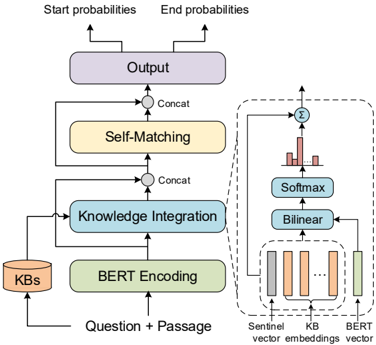
Machine reading comprehension (MRC) is a crucial and challenging task in NLP.Recently, pre-trained language models (LMs), especially BERT, have achieved remarkable success, presenting new state-of-the-art results in MRC.In this work, we investigate the potential of leveraging external knowledge bases (KBs) to further improve BERT for MRC.We introduce KT-NET, which employs an attention mechanism to adaptively select desired knowledge from KBs, and then fuses selected knowledge with BERT to enable context-and knowledgeaware predictions.We believe this would combine the merits of both deep LMs and curated KBs towards better MRC.Experimental results indicate that KT-NET offers significant and consistent improvements over BERT, outperforming competitive baselines on ReCoRD and SQuAD1.1 benchmarks.Notably, it ranks the 1st place on the ReCoRD leaderboard, and is also the best single model on the SQuAD1.1 leaderboard at the time of submission (March 4th, 2019). 1
Overview
The claims and statistics of this paper haven’t been checked yet.
Free: it reads the open-access text and checks the first 5 claims that cite a source we can check. Create a free account to check every claim.
Integrity signals
Registry
Cites
Statistics
Figures
Verification
Claims the paper makes
The claims and statistics of this paper haven’t been checked yet.
Free: it reads the open-access text and checks the first 5 claims that cite a source we can check. Create a free account to check every claim.
Claims other papers make about this one
Each is checked against this paper’s own text: does it say what the citing paper says it does?
In the citing paper
“Besides, Tenney et al. [122] analyzed the roles of BERT's layers in di erent tasks and found that BERT solves tasks in a similar order to that in NLP pipelines.”
From Pre-trained models for natural language processing: A survey (2020) · cites this paper as [122]
Self-check
Percentages, sums and reported differences re-computed from the paper’s own numbers.
The self-check needs the paper’s full text.
Citations
Cites
Vaswani, A., Shazeer, N., Parmar, N., Uszkoreit, J., Jones, L., Gomez, A. N., Kaiser, L., & Polosukhin, I. (2017) · arXiv · doi:10.48550/arxiv.1706.03762 · Cited by 120,404 · cited 2×
“We refer readers to (Devlin et al., 2018; Vaswani et al., 2017) for details.”
MethodAdam: A Method for Stochastic Optimization
Kingma, D. P., & Ba, J. (2014) · arXiv · doi:10.48550/arxiv.1412.6980 · Cited by 98,946 · cited 1×
“We use the Adam optimizer (Kingma and Ba, 2015) with a learning rate of 3e-5 and a batch size of 24.”
MethodExploiting Generative AI to Scale up Intelligent Tutoring Systems
Jakubův, J., Chvalovský, K., Goertzel, Z., Kaliszyk, C., Olšák, M., Piotrowski, B., Schulz, S., Suda, M., & Urban, J. (2023) · DROPS (Schloss Dagstuhl – Leibniz Center for Informatics) · doi:10.4230/lipics.itp.2023.19 · Cited by 76,658
BERT: Pre-training of Deep Bidirectional Transformers for Language Understanding
Devlin, J., Chang, M.-W., Lee, K., & Toutanova, K. (2018) · arXiv · doi:10.48550/arxiv.1810.04805 · Cited by 73,173 · cited 6×
“Finally, we follow Devlin et al. (2018) and use the FullTokenizer built in BERT to segment words into wordpieces.”
MethodInfluentialBERT: Pre-training of Deep Bidirectional Transformers for Language Understanding
Devlin, J., Chang, M.-W., Lee, K., & Toutanova, K. (2019) · Proceedings of the 2019 Conference of the North American Chapter of the Association for Computational Linguistics: Human Language Technologies, Volume 1 (Long and Short Papers) · doi:10.18653/v1/n19-1423 · Cited by 54,325 · cited 6×
“Finally, we follow Devlin et al. (2018) and use the FullTokenizer built in BERT to segment words into wordpieces.”
MethodInfluentialWordNet: a lexical database for English
Miller, G. A. (1995) · Communications of the ACM · doi:10.1145/219717.219748 · Cited by 14,015 · cited 3×
“We use two KBs: WordNet and NELL.”
MethodDeep Contextualized Word Representations
Peters, M., Neumann, M., Iyyer, M., Gardner, M., Clark, C., Lee, K., & Zettlemoyer, L. (2018) · Proceedings of the 2018 Conference of the North American Chapter of the Association for Computational Linguistics: Human Language Technologies, Volume 1 (Long Papers) · doi:10.18653/v1/n18-1202 · Cited by 11,983 · cited 3×
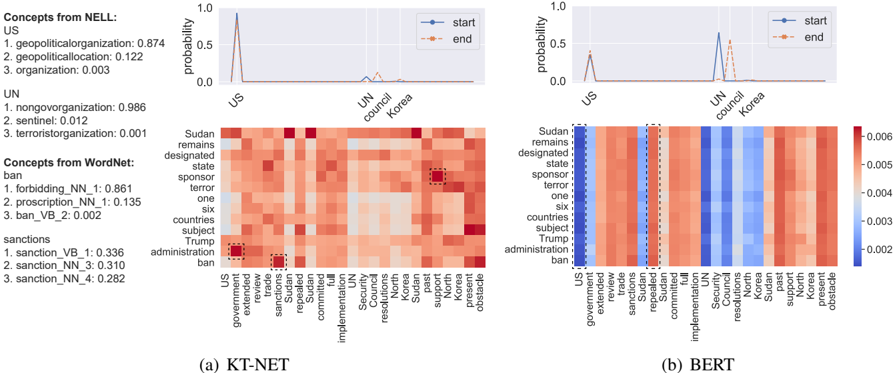
“…government has extended its review into whether trade sanctions against Sudan should be repealed. are pre-trained on unlabeled text and then applied to MRC, in either a feature-based (Peters et al., 2018a) or a fine-tuning (Radford et al., 2018) manner, both offering substantial performance boosts.”
BackgroundMethodThe Stanford CoreNLP Natural Language Processing Toolkit
Manning, C., Surdeanu, M., Bauer, J., Finkel, J., Bethard, S., & McClosky, D. (2014) · Proceedings of 52nd Annual Meeting of the Association for Computational Linguistics: System Demonstrations · doi:10.3115/v1/p14-5010 · Cited by 7,037 · cited 1×
“Entity mentions are given as answer candidates on ReCoRD, and recognized by Stanford CoreNLP (Manning et al., 2014) on SQuAD1.”
MethodSQuAD: 100,000+ Questions for Machine Comprehension of Text
Rajpurkar, P., Zhang, J., Lopyrev, K., & Liang, P. (2016) · Proceedings of the 2016 Conference on Empirical Methods in Natural Language Processing · doi:10.18653/v1/d16-1264 · Cited by 6,208 · cited 4×
“1 (Rajpurkar et al., 2016) is a well-known extractive MRC dataset that consists of questions created by crowdworkers for Wikipedia articles.”
BackgroundMethodInfluentialNLTK: the Natural Language Toolkit
Loper, E., & Bird, S. (2002) · Proceedings of the ACL-02 Workshop on Effective tools and methodologies for teaching natural language processing and computational linguistics - · doi:10.3115/1118108.1118117 · Cited by 3,218
Research works printed but not linked: 1
- Matthew Peters, Mark Neumann, Mohit Iyyer, Matt Gardner, Christopher Clark, Kenton Lee, and Luke Zettlemoyer. 2018a. Deep contextualized word rep- resentations. In Proceedings of the 2018 Conference of the North American Chapter of the Association for Computational Linguistics: Human Language Technologies, Volume 1 (Long Papers), pages 2227- 2237. Association for Computational Linguistics.
Cited by
Items 101–156 of 156
Machine Reading Comprehension with Rich Knowledge
He, J. Y. D., Li, P., Zhang, Y., Sun, B., Xiao, R., & Xiao, Y. (2022) · International Journal of Pattern Recognition and Artificial Intelligence · doi:10.1142/s0218001422510041 · Cited by 3
Plug-and-Play Module for Commonsense Reasoning in Machine Reading Comprehension
Dai, D., Zheng, H., Sui, Z., & Chang, B. (2022) · Lecture notes in computer science · doi:10.1007/978-3-031-17189-5_3 · Cited by 3
Wang, M., He, X., Liu, L., Fang, Q.-M., Zhang, M., Chen, H., & Liu, Y. (2024) · IEEE Journal of Biomedical and Health Informatics · doi:10.1109/jbhi.2024.3368288 · Cited by 5
“(cid:2) KT-NET [67]investigatesusingexternalknowledgebases (KBs) to improve MRC BERT.”
BackgroundSiBert: Enhanced Chinese Pre-trained Language Model with Sentence Insertion
Chen, J., Cao, C., & Jiang, X. (2020) · Language Resources and Evaluation · Cited by 6
Improving the Utility of Knowledge Graph Embeddings with Calibration.Preprint
Safavi, T., Koutra, D., & Meij, E. (2020) · arXiv (Cornell University) · Cited by 3
Bridging Subword Gaps in Pretrain-Finetune Paradigm for Natural Language GenerationPreprint
Liu, X., Yang, B., Liu, D., Zhang, H., Luo, W., Zhang, M., Zhang, H., & Su, J. (2021) · arXiv (Cornell University) · doi:10.48550/arxiv.2106.06125 · Cited by 3
“Due to its simplicity yet impressive performance, pretrain-finetune paradigm becomes the undoubtedly dominant solution for building state-of-the-art models in many natural language understanding tasks (Xu et al., 2019; Yang et al., 2019a; Liu et al., 2020b).”
BackgroundProceedings of the First Workshop on Commonsense Inference in Natural Language Processing
(2019) · doi:10.18653/v1/d19-60 · Cited by 5
“Compared with the best baseline, KTNET (Yang et al., 2019a), PSH-SJTU achieves significantly better scores.”
Time-Aware Representation Learning of Knowledge Graphs
Wang, Z., Li, L., & Zeng, D. D. (2021) · International Joint Conference on Neural Networks (IJCNN) · doi:10.1109/ijcnn52387.2021.9533920 · Cited by 3
“They have been widely adopted in various applications, such as recommendation systems [5], question answering [6], reading comprehension [7], to name a few.”
BackgroundSpatial Commonsense Reasoning for Machine Reading Comprehension
Lin, M., Wang, M., Yu, J., Wang, S., Lai, H., Liu, W., & Yin, J. (2023) · Lecture notes in computer science · doi:10.1007/978-3-031-46664-9_24 · Cited by 3
Huang, H., Feng, X., & Wan, Z. (2024) · Chinese Control and Decision Conference (CCDC) · doi:10.1109/ccdc62350.2024.10587455 · Cited by 5
“Reference [9] adaptively selects knowledge from an external knowledge base by using an attention mechanism and integrates it with a BERT model to achieve context-and knowledge-aware predictions.”
MethodTopic-oriented sarcasm detection via Entity Knowledge-based prompt learning
Zhou, Y., Zhang, S., Wang, C., Wang, Y., Wang, X., & Li, K. (2024) · Computer Science and Information Systems · doi:10.2298/csis240320067z · Cited by 4
“The utilization of external knowledge to enhance the performance of PLM has been extensively researched [46-47].”
Deep Understanding Based Multi-Document Machine Reading Comprehension
Ren, F., Liu, Y., Li, B., Wang, Z., Guo, Y. H., Liu, S., Wu, H., Wang, J., Liu, C., & Wang, B. (2022) · ACM Transactions on Asian and Low-Resource Language Information Processing · doi:10.1145/3519296 · Cited by 2
“Some researchers [Yang et al. 2019b,c; Zhang et al. 2020b] explore to integrate extra pretrained language models in the embedding layer, which can alleviate above issues but at the cost of introducing more parameters.”
BackgroundResultInfluentialSelf-citationA Textual Entailment Recognition Method Fused with Language Knowledge
Liu, Y., Mu, L., Chu, W., & Zan, H. (2022) · Lecture notes in computer science · doi:10.1007/978-3-031-06703-7_34 · Cited by 2
Zhang, T., Wang, C., Qiu, M., Yang, B., Cai, Z., He, X., & Huang, J. (2021) · Findings of the Association for Computational Linguistics: ACL (Findings of ACL) · doi:10.18653/v1/2021.findings-acl.197 · Cited by 4
KG-SQL: Hybrid Knowledge-Guided Semantic Understanding for Text-to-SQL
Guo, M., Chen, Y., Xu, J., & Zhang, Y. (2022) · 2022 4th International Conference on Natural Language Processing (ICNLP) · doi:10.1109/icnlp55136.2022.00076 · Cited by 3
SDSK2BERT: Explore the Specific Depth with Specific Knowledge to Compress BERT
Ding, L., & Yang, Y. (2020) · IEEE International Conference on Knowledge Graph (ICKG) · doi:10.1109/icbk50248.2020.00066 · Cited by 3
“…models like BERT [3] have achieved remarkable results on general language understanding tasks, incorporating BERT as a fundamental architecture to extract the language features with additive task-specific layers becomes a normal pattern in recent Natural Language Processing tasks [23], [27].”
BackgroundObstetric Diagnosis Assistant via Knowledge Powered Attention and Information-Enhanced Strategy
Zhang, K., Zhao, X., Zhuang, L., Zan, H., & Xie, Q. (2021) · Communications in computer and information science · doi:10.1007/978-981-16-1964-9_22 · Cited by 2
Sentence Extraction-Based Machine Reading Comprehension for VietnamesePreprint
Nguyen-Thuan, P., Nguyen, N. D., Huynh, T. V., Nguyen, K. V., Nguyen, A. G.-T., & Nguyen, N. L.-T. (2021) · arXiv (Cornell University) · doi:10.48550/arxiv.2105.09043 · Cited by 2
“In future, we propose several directions: (1) increasing the quantity of complex questions can boost the performance of models; (2) addressing the challenging questions using knowledge base [24] is to enhance the performance of this task; (3) researchers will exploit the challenging task of multilingual sentence extra…”
BackgroundKnowledge-enhanced AI models for domain-specific application: a survey
Li, X.-Y., Wang, Y., Liang, J., Wang, X., Zhou, P., Zhao, Q., Zhang, Y., & Song, Q. (2026) · Science China Information Sciences · doi:10.1007/s11432-025-4635-0 · Cited by 1
“Pre-execution knowledge enhancement is essential for small-scale PLMs because passive knowledge acquisition from text leads to structural gaps, domain adaptation bottlenecks, and inefficient fact memorization [228].”
Utilizing External Knowledge with Multi-granularity Attention for Review Reading Comprehension
Hu, Z., & Wang, Y. (2021) · IEEE International Conference on Tools with Artificial Intelligence (ICTAI) · doi:10.1109/ictai52525.2021.00195 · Cited by 1
Generative Data Augmentation via Wasserstein Autoencoder for Text Classification
Jin, K., Lee, J., Choi, J., Jang, S., & Kim, Y. (2022) · International Conference on Information and Communication Technology Convergence (ICTC) · doi:10.1109/ictc55196.2022.9952762 · Cited by 1
“PLMs provided significant gains in language understanding or sentence generation by better capturing information such as semantics and syntactics [26], [27].”
BackgroundCoherent Story Generation with Structured Knowledge
Ma, C., Funakoshi, K., Shirai, K., & Okumura, M. (2023) · International conference Recent advances in natural language processing · doi:10.26615/978-954-452-092-2_074 · Cited by 1
Santhiya, S., Sharmila, C., Jayadharshini, P., Dharshini, M. N., Kumar, B., & Sandeep, K. (2024) · Communications in computer and information science · doi:10.1007/978-3-031-58495-4_10 · Cited by 1
Path-Aware Cross-Attention Network for Question Answering
Luo, Z., Xiong, Y., & Tang, B. (2024) · Lecture notes in computer science · doi:10.1007/978-981-97-2253-2_9 · Cited by 1
KGAT-MRC: A Knowledge Graph and Attention Mechanism-Based Model for Machine Reading Comprehension
Zhou, M., Wang, D., Feng, Y. X., & Liu, S. (2024) · International Conference on Communications, Information System and Computer Engineering (CISCE) · doi:10.1109/cisce62493.2024.10653408 · Cited by 1
“It is essential to select the most suitable knowledge for embedding to eliminate the influence of irrelevant factors on the model[2][3].”
BackgroundQLSC: A Query Latent Semantic Calibrator for Robust Extractive Question Answering
Ouyang, S., Wang, J., Zhang, Y., Li, Z., Liang, Z., Zhang, X., Cheng, N., & Xiao, J. (2024) · International Joint Conference on Neural Networks (IJCNN) · doi:10.1109/ijcnn60899.2024.10651462 · Cited by 1
PreAdapter: Pre-training Language Models on Knowledge Graphs
Omeliyanenko, J., Hotho, A., & Schlör, D. (2024) · Lecture notes in computer science · doi:10.1007/978-3-031-77850-6_12 · Cited by 2
“Although this general knowledge has proven useful for improving these down-stream tasks [26], exploring its limitations [9,28] and expanding it by introducing specific unstructured [25,42] or structured [37,39] knowledge has recently gained attention.”
Multi-paragraph Reading Comprehension with Token-level Dynamic Reader and Hybrid Verifier
Dai, Y., Ji, Q., Liu, G., & Su, B. (2020) · International Joint Conference on Neural Networks (IJCNN) · doi:10.1109/ijcnn48605.2020.9206859 · Cited by 1
“Recently, some work replaces word and character embeddings [6] with outputs from pre-trained language models (LMs) to get deeper word representations [7], [8], [9].”
BackgroundEnhancing Embedding via Two-Level Features for Machine Reading Comprehension
Wang, S., Song, H., Xu, B., & Zhang, H. (2021) · Communications in computer and information science · doi:10.1007/978-981-16-1964-9_21 · Cited by 1
Han, S., Gao, N., Guo, X., & Shan, Y. (2021) · Lecture notes in computer science · doi:10.1007/978-3-030-82153-1_45 · Cited by 1
Knowledge Representation, Reasoning and Learning for Non-Extractive Reading Comprehension
Mitra, A. (2019) · Cited by 1
Competing Independent Modules for Knowledge Integration and Optimization
Bagherzadeh, P., & Bergler, S. (2021) · Findings of the Association for Computational Linguistics: EMNLP (Findings of EMNLP) · doi:10.18653/v1/2021.findings-emnlp.376 · Cited by 2
“, which were proven to be effective as knowledge sources in different machine learning architectures (Özdemir and Bergler, 2015; Yang et al., 2019; Zhao et al., 2020; Ke et al., 2020).”
BackgroundTrends and Highlights in China
Chinese Academy of Engineering (2021) · Springer eBooks · doi:10.1007/978-981-16-1986-1_3 · Cited by 1
UoR-NCL at SemEval-2022 Task 3: Fine-Tuning the BERT-Based Models for Validating Taxonomic Relations
Markchom, T., Liang, H., & Chen, J. (2022) · International Workshop on Semantic Evaluation (SemEval) · doi:10.18653/v1/2022.semeval-1.33 · Cited by 1
“Many previous studies have shown that pre-trained models comprise the prior knowledge of context comprehension (Yang et al., 2019).”
BackgroundTowards information-rich, logical text generation with knowledge-enhanced neural modelsPreprint
Wang, H., Guo, B., Wu, W., & Yu, Z. (2020) · arXiv (Cornell University) · doi:10.48550/arxiv.2003.00814 · Cited by 1
Enhancing Review Comprehension with Domain-Specific CommonsensePreprint
Traylor, A., Chen, C., Golshan, B., Wang, X., Li, Y., Suhara, Y., Li, J., Demiralp, Ç., & Tan, W.-C. (2020) · arXiv (Cornell University) · doi:10.48550/arxiv.2004.03020 · Cited by 1
“In recent years, several pre-training techniques (Devlin et al., 2019; Liu et al., 2019; Yang et al., 2019b) have shown the state-of-the-art (SOTA) performance on commonsense reasoning tasks (Zellers et al., 2018; Talmor et al., 2019; Huang et al., 2019; Zhang et al., 2018).”
BackgroundZhang, T., Wang, C., Qiu, M., Yang, B., He, X., & Huang, J. (2020) · arXiv · doi:10.48550/arxiv.2008.10327 · Cited by 1
“C.2 Additional Training Details In average, the training time for DrQA, BERT base, MC-BERT, KT-NET, ERNIE, KMQA and CMedBERT takes 10, 16, 16, 27, 29, 28 and 25 minutes per epoch on a TiTAN RTX GPU.”
MethodInfluentialUnderstanding in Artificial IntelligencePreprint
Maetschke, S., Iraola, D. M., Barnard, P., ShafieiBavani, E., Zhong, P., Xu, Y., & Yepes, A. J. (2021) · arXiv (Cornell University) · doi:10.48550/arxiv.2101.06573 · Cited by 5
“Three baseline models: logistic regression [233], attentive reader [234] and three-way attentive network [235]; and five baseline models: BERT [213], KT-NET [236], stochastic answer network (SAN) [237], the DocQA [238] and random guess, were presented for task1 and task2, respectively.”
MethodDai, D., Zheng, H., Sui, Z., & Chang, B. (2021) · arXiv (Cornell University) · doi:10.48550/arxiv.2103.14443 · Cited by 1
“Yang and Mitchell (2017) and Yang et al. (2019) enrich each word by applying attention mechanism to its KG neighbors and a sentinel vector.”
BackgroundCoarse-To-Careful: Seeking Semantic-Related Knowledge for Open-Domain Commonsense Question Answering
Xing, L., Hu, Y., Yu, J., Xie, Y., & Peng, W. (2021) · IEEE International Conference on Acoustics Speech and Signal Processing · doi:10.1109/icassp39728.2021.9413878
Graph-based Multilingual Product Retrieval in E-commerce SearchPreprint
Lu, H., Hu, Y., Zhao, T., Wu, T., Song, Y., & Yin, B. (2021) · arXiv (Cornell University) · doi:10.48550/arxiv.2105.02978 · Cited by 7
“Query Encoder: The query encoder could be any transformer-based encoder, such as BERT (Devlin et al., 2018), XLNet (Yang et al., 2019b), DistilBERT (Sanh et al., 2019), and RoBERTa (Liu et al., 2019).”
MethodFan, J., Zhang, X., & Zhang, S. (2021) · arXiv (Cornell University)
Triple-as-Node Knowledge Graph and Its Embeddings
Lv, X., Shi, J., Cao, S., Hou, L., & Li, J. (2022) · Lecture notes in computer science · doi:10.1007/978-3-031-00123-9_8 · Cited by 1
Chinese Machine Reading Comprehension Based on Language Model Containing Knowledge
Chen, W., Fan, C., Wu, Y., & Wang, Y. (2022) · International Conference on Computer Science and Application Engineering (CSAE) · doi:10.1145/3565387.3565405 · Cited by 1
“[38] proposed a knowledge-text fusion model to acquire linguistic and factual knowledge related to MRC tasks.”
BackgroundJose, J., & Soundarabai, P. B. (2023) · Algorithms for intelligent systems · doi:10.1007/978-981-99-4577-1_14
Fusing Temporal Graphs into Transformers for Time-Sensitive Question Answering
Su, X., Howard, P., Hakim, N. Z., & Bethard, S. J. (2023) · Findings of the Association for Computational Linguistics: EMNLP (Findings of EMNLP) · doi:10.18653/v1/2023.findings-emnlp.67 · Cited by 9
A Survey of Pre-Trained Language Models IncorporatingKnowledge Graphs
Wang, X., Liu, J., Zhou, J., & Wang, J. (2023) · IEEE International Conference on Electrical, Automation and Computer Engineering (ICEACE) · doi:10.1109/iceace60673.2023.10442824
“[11] The KT-NET model (shown in Fig.”
MethodSelf-citationDuan, J., Chen, Q., Bi, X., Meng, T., & Liu, S. (2024) · Chinese Control Conference (CCC) · doi:10.23919/ccc63176.2024.10661721
“In natural language processing tasks, the successful application of pre-trained models has achieved significant accomplishments (Yang et al., 2019) [12].”
BackgroundMethodInfluentialUnderstanding and Reasoning with Negation
Hossain, M. M. (2022) · University of North Texas Digital Library (University of North Texas) · doi:10.12794/metadc2048613
Gao, Y., Wang, S., Ren, F., & Wang, X. (2025) · Journal of Computer and Communications · doi:10.4236/jcc.2025.132007 · Cited by 1
Towards Explainable Medical Machine Reading Comprehension With Rationale Generation
Li, D., He, S., Hu, B., & Chen, Q. (2025) · IEEE Transactions on Audio Speech and Language Processing · doi:10.1109/taslpro.2025.3555105 · Cited by 1
“Once the knowledge is determined, we can choose the appropriate integration mechanism for further knowledge injection, such as attention mechanism [52], [83], [84], pre-training tasks [54] and multi-task training [85].”
Relation-Aware Graph Reasoning for Multiple Choice Question Answering
Lu, D., Liu, P., & Lu, R. (2025) · Lecture notes in computer science · doi:10.1007/978-981-95-3349-7_8
Foolad, S., & Kiani, K. (2026) · Multimedia Tools and Applications · doi:10.1007/s11042-026-21221-w
“Unlike models such as SKG-BERT [24], KT-NET [25], and KELM [26], which rely on external knowledge graphs like WordNet, ConceptNet, or NELL, our approach constructs a graph purely from document entities, thereby avoiding the dependency on ex-ternal resources.”
InfluentialA Survey of the Applications of Large Language Models in the Educational Sector
Muchina, F. E., Damle, A., Yadav, S., Kaushik, A., & Morris, D. B. (2026) · Advances in computational intelligence and robotics book series · doi:10.4018/979-8-3373-9195-3.ch006
Facing Data Scarcity in Dialogues for Discourse Structure Discovery and Prediction
Li, C. (2023) · theses.fr (ABES) · doi:10.70675/c379d1f5z5324z4865z9c13z84c9508836f1 · Cited by 7
Rule-Guided Reinforcement Learning for Process Knowledge Graph Reasoning
Chen, J. F., Fu, Y.-K., Liu, Y., Peng, R., Bai, H.-F., & Cui, H. (2025) · China Automation Congress (CAC) · doi:10.1109/cac67268.2025.11487750
Metadata
- Authors
- Yang, A., Wang, Q., Liu, J., Liu, K., Lyu, Y., Wu, H., She, Q., & Li, S.
- Affiliations
- Baidu (China) (CN)
- Peking University (CN)
- Venue
- Proceedings of the 57th Annual Meeting of the Association for Computational Linguistics
- Published
- 2019
- Pages
- 2346-2357
- ISSN
- 0736-587X (ISSN-L)
- OpenAlex
- W2951561177
- Cited by
- 155
- References
- 45
- Citations by year
- 2026: 3 · 2025: 5 · 2024: 16 · 2023: 22 · 2022: 24 · 2021: 47 · 2020: 29 · 2019: 9
- FWCI
- 10.43
- Type
- conference paper
- Language
- en
- Open access
- hybrid
- doi.org
- Licence
- cc-by
- Locations
- Proceedings of the conference - Association for Computational Linguistics. Meeting (publishedVersion, cc-by)
- Funders
- Baidu
- National Natural Science Foundation of China (61876009, 61533018, 61876223)
- Peking University
- Topics
- Physical Sciences › Computer Science › Artificial Intelligence › Topic Modeling
- Physical Sciences › Computer Science › Computer Vision and Pattern Recognition › Multimodal Machine Learning Applications
- Physical Sciences › Computer Science › Artificial Intelligence › Natural Language Processing Techniques
- Keywords
- machine reading comprehension, pre-trained language models, BERT, knowledge base, external knowledge integration, knowledge fusion, records
About these checks
Registry, retraction, Cites and statistics results are computed, not judged, with one exception: a printed reference that no index lists is read once by a model before it counts as a citation error. Claims are extracted by a model and kept only when their quote appears verbatim in the text; each cited source is then checked, with a model’s help, for whether it says what the claim relies on. Those verdicts can be wrong — read the claim’s quote and the cited source before relying on one.
Statistics and arithmetic are recomputed, not judged.
Confidence bands are shown only for fields calibrated on our annotated test set. None is calibrated yet, so no band is shown.
What counts as a claim ›How we measure confidence ›How we check this ›
Are you an author, or do you see a problem with this page? Request a review
Data sources
Bibliographic data: Semantic Scholar, OpenAlex, Crossref.
Contains information from the Semantic Scholar Academic Graph Datasets, made available under the ODC Attribution License (ODC-BY 1.0).
Semantic Scholar’s data is described in: Kinney, R., et al. (2023). The Semantic Scholar Open Data Platform. arXiv:2301.10140.
