

A Multiscale Visualization of Attention in the Transformer Model
Open accessThe DOI matches its Crossref record; 22 of the 22 references it cites were found in a registry or an index.
Abstract
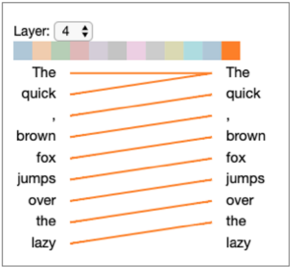
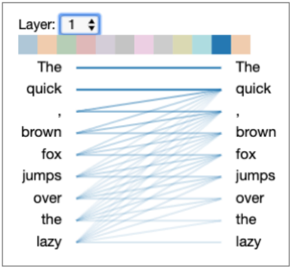
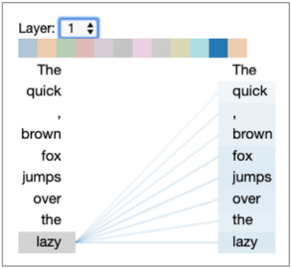
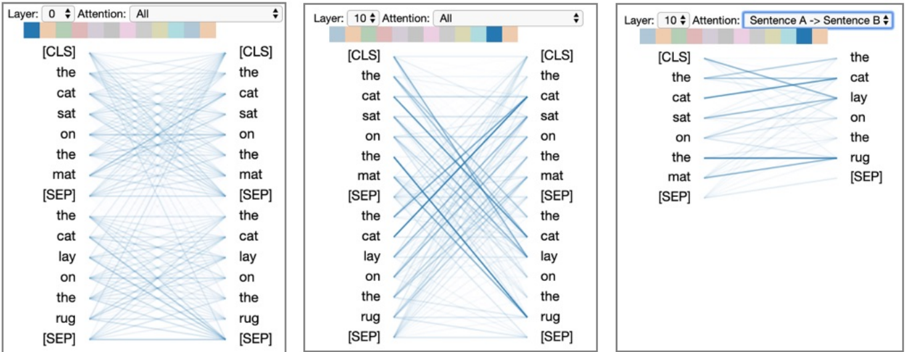
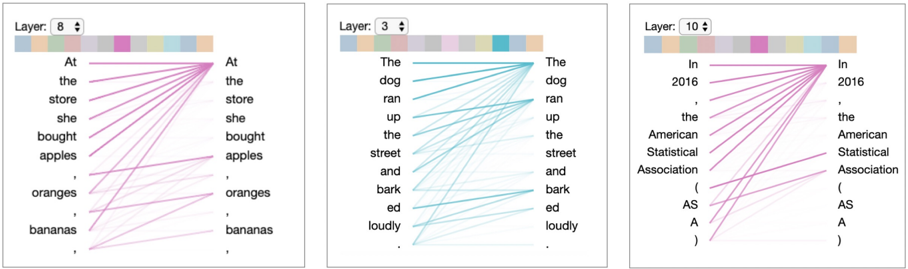
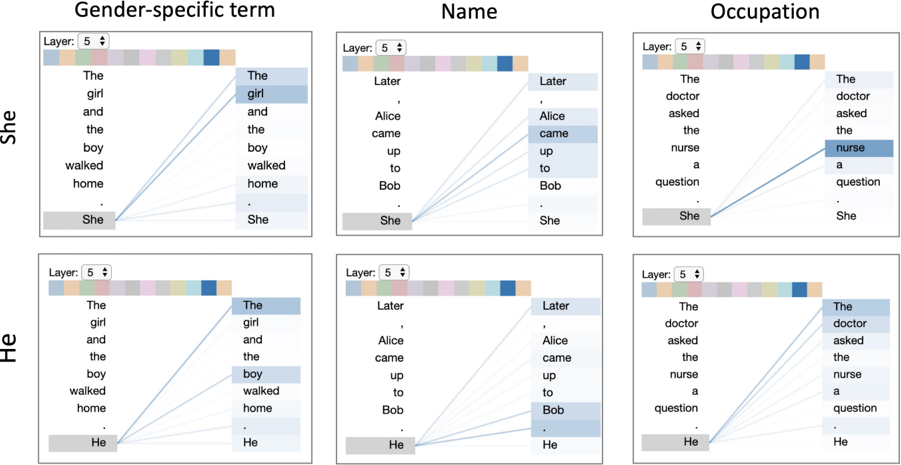
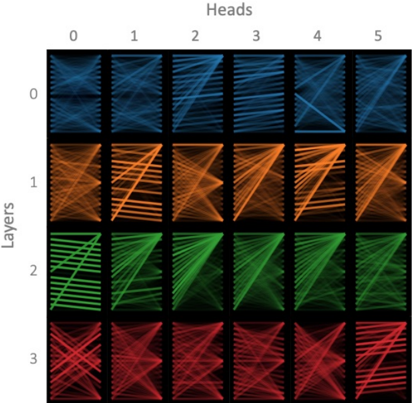
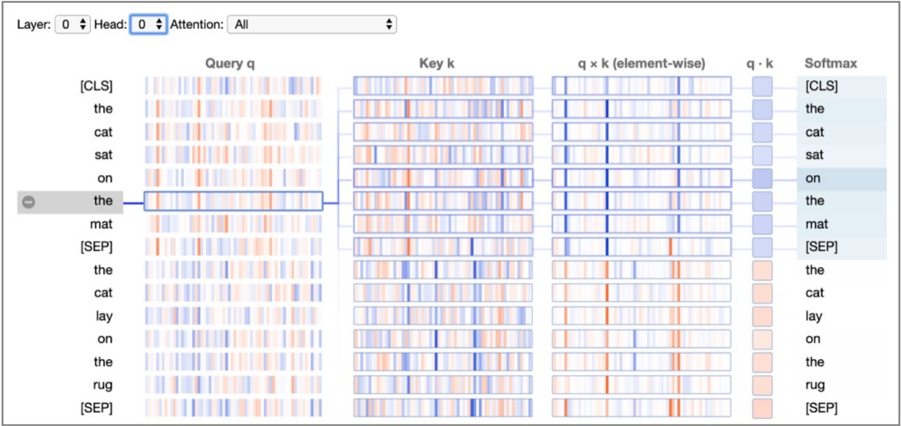
The Transformer is a sequence model that forgoes traditional recurrent architectures in favor of a fully attention-based approach.Besides improving performance, an advantage of using attention is that it can also help to interpret a model by showing how the model assigns weight to different input elements.However, the multi-layer, multi-head attention mechanism in the Transformer model can be difficult to decipher.To make the model more accessible, we introduce an open-source tool that visualizes attention at multiple scales, each of which provides a unique perspective on the attention mechanism.We demonstrate the tool on BERT and OpenAI GPT-2 and present three example use cases: detecting model bias, locating relevant attention heads, and linking neurons to model behavior.
Overview
The claims and statistics of this paper haven’t been checked yet.
Free: it reads the open-access text and checks the first 5 claims that cite a source we can check. Create a free account to check every claim.
Integrity signals
Registry
Cites
Statistics
Figures
Verification
Claims the paper makes
The claims and statistics of this paper haven’t been checked yet.
Free: it reads the open-access text and checks the first 5 claims that cite a source we can check. Create a free account to check every claim.
Claims other papers make about this one
Each is checked against this paper’s own text: does it say what the citing paper says it does?
The source backs part of the claim, not all of it — or backs it for a different population, condition or comparison.
In the citing paper
“Prior work has shown how to use attention weights to visually depict which words in an input sequence, plus which words in previously-generated output, were responsible for a given token's output [95,96].”
From Investigating Explainability of Generative AI for Code through Scenario-based Design (2022) · cites this paper as [95]
Experimental — accuracy not yet measuredThe source backs part of the claim, not all of it — or backs it for a different population, condition or comparison.
In the citing paper
“Attention distribution is a popular approach to explain an individual prediction made by a neural networks model, by the relative importance of parts of input to determine the output [95,96].”
From Investigating Explainability of Generative AI for Code through Scenario-based Design (2022) · cites this paper as [95]
Experimental — accuracy not yet measured
Self-check
Percentages, sums and reported differences re-computed from the paper’s own numbers.
The self-check needs the paper’s full text.
Citations
Cites
Vaswani, A., Shazeer, N., Parmar, N., Uszkoreit, J., Jones, L., Gomez, A. N., Kaiser, L., & Polosukhin, I. (2017) · arXiv · doi:10.48550/arxiv.1706.03762 · Cited by 120,404 · cited 2×
“Jones (2017) designed a visualization tool specifically for multihead attention, which visualizes attention over multiple heads in a layer by superimposing their attention patterns (Vaswani et al., 2017, 2018).”
MethodBERT: Pre-training of Deep Bidirectional Transformers for Language Understanding
Devlin, J., Chang, M.-W., Lee, K., & Toutanova, K. (2018) · arXiv · doi:10.48550/arxiv.1810.04805 · Cited by 73,173 · cited 1×
“In 2018, the BERT (Bidirectional Encoder Representations from Transformers) language representation model achieved state-of-the-art performance across NLP tasks ranging from sentiment analysis to question answering (Devlin et al., 2018).”
BackgroundBERT: Pre-training of Deep Bidirectional Transformers for Language Understanding
Devlin, J., Chang, M.-W., Lee, K., & Toutanova, K. (2019) · Proceedings of the 2019 Conference of the North American Chapter of the Association for Computational Linguistics: Human Language Technologies, Volume 1 (Long and Short Papers) · doi:10.18653/v1/n19-1423 · Cited by 54,325 · cited 1×
“In 2018, the BERT (Bidirectional Encoder Representations from Transformers) language representation model achieved state-of-the-art performance across NLP tasks ranging from sentiment analysis to question answering (Devlin et al., 2018).”
BackgroundNeural Machine Translation by Jointly Learning to Align and Translate
Bahdanau, D., Cho, K., & Bengio, Y. (2014) · arXiv · doi:10.48550/arxiv.1409.0473 · Cited by 16,213 · cited 3×
“Various tools have been developed to visualize attention in NLP models, ranging from attention-matrix heatmaps (Bahdanau et al., 2015; Rush et al., 2015; Rocktäschel et al., 2016) to bipartite graph representations (Liu et al., 2018; Lee et al., 2017; Strobelt et al., 2018).”
BackgroundMethodKemp, C. D., & Tufte, E. R. (1992) · Biometrics · doi:10.2307/2532323 · Cited by 2,713
A Neural Attention Model for Abstractive Sentence Summarization
Rush, A. M., Chopra, S., & Weston, J. (2015) · Proceedings of the 2015 Conference on Empirical Methods in Natural Language Processing · doi:10.18653/v1/d15-1044 · Cited by 2,656 · cited 2×
“Various tools have been developed to visualize attention in NLP models, ranging from attention-matrix heatmaps (Bahdanau et al., 2015; Rush et al., 2015; Rocktäschel et al., 2016) to bipartite graph representations (Liu et al., 2018; Lee et al., 2017; Strobelt et al., 2018).”
MethodJain, S., & Wallace, B. (2019) · Conference of the North American Chapter of the Association for Computational Linguistics: Human Language Technologies (NAACL-HLT) · doi:10.18653/v1/n19-1357 · Cited by 1,987 · cited 1×
“, 2015; Belinkov and Glass, 2019), although its value in explaining individual predictions may be limited (Jain and Wallace, 2019).”
BackgroundAnalyzing Multi-Head Self-Attention: Specialized Heads Do the Heavy Lifting, the Rest Can Be Pruned
Voita, E., Talbot, D., Moiseev, F., Sennrich, R., & Titov, I. (2019) · Proceedings of the 57th Annual Meeting of the Association for Computational Linguistics · doi:10.18653/v1/p19-1580 · Cited by 1,146 · cited 2×
“Recent work shows that attention in the Transformer correlates with syntactic constructs such as dependency relations and part-of-speech tags (Raganato and Tiedemann, 2018; Voita et al., 2019; Vig and Belinkov, 2019).”
BackgroundGender bias in coreference resolution: Evaluation and debiasing methods
Zhao, J., Wang, T., Yatskar, M., Ordonez, V., & Chang, K.-W. (2018) · Proceedings of the 2018 Conference of the North American Chapter of the Association for Computational Linguistics: Human Language Technologies, Volume 2 (Short Papers) · doi:10.18653/v1/n18-2003 · Cited by 684 · cited 1×
“This suggests that the model’s coreference mechanism may encode gender bias (Zhao et al., 2018; Lu et al., 2018).”
BackgroundTensor2Tensor for Neural Machine TranslationPreprint
Vaswani, A., Bengio, S., Brevdo, E., Chollet, F., Gomez, A. N., Gouws, S., Jones, L., Kaiser, Ł., Kalchbrenner, N., Parmar, N., et al. (2018) · arXiv (Cornell University) · doi:10.48550/arxiv.1803.07416 · Cited by 639 · cited 1×
“Jones (2017) designed a visualization tool specifically for multi-head attention, which visualizes attention over multiple heads in a layer by superimposing their attention patterns (Vaswani et al., 2017, 2018).”
Reasoning about Entailment with Neural Attention
Rocktäschel, T., Grefenstette, E., Hermann, K. M., Kočiský, T., & Blunsom, P. (2015) · arXiv (Cornell University) · doi:10.48550/arxiv.1509.06664 · Cited by 582 · cited 2×
“Various tools have been developed to visualize attention in NLP models, ranging from attention-matrix heatmaps (Bahdanau et al., 2015; Rush et al., 2015; Rocktäschel et al., 2016) to bipartite graph representations (Liu et al., 2018; Lee et al., 2017; Strobelt et al., 2018).”
MethodAnalysis Methods in Neural Language Processing: A Survey
Belinkov, Y., & Glass, J. (2019) · Transactions of the Association for Computational Linguistics · doi:10.1162/tacl_a_00254 · Cited by 477 · cited 1×
“An advantage of using attention is that it can help interpret a model by showing how the model assigns weight to different input elements (Bahdanau et al., 2015; Belinkov and Glass, 2019), although its value in explaining individual predictions may be limited (Jain and Wallace, 2019).”
BackgroundJain, S., & Wallace, B. (2019) · arXiv (Cornell University) · doi:10.48550/arxiv.1902.10186 · Cited by 467 · cited 1×
“, 2015; Belinkov and Glass, 2019), although its value in explaining individual predictions may be limited (Jain and Wallace, 2019).”
BackgroundAnalyzing the Structure of Attention in a Transformer Language Model
Vig, J., & Belinkov, Y. (2019) · Proceedings of the 2019 ACL Workshop BlackboxNLP: Analyzing and Interpreting Neural Networks for NLP · doi:10.18653/v1/w19-4808 · Cited by 301 · cited 2×
“shows that attention in the Transformer correlates with syntactic constructs such as dependency relations and part-of-speech tags (Raganato and Tiedemann, 2018; Voita et al., 2019; Vig and Belinkov, 2019).”
BackgroundSelf-citationAn Analysis of Encoder Representations in Transformer-Based Machine Translation
Raganato, A., & Tiedemann, J. (2018) · Proceedings of the 2018 EMNLP Workshop BlackboxNLP: Analyzing and Interpreting Neural Networks for NLP · doi:10.18653/v1/w18-5431 · Cited by 277 · cited 1×
“shows that attention in the Transformer correlates with syntactic constructs such as dependency relations and part-of-speech tags (Raganato and Tiedemann, 2018; Voita et al., 2019; Vig and Belinkov, 2019).”
BackgroundGender Bias in Neural Natural Language Processing
Lu, K., Mardziel, P., Wu, F., Amancharla, P., & Datta, A. (2020) · Lecture Notes in Computer Science · doi:10.1007/978-3-030-62077-6_14 · Cited by 250
Seq2seq-Vis: A Visual Debugging Tool for Sequence-to-Sequence Models
Strobelt, H., Gehrmann, S., Behrisch, M., Perer, A., Pfister, H., & Rush, A. M. (2019) · IEEE Transactions on Visualization and Computer Graphics · doi:10.1109/tvcg.2018.2865044 · Cited by 239
Identifying and Controlling Important Neurons in Neural Machine TranslationPreprint
Bau, A., Belinkov, Y., Sajjad, H., Durrani, N., Dalvi, F., & Glass, J. R. (2018) · arXiv (Cornell University) · doi:10.48550/arxiv.1811.01157 · Cited by 182 · cited 4×
“Finally, we would like to enable users to manipulate the model, either by modifying attention (Lee et al., 2017; Liu et al., 2018; Strobelt et al., 2018) or editing individual neurons (Bau et al., 2019).”
BackgroundMethodInfluentialGender Bias in Neural Natural Language ProcessingPreprint
Lu, K., Mardziel, P., Wu, F., et al. (2018) · arXiv (Cornell University) · doi:10.48550/arxiv.1807.11714 · Cited by 70 · cited 1×
“This suggests that the model’s coreference mechanism may encode gender bias (Zhao et al., 2018; Lu et al., 2018).”
BackgroundAnalyzing Multi-Head Self-Attention: Specialized Heads Do the Heavy Lifting, the Rest Can Be Pruned
Voita, E., Talbot, D., Moiseev, F., et al. (2019) · Zurich Open Repository and Archive (University of Zurich) · doi:10.48550/arxiv.1905.09418 · Cited by 69 · cited 2×
“Recent work shows that attention in the Transformer correlates with syntactic constructs such as dependency relations and part-of-speech tags (Raganato and Tiedemann, 2018; Voita et al., 2019; Vig and Belinkov, 2019).”
BackgroundInteractive Visualization and Manipulation of Attention-based Neural Machine Translation
Lee, J., Shin, J.-H., & Kim, J.-S. (2017) · Proceedings of the 2017 Conference on Empirical Methods in Natural Language Processing: System Demonstrations · doi:10.18653/v1/d17-2021 · Cited by 67
Liu, S., Li, T., Li, Z., Srikumar, V., Pascucci, V., & Bremer, P.-T. (2018) · Proceedings of the 2018 Conference on Empirical Methods in Natural Language Processing: System Demonstrations · doi:10.18653/v1/d18-2007 · Cited by 29 · cited 4×
“Finally, we would like to enable users to manipulate the model, either by modifying attention (Lee et al., 2017; Liu et al., 2018; Strobelt et al., 2018) or editing individual neurons (Bau et al., 2019).”
MethodInfluential
Research works printed but not linked: 1
- [18]18. Jesse Vig. 2019. BertViz: A tool for visualizing multi- head self-attention in the BERT model. In ICLR Workshop: Debugging Machine Learning Models.
Cited by
ProtTrans: Toward Understanding the Language of Life Through Self-Supervised Learning
Elnaggar, A., Heinzinger, M., Dallago, C., Rehawi, G., Wang, Y., Jones, L., Gibbs, T., Feher, T., Angerer, C., Steinegger, M., et al. (2022) · IEEE Transactions on Pattern Analysis and Machine Intelligence · doi:10.1109/tpami.2021.3095381 · Cited by 2,329
“We visualized [68] the attention weights of ProtAlbert to”
MethodPre-trained models for natural language processing: A survey
Qiu, X., Sun, T., Xu, Y., Shao, Y., Dai, N., & Huang, X. (2020) · Science China Technological Sciences · doi:10.1007/s11431-020-1647-3 · Cited by 1,591
“BertViz [185] Visualization Tool https://github.”
Liu, X., Zheng, Y., Du, Z., Ding, M., Qian, Y., Yang, Z., & Tang, J. (2024) · AI Open · doi:10.1016/j.aiopen.2023.08.012 · Cited by 596
Ji, Y., Zhou, Z., Liu, H., & Davuluri, R. V. (2021) · Bioinformatics · doi:10.1093/bioinformatics/btab083 · Cited by 1,303
ChemBERTa: Large-Scale Self-Supervised Pretraining for Molecular Property Prediction
Chithrananda, S., Grand, G., & Ramsundar, B. (2020) · arXiv (Cornell University) · doi:10.48550/arxiv.2010.09885 · Cited by 379
“Meanwhile, software infrastructure for transformers is maturing rapidly: HuggingFace [12] provides streamlined pretraining and finetuning pipelines, while packages like BertViz [13] offer sophisticated interfaces for attention visualization.”
Method
Metadata
- Authors
- Vig, J.
- Affiliations
- Palo Alto Research Center (US)
- Corresponding author
- Vig, Jesse
- ORCID
- Vig, Jesse
- Venue
- Proceedings of the 57th Annual Meeting of the Association for Computational Linguistics: System Demonstrations
- Published
- 2019
- Pages
- 37-42
- OpenAlex
- W2949202705
- Semantic Scholar
- 0de0a44b859a3719d11834479112314b4caba669
- Cited by
- 600
- References
- 17
- Citations by year
- 2026: 46 · 2025: 87 · 2024: 79 · 2023: 112 · 2022: 84 · 2021: 112 · 2020: 71 · 2019: 9
- FWCI
- 26.40
- Type
- conference paper
- Language
- en
- Open access
- hybrid
- doi.org
- Licence
- cc-by
- Locations
- Annual Meeting of the Association for Computational Linguistics: System Demonstrations (ACL Demo) (publishedVersion, cc-by)
- arXiv (Cornell University) (submittedVersion)
- arXiv (Cornell University)
- Topics
- Physical Sciences › Computer Science › Artificial Intelligence › Explainable Artificial Intelligence (XAI)
- Physical Sciences › Computer Science › Artificial Intelligence › Topic Modeling
- Physical Sciences › Computer Science › Computer Graphics and Computer-Aided Design › Data Visualization and Analytics
- Keywords
- attention visualization, transformer models, multi-scale visualization, interpretability, multi-head attention, BERT, GPT-2, attention heads, open-source visualization tool
About these checks
Registry, retraction, Cites and statistics results are computed, not judged, with one exception: a printed reference that no index lists is read once by a model before it counts as a citation error. Claims are extracted by a model and kept only when their quote appears verbatim in the text; each cited source is then checked, with a model’s help, for whether it says what the claim relies on. Those verdicts can be wrong — read the claim’s quote and the cited source before relying on one.
Statistics and arithmetic are recomputed, not judged.
Confidence bands are shown only for fields calibrated on our annotated test set. None is calibrated yet, so no band is shown.
What counts as a claim ›How we measure confidence ›How we check this ›
Are you an author, or do you see a problem with this page? Request a review
Data sources
Bibliographic data: Semantic Scholar, OpenAlex, Crossref.
Contains information from the Semantic Scholar Academic Graph Datasets, made available under the ODC Attribution License (ODC-BY 1.0).
Semantic Scholar’s data is described in: Kinney, R., et al. (2023). The Semantic Scholar Open Data Platform. arXiv:2301.10140.
