

Recognizing Emotions in Video Using Multimodal DNN Feature Fusion
Open accessThe DOI matches its Crossref record; 35 of the 35 references it cites were found in a registry or an index.
Abstract
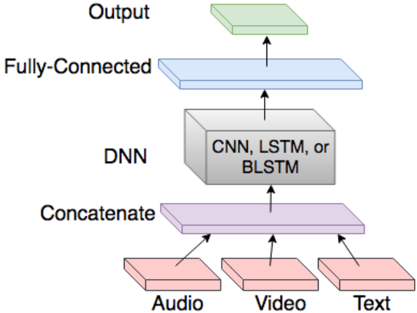
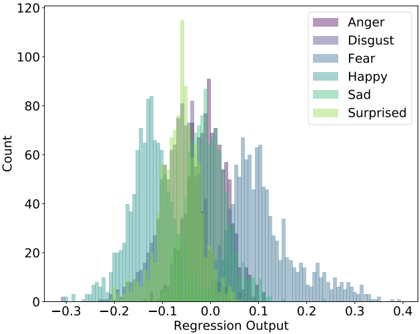
We present our system description of input-level multimodal fusion of audio, video, and text for recognition of emotions and their intensities for the 2018 First Grand Challenge on Computational Modeling of Human Multimodal Language.Our proposed approach is based on input-level feature fusion with sequence learning from Bidirectional Long-Short Term Memory (BLSTM) deep neural networks (DNNs).We show that our fusion approach outperforms unimodal predictors.Our system performs 6-way simultaneous classification and regression, allowing for overlapping emotion labels in a video segment.This leads to an overall binary accuracy of 90%, overall 4-class accuracy of 89.2% and an overall mean-absolute-error (MAE) of 0.12.Our work shows that an early fusion technique can effectively predict the presence of multi-label emotions as well as their coarsegrained intensities.The presented multimodal approach creates a simple and robust baseline on this new Grand Challenge dataset.Furthermore, we provide a detailed analysis of emotion intensity distributions as output from our DNN, as well as a related discussion concerning the inherent difficulty of this task.
Overview
The claims and statistics of this paper haven’t been checked yet.
Free: it reads the open-access text and checks the first 5 claims that cite a source we can check. Create a free account to check every claim.
Integrity signals
Registry
Cites
Statistics
Figures
Verification
Claims the paper makes
The claims and statistics of this paper haven’t been checked yet.
Free: it reads the open-access text and checks the first 5 claims that cite a source we can check. Create a free account to check every claim.
Claims other papers make about this one
Each is checked against this paper’s own text: does it say what the citing paper says it does?
The cited source says what the claim attributes to it.
In the citing paper
“They constructed a multimodal fusion system that discerns emotions and their intensities. By carrying out feature fusion at the input level and employing a Bidirectional Long Short-Term Memory (BLSTM) model for sequence learning, they underscored that early fusion can effectively predict the presence of multi-label emotions and their coarse-grained intensities.”
From A Survey of Deep Learning-Based Multimodal Emotion Recognition: Speech, Text, and Face (2023) · cites this paper as [84]
Self-check
Percentages, sums and reported differences re-computed from the paper’s own numbers.
The self-check needs the paper’s full text.
Citations
Cites
Adam: A Method for Stochastic Optimization
Kingma, D. P., & Ba, J. (2014) · arXiv · doi:10.48550/arxiv.1412.6980 · Cited by 98,946 · cited 2×
“The learning rule was Adam (Kingma and Ba, 2014) with default Tensorflow parameters.”
MethodGlove: Global Vectors for Word Representation
Pennington, J., Socher, R., & Manning, C. (2014) · Proceedings of the 2014 Conference on Empirical Methods in Natural Language Processing (EMNLP) · doi:10.3115/v1/d14-1162 · Cited by 34,071 · cited 1×
“Text features consist of word vectors obtained from the Global Vectors for Word Representation (GloVe) software (Pennington et al., 2014) as well as one-hot word representations.”
Method(2014) · Cited by 33,419
Batch Normalization: Accelerating Deep Network Training by Reducing Internal Covariate Shift
Ioffe, S., & Szegedy, C. (2015) · arXiv · doi:10.48550/arxiv.1502.03167 · Cited by 27,818 · cited 1×
“sizes set to 64 (Ioffe and Szegedy, 2015).”
Convolutional Neural Networks for Sentence Classification
Kim, Y. (2014) · Proceedings of the 2014 Conference on Empirical Methods in Natural Language Processing (EMNLP) · doi:10.3115/v1/d14-1181 · Cited by 14,831 · cited 1×
“CNN: Convolutional Neural Networks are often used in NLP for various prediction tasks, including sentiment analysis (Kim, 2014).”
Method(2010) · International Conference on Machine Learning · Cited by 13,995
TensorFlow: A system for large-scale machine learning
Abadi, M., Barham, P., Chen, J., Chen, Z., Davis, A., Dean, J., Devin, M., Ghemawat, S., Irving, G., Isard, M., et al. (2016) · arXiv (Cornell University) · doi:10.48550/arxiv.1605.08695 · Cited by 11,822
Multimodal Machine Learning: A Survey and Taxonomy
Baltrusaitis, T., Ahuja, C., & Morency, L.-P. (2019) · IEEE Transactions on Pattern Analysis and Machine Intelligence · doi:10.1109/tpami.2018.2798607 · Cited by 5,018
IEMOCAP: Interactive emotional dyadic motion capture database
Busso, C., Bulut, M., Lee, C.-C., Kazemzadeh, A., Mower, E., Kim, S., Chang, J. N., Lee, S., & Narayanan, S. S. (2008) · Language Resources and Evaluation · doi:10.1007/s10579-008-9076-6 · Cited by 3,869 · cited 2×
“The subjects functioned as emotional actors and were asked to perform scripts that were designed to elicit specific emotions: happy, angry, sad, frustrated and neutral (Busso et al., 2008).”
BackgroundFace recognition: a convolutional neural-network approach
Lawrence, S., Giles, C. L., Tsoi, A. C., & Back, A. D. (1997) · IEEE Transactions on Neural Networks · doi:10.1109/72.554195 · Cited by 3,092 · cited 2×
“From the first time that convolutional neural networks (CNNs) were employed for face recognition (Lawrence et al., 1997) to the present times when sentiment analysis revolves around using CNNs (Tripathi et al.”
Method
Research works printed but not linked: 2
- Keng-hao Chang, Drew Fisher, and John Canny. 2011. AMMON: A Speech Analysis Library For Analyz- ing Affect, Stress, and Mental Health on Mobile Phones. Proceedings of PhoneSense.
- Samarth Tripathi, Shrinivas Acharya, Ranti Dev Sharma, Sudhanshu Mittal, and Samit Bhattacharya. 2017. Using Deep and Convolutional Neural Net- works for Accurate emotion classification on DEAP Dataset. In Proceedings of the Thirty-First AAAI Conference on Artificial Intelligence, February 4-9, 2017, San Francisco, California, USA., pages 4746- 4752.
Cited by
Items 101–132 of 132
Cross-Modal Sentiment Analysis
Xu, H. (2023) · Springer eBooks · doi:10.1007/978-981-99-5776-7_5
Multimodal Sentiment Analysis Data Sets and Preprocessing
Xu, H. (2023) · Springer eBooks · doi:10.1007/978-981-99-5776-7_2 · Cited by 3
A Multimodal Sentiment Analysis Method Based on Interactive Attention
Tang, Y., Hu, P., Dong, L., Mao, M., Li, G., & Tan, L. (2023) · IEEE International Conference on Bioinformatics and Biomedicine (BIBM) · doi:10.1109/bibm58861.2023.10385594
Mobile Phone Location Algorithm in Classroom -- Solving Students’ Attention Problem
Zhang, Y., & Zhang, Y. (2024) · IEEE Advanced Information Technology, Electronic and Automation Control Conference (IAEAC) · doi:10.1109/iaeac59436.2024.10503821
Emvas: End-to-End Multimodal Emotion Visualization Analysis SystemPreprint
Zhu, X., Feng, H., Guo, C., Fan, X., Huang, J., & Wang, R. (2024) · SSRN Electronic Journal · doi:10.2139/ssrn.4832899
Extracting method for fine-grained emotional features in videos
Zheng, C., Peng, J., & Cai, Z. (2024) · Knowledge-Based Systems · doi:10.1016/j.knosys.2024.112382
ConD2: Contrastive Decomposition Distilling for Multimodal Sentiment Analysis
Xi, Y., Huang, W., & Long, J. (2024) · Lecture notes in computer science · doi:10.1007/978-981-97-8620-6_11
A Crux on Audio-Visual Emotion Recognition in the Wild with Fusion Methods
Jeong, S., Kim, D.-H., Moon, A.-S., & Lee, J. (2025) · International Conference on Consumer Electronics · doi:10.1109/icce63647.2025.10930176 · Cited by 1
“For example, J. Williams et al. [14] proposed a multimodal system that integrates audio, video, and text data to predict emotions and their intensities.”
Decoding Hostility from Conversations Through Speech and Text Integration
Xin, J., Gump, B. B., Maisto, S. A., Jorgensen, R. S., Bhatia, T. K., Phoha, V. V., & Salekin, A. (2024) · International Conference on Affective Computing and Intelligent Interaction and workshops · doi:10.1109/acii63134.2024.00032
“The common approaches for modality integration include early fusion that concatenates initial feature vectors from various modalities [35], [36], late fusion that con-catenates embeddings of different modalities generated from independent embedding generating neural networks [37], [38], and…”
Liu, C., Gao, Z., & Zhang, L. (2024) · Journal of big data and computing. · doi:10.62517/jbdc.202401313
QSMT: Query-Shared Multimodal Transformer for Multimodal Sentiment Analysis
Liu, H., Liu, Y., Ding, J., & Zhang, W. (2025) · Lecture notes in computer science · doi:10.1007/978-981-96-8180-8_9
Motif: A Text-Aware and Disentangled Mamba-Based Architecture for Multimodal Emotion RecognitionPreprint
Hu, B., & Li, Y. (2025) · SSRN Electronic Journal · doi:10.2139/ssrn.5351685
Zhu, L., Peng, J., & Zhang, H. (2025) · Communications in computer and information science · doi:10.1007/978-981-96-9986-5_14
LGFN: A Dynamic Gating Framework for Lyrics-Audio Alignment in Music Emotion RecognitionPreprint
Wang, Y., Zang, M., Zhang, H., Shan, X., & Wang, X. (2025) · bioRxiv (Cold Spring Harbor Laboratory) · doi:10.1101/2025.08.11.669801
DMBT Decoupled Multi-Modal Binding Transformer for Multimodal Sentiment Analysis
Guo, R., Gong, G., & Jiang, F. (2025) · Electronics · doi:10.3390/electronics14214296
Multilevel Feature Fusion and Attention Enhancement for Multimodal Sentiment Analysis
Zhang, L., He, T., Chen, B., & Shuan, C. (2025) · International Symposium on Computer and Information Processing Technology (ISCIPT) · doi:10.1109/iscipt67144.2025.11265256
“Early fusion integrates multimodal data before feeding it into the model, as in the EF-LSTM model [11], which concatenates features from three modalities and inputs them into an LSTM. Late fusion processes each modality independently and fuses the outputs later [12].”
The Multimodal Data Analysis for Emotion Recognition
Zherebetskyi, O. (2025) · Studies in systems, decision and control · doi:10.1007/978-3-031-95955-4_15
A Multimodal Fusion Adapter for Enhanced Chinese Sentiment Analysis
Peng, S.-W., Ho, T.-Y., & 蘇順豐 (2025) · IEEE International Conference on Consumer Electronics - Taiwan (ICCE-Taiwan) · doi:10.1109/icce-taiwan66881.2025.11208071
BNF: Bayesian Network Fusion for Multimodal Sentiment Analysis
Sun, C. (2025) · Lecture notes in computer science · doi:10.1007/978-981-96-6603-4_6
Multimodal Emotion Detection and Classification of Audio-Visual Using Deep Learning
Srivastava, M., Singh, P., & Sharma, M. K. (2025) · International Conference on Advanced Computing and Emerging Technologies (ACET) · doi:10.1109/acet67282.2025.11430197
“Nemati, et al. [13] familiarized a hybrid fusion approach that integrates audio and visual modalities using feature-level fusion.”
Wang, H., Baihetiyaer, K., Yang, D., Ma, Q., Natsagdorj, Liu, X., Sun, Q., Deng, L., Yu, F., Guo, Z., et al. (2026) · Journal of Raman Spectroscopy · doi:10.1002/jrs.70124
Zhang, Y., Chen, Q., Huang, Y., Xu, H., Qi, B., & Zhou, L. (2026) · Lecture notes in computer science · doi:10.1007/978-981-95-7078-2_1
GRNet: Graph Reconstruction Network for Robust Multimodal Sentiment Analysis
Xu, Z., Tian, L., Zhang, P., Peng, X., & Yao, H. (2026) · IEEE International Conference on Acoustics Speech and Signal Processing · doi:10.1109/icassp55912.2026.11463932
Dan, X., Gao, B., Chen, Y., Fu, Q., Li, L., Li, Y., Liu, S., & Liu, Z. (2026) · IEEE Transactions on Affective Computing · doi:10.1109/taffc.2026.3707891 · Cited by 1
“Baselines: To evaluate the effectiveness of CADET, we compare it with representative MSA methods, including TFN [12], LMF[40],EF-LSTM[41],LF-DNN[42],MFN[13],MulT[14], MISA[23],MAG-BERT[15],TFR-Net[43],DMD[44], TETFN[16],DEVA[45],andDLF[17].”
Multimodal sentiment analysis based on noise injection and adaptive multi-view dynamic fusion
Zheng, W., Chen, Q., Zhang, Z., & Cui, C. (2026) · International Journal of Machine Learning and Cybernetics · doi:10.1007/s13042-026-03205-2
“Early static fusion methods, such as EF-LSTM [ 25] and TFN [ 10], integrated modality information through feature concatenation or weighted averaging.”
Improved evidence theory based on information fusion for multimodal emotion recognition
Xiao, K., Yang, W., Zhu, G., Qiu, J., Pang, S., & Zhao, C. (2026) · The Journal of Supercomputing · doi:10.1007/s11227-026-08685-1 · Cited by 1
“Data-level fusion integrates raw or low-level features at the input stage, often via concatenation or tensor-based operations [37, 38].”
Qu, W., & Wei, B. (2026) · International Conference on Artificial Intelligence, Big Data and Algorithms (CAIBDA) · doi:10.1109/caibda70336.2026.11621444
“The comparison models include CM-Bert [25] , EF-LSTM [26] , LMF [27] , TFN [28] , MFM [29] , MulT [30] , DVMI [31] , EMT [32] , and MMIN [33] , all of which have been widely validated on the CMU-MOSEI dataset, ensuring the comprehensiveness and persuasiveness of the comparative experiments.”
Jin, Z., He, P., Guo, Y., Wang, X., & Fang, A. (2026) · Sensors · doi:10.3390/s26175580
Wang, D., Liu, Y., Li, A., & Zhou, Y. (2026) · International Conference on Machine Learning and Neural Networks · doi:10.1145/3821725.3821744
“The comparison includes several representative meth-ods, namely MFN [8], EF-LSTM [5], MulT [3], CENet [4], and HCIL [2].”
Cheng, Y., Lei, T., Yang, C., Li, J., & Kewei, Y. (2026) · SSRN Electronic Journal · doi:10.2139/ssrn.7493755
DAGF: a disentangled adaptive gating fusion network for multimodal sentiment analysis
Shi, M., & Shen, J. (2026) · Pattern Analysis and Applications · doi:10.1007/s10044-026-01780-2
“Early and late fusion approaches, such as EF-LSTM and LF-DNN [4, 5 ], directly aggregate multi-modal features or modality-level decisions, but their ability to model complex cross-modal dependencies is limited.”
Cross-modal consistency gating for reliable LLM reasoning in multimodal sentiment analysis
Bai, Y., Yan, Z., Yang, C., & Li, S. (2026) · Multimedia Systems · doi:10.1007/s00530-026-02731-x
“The proposed method is compared with several representative MSA baselines, including TFN [26], LMF [36], EF-LSTM [37 ], LF-DNN [ 38], MulT [5], MISA [27], MAG-BERT [3], Self-MM [23 ], ConFEDE [ 11], and TMBL [39].”
Metadata
- Authors
- Williams, J., Kleinegesse, S., Comanescu, R., & Radu, O.
- Affiliations
- University of Edinburgh (GB)
- Corresponding author
- Williams, Jennifer
- Venue
- Proceedings of Grand Challenge and Workshop on Human Multimodal Language (Challenge-HML)
- Published
- 2018
- Pages
- 11-19
- OpenAlex
- W2924126491
- Cited by
- 132
- References
- 35
- Citations by year
- 2026: 16 · 2025: 31 · 2024: 30 · 2023: 26 · 2022: 9 · 2021: 11 · 2020: 7 · 2019: 1 · 2018: 1
- FWCI
- 6.11
- Type
- conference paper
- Language
- en
- Open access
- gold
- doi.org
- Licence
- cc-by
- Locations
- ePrints Soton (University of Southampton) (submittedVersion)
- Edinburgh Research Explorer (University of Edinburgh) (submittedVersion, cc-by)
- Funders
- University of Edinburgh
- Engineering and Physical Sciences Research Council (EP/L016427/1)
- Topics
- Physical Sciences › Computer Science › Artificial Intelligence › Emotion and Mood Recognition
- Physical Sciences › Computer Science › Artificial Intelligence › Sentiment Analysis and Opinion Mining
- Physical Sciences › Computer Science › Signal Processing › Speech and Audio Processing
- Keywords
- emotion recognition, video, multimodal fusion, feature-level fusion, emotion intensity estimation, multi-label emotion classification, bidirectional LSTM, deep neural network
About these checks
Registry, retraction, Cites and statistics results are computed, not judged, with one exception: a printed reference that no index lists is read once by a model before it counts as a citation error. Claims are extracted by a model and kept only when their quote appears verbatim in the text; each cited source is then checked, with a model’s help, for whether it says what the claim relies on. Those verdicts can be wrong — read the claim’s quote and the cited source before relying on one.
Statistics and arithmetic are recomputed, not judged.
Confidence bands are shown only for fields calibrated on our annotated test set. None is calibrated yet, so no band is shown.
What counts as a claim ›How we measure confidence ›How we check this ›
Are you an author, or do you see a problem with this page? Request a review
Data sources
Bibliographic data: Semantic Scholar, OpenAlex, Crossref.
Contains information from the Semantic Scholar Academic Graph Datasets, made available under the ODC Attribution License (ODC-BY 1.0).
Semantic Scholar’s data is described in: Kinney, R., et al. (2023). The Semantic Scholar Open Data Platform. arXiv:2301.10140.
