

Recognizing Emotions in Video Using Multimodal DNN Feature Fusion
Open accessThe DOI matches its Crossref record; 35 of the 35 references it cites were found in a registry or an index.
Abstract
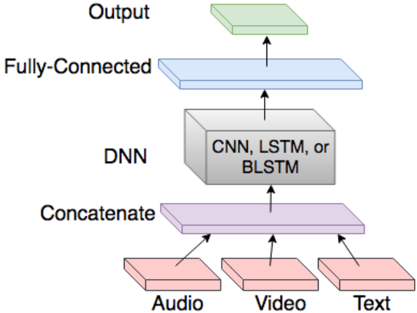
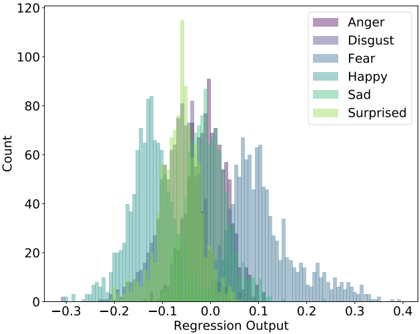
We present our system description of input-level multimodal fusion of audio, video, and text for recognition of emotions and their intensities for the 2018 First Grand Challenge on Computational Modeling of Human Multimodal Language.Our proposed approach is based on input-level feature fusion with sequence learning from Bidirectional Long-Short Term Memory (BLSTM) deep neural networks (DNNs).We show that our fusion approach outperforms unimodal predictors.Our system performs 6-way simultaneous classification and regression, allowing for overlapping emotion labels in a video segment.This leads to an overall binary accuracy of 90%, overall 4-class accuracy of 89.2% and an overall mean-absolute-error (MAE) of 0.12.Our work shows that an early fusion technique can effectively predict the presence of multi-label emotions as well as their coarsegrained intensities.The presented multimodal approach creates a simple and robust baseline on this new Grand Challenge dataset.Furthermore, we provide a detailed analysis of emotion intensity distributions as output from our DNN, as well as a related discussion concerning the inherent difficulty of this task.
Overview
The claims and statistics of this paper haven’t been checked yet.
Free: it reads the open-access text and checks the first 5 claims that cite a source we can check. Create a free account to check every claim.
Integrity signals
Registry
Cites
Statistics
Figures
Verification
Claims the paper makes
The claims and statistics of this paper haven’t been checked yet.
Free: it reads the open-access text and checks the first 5 claims that cite a source we can check. Create a free account to check every claim.
Claims other papers make about this one
Each is checked against this paper’s own text: does it say what the citing paper says it does?
The cited source says what the claim attributes to it.
In the citing paper
“They constructed a multimodal fusion system that discerns emotions and their intensities. By carrying out feature fusion at the input level and employing a Bidirectional Long Short-Term Memory (BLSTM) model for sequence learning, they underscored that early fusion can effectively predict the presence of multi-label emotions and their coarse-grained intensities.”
From A Survey of Deep Learning-Based Multimodal Emotion Recognition: Speech, Text, and Face (2023) · cites this paper as [84]
Self-check
Percentages, sums and reported differences re-computed from the paper’s own numbers.
The self-check needs the paper’s full text.
Citations
Cites
Adam: A Method for Stochastic Optimization
Kingma, D. P., & Ba, J. (2014) · arXiv · doi:10.48550/arxiv.1412.6980 · Cited by 98,946 · cited 2×
“The learning rule was Adam (Kingma and Ba, 2014) with default Tensorflow parameters.”
MethodGlove: Global Vectors for Word Representation
Pennington, J., Socher, R., & Manning, C. (2014) · Proceedings of the 2014 Conference on Empirical Methods in Natural Language Processing (EMNLP) · doi:10.3115/v1/d14-1162 · Cited by 34,071 · cited 1×
“Text features consist of word vectors obtained from the Global Vectors for Word Representation (GloVe) software (Pennington et al., 2014) as well as one-hot word representations.”
Method(2014) · Cited by 33,419
Batch Normalization: Accelerating Deep Network Training by Reducing Internal Covariate Shift
Ioffe, S., & Szegedy, C. (2015) · arXiv · doi:10.48550/arxiv.1502.03167 · Cited by 27,818 · cited 1×
“sizes set to 64 (Ioffe and Szegedy, 2015).”
Convolutional Neural Networks for Sentence Classification
Kim, Y. (2014) · Proceedings of the 2014 Conference on Empirical Methods in Natural Language Processing (EMNLP) · doi:10.3115/v1/d14-1181 · Cited by 14,831 · cited 1×
“CNN: Convolutional Neural Networks are often used in NLP for various prediction tasks, including sentiment analysis (Kim, 2014).”
Method(2010) · International Conference on Machine Learning · Cited by 13,995
TensorFlow: A system for large-scale machine learning
Abadi, M., Barham, P., Chen, J., Chen, Z., Davis, A., Dean, J., Devin, M., Ghemawat, S., Irving, G., Isard, M., et al. (2016) · arXiv (Cornell University) · doi:10.48550/arxiv.1605.08695 · Cited by 11,822
Multimodal Machine Learning: A Survey and Taxonomy
Baltrusaitis, T., Ahuja, C., & Morency, L.-P. (2019) · IEEE Transactions on Pattern Analysis and Machine Intelligence · doi:10.1109/tpami.2018.2798607 · Cited by 5,018
IEMOCAP: Interactive emotional dyadic motion capture database
Busso, C., Bulut, M., Lee, C.-C., Kazemzadeh, A., Mower, E., Kim, S., Chang, J. N., Lee, S., & Narayanan, S. S. (2008) · Language Resources and Evaluation · doi:10.1007/s10579-008-9076-6 · Cited by 3,869 · cited 2×
“The subjects functioned as emotional actors and were asked to perform scripts that were designed to elicit specific emotions: happy, angry, sad, frustrated and neutral (Busso et al., 2008).”
BackgroundFace recognition: a convolutional neural-network approach
Lawrence, S., Giles, C. L., Tsoi, A. C., & Back, A. D. (1997) · IEEE Transactions on Neural Networks · doi:10.1109/72.554195 · Cited by 3,092 · cited 2×
“From the first time that convolutional neural networks (CNNs) were employed for face recognition (Lawrence et al., 1997) to the present times when sentiment analysis revolves around using CNNs (Tripathi et al.”
Method
Research works printed but not linked: 2
- Keng-hao Chang, Drew Fisher, and John Canny. 2011. AMMON: A Speech Analysis Library For Analyz- ing Affect, Stress, and Mental Health on Mobile Phones. Proceedings of PhoneSense.
- Samarth Tripathi, Shrinivas Acharya, Ranti Dev Sharma, Sudhanshu Mittal, and Samit Bhattacharya. 2017. Using Deep and Convolutional Neural Net- works for Accurate emotion classification on DEAP Dataset. In Proceedings of the Thirty-First AAAI Conference on Artificial Intelligence, February 4-9, 2017, San Francisco, California, USA., pages 4746- 4752.
Cited by
CH-SIMS: A Chinese Multimodal Sentiment Analysis Dataset with Fine-grained Annotation of Modality
Yu, W., Xu, H., Meng, F., Zhu, Y., Ma, Y., Wu, J., Zou, J., & Yang, K. (2020) · Proceedings of the 58th Annual Meeting of the Association for Computational Linguistics · doi:10.18653/v1/2020.acl-main.343 · Cited by 482
“The Early Fusion LSTM (EF-LSTM) (Williams et al., 2018) concatenates initial inputs of three modalities first and then use LSTM to capture long-distance dependencies in a sequence.”
MethodTransformer-based Feature Reconstruction Network for Robust Multimodal Sentiment Analysis
Yuan, Z., Li, W., Xu, H., & Yu, W. (2021) · Proceedings of the 29th ACM International Conference on Multimedia · doi:10.1145/3474085.3475585 · Cited by 211
“The models like MFN [30] and EF-LSTM [27] can work on aligned multimodal data, which means the frames of audio and vision have explicit correspondence with the words in the text modality.”
MethodA Survey of Deep Learning-Based Multimodal Emotion Recognition: Speech, Text, and Face
Lian, H., Lu, C., Li, S., Zhao, Y., Tang, C., & Zong, Y. (2023) · Entropy · doi:10.3390/e25101440 · Cited by 224
“Further progress in early fusion was seen in the work of Williams et al. [84].”
MethodAutomated emotion recognition: Current trends and future perspectives
Maithri, M., Raghavendra, U., Gudigar, A., Samanth, J., Barua, P. D., Murugappan, M., Chakole, Y., & Acharya, U. R. (2022) · Computer Methods and Programs in Biomedicine · doi:10.1016/j.cmpb.2022.106646 · Cited by 172
Ho, N.-H., Yang, H.-J., Kim, S.-H., & Lee, G. (2020) · IEEE Access · doi:10.1109/access.2020.2984368 · Cited by 167
A Survey of Video Surveillance Systems in Smart City
Myagmar-Ochir, Y., & Kim, W. (2023) · Electronics · doi:10.3390/electronics12173567 · Cited by 134
“Deep learning can be performed by various types of neural networks such as CNNs [39–42], DNNs [43,44], and RNNs [45,46], to recognize objects, track movements, and analyze behavior in video data [47].”
BackgroundA cross modal hierarchical fusion multimodal sentiment analysis method based on multi-task learning
Wang, L., Peng, J., Zheng, C., Zhao, T., & Zhu, L. (2024) · Information Processing & Management · doi:10.1016/j.ipm.2024.103675 · Cited by 134
Multimodal Learning with Incomplete Modalities by Knowledge Distillation
Wang, Q., Zhan, L., Thompson, P., & Zhou, J. (2020) · Proceedings of the 26th ACM SIGKDD International Conference on Knowledge Discovery & Data Mining · doi:10.1145/3394486.3403234 · Cited by 96
“If we train the M-DNN as the methods in [33], i.e., only use the samples with complete modalities f X 1 c ; X 2 c ; y c g to train the model, the sample size is limited to be n c .”
MethodMultimodal Routing: Improving Local and Global Interpretability of Multimodal Language Analysis
Tsai, Y.-H. H., Ma, M., Yang, M., Salakhutdinov, R., & Morency, L.-P. (2020) · Proceedings of the 2020 Conference on Empirical Methods in Natural Language Processing (EMNLP) · doi:10.18653/v1/2020.emnlp-main.143 · Cited by 98
“Recent work (Liu et al., 2018; Williams et al., 2018; Ortega et al., 2019) proposed methods to fuse information across modalities and yielded superior performance, but these models are often black-box with very limited interpretability.”
MethodTeFNA: Text-centered fusion network with crossmodal attention for multimodal sentiment analysis
Huang, C., Zhang, J., Wu, X., Wang, Y., Li, M., & Huang, X. (2023) · Knowledge-Based Systems · doi:10.1016/j.knosys.2023.110502 · Cited by 99
MissModal: Increasing Robustness to Missing Modality in Multimodal Sentiment Analysis
Lin, R., & Hu, H. (2023) · Transactions of the Association for Computational Linguistics · doi:10.1162/tacl_a_00628 · Cited by 137
Multi-Task Momentum Distillation for Multimodal Sentiment Analysis
Lin, R., & Hu, H. (2023) · IEEE Transactions on Affective Computing · doi:10.1109/taffc.2023.3282410 · Cited by 95
“The baselines are introduced in detail as below: EF-LSTM (Early Fusion LSTM) [29] concatenates the modality features at the input level and processes the concatenated features with a LSTM layer and classifier.”
BackgroundMethodMultimodal sentiment analysis based on multi-layer feature fusion and multi-task learning
Cai, Y., Li, X., Zhang, Y., Li, J., Zhu, F., & Rao, L. (2025) · Scientific Reports · doi:10.1038/s41598-025-85859-6 · Cited by 108
Cheng, H., Yang, Z., Zhang, X., & Yang, Y. (2023) · IEEE Transactions on Affective Computing · doi:10.1109/taffc.2023.3265653 · Cited by 76
“Some multimodal fusion models with the recurrent neural networks, such as LSTMs and GRUs [7], [8], [9], can effectively capture the temporal structure within a single modality, but they are short of specific components to capture intra-modal and inter-modal interactions explicitly and fuse…”
BackgroundMake Acoustic and Visual Cues Matter: CH-SIMS v2.0 Dataset and AV-Mixup Consistent Module
Liu, Y., Yuan, Z., Mao, H., Liang, Z., Yang, W., Qiu, Y., Cheng, T., Li, X., Xu, H., & Gao, K. (2022) · Proceedings of the 2022 International Conference on Multimodal Interaction · doi:10.1145/3536221.3556630 · Cited by 64
“The traditional MSA models which are supervised with the unified multimodal annotations include the Late Fusion Deep Neural Network (LF_DNN) [36], the Tensor Fusion Network (TFN) [43], the Low-rank Multimodal Fusion (LMF) [17], the Memory Fusion Network (MFN) [44], the Graph Memory Fusion Network (Graph_MFN) [46], the…”
MethodDynamically Adjust Word Representations Using Unaligned Multimodal Information
Guo, J., Tang, J., Dai, W., Ding, Y., & Kong, W. (2022) · ACM International Conference on Multimedia (ACM MM) · doi:10.1145/3503161.3548137 · Cited by 92
“The expressive power of the single language modality is limited by the ambiguity of the language [33].”
BackgroundConKI: Contrastive Knowledge Injection for Multimodal Sentiment Analysis
Yu, Y., Zhao, M. M., Qi, S.-A., Sun, F., Wang, B., Guo, W., Wang, X. L., Yang, L., & Niu, D. (2023) · Findings of the Association for Computational Linguistics: ACL (Findings of ACL) · doi:10.18653/v1/2023.findings-acl.860 · Cited by 82
Video multimodal sentiment analysis using cross-modal feature translation and dynamical propagation
Gan, C., Tang, Y., Fu, X., Zhu, Q., Jain, D. K., & García, S. (2024) · Knowledge-Based Systems · doi:10.1016/j.knosys.2024.111982 · Cited by 62
Li, X., Liu, J., Xie, Y., Gong, P., Zhang, X., & He, H. (2023) · Knowledge-Based Systems · doi:10.1016/j.knosys.2023.111126 · Cited by 61
FMSA-SC: A Fine-Grained Multimodal Sentiment Analysis Dataset Based on Stock Comment Videos
Song, L., Chen, S., Meng, Z., Sun, M., & Shang, X. (2024) · IEEE Transactions on Multimedia · doi:10.1109/tmm.2024.3363641 · Cited by 51
“In these methods, various multimodal fusion methods are developed to fuse sentiment cues from multiple different modalities, such as feature concatenation [40], tensor factorization [41], [42] or importing attention mechanisms [36], [43], [44].”
MethodA multimodal fusion method for sarcasm detection based on late fusion
Ding, N., Tian, S., & Yu, L. (2022) · Multimedia Tools and Applications · doi:10.1007/s11042-022-12122-9 · Cited by 62
“In order to verify the comparison results between the deep learning models, we have added the experimental results of several models, they are: EF-LSTM [38], MFN [47], LMF [22], TFN [44] and MULT [36].”
MethodResultA fine-grained modal label-based multi-stage network for multimodal sentiment analysis
Peng, J., Wu, T., Zhang, W., Cheng, F., Tan, S., Yi, F., & Huang, Y. (2023) · Expert Systems with Applications · doi:10.1016/j.eswa.2023.119721 · Cited by 60
Multimodal Mutual Attention-Based Sentiment Analysis Framework Adapted to Complicated Contexts
He, L., Wang, Z., Wang, L., & Li, F. (2023) · IEEE Transactions on Circuits and Systems for Video Technology · doi:10.1109/tcsvt.2023.3276075 · Cited by 49
“We compare the performance of our proposed MMSA with the following multimodal sentiment analysis models: (1) EF-LSTM [57]: The early fusion LSTM method splices the initial features of three modalities and then captures the sequence’s long-distance dependencies among the spliced features by using…”
MethodWeakening the Dominant Role of Text: CMOSI Dataset and Multimodal Semantic Enhancement Network
Jin, C., Luo, C., Yan, M. G., Zhao, G., Zhang, G., & Zhang, S. (2023) · IEEE Transactions on Neural Networks and Learning Systems · doi:10.1109/tnnls.2023.3282953 · Cited by 48
“1) Early Fusion LSTM (EF-LSTM): EF-LSTM model [49] uses early fusion to concatenate the original features of the three modalities.”
A Deep Multi-task Contextual Attention Framework for Multi-modal Affect Analysis
Akhtar, M. S., Chauhan, D. S., & Ekbal, A. (2020) · ACM Transactions on Knowledge Discovery from Data · doi:10.1145/3380744 · Cited by 49
“We obtained the overall Pearson score of 0.32 and MAE of 0.16, while the existing systems obtained the best Pearson score of 0.27 (i.e., System L [34]) and MAE of 0.12 (i.e., System J [50]).”
MethodInfluentialEMOE: Modality-Specific Enhanced Dynamic Emotion Experts
Fang, Y., Huang, W., Wan, G., Su, K., & Ye, M. (2025) · IEEE Computer Society Conference on Computer Vision and Pattern Recognition/Proceedings - IEEE Computer Society Conference on Computer Vision and Pattern Recognition/Proceedings · doi:10.1109/cvpr52734.2025.01335 · Cited by 97
Zhou, X., Chen, C., Zuo, E., Chen, C., & Lv, X. (2024) · Applied Soft Computing · doi:10.1016/j.asoc.2024.112204 · Cited by 42
Zhou, X., Chen, C., Lv, X., Zuo, E., Li, M., Wu, L., Chen, X., Wu, X., & Chen, C. (2024) · Information Processing & Management · doi:10.1016/j.ipm.2024.103804 · Cited by 45
Layer-wise Fusion with Modality Independence Modeling for Multi-modal Emotion Recognition
Sun, J., Han, S., Ruan, Y.-P., Zhang, X., Zheng, S., Liu, Y., Huang, Y., & Li, T. (2023) · Proceedings of the conference - Association for Computational Linguistics. Meeting · doi:10.18653/v1/2023.acl-long.39 · Cited by 56
“Early fusion (Lazaridou et al., 2015; Williams et al., 2018) simply concatenates the low-level features of all the modalities, and feeds the joint feature to the model.”
BackgroundMethodAdaMoW: Multimodal Sentiment Analysis Based on Adaptive Modality-Specific Weight Fusion Network
Zhang, J., Wu, X., & Huang, C. (2023) · IEEE Access · doi:10.1109/access.2023.3276932 · Cited by 40
“In the early fusion, the modality features obtained by connecting various modality features are used as the fusion features to input the model [30].”
MethodSSLMM: Semi-Supervised Learning with Missing Modalities for Multimodal Sentiment Analysis
Wang, Y., Jian, H., Zhuang, J., Guo, H., & Leng, Y. (2025) · Information Fusion · doi:10.1016/j.inffus.2025.103058 · Cited by 41
EMVAS: end-to-end multimodal emotion visualization analysis system
Zhu, X., Feng, H., Cambria, E., Huang, Y., Ju, M., Yuan, H., & Wang, R. (2025) · Complex & Intelligent Systems · doi:10.1007/s40747-025-01931-8 · Cited by 40
“EF-LSTM [13]: The Early Fusion Long Short-Term Memory network amalgamates input from three modalities into a fused feature set, which is then processed through an LSTM for emotional analysis.”
InfluentialDeng, H., Yang, Z., Hao, T., Li, Q., & Liu, W. (2022) · IEEE Transactions on Multimedia · doi:10.1109/tmm.2022.3211197 · Cited by 36
“For example, Williams et al. [5] concatenated the inputs into LSTM from different modalities at each time step, which could not model intra-modality interactions.”
BackgroundMulti-modal feature fusion based on multi-layers LSTM for video emotion recognition
Nie, W., Yan, Y., Song, D., & Wang, K. (2020) · Multimedia Tools and Applications · doi:10.1007/s11042-020-08796-8 · Cited by 37
“Williams et al. [17] concatenate the multimodal features as input and only contain one DNN (CNN, LSTM, BLSTM) layer to recognize emotions of a video segment.”
BackgroundMultimodal Emotion Recognition Using Different Fusion Techniques
Subramanian, G., Cholendiran, N., Prathyusha, K., Balasubramanain, N., & Aravinth, J. (2021) · International Conference on Bio Signals, Images, and Instrumentation (ICBSII) · doi:10.1109/icbsii51839.2021.9445146 · Cited by 33
“The resultant fused features of dimension (1,1664) were fused the individual features using CNN [23].”
MethodLi, Y., Yang, Q., Chen, Q., Hu, B., Wang, X., Ding, Y., & Ma, L. (2022) · IEEE Transactions on Multimedia · doi:10.1109/tmm.2022.3143324 · Cited by 36
“Inspired by previous fusion methods of multi-modal representation such as Early Fusion LSTM [50], Tensor Fusion Network [51], Memory Fusion Network [52] and Low-rank Multi-Modal Fusion [53], we design a multi-modal fusion sub-layer in each block of DSCIFN to strongly integrate the cross-modal…”
BackgroundMethodMuti-Modal Emotion Recognition via Hierarchical Knowledge Distillation
Sun, T., Wei, Y., Ni, J., Liu, Z., Song, X., Wang, Y., & Nie, L. (2024) · IEEE Transactions on Multimedia · doi:10.1109/tmm.2024.3385180 · Cited by 43
“…validate our proposed model, we compared the model with several state-of-the-art baselines, including the feature-level fu-sionmodels( i.e.,EF-LSTM [43], TFN [22], MFM [16], MulT [3], MISA [44], LF-DNN [45], and ALBEF [20]) and decision-level fusion models ( i.e., FE2E [4], MESM [4], and UMT [46]).”
MethodSecuring IP in edge AI: neural network watermarking for multimodal models
Nie, H., & Lu, S. (2024) · Applied Intelligence · doi:10.1007/s10489-024-05746-x · Cited by 28
“Long Short-Term Memory (LSTM): LSTM models, first proposed by Hochreiter & Schmidhuber [51], are a type of recurrent neural network (RNN) specifically designed to handle sequence prediction problems.”
Song, H., Zhou, X., Chen, C., Dong, C., He, Y., Wu, M., Yu, J., Chen, X., Li, Y., & Ma, B. (2024) · Scientific Reports · doi:10.1038/s41598-024-80590-0 · Cited by 29
StyleBERT: Text-audio sentiment analysis with Bi-directional Style Enhancement
Lin, F., Liu, S., Zhang, C., Jin, F., & Wu, Z. (2022) · Information Systems · doi:10.1016/j.is.2022.102147 · Cited by 26
Detecting Topic-Oriented Speaker Stance in Conversational Speech
Lai, C., Alex, B., Moore, J. D., Tian, L., Hori, T., & Francesca, G. (2019) · Interspeech (USB) · doi:10.21437/interspeech.2019-2632 · Cited by 20
“However, relatively little work has been done on detecting stance in speech compared to automatic emotion recognition [6, 7, 8] or sentiment analysis [9, 10, 11].”
BackgroundQi, Q., Lin, L., & Zhang, R. (2021) · Information · doi:10.3390/info12090342 · Cited by 19
“In [23], the author directly performs input-level feature fusion on multimodal data in the input stage and combines deep neural networks for sentiment analysis.”
Chen, R., Zhou, W., Hu, H., Fei, Z., Fei, M., & Zhou, H. (2024) · Knowledge-Based Systems · doi:10.1016/j.knosys.2024.112372 · Cited by 20
A Three-stage multimodal emotion recognition network based on text low-rank fusion
Zhao, L., Yang, Y., & Ning, T. (2024) · Multimedia Systems · doi:10.1007/s00530-024-01345-5 · Cited by 22
“We choose the EF-LSTM, LF-DNN [43], TFN, LMF, MFN [44], Graph-MFN, Mult, PMR [45], DEAN, and UniMF as baseline models.”
Adaptive multimodal transformer based on exchanging for multimodal sentiment analysis
Tuerhong, G., Fu, F., & Wushouer, M. (2025) · Scientific Reports · doi:10.1038/s41598-025-11848-4 · Cited by 21
Zhou, X., Chen, X., Song, H., Lv, X., Gu, J., Chen, C., & Chen, C. (2025) · Microchemical Journal · doi:10.1016/j.microc.2025.112870 · Cited by 15
Multimodal Activation: Awakening Dialog Robots without Wake Words
Nie, L., Jia, M., Song, X., Wu, G., Cheng, H. H., & Gu, J. H. (2021) · International ACM SIGIR Conference on Research and Development in Information Retrieval (SIGIR) · doi:10.1145/3404835.3462964 · Cited by 14
“• MSA_EF-LSTM: Derived from MSA_TFN, this method [40] first concatenates initial inputs of three modalities and then uses LSTM to capture their dependencies in the sequence.”
MethodBimodal fusion network with multi-head attention for multimodal sentiment analysis
Zhang, R., Xue, C., Qi, Q., Lin, L., Zhang, J., & Zhang, L. (2023) · Applied Sciences · doi:10.3390/app13031915 · Cited by 11
Li, X., Dong, Z., Cheng, X., Miao, D., Zhang, H., Wang, T., Zhang, X., & Li, Z. (2025) · Expert Systems with Applications · doi:10.1016/j.eswa.2025.129341 · Cited by 21
Dense Fusion Network with Multimodal Residual for Sentiment Classification
Deng, H., Kang, P., Yang, Z., Hao, T., Li, Q., & Liu, W. (2021) · IEEE International Conference on Multimedia and Expo (ICME) · doi:10.1109/icme51207.2021.9428321 · Cited by 12
“…(TFN) [2], Low rank Multimodal Fusion (LMF) [6], Memory Fusion Network (MFN) [7], Dynamic fusion graph (DFG) [14], Early Fusion LSTM (EF-LSTM) [1], Bi-directional Contextual LSTM (BC-LSTM) [15], Convolutional Multiple Kernel Learning (C-MKL) [5], Multi-attention Recurrent Network (MARN) [3] ,…”
BackgroundGlobal distilling framework with cognitive gravitation for multimodal emotion recognition
Li, H., Zhong, H., Xu, C., Liu, X., Wen, G., & Liu, L. (2025) · Neurocomputing · doi:10.1016/j.neucom.2024.129306 · Cited by 9
Towards Explainable Fusion and Balanced Learning in Multimodal Sentiment Analysis
Luo, M., Jiang, Y., & Mai, S. (2025) · ACM International Conference on Multimedia (ACM MM) · doi:10.1145/3746027.3755591 · Cited by 30
GRACE: GRadient-based Active Learning with Curriculum Enhancement for Multimodal Sentiment Analysis
Li, X., Ye, W., Zhang, Y., & Sun, X. (2024) · ACM International Conference on Multimedia (ACM MM) · doi:10.1145/3664647.3681617 · Cited by 17
“Various fusion techniques have been explored, including early fusion [39], late fusion [50], and hybrid fusion [6], aiming to leverage the complementary strengths of each modality.”
Chen, M., Liu, J., Li, X., Zhang, Y., Liu, H., Jiao, J., & He, H. (2025) · IEEE Transactions on Affective Computing · doi:10.1109/taffc.2025.3569089 · Cited by 11
“EF-LSTM[46]:EF-LSTMconcatenatesfeaturevectorsfrom differentmodalitiesandfeedsthemintoanLSTMtopredict sentimentpolarity.”
Circular Decomposition and Cross-Modal Recombination for Multimodal Sentiment Analysis
Liang, H., Xie, W., He, X., Song, S., & Shen, L. (2024) · IEEE International Conference on Acoustics Speech and Signal Processing · doi:10.1109/icassp48485.2024.10446166 · Cited by 8
“Most prior studies have concentrated on the development of sophisticated fusion networks for effectively harnessing diverse modal information, typically classified as early fusion [4, 5, 2] and late fusion [6, 7, 8].”
BackgroundMECG: modality-enhanced convolutional graph for unbalanced multimodal representations
Tang, J., Ni, B., Yang, Y., Ding, Y., & Kong, W. (2024) · The Journal of Supercomputing · doi:10.1007/s11227-024-06729-y · Cited by 6
“Due to the ambiguity of single language modality, sentiments are limited in their expressiveness [18].”
Modality-uncertainty-aware knowledge distillation framework for multimodal sentiment analysis
Wang, N., & Wang, Q. (2025) · Complex & Intelligent Systems · doi:10.1007/s40747-025-02135-w · Cited by 11
“Early fusion integrates multimodal information to generate unified sentiment representations [ 26–28], while late fusion combined the predictions from individual modalities to produce final assessments [ 29–31].”
Zhang, L., Liu, C., & Jia, N. (2023) · Applied Sciences · doi:10.3390/app13179910 · Cited by 8
Semantic Interaction Fusion Framework for Multimodal Sentiment Recognition
Yang, S., Cui, L., & Wang, T. (2023) · Conference proceedings/Conference proceedings - IEEE International Conference on Systems, Man, and Cybernetics · doi:10.1109/smc53992.2023.10394433 · Cited by 7
“Previous works have verified that multimodal sentiment recognition accuracy is higher than unimodal sentiment recognition through numerous experiments [1][2].”
BackgroundMultimodal Emotion Fusion Mechanism and Empathetic Responses in Companion Robots
Liu, X., Lv, Q., Li, J., Song, S., & Cangelosi, A. (2024) · IEEE Transactions on Cognitive and Developmental Systems · doi:10.1109/tcds.2024.3442203 · Cited by 10
“Our method incorporates the For the MOSI dataset, we compare our method with EF-LSTM [65], TFN, MFN, ICCN [66], MulT, MISA [67], Cube-MLP [68], multimodal cyclic translation network (MCTN) [69], FmlMSN, and BBFN [70].”
InfluentialMultimodal Sentiment Analysis for the Malay Language: New Corpus using CNN-based Framework
Taylor, S., & Fauzi, F. (2025) · ACM Transactions on Asian and Low-Resource Language Information Processing · doi:10.1145/3703445 · Cited by 7
“This approach leverages the spatial-temporal understanding of 3D models while simplifying the extraction to 2D frames for efficiency.”
Self-attention mechanism prior to modality fusion for multimodal sentiment analysis
Chen, Z., Lu, C., & Wang, Y. (2025) · Multimedia Systems · doi:10.1007/s00530-025-01868-5 · Cited by 7
“Williams et al. [23] applied a feature fusion method at the input layer, using deep neural networks to predict multi-label sentiment and its intensity.”
Rethinking the Effect of Unimodal Labels in Multimodal Sentiment Analysis
Zhang, L., Li, T., Lu, B., Fang, J.-F., Zheng, D., Zhou, W., Liu, W., & Lv, F. (2026) · ACM Transactions on Multimedia Computing Communications and Applications · doi:10.1145/3796718 · Cited by 8
“For the CH-SIMS v2.”
InfluentialEvaluation of Data Inconsistency for Multi-modal Sentiment Analysis
Wang, Y., & Wu, M. (2024) · Communications in computer and information science · doi:10.1007/978-981-96-1045-7_25 · Cited by 11
Jiang, S., Wang, Z., Wu, X., Ji, H., Li, M. X., Li, X., & Gao, C. (2025) · ACM International Conference on Multimedia (ACM MM) · doi:10.1145/3746027.3754817 · Cited by 12
“To demonstrate the effectiveness of our DDSE, we conduct comprehensive comparisons with 16 state-of-the-art baselines: TFN [66], LMF [38], EF-LSTM [56] LF-DNN [55], MFN [67], Graph-MPN [70], MulT [49], PMR [39], MISA [22], MAG-BERT [44], GCNet [35], DMD [30], IMDer [54], Coupled Mamba [29], CMHFM…”
Handwritten Signature Verification via Multimodal Consistency Learning
Shi, Z., Li, F., Hao, D., & Sun, Q. (2025) · IEEE Transactions on Information Forensics and Security · doi:10.1109/tifs.2025.3557674 · Cited by 5
“For simple operation, the Early Fusion Network [42] first fuses inputs and then processes them through feature networks.”
Unimodal and Crossmodal Refinement Network for Multimodal Sequence Fusion
Guo, X., Kong, A. W., Zhou, H., Wang, X., & Wang, M. (2021) · Conference on Empirical Methods in Natural Language Processing (EMNLP) · doi:10.18653/v1/2021.emnlp-main.720 · Cited by 6
“With the development of various network architectures, considerable progress has been achieved in multimodal fusion (Williams et al., 2018; Tsai et al., 2019; Mai et al., 2020; Zadeh et al., 2019), showing that multimodal representation outperforms unimodal ones on emotion and sentiment prediction…”
BackgroundEmotion Classification of Social Media Posts using Artificial Intelligence and Machine Learning
Aggarwal, V., Kaur, H., Sharma, D., & Singhal, A. (2023) · International Conference on Computational Intelligence and Sustainable Engineering Solutions (CISES) · doi:10.1109/cises58720.2023.10183414 · Cited by 6
Model for Determining the Psycho-Emotional State of a Person Based on Multimodal Data Analysis
Shakhovska, N., Zherebetskyi, O., & Lupenko, S. A. (2024) · Applied Sciences · doi:10.3390/app14051920 · Cited by 4
Multi-modal Intent Detection with LVAMoE: the Language-Visual-Audio Mixture of Experts
Li, T., Bao, J., Qin, J., Liang, Y., Zhang, R., & Wang, J. (2024) · IEEE International Conference on Multimedia and Expo (ICME) · doi:10.1109/icme57554.2024.10688018 · Cited by 10
Multimodal Sentiment Analysis Method Based on Multi-task Learning
Li, J., & Zhao, H. (2023) · doi:10.1145/3614008.3614055 · Cited by 7
“Early fusion methods [3] integrate the features of each modality at the input layer, which results in information within modalities that cannot be modeled effectively.”
BackgroundVideo sentiment analysis with bimodal information-augmented multi-head attention
Wu, T., Peng, J., Zhang, W., Zhang, H., Tan, S., Yi, F., Ma, C., & Huang, Y. (2022) · Knowledge-Based Systems · doi:10.1016/j.knosys.2021.107676 · Cited by 131
MMKT: Multimodal Sentiment Analysis Model Based on Knowledge-Enhanced and Text-Guided Learning
Shi, C., & Zhang, Y. (2025) · Applied Sciences · doi:10.3390/app15179815 · Cited by 8
Multimodal intent recognition based on text-guided cross-modal attention
Li, Z., Peng, J., Lin, X., & Cai, Z. (2025) · Applied Intelligence · doi:10.1007/s10489-025-06583-2 · Cited by 11
“In the initial stages of exploring multimodal fusion, researchers investigate various methods for integrating multimodal features using techniques such as deep neural networks (DNNs) [27], long short-term memory (LSTM) networks [28], and attention-based LSTM models [29], and others.”
Feature Alignment and Reconstruction Constraints for Multimodal Sentiment Analysis
Zhu, Q., Lan, T., Liang, J. P., Xiang, D., & He, H. (2024) · International Joint Conference on Neural Networks (IJCNN) · doi:10.1109/ijcnn60899.2024.10650976 · Cited by 4
“LF-DNN [16], which only fuses multimodal information for classification, performs the worst on all metrics.”
BackgroundMethodMulti-Modal Graph-Based Sentiment Analysis via Hybrid Contrastive Learning
Zhang, J. (2024) · IEEE International Conference on Sensors, Electronics and Computer Engineering (ICSECE) · doi:10.1109/icsece61636.2024.10729439 · Cited by 4
“For optimal performance on the MOSI [49] and MOSEI [50] datasets that are public available, we have set the number of LSTM and GNN layers to 1, the number of attention heads to the best performing value, and the dropout rate to 0.1.”
MethodInfluentialZhu, C., Chen, M., Li, H., Zhang, S., Liang, H., Sun, C., Liu, Y., & Chen, J. (2024) · Neural Computing and Applications · doi:10.1007/s00521-024-10678-1 · Cited by 2
“Williams et al. [19] present the early fusion Long Short-Term Memory (EF-LSTM) network that concatenates the features of three modalities together for sequence learning.”
From Feature Alignment to Multimodal Fusion: A Two-Stage Primary Modality-Guided Approach for MSA
Ma, G., Ren, X., Jiang, Y., Guan, H., & Xu, B. (2025) · ACM International Conference on Multimedia in Asia (MMAsia) · doi:10.1145/3743093.3771041 · Cited by 4
“We compare TSPMG with 12 state-of-the-art MSA methods, including EF-LSTM [37], LF-DNN [36], TFN [39], LMF [21], MFN [40], Graph-MFN [41], MulT [33], PMR [22], MISA [10], MAG-BERT [30], DMD [16], and DLF [34].”
Bimodal Emotion Recognition for the Patients with Depression
Wang, X., Zhao, S., & Wang, Y. (2021) · IEEE International Conference on Signal and Image Processing (ICSIP) · doi:10.1109/icsip52628.2021.9688837 · Cited by 4
“In 2018, Williams et al. [5] proposed to use the bidirectional long short-term memory network for multi-modal emotion recognition.”
BackgroundWang, B., Zhang, X., Du, K., Gao, C., & Li, L. (2023) · IEEE International Conference on Software Analysis, Evolution and Reengineering (SANER) · doi:10.1109/saner56733.2023.00117 · Cited by 4
“Earlier work [12-14] focused on aligned multimodal data, which implies that there must be an explicit correspondence in each modality.”
BackgroundMethodInfluentialA Dual-branch Enhanced Multi-task Learning Network for Multimodal Sentiment Analysis
Geng, W., Li, X., & Bian, Y. (2023) · International Conference on Multimedia Retrieval · doi:10.1145/3591106.3592260 · Cited by 4
“Early fusion intra-modal dynamics may be inhibited [18, 19], which leads to the loss of contextual and temporal dependencies within each modality.”
BackgroundAVMFAC: Acoustic Visual Multi-scale Feature Aggregation Conformer for Multimodal Sentiment Analysis
Zheng, Q. (2023) · Lecture notes in computer science · doi:10.1007/978-981-99-8565-4_23 · Cited by 2
Jiang, R., Wen, Z., Liu, H., & Liu, C. (2023) · IEEE International Conference on Computer and Communications (ICCC) · doi:10.1109/iccc59590.2023.10507508 · Cited by 2
Nguyen, D.-K., Lim, E., Kim, S.-H., Yang, H.-J., & Kim, S. (2025) · Applied Sciences · doi:10.3390/app15052862 · Cited by 3
Feng, C., Yang, H., Wang, S., & Li, X. (2025) · The Journal of Supercomputing · doi:10.1007/s11227-025-07474-6 · Cited by 3
“If the feature is only important in the other modality, the value is close to 0.5; if it is not related to text and audio, the value is close to 0 [11].”
InfluentialMorales, C. R. G., & Shinde, S. (2018) · Lecture notes in computer science · doi:10.1007/978-3-030-04497-8_18 · Cited by 2
Activity Identification and Recognition in Real-Time Video Data Using Deep Learning Techniques
Grover, A., Arora, D., & Grover, A. (2024) · Algorithms for intelligent systems · doi:10.1007/978-981-99-7962-2_31 · Cited by 1
Multimodal Sentiment Analysis for Movie Scenes Based on a Few-Shot Learning Approach
Yang, H., & Li, B. (2024) · International Journal of Pattern Recognition and Artificial Intelligence · doi:10.1142/s0218001424510091 · Cited by 2
Multimodal sentiment analysis based on slice aggregation and dynamic fusion
Zhan, Z., Cao, D., Chen, Z., Cheng, H., & Yu, Z. (2025) · CCF Transactions on Pervasive Computing and Interaction · doi:10.1007/s42486-025-00195-y · Cited by 3
“Concatenation and other similar ideas were proposed in early related works to fuse the low-level features of different modalities (Williams et al. 2018; He et al. 2015).”
A Review of Multimodal Sentiment Analysis in Online Public Opinion Monitoring
Liu, S., & Li, T. (2026) · Informatics · doi:10.3390/informatics13010010 · Cited by 6
Refined separated representation learning and conflict alleviation for multimodal sentiment analysis
Zheng, Y., Lu, A., Peng, S., Chen, Y., & Peng, X. (2026) · Journal of King Saud University - Computer and Information Sciences · doi:10.1007/s44443-026-00568-y · Cited by 1
“MFN introduces delta memory attention and multi-view gated memories to model cross-temporal dependencies (Williams et al. 2018).”
HDR: Hypergraph dynamic representation network for multimodal sentiment analysis
Xiao, K., Zhang, C., & Pang, S. (2026) · Expert Systems with Applications · doi:10.1016/j.eswa.2026.133313 · Cited by 2
A Multimodal, Multilabel Approach to Recognize Emotions in Oral History Interviews
Viswanath, A., Gref, M., Hassan, T., & Schmidt, C. (2024) · International Conference on Affective Computing and Intelligent Interaction and workshops · doi:10.1109/acii63134.2024.00038 · Cited by 1
“…(MFN) [42], Graph-Memory Fusion Network [22], Recurrent Attended Variation Embedding Network (RAVEN) [43], Multilogue-Net [44], Multimodal DNN [45], Multiplicative Multimodal Emotion Recognition (M3ER) model [46], and Self-Supervised Multi-task Multimodal sentiment analysis network (Self-MM)…”
INTELLIGENT ASSISTANCE IN ONLINE INTERVIEWING. EMOTIONAL ROUTING METHOD
Sorokina, S., & Soma, G. M. (2020) · Research Result Information Technologies · doi:10.18413/2518-1092-2020-5-4-0-6
“MATERIALS AND METHODS Today, there are ways to detect emotions from video channels [3, 4], services that recognize spoken speech and sounds [5, 6], as well as written text analyzers [7, 8].”
BackgroundМетод эмоционального прогнозирования в онлайн-собеседовании
Алейников, С. А., Сорокина, С. А., & Офицеров, А. И. (2022) · Экономика Информатика · doi:10.52575/2687-0932-2021-48-1-178-187
Sentence-level Online Handwritten Chinese Character RecognitionPreprint
Li, Y., Yang, Q., Chen, Q., Ma, L., Hu, B., Wang, X., & Ding, Y. (2021) · arXiv (Cornell University) · doi:10.48550/arxiv.2108.02561
“Inspired by the previous fusion methods of multi-modal representation such as Early Fusion LSTM [35], Tensor Fusion Network [40], Memory Fusion Network [41] and Low-rank multi-modal Fusion [21], we design a multi-modal fusion sub-layer in each block of DSTFN to tackle the above features.”
MethodAutomatic Multimodal Emotion Recognition Using Facial Expression, Voice, and Text
Tran, H. (2022) · International Joint Conference on Artificial Intelligence · doi:10.24963/ijcai.2022/843
A Multi-step Attention and Multi-level Structure Network for Multimodal Sentiment Analysis
Zhang, C., Zhao, H., Wang, B., Wang, W., Ke, T., & Li, J. (2022) · Lecture notes in computer science · doi:10.1007/978-3-031-17120-8_56
Wang, Y., Guo, X., Zhang, Y., Ren, Y., Huang, W., Liu, Z., Feng, Y., Dai, X., Zhang, W., & Che, H. (2023) · International Conference on Advanced Computational Intelligence (ICACI) · doi:10.1109/icaci58115.2023.10146184 · Cited by 1
“The LF-DNN model [18] uses LSTM to capture long-range dependencies in sequences to extract text features, and uses the nonlinear fitting capability of MLP to extract feature information of face and speech modalities.”
BackgroundMethodModal Interactive Feature Encoder for Multimodal Sentiment Analysis
Zhao, X., Zhou, J., & Xiu-juan, X. (2023) · Communications in computer and information science · doi:10.1007/978-981-99-5971-6_21
Metadata
- Authors
- Williams, J., Kleinegesse, S., Comanescu, R., & Radu, O.
- Affiliations
- University of Edinburgh (GB)
- Corresponding author
- Williams, Jennifer
- Venue
- Proceedings of Grand Challenge and Workshop on Human Multimodal Language (Challenge-HML)
- Published
- 2018
- Pages
- 11-19
- OpenAlex
- W2924126491
- Cited by
- 132
- References
- 35
- Citations by year
- 2026: 16 · 2025: 31 · 2024: 30 · 2023: 26 · 2022: 9 · 2021: 11 · 2020: 7 · 2019: 1 · 2018: 1
- FWCI
- 6.11
- Type
- conference paper
- Language
- en
- Open access
- gold
- doi.org
- Licence
- cc-by
- Locations
- ePrints Soton (University of Southampton) (submittedVersion)
- Edinburgh Research Explorer (University of Edinburgh) (submittedVersion, cc-by)
- Funders
- University of Edinburgh
- Engineering and Physical Sciences Research Council (EP/L016427/1)
- Topics
- Physical Sciences › Computer Science › Artificial Intelligence › Emotion and Mood Recognition
- Physical Sciences › Computer Science › Artificial Intelligence › Sentiment Analysis and Opinion Mining
- Physical Sciences › Computer Science › Signal Processing › Speech and Audio Processing
- Keywords
- emotion recognition, video, multimodal fusion, feature-level fusion, emotion intensity estimation, multi-label emotion classification, bidirectional LSTM, deep neural network
About these checks
Registry, retraction, Cites and statistics results are computed, not judged, with one exception: a printed reference that no index lists is read once by a model before it counts as a citation error. Claims are extracted by a model and kept only when their quote appears verbatim in the text; each cited source is then checked, with a model’s help, for whether it says what the claim relies on. Those verdicts can be wrong — read the claim’s quote and the cited source before relying on one.
Statistics and arithmetic are recomputed, not judged.
Confidence bands are shown only for fields calibrated on our annotated test set. None is calibrated yet, so no band is shown.
What counts as a claim ›How we measure confidence ›How we check this ›
Are you an author, or do you see a problem with this page? Request a review
Data sources
Bibliographic data: Semantic Scholar, OpenAlex, Crossref.
Contains information from the Semantic Scholar Academic Graph Datasets, made available under the ODC Attribution License (ODC-BY 1.0).
Semantic Scholar’s data is described in: Kinney, R., et al. (2023). The Semantic Scholar Open Data Platform. arXiv:2301.10140.
