

The DOI matches its Crossref record; 9 of the 9 references it cites were found in a registry or an index; none of the 24 sources its claims cite is checked for support yet.
Estimating the impact of the Mongol expansion upon the gene pool of Tuvans
Open accessAbstract
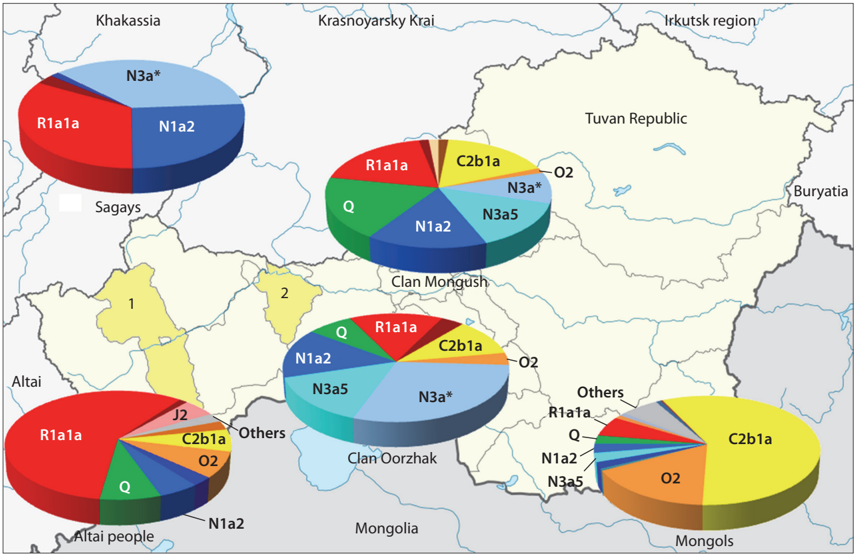
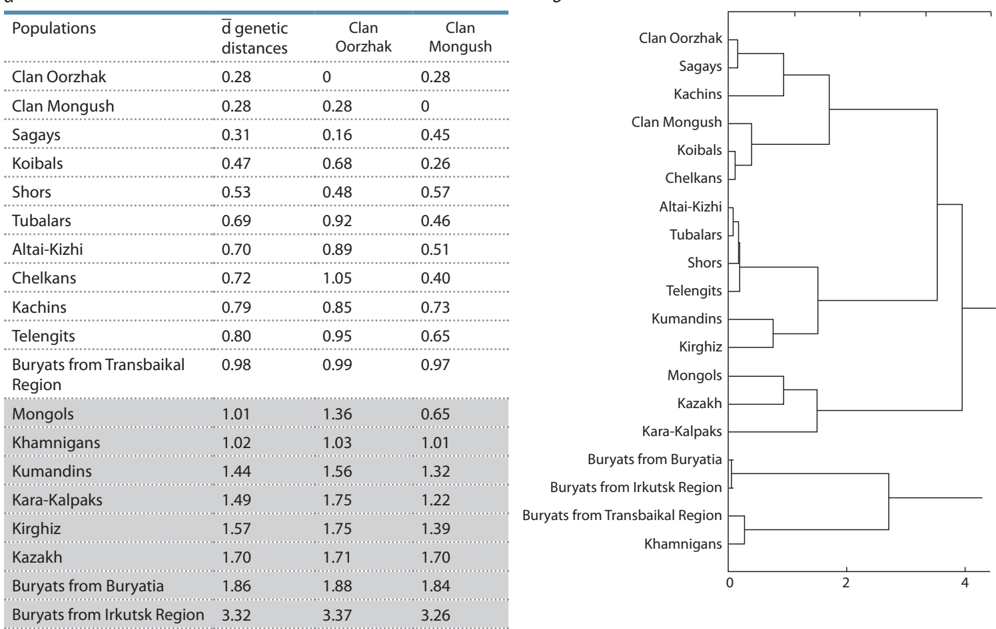
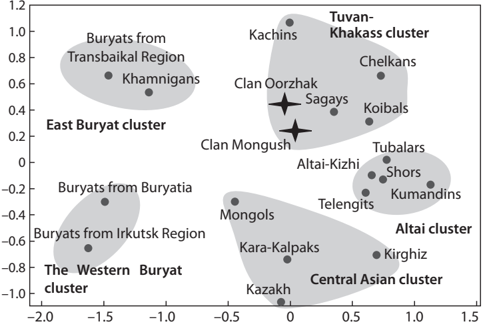
With a view to trace the Mongol expansion in Tuvinian gene pool we studied two largest Tuvinian clans – those in which, according to data of humanities, one could expect the highest Central Asian ancestry, connected with the Mongol expansion. Thus, the results of Central Asian ancestry in these two clans component may be used as upper limit of the Mongol influence upon the Tuvinian gene pool in a whole. According to the data of 59 Y-chromosomal SNP markers, the haplogroup spectra in these Tuvinian tribal groups (Mongush, N = 64, and Oorzhak, N = 27) were similar. On average, two-thirds of their gene pools (63 %) are composed by North Eurasian haplogroups (N*, N1a2, N3a, Q) connected with autochtonous populations of modern area of Tuvans. The Central Asian haplogroups (C2, O2) composed less then fifth part (17 %) of gene pools of the clans studied. The opposite ratio was revealed in Mongols: there were 10 % North Eurasian haplogroups and 75 % Central Asian haplogroups in their gene pool. All the results derived – “genetic portraits”, the matrix of genetic distances, the dendrogram and the multidimensional scaling plot, which mirror the genetic connections between Tuvinian clans and populations of South Siberia and East Asia, demonstrated the prominent similarity of the Tuvinian gene pools with populations from and Khakassia and Altai. It could be therefore assumed that Tuvinian clans Mongush and Oorzhak originated from autochtonous people (supposedly, from the local Samoyed and Kets substrata). The minor component of Central Asian haplogroups in the gene pool of these clans allowed to suppose that Mongol expansion did not have a significant influence upon the Tuvinan gene pool at a whole.
Overview
CoChat Summary
Written by AI from the paper’s full text.
TL;DR
Y-chromosome SNP analysis of the two largest Tuvan clans (Mongush, N=64; Oorzhak, N=27) found their gene pools dominated by North Eurasian haplogroups (average 63%) and only a minor Central Asian component (average 17%), whereas Mongols show the opposite ratio (10% vs 75%). The authors conclude that the Mongol expansion had no significant impact on the Tuvan gene pool as a whole, with these clans mainly descending from autochthonous Altai-Sayan populations.
Key findings
- In the two clans, North Eurasian haplogroups (N*, N1a2, N3a, Q) made up an average of 63% of the Y-chromosome gene pool, while Central Asian haplogroups (C2, O2) made up about 17%; in Mongols, the proportions were 10% North Eurasian and 75% Central Asian.
- The Mongush and Oorzhak haplogroup spectra were similar; the Mongush clan was genetically closer to Mongols (d = 0.65) than the Oorzhak clan was (d = 1.36), but both were closest to populations of Khakassia and Altai (e.g., Oorzhak–Sagays d = 0.16; Mongush–Koibals d = 0.26).
- The authors infer that the clans originated largely from autochthonous people, supposedly from local Samoyed and Ket substrata, and that the minor Central Asian component may reflect only a weak trace of Mongol ancestry or earlier Central Asian migrations.
Methods
- Genomic DNA was obtained from venous blood of male indigenous Tuvan representatives; relatedness between any individuals was more than 3, and all ancestors belonged to the same clan and lived in the same territory for more than 3 generations. Samples were Mongush from Chaa-Kholsky koshuun (N = 64) and Oorzhak from Barun-Khemchiksky koshuun (N = 27), total N = 91.
- Genotyping used real-time PCR with Taqman assays on StepOnePlus and 7900HT systems, covering 59 Y-chromosomal SNP markers; haplogroup nomenclature followed ISOGG Y-DNA Haplogroup Tree 2018, with N3 sub-clades named according to Ilumäe et al. (2016).
- Nei’s genetic distances were calculated from haplogroup frequencies using Djgenetic; multivariate analysis used STATISTICA 6.0 with Ward’s method, compared with unpublished Y-chromosome haplogroup frequencies from the “Y-base” database. The multidimensional scaling plot used frequencies of 75 Y-chromosomal haplogroups in 19 populations of South Siberia and Central Asia (stress = 0.13; alienation = 0.15).
Limitations
- The paper states that different haplogroup frequencies between the clans may mainly result from small samples; the study intentionally analyzed only Y-chromosome paternal lines and is described as a first step, with autosomal markers not analyzed.
- The paper states that the source of the weak Central Asian ancestry remains unresolved—whether it is associated with the late Mongol expansion or earlier constant migrations from Central Asia—and that genetic and anthropological data indicate only biological traces of migrations, not cultural influence.
- Evident from the text: the Oorzhak sample is small (N = 27), only two clans were sampled as an upper-bound estimate, and comparative analyses rely partly on unpublished “Y-base” data.
Model-written summary. Check it against the paper before relying on it.
Integrity signals
Registry
Cites
Statistics
Figures
Verification
Claims the paper makes
33 Own result · 20 Own interpretation · 16 Sources not found · 3 Own method · 2 Not checked yet · 1 No basis given
A result the paper reports from its own data — it cites no other source for it, so there is none to check. The quote shows it is in the paper.
In the paper
“All the results derived - 'genetic portraits' , the matrix of genetic distances, the dendrogram and the multidimensional scaling plot, which mirror the genetic connections between Tuvinian clans and populations of South Siberia and East Asia, demonstrated the prominent similarity of the Tuvinian gene pools with populations from and Khakassia and Altai.”
boostedstates an association- Asserted: passes — The authors put it forward as true.
- Checkable: passes — It can be checked against evidence.
- Load-bearing: unclear — It is unclear whether the paper’s conclusions depend on it.
- Based: passes — The paper gives a reason why it holds.
A result the paper reports from its own data — it cites no other source for it, so there is none to check. The quote shows it is in the paper.
In the paper
“Thus, in the gene pools of Oorzhak and Mongush Tuvinian clans, which are speculated to be mostly affected by Mongolian ancestry, two thirds of the entire gene pools are represented by typical 'North Eurasian' haplogroups (58 % in Mongush and 67 % in Oorzhak).”
plain- Asserted: passes — The authors put it forward as true.
- Checkable: passes — It can be checked against evidence.
- Load-bearing: passes — The paper’s conclusions depend on it.
- Based: passes — The paper gives a reason why it holds.
- Rests on 2 assumptions not shown here.
A result the paper reports from its own data — it cites no other source for it, so there is none to check. The quote shows it is in the paper.
In the paper
“Within the genetic space of Siberia and Central Asia, a compact cluster of Altai and the TuvinianKhakassian one are the closest.”
plainstates an association- Asserted: passes — The authors put it forward as true.
- Checkable: passes — It can be checked against evidence.
- Load-bearing: passes — The paper’s conclusions depend on it.
- Based: passes — The paper gives a reason why it holds.
A result the paper reports from its own data — it cites no other source for it, so there is none to check. The quote shows it is in the paper.
In the paper
“Great variety of Buryat populations is reflected by two welldistinctive clusters of 'west Buryats' and 'east Buryats'.”
boostedstates an association- Asserted: passes — The authors put it forward as true.
- Checkable: passes — It can be checked against evidence.
- Load-bearing: unclear — It is unclear whether the paper’s conclusions depend on it.
- Based: passes — The paper gives a reason why it holds.
A result the paper reports from its own data — it cites no other source for it, so there is none to check. The quote shows it is in the paper.
In the paper
“On average, two-thirds of their gene pools (63 %) are composed by North Eurasian haplogroups (N*, N1a2, N3a, Q) connected with autochtonous populations of modern area of Tuvans.”
- Also stated in: § ' Genetic portrays ' of Mongush and Oorzhak clans · p. 3 · plain
“In both clans, two thirds of Y gene pools (in total sample, average 63 %) were represented by North Eurasian hg N and hg Q (see Table), while on the contrary, Central Asian hg C2 and hg O had an insignificant place in the gene pools of Tuvinian clans, average frequency being about 17 %.”
plainn = 64- Asserted: passes — The authors put it forward as true.
- Checkable: passes — It can be checked against evidence.
- Load-bearing: passes — The paper’s conclusions depend on it.
- Based: passes — The paper gives a reason why it holds.
- Also stated in: § ' Genetic portrays ' of Mongush and Oorzhak clans · p. 3 · plain
- It may state two separate claims as one. 31
- Probably not a substantial claim. 14
- The quote only partly states this claim. 1
Create a free account to see these claims.
Create a free account to see these assumptions.
29 more claims
Create a free account to see all 75 claims and to verify the 2 references still open.
Citations
Cites
The Genetic Legacy of the Mongols
Zerjal, T., Xue, Y., Bertorelle, G., Wells, R. S., Bao, W., Zhu, S., Qamar, R., Ayub, Q., Mohyuddin, A., Fu, S., et al. (2003) · The American Journal of Human Genetics · doi:10.1086/367774 · Cited by 563
The Eurasian Heartland: A continental perspective on Y-chromosome diversity
Wells, R. S., Yuldasheva, N., Ruzibakiev, R., Underhill, P. A., Evseeva, I., Blue-Smith, J., Jin, L., Su, B., Pitchappan, R., Shanmugalakshmi, S., et al. (2001) · Proceedings of the National Academy of Sciences · doi:10.1073/pnas.171305098 · Cited by 356
Rootsi, S., Анатольевич, Ж. Л., Baldovič, M., Kayser, M., Kutuev, I. A., Khusainova, R. I., Bermisheva, M., Gubina, M. A., Федорова, С. А., IlumäE, A.-M., et al. (2006) · European Journal of Human Genetics · doi:10.1038/sj.ejhg.5201748 · Cited by 186
Ilumäe, A.-M., Reidla, M., Chukhryaeva, M., Järve, M., Post, H., Karmin, M., Saag, L., Agdzhoyan, A., Kushniarevich, A., Litvinov, S., et al. (2016) · The American Journal of Human Genetics · doi:10.1016/j.ajhg.2016.05.025 · Cited by 134
Self-citationAbilev, S., Malyarchuk, B., Derenko, M., Wozniak, M., Grzybowski, T., & Zakharov, I. (2012) · Human Biology · doi:10.3378/027.084.0106 · Cited by 56
The Connection of the Genetic, Cultural and Geographic Landscapes of Transoxiana
Zhabagin, M., Balanovska, E., Sabitov, Z., Kuznetsova, M., Agdzhoyan, A., Balaganskaya, O., Chukhryaeva, M., Markina, N., Romanov, A., Skhalyakho, R., et al. (2017) · Scientific Reports · doi:10.1038/s41598-017-03176-z · Cited by 39
Self-citationХарьков, В. Н., Khamina, K. V., Медведева, О. Ф., Симонова, К. В., Робертовна, Е. Е., & Степанов, В. А. (2014) · Russian Journal of Genetics · doi:10.1134/s1022795413110082 · Cited by 32
Gene-pool structure of Tuvinians inferred from Y-chromosome marker data
Харьков, В. Н., Khamina, K. V., Медведева, О. Ф., Симонова, К. В., Khitrinskaya, I. Y., & Степанов, В. А. (2013) · Russian Journal of Genetics · doi:10.1134/s102279541312003x · Cited by 15
Comparative characteristics of the gene pool of Teleuts inferred from Y-chromosomal marker data
Харьков, В. Н., Медведева, О. Ф., Лузина, Ф. А., Владимирович, К. А., Gafarov, N. I., Puzyrev, V. P., & Степанов, В. А. (2009) · Russian Journal of Genetics · doi:10.1134/s1022795409080158 · Cited by 13
Research works printed but not linked: 6
- Balaganskaya O.A., Damba L.D., Zhabagin M.K., Agdzhoy¬an A.T., Yusupov Y.M., Sabitov Z.M., Bogunov Y.V., Balaganskiy A.G., Sultanova G.D., Dolinina D.O., Pady¬ukova A.D., Shalyaho R.A., Markina N.V., Bukin A.G., Lavryashina M.B., Balanovskaya E.V., Baranova E.G., Balanovsky O.P. Mongolian trace in gene pool of popula¬tions along the steppe of Eurasia. Sovremennye Problemy Nauki i Obrazovaniya = Modern Problems of Science and Education. 2016;4:211. (in Russian)
- Balaganskaya O.A., Lavryashina M.B., Kuznetsova M.A., Romanov A.G., Dibirova Kh.D., Frolova S.A., Kuznetso¬va A.A., Zakharova T.A., Baranova E.E., Teutchezh I.E., Romashkina M.V., Sabitov Z., Tazhigulova I., Nima¬dava P., Balanovskaya E.V., Balanovsky O.P. Genetic structure of Altai people (Russia, Kazarhstan, Mongolia). Vestnik Moskovskogo Universiteta. Seria XXIII. Antro¬pologia = Vestnik of Moscow University. Ser. XXIII. Antropology. 2011b;2: 25-39. (in Russian)
- Balanovskaya E.V., Balaganskaya O.A., Damba L.D., Di¬birova Kh.D., Agdzhoyan A.T., Bogunov Y.V., Zhabagin M.K., Isakova Z.T., Lavryashina M.B., Bala¬novsky O.P. Impact of the environment on the gene pool of Turkic-speaking populations of mountains and steppes in Altay, Sayan, Tien Shan and Pamir. Vestnik Moskovsk¬ogo Universiteta. Seria XXIII. Antropologia = Vestnik of Moscow University. Ser. XXIII. Antropology. 2014;2:4655. (in Russian)
- Damba L.D., Aiyzhy E.V., Mongush B.B., Zhabagin M.K., Yusupov Y.M., Bogunov Y.V., Sabitov Z.M., Agdzhoy¬an A.T., Markina N.V., Dorzhu C.M., Balanovskaya E.V., Balanovsky O.P. Complex approach in tribal structure of Tuvans by the example of tribal groups Oorzhak and Mon¬gush. Vestnik Tuvinskogo Gosudarstvennogo Universite¬ta = Bulletin of Tuvan State University. 2018;2. (in Russian)
- Zhabagin M.K., Dibirova Kh.D., Frolova S.A., Sabitov Z.M., Yusupov Y.M., Utevskaya O.M., Tarlikov P.V., Tazhigulo¬va I.M., Balaganskaya O.A., Nimadava P., Zakharov I.A., Balanovsky O.P. The relation between the Y-chromosomal variation and the clan structure: the gene pool of the steppe aristocracy and the steppe clergy of the Kazakhs. Vestnik Moskovskogo Universiteta. Seria XXIII. Antropologia = Vestnik of Moscow University. Ser. XXIII. Antropology. 2014;1:96-101. (in Russian)
- Zhabagin M.K., Sabitov Z., Balaganskaya O., Bogunova A., Frolova S., Tazhigulova I., Nimadava P., Zakharov-Geze¬hus I.A., Balanovsky O.P. The possible role of social se¬lection in the distribution of major haplotypes of Y-hap¬logroup C* in the people of Central Asia. 5th Int. conf. “Alexeev reading” on the memory of T.I. Alexeeva and V.P. Alexeev. Moscow, 2013. (in Russian)
Cited by
Khussainova, E., Kisselev, I., Iksan, O., Bekmanov, B., Skvortsova, L., Garshin, A., Kuzovleva, E., Zhaniyazov, Z., Zhunussova, G., Musralina, L., et al. (2022) · Frontiers in Genetics · doi:10.3389/fgene.2021.801295 · Cited by 12
Gene pool of three Eastern Tuvan clans according to Y-chromosome polymorphism
Damba, L. D., Balanovska, E. V., Agdzhoyan, A., Korotkova, N. A., Biobank of Northern Eurasia, K., Olkova, M. V., Utrivan, S. A., Pylev, V. Y., Aiyzhy, E. V., Михайловна, Д. Ч., et al. (2019) · Moscow University Anthropology Bulletin (Vestnik Moskovskogo Universiteta Seria XXIII Antropologia) · doi:10.32521/2074-8132.2019.1.074-085 · Cited by 8
Self-citationAnalysis of Clan Structure of Tuvans by Y-Chromosome Markers
Zhabagin, M. K., Damba, L., Korotkova, N. A., Chernishenko, D. N., Utrivan, S. A., Pilev, V. Y., Olkova, M. V., Balanovska, E. V., Yankovsky, N. K., & Balanovsky, O. P. (2020) · Russian Journal of Genetics · doi:10.1134/s1022795420060137 · Cited by 6
Self-citationStructure and origin of Tuvan gene pool according to autosome SNP and Y-chromosome haplogroups
Степанов, В. А., Kolesnikov, N. A., Валихова, Л. В., Зарубин, А. А., Khitrinskaya, I. Y., & Харьков, В. Н. (2023) · Vavilov Journal of Genetics and Breeding · doi:10.18699/vjgb-23-06 · Cited by 4
Research Institute of Medical and Social Problems and Control of the Healthcare Department, K.-O. S., Damba, L. D., Aigygy, E. V., Tuvan State University, L. S., Balanovsky, O. P., Vavilov Institute of General Genetics RAS, G. S., Markina, N. V., Vavilov Institute of General Genetics RAS, G. S., Zhabagin, M. K., National Center for Biotechnology, K. S., et al. (2022) · Moscow University Anthropology Bulletin (Vestnik Moskovskogo Universiteta. Seria XXIII. Antropologia) · doi:10.32521/2074-8132.2022.1.077-085 · Cited by 3
Self-citationDiversity of gene pools in twelve Tuvan tribal groups (based on Y-chromosome haplogroup data)
Balanovska, E. V., Damba, L. D., Adamov, D., Ponomarev, G., Potanina, A. Y., & Pocheshkhova, E. (2025) · Moscow University Anthropology Bulletin (Vestnik Moskovskogo Universiteta Seria XXIII Antropologia) · doi:10.55959/msu2074-8132-25-3-5 · Cited by 2
Self-citationХарьков, В. Н. (2021) · Russian Journal of Genetics · doi:10.1134/s1022795421090040 · Cited by 2
The structure of the gene pool of the southern tribal groups of tuvans
Damba, L. D., Ponomarev, G., Pylev, V. Y., & Balanovska, E. V. (2024) · Moscow University Anthropology Bulletin (Vestnik Moskovskogo Universiteta Seria XXIII Antropologia) · doi:10.55959/msu2074-8132-24-3-8 · Cited by 2
Self-citationAdamov, D., Ponomarev, G., Larissa, D., Pocheshkhova, E., & Balanovska, E. V. (2026) · Nature anthropology · doi:10.70322/natanthropol.2026.10010 · Cited by 1
Damba, L. D., Pylev, V. Y., Balanovska, E. V., & Biobank of North Eurasia (3, K. S. (2022) · ORIENTAL STUDIES · doi:10.22162/2619-0990-2022-63-5-1064-1076
Self-citationStatistical association between genetic markers and food addiction: methodological considerations
Flores-Carrasco, S. V., Roco-Videla, Á., Maureira-Carsalade, N., & Olguín-Barraza, M. (2023) · Nutrición Hospitalaria · doi:10.20960/nh.04871
COMMON ANCESTORS OF TURKIC-SPEAKING PEOPLES: GENETIC ASPECTS
Spitsyna, N. K., & Balinova, N. (2024) · Вестник антропологии (Herald of Anthropology) · doi:10.33876/2311-0546/2024-3/355-365
Adamov, D., Ponomarev, G., Damba, L. D., & Balanovska, E. V. (2026) · Genes · doi:10.3390/genes17080896
Self-citation
Metadata
- Authors
- Damba, L. D., Balanovskaya, Е. V., Zhabagin, M. K., Yusupov, Y. М., Bogunov, Y. V., Sabitov, Z. M., Agdzhoyan, A. T., Korotkova, N. A., Lavryashina, M. B., Mongush, B. B., Kavai-ool, U. N., & Balanovsky, O. P.
- Affiliations
- National Center for Biotechnology (KZ)
- Vavilov Institute of General Genetics (RU)
- L. N. Gumilyov Eurasian National University (KZ)
- Kemerovo State University (RU)
- ORCID
- Venue
- Vavilov Journal of Genetics and Breeding
- Published
- 2018-08-10
- Volume
- 22
- Issue
- 5
- Pages
- 611-619
- ISSN
- 1814-554X (ISSN-L)
- 2500-3259
- 2500-0462
- OpenAlex
- W2886615831
- Cited by
- 15
- References
- 9
- Citations by year
- 2026: 2 · 2025: 1 · 2024: 2 · 2023: 3 · 2022: 4 · 2021: 1 · 2020: 1 · 2019: 1
- FWCI
- 0.39
- Type
- journal article
- Language
- en
- Open access
- diamond
- doi.org
- Licence
- cc-by
- Locations
- Vavilov Journal of Genetics and Breeding (publishedVersion, cc-by)
- DOAJ (DOAJ: Directory of Open Access Journals) (submittedVersion, cc-by-sa)
- Topics
- Life Sciences › Biochemistry, Genetics and Molecular Biology › Genetics › Forensic and Genetic Research
- Life Sciences › Biochemistry, Genetics and Molecular Biology › Genetics › Genetic diversity and population structure
- Social Sciences › Arts and Humanities › History › Eurasian Exchange Networks
- Keywords
- Mongol expansion, Tuvans, Y-chromosome haplogroups, genetic admixture, Mongol origins, Khakassia, Altai, Samoyeds, Kets
About these checks
Registry, retraction, Cites and statistics results are computed, not judged, with one exception: a printed reference that no index lists is read once by a model before it counts as a citation error. Claims are extracted by a model and kept only when their quote appears verbatim in the text; each cited source is then checked, with a model’s help, for whether it says what the claim relies on. Those verdicts can be wrong — read the claim’s quote and the cited source before relying on one.
A language model drew the claims from the paper on 2026-11-12, under version 3 of the claim definition (model deepseek-v4.1-flash, prompt extract-v3).
A second model labelled each claim on 2026-11-12 (model jev-1.13-20260917, definition revision gold-guideline-v0.2).
Statistics and arithmetic are recomputed, not judged.
Confidence bands are shown only for fields calibrated on our annotated test set. None is calibrated yet, so no band is shown.
What counts as a claim ›How we measure confidence ›How we check this ›
Are you an author, or do you see a problem with this page? Request a review
