

The Bakhshālī Manuscript: A Response to the Bodleian Library's Radiocarbon Dating
Open accessThe DOI matches its Crossref record; 11 of the 11 references it cites were found in a registry or an index; 1 of the 35 sources its claims cite were checked for support.
Abstract
Popular attention has recently been captured by the results of the Bodleian Library's 2017 project of radiocarbon datingportions of the birch-bark fragments constituting what is known as the Bakhshālī Manuscript. In this paper, we disagree with the interpretation of the findings announced by the Bodleian team. In particular, we argue that the earliest dated folio of this manuscript is unlikely to be the date of the whole text. Rather, the latest dateable folio is logically the date of the scribal activity. This fits well with past estimates of the date of the Bakhshālī Manuscript based on historical, philological and palaeographic arguments.. And we argue that the Bakhshālī Manuscript does include written zeros that function as arithmetical operators, i.e., as numbers in their own right, and not merely as place-holders, as asserted by the Bodleian team. Finally, we express regret that the Bodleian Library chose to announce scientific results without peer-review and through a press release to newspapers and a YouTube video.
Overview
CoChat Summary
TL;DR
The paper argues that the Bodleian Library's 2017 radiocarbon date ranges for three Bakhshālī Manuscript samples (224–383, 680–779, and 885–993 CE) do not justify treating the manuscript as three chronologically distinct manuscripts. It contends that palaeographic and content continuity, plus the manuscript's use of zero as an arithmetical operator, fit a unified text whose scribal date should be the youngest folio, consistent with earlier historical and philological estimates.
Key findings
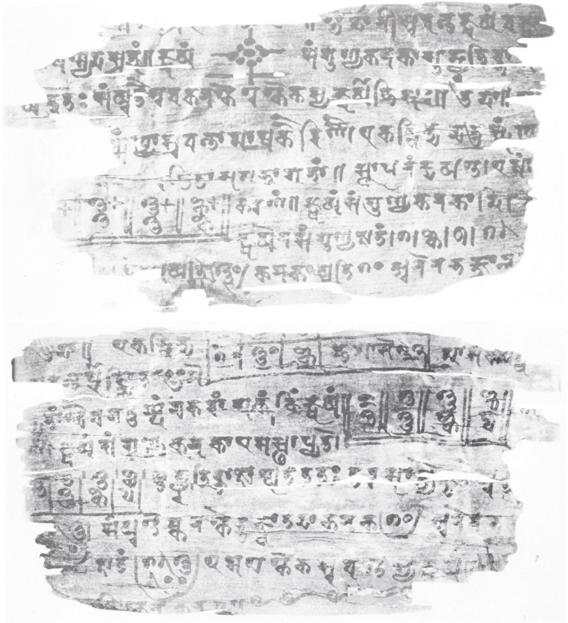
- Bodleian samples from folios 16, 17, and 33 gave ranges 224–383, 680–779, and 885–993 CE; the authors say this would separate folios 16 and 17 by at least three and possibly five and a half centuries, yet Hayashi states there is no evidence the scribe of fol. 17 differs from fol. 16 and that the content of fol. 16v continues on fol. 17r.
- The script, handwriting, and layout are far more uniform than expected for manuscripts differing by hundreds of years; the authors conclude the manuscript was likely written as a single unified work, so if bark leaves differ in age, the date of the youngest folio is the approximate date of scribal activity. This fits Hayashi's tentative dating of the commentary to the seventh century and the manuscript to between the eighth and twelfth centuries.
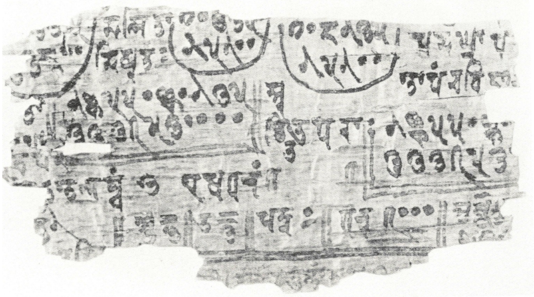
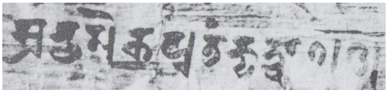
- The authors argue the Bakhshālī zero functions as an arithmetical operator/number in its own right, not merely a placeholder; they cite f. 47r, where 108625/65600 × 59425/49200 = 6455040625/3227520000, and folio 22v, where a zero-dot for the unknown is replaced by 1 under the rule "having added unity to zero" (śūnyam ekayutaṃ kṛtvā).
- They maintain that tracing zero and decimal place value solely through physical evidence is unreliable; textual evidence places zero ideas in South Asia at least to the early centuries CE, and the earliest definite complete decimal place-value system dates to around 550 CE ("sixty minus zero"). They also reject the "Buddhist merchant" scenario, noting the colophon author identifies as a brāhmaṇa and that no definite social milieu can be drawn beyond the work being intended for Vasiṣṭha's family.
Methods
- Critical response/review, not new radiocarbon dating: the authors examine the Bodleian's 2017 radiocarbon project and prior scholarship/editions (Hoernle, Kaye, Hayashi) using palaeographic, codicological, philological, and historical arguments.
- Data discussed include the three bark samples from folios 16, 17, and 33; Hayashi's edition/translation/commentary; facsimiles; and comparative cases such as two Tibetan folia whose C-14 dates differ by six hundred years.
- Main analysis compares the radiocarbon implications with the manuscript's script/content continuity, birch-bark production and use, linguistic features, and the history of zero/decimal place value, concluding that physical testing must be reconciled with historical and cultural criteria.
Limitations
- The authors state they are not qualified to challenge the assigned radiocarbon dates on technical grounds; they request supplementary explanations on cross-checking more than one sample per folio, sampling actual written characters rather than uninked bark, and considering birch-bark manufacture, storage, use, and dating of other early folios.
- They state the Bodleian kept the carbon-dating findings embargoed for months and then used a newspaper press release and YouTube, bypassing standard academic channels and peer review.
- Evident from the text: no new C-14 measurements or technical reanalysis are presented; the argument relies on prior facsimiles/editions and personal communications, and the authors say no definite conclusions can be drawn about the social milieu beyond the colophon's stated intended recipient family.
Model-written summary. Check it against the paper before relying on it.
Integrity signals
Registry
Cites
Statistics
Figures
Verification
Claims the paper makes
0 Valid · 7 Not valid · 32 Not checked · 29 Own results and interpretations
The cited sources that could be checked couldn’t confirm or dispute this claim.
In the paper
“Yet the category of technical works that Dr. Formigatti suggests that the ancient”
§ The Bakhshālī Manuscript: A Response to the Bodleian Library's Radiocarbon Dating > Additional information
What the sources say
- Could not verifycites Neelis 2011 matched to “Early Buddhist Transmission and Trade Networks: Mobility and Exchange within and beyond the Northwestern Borderlands of South Asia” (2011) sourceExperimental — accuracy not yet measured
Our copy of Neelis (2011) does treat Buddhist merchant culture in Gandhāra and the northwestern borderlands at length — merchant titles in donative inscriptions (Buddhist Inscriptions of Meritorious Merchants, p. 97), jātaka/avadāna narratives of merchant caravans and maritime journeys (Patronage Patterns in Buddhist Literary Narratives), and the limits of archaeological reconstruction of trade (Buddhist Material Culture and Long-Distance Trade) — but no passage states that a category of technical works required of ancient Buddhist merchants is unknown or unattested. Searches for 'technical works/treatises for merchants', 'merchant education and literacy', 'śāstra/arthaśāstra/manuals of commerce', and 'lack of evidence for merchants' practical knowledge' returned only the general remark that trade 'closely parallels the movement of technical knowledge, religious and cultural ideologies, and symbolic systems' (Buddhist Material Culture and Long-Distance Trade), which does not address the claim's negative point. An argument from silence of this kind cannot be settled from our copy, which is also truncated at the end, so the decisive statement (if any) may be missing. (LLM, conf=0.62)
hedged- Asserted: passes — The authors put it forward as true.
- Checkable: passes — It can be checked against evidence.
- Load-bearing: passes — The paper’s conclusions depend on it.
- Based: passes — The paper gives a reason why it holds.
- Rests on an assumption not shown here.
- Could not verify
In the paper
“in a problem solution on folio 22v, 29 a zero-dot standing for the unknown quantity is replaced by the nonzero number 1.”
§ The Bakhshālī Manuscript: A Response to the Bodleian Library's Radiocarbon Dating > 3. MISCONCE P T I O N S A B O U T T H E M AT H E M AT I CA L CO N T E N T AN D CO N T EX T
What the sources say
- Not matchedcites Hayashi 1995: §IV 4, pp.210, 315
An author–year citation the paper’s reference list doesn’t settle. We don’t search these by name.
plainSingle case- Asserted: passes — The authors put it forward as true.
- Checkable: passes — It can be checked against evidence.
- Load-bearing: unclear — It is unclear whether the paper’s conclusions depend on it.
- Based: passes — The paper gives a reason why it holds.
- Not matched
A result the paper states — it cites no source for it, so there is none to check. The quote shows it is in the paper.
In the paper
“The script, handwriting and layout format seen on all the leaves of the Bakhshālī Manuscript show far more uniformity than we would expect to find in manuscripts differing in date by hundreds of years.”
§ The Bakhshālī Manuscript: A Response to the Bodleian Library's Radiocarbon Dating > general palaeographic consistency
plain- Asserted: passes — The authors put it forward as true.
- Checkable: passes — It can be checked against evidence.
- Load-bearing: passes — The paper’s conclusions depend on it.
- Based: passes — The paper gives a reason why it holds.
- Rests on 2 assumptions not shown here.
A result the paper states — it cites no source for it, so there is none to check. The quote shows it is in the paper.
In the paper
“the leaves treat exactly the same problem on the topic of”
§ The Bakhshālī Manuscript: A Response to the Bodleian Library's Radiocarbon Dating > continuity of content between samples
plainstates an associationSingle case- Asserted: passes — The authors put it forward as true.
- Checkable: passes — It can be checked against evidence.
- Load-bearing: passes — The paper’s conclusions depend on it.
- Based: passes — The paper gives a reason why it holds.
In the paper
“In fact, all of them appear to be indicated in various places as exhibiting various characteristics associated with every one of the languages in question.39”
§ The Bakhshālī Manuscript: A Response to the Bodleian Library's Radiocarbon Dating > relation of the proposed dating to the language(s) of the manuscript
What the sources say
- Not matchedcites [39]
The reference list we hold has no entry [39].
hedgedstates an association- Asserted: passes — The authors put it forward as true.
- Checkable: passes — It can be checked against evidence.
- Load-bearing: passes — The paper’s conclusions depend on it.
- Based: passes — The paper gives a reason why it holds.
- Not matched
20 more claims
Create a free account to see all 68 claims and to verify the 1 reference still open.
- Probably not a substantial claim. 36
- The quote only partly states this claim. 2
- It may state two separate claims as one. 16
Self-check
Percentages, sums and reported differences re-computed from the paper’s own numbers.
Each contradiction between two passages listed here was confirmed by an independent check.
Rated minor: it would not touch a result — a value no result rests on, a p-value that stays on the same side of the significance level, or a conflict that is clerical, resolved elsewhere in the paper, or outside its own findings.
In the paper
§ The Bakhshālī Manuscript: A Response to the Bodleian Library's Radiocarbon Dating > 3. MISCONCE P T I O N S A B O U T T H E M AT H E M AT I CA L CO N T E N T AN D CO N T EX T
“Pingree 2003: 137-58.”
§ The Bakhshālī Manuscript: A Response to the Bodleian Library's Radiocarbon Dating > References
“Pingree, David E. (2003). "Zero and the Symbol for Zero in Early Sexagesimal and Decimal Place-Value Systems". In: The Concept of Śūnya. Ed. by A. K. Bag and Sreeramula Rajeswara Sarma. Delhi: Indian National Science Academy, pp. 137-41.”
Rated minor: it would not touch a result — a value no result rests on, a p-value that stays on the same side of the significance level, or a conflict that is clerical, resolved elsewhere in the paper, or outside its own findings.
In the paper
§ The Bakhshālī Manuscript: A Response to the Bodleian Library's Radiocarbon Dating
“Wujastyk 2014: 161 f.”
§ The Bakhshālī Manuscript: A Response to the Bodleian Library's Radiocarbon Dating > References
“Wujastyk, Dominik (2014). "Indian Manuscripts". In: Manuscript Cultures: Map- ping the Field. Ed. by Jörg Quenzer, Dmitry Bondarev, and Jan-Ulrich Sobisch. Vol. 1. Studies in Manuscript Cultures. Berlin: De Gruyter, pp. 135-57.”
Citations
Cites
Neelis, J. (2011) · doi:10.1163/ej.9789004181595.i-372 · Cited by 145 · cited 1×
“850 CE) (Raṅgācārya 1912: 40, 62; #107– 108) and the Līlāvatī of Bhāskara (1149/1150) (Colebrooke 1817: 23; #50–51). We thank Hayashi (2017b) for these references and for his guidance concerning the functional equivalence of śūnyam ekayutaṃ kṛtvā (“having added unity to zero,” Bakhshālī sūtra N8) and śūnyasthāne rūpaṃ…”
Plofker, K., & author), J. H. (. (2008) · Princeton University Press eBooks · doi:10.2307/j.ctv1qgnq84.9 · Cited by 137
Self-citationNeither Sherlock Holmes nor Babylon: A Reassessment of Plimpton 322
Robson, E. (2001) · Historia Mathematica · doi:10.1006/hmat.2001.2317 · Cited by 110
From China to Paris: 2000 Years Transmission of Mathematical Ideas
Dold‐Samplonius, Y. (2002) · Cited by 62
Mak, B. M. (2013) · History of Science in South Asia · doi:10.18732/h2rp4t · Cited by 24
Høyrup, J. (2004) · Hindustan Book Agency · doi:10.1007/978-93-86279-16-3_7 · Cited by 13
Wujastyk, D. (2014) · Manuscript Cultures: Mapping the Field · doi:10.1515/9783110225631.159 · Cited by 8
Self-citationBarrera, G. (2016) · Critical Interventions · doi:10.1080/19301944.2016.1180932 · Cited by 7
Staal, F. (2010) · Hindustan Book Agency · doi:10.1007/978-93-86279-49-1_4 · Cited by 5
Research works printed but not linked: 13
- Clark, Walter Euigene (1929). "Hindu-Arabic Numerals". In: Indian Sutdies in Honor of Charles Rockwell Lanman. Cambridge, Mass: Harvard University Press, pp. 217-36.
- Datta, B. (1929). "The Bakhshālı̄Manuscript". In: Bulletin of the Calcutta Mathem- atical Society 21, pp. 1-60.
- Gupta, R. C. (1995). "Who Invented the Zero?" In: Gaṇita Bhāratī 17.1-4, pp. 45- 61. Reprinted in Ramasubramanian 2015: 70-83.
- Harrison, Paul (2007). "Notes on Some West Tibetan Manuscript Folios in the Los Angeles County Museum of Art". In: Pramāṇakīrtiḥ. Papers dedicated to Ernst Steinkellner on the occasion of his 70th birthday. Part I. Ed. by Birgit Kellner et al. Vienna: University of Vienna, pp. 229-45. isbn: 9783902501097.
- Heller, Amy (2016). "Three Ancient Manuscripts from Tholing in the Tucci Col- lection, IsIAO, Roma: Part I: Manuscript 1329 E." In: Studies in Honour of Lu- ciano Petech. A Commemoration Volume, 1914-2014, Pisa, Roma: Fabrizio Serra, pp. 125-131. Supplement volume of the journal Rivista degli studi orientali.
- Hoernle, A. F. R. (1882). "On a Birchbark Manuscript". In: Proceedings of the Asi- atic Society of Bengal January to December 1882, pp. 108-111. url: https:// archive . org / stream / proceedingsofasi1882asia # page / 108 / mode / 2up (visited on 09/19/2017).
- -(1888). "The Bakshâli Manuscript". In: Indian Antiquary 17, pp. 33-48. url: https : / / archive . org / stream / in . ernet . dli . 2015 . 530439 / 2015 . 530439.indian-antiquary#page/n43/mode/1up (visited on 09/18/2017).
- Kaye, George Rusby (1912). "The Bakhshāli Manuscript". In: Journal of the Asiatic Society of Bengal N.S. 8, pp. 349-61. url: https : / / archive . org / stream / mobot31753002183835#page/349/mode/2up (visited on 09/18/2017).
- Raṅgācārya, M., ed. (1912). The Gaṇita-sāra-sangraha of Mahāvīrācārya with English Translation and Notes. Madras: Madras Govt. Press. url: https://archive. org/details/RangacaryaTheGanitaSaraSangrahaOfMahavira1912.
- Ruegg, D. Seyfort (1978). "Mathematical and Linguistic Models in Indian Thought: The Case of Zero and Śūnyatā". In: Wiener Zeitschrift für die Kunde Südasiens 12, pp. 171-181.
- Sathaye, Adheesh (2017). "The Public Life of Sanskrit Manuscripts". In: Traces of Words. Art and Calligraphy from Asia. Ed. by Fuyubi Nakamura. Vancouver: Museum of Anthropology, pp. 52-65, 153-160. isbn: 978-1-927958-90-2.
- Walser, Joseph (2014). "Nagarjuna: The Great Philosopher". In: Buddhists. Un- derstanding Buddhism through the Lives of Believers. Ed. by Todd Lewis. Lived Religions. Chicester: Wiley. Chap. 4, pp. 39-51. isbn: 9780470658185.
- -(2017). "Some Problematic Yoga Sutras and their Buddhist Background [Preprint]". In: url: https : / / www . academia . edu / 25517181/ (visited on 09/22/2017). history of science in south asia 5.1 (2017) 134-150
Cited by
Garga and Early Astral Science in India
Geslani, M., Mak, B., Yano, M., & Zysk, K. G. (2017) · History of Science in South Asia · doi:10.18732/h2nd44 · Cited by 24
Mathematical Abstraction as Unstable Translation Between Concrete Presentations
Wagner, R. (2019) · Philosophy of mathematics education journal · doi:10.3929/ethz-b-000387100 · Cited by 7
Global Dialogues in the Philosophy of Religion: From Religious Experience to the Afterlife
Nagasawa, Y., & Zarepour, M. S. (2024) · doi:10.1093/oso/9780192865496.001.0001 · Cited by 3
From Zero to Infinity: China’s Encounter with Indian Mathematics
Mak, B. M. (2024) · Inner Asia · doi:10.1163/22105018-02602003 · Cited by 2
Dilbilimsel Sıfırlar: Mit mi, Gerçek mi?
Kerimoğlu, C. (2024) · Dil Araştırmaları · doi:10.54316/dilarastirmalari.1519089 · Cited by 1
Metadata
- Authors
- Wujastyk, D., Hayashi, T., Keller, A., Montelle, C., & Plofker, K.
- Affiliations
- University of Alberta (CA)
- Doshisha University (JP)
- Centre National de la Recherche Scientifique (FR)
- University of Canterbury (NZ)
- Union College (US)
- Venue
- History of Science in South Asia
- Publisher
- University of Alberta Libraries
- Published
- 2017-10-06
- Volume
- 5
- Issue
- 1
- Pages
- 134-150
- ISSN
- 2369-775X (ISSN-L)
- OpenAlex
- W2761201928
- Cited by
- 20
- References
- 11
- Citations by year
- 2026: 2 · 2025: 3 · 2024: 6 · 2023: 1 · 2022: 3 · 2019: 1 · 2018: 2 · 2017: 2
- FWCI
- 4.47
- Type
- journal article
- Language
- en
- Open access
- diamond
- doi.org
- Licence
- Locations
- History of Science in South Asia (publishedVersion, cc-by-sa)
- HAL (submittedVersion, other-oa)
- DOAJ (DOAJ: Directory of Open Access Journals) (submittedVersion, cc-by-sa)
- Érudit (Université de Montréal) (submittedVersion)
- ERA: Education and Research Archive (University of Alberta) (cc-by-sa)
- Topics
- Social Sciences › Arts and Humanities › History and Philosophy of Science › History and Theory of Mathematics
- Physical Sciences › Physics and Astronomy › Astronomy and Astrophysics › Historical Astronomy and Related Studies
- Social Sciences › Arts and Humanities › History › Libraries, Manuscripts, and Books
- Keywords
- radiocarbon dating, manuscript dating, scribal activity, Indian mathematics, history of mathematics, paleography, Bodleian Library, peer review
About these checks
Registry, retraction, Cites and statistics results are computed, not judged, with one exception: a printed reference that no index lists is read once by a model before it counts as a citation error. Claims are extracted by a model and kept only when their quote appears verbatim in the text; each cited source is then checked, with a model’s help, for whether it says what the claim relies on. Those verdicts can be wrong — read the claim’s quote and the cited source before relying on one.
The claim verdicts this report counts are experimental: their accuracy is not yet measured.
A language model drew the claims from the paper on 2026-11-21, under version 3 of the claim definition (model deepseek-v4.1-flash, prompt extract-v3).
A second model labelled each claim on 2026-11-21 (model jev-1.13-20260917, definition revision gold-guideline-v0.2).
Cited sources are checked with a language model’s help (qwen3.8-omni-flash).
Statistics and arithmetic are recomputed, not judged.
Confidence bands are shown only for fields calibrated on our annotated test set. None is calibrated yet, so no band is shown.
What counts as a claim ›How we measure confidence ›How we check this ›
Are you an author, or do you see a problem with this page? Request a review
How to cite
Cite CoChat for the checks on this page, and the paper for its own findings.
- This page
- CoChat. (2026). Citation check: The Bakhshālī Manuscript: A Response to the Bodleian Library's Radiocarbon Dating. https://app.cochat.ai/papers/10.18732/h2xt07
- The paper
- Wujastyk, D., Hayashi, T., Keller, A., Montelle, C., & Plofker, K. (2017). The Bakhshālī Manuscript: A Response to the Bodleian Library's Radiocarbon Dating. History of Science in South Asia. https://doi.org/10.18732/h2xt07
Data sources
Bibliographic data: Semantic Scholar, OpenAlex, Crossref.
Contains information from the Semantic Scholar Academic Graph Datasets, made available under the ODC Attribution License (ODC-BY 1.0).
Semantic Scholar’s data is described in: Kinney, R., et al. (2023). The Semantic Scholar Open Data Platform. arXiv:2301.10140.
