

The DOI matches its Crossref record; 124 of the 124 references it cites were found in a registry or an index.
Titanium Dioxide Nanoparticles – Prospects and Applications in Medicine
Open accessAbstract
Metallic nanoparticles (NPs), among polymeric NPs, liposomes, micelles, quantum dots, dendrimers, or fullerenes, are becoming more and more important due to their potential use in the novel medical therapies. Titanium dioxide (titanium(IV) oxide, titania, TiO2) is an inorganic compound that owes its recent rise in scientific interest to photoactivity. After the illumination in aqueous media with UV light, TiO2 produces an array of reactive oxygen species (ROS). The capability to produce ROS and thus induce cell death has found application in the photodynamic therapy (PDT) for the treatment of a wide range of maladies, from psoriasis to cancer. Titanium dioxide NPs were studied as photosensitizing agents in the treatment of malignant tumors as well as in photodynamic inactivation of antibiotic-resistant bacteria. Both TiO2 NPs themselves, as well as their composites with other molecules, can be successfully used as photosensitizers in PDT. Moreover, various organic compounds can be grafted on TiO2 NPs, leading to hybrid materials. These nanostructures can reveal increased light absorption allowing their further use in targeted therapy in medicine. In order to improve efficient anticancer therapy, many approaches utilizing titanium dioxide were tested. The most significant studies are discussed in this review.
Overview
The claims and statistics of this paper haven’t been checked yet.
Run the check — free, no account needed. It reads the open-access text and checks the sources it cites.
Integrity signals
Registry
Cites
Statistics
Figures
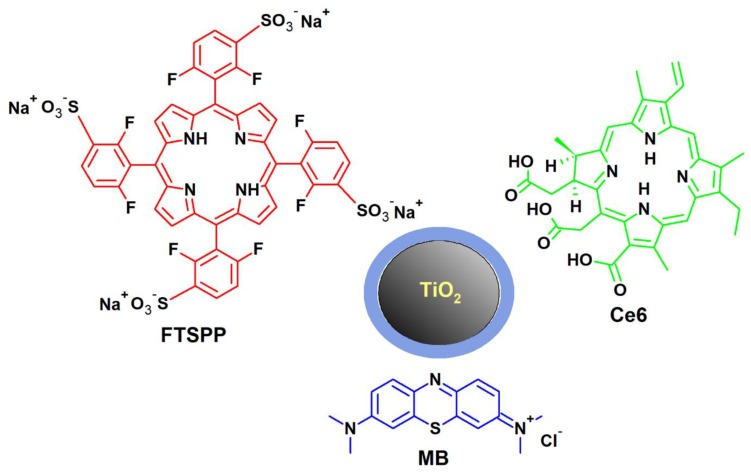
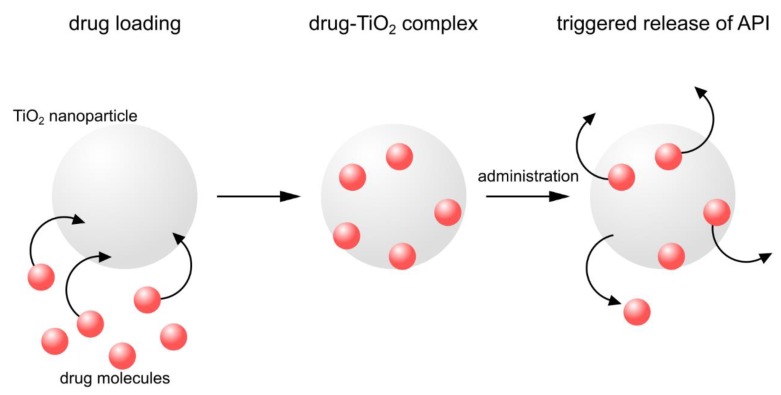
Verification
Claims the paper makes
The claims and statistics of this paper haven’t been checked yet.
Run the check — free, no account needed. It reads the open-access text and checks the sources it cites.
Claims other papers make about this one
Each is checked against this paper’s own text: does it say what the citing paper says it does?
The source backs part of the claim, not all of it — or backs it for a different population, condition or comparison.
In the citing paper
“The results showed that structure of anatase can produce OH˙radicals in the photocatalytic reaction, which will help eliminate the bacteria walls [39].”
From Antibacterial Activity of TiO2 Nanoparticles Prepared by One-Step Laser Ablation in Liquid (2021) · cites this paper as [39]
Experimental — accuracy not yet measured
Self-check
Percentages, sums and reported differences re-computed from the paper’s own numbers.
The self-check needs the paper’s full text.
Citations
Cites
Titanium Dioxide Nanomaterials: Synthesis, Properties, Modifications, and Applications
Chen, X., & Mao, S. S. (2007) · Chemical Reviews · doi:10.1021/cr0500535 · Cited by 10,871
Photoinduced reactivity of titanium dioxide
Carp, O. (2004) · Progress in Solid State Chemistry · doi:10.1016/j.progsolidstchem.2004.08.001 · Cited by 4,673
Evolving concepts of rheumatoid arthritis
Firestein, G. S. (2003) · Nature · doi:10.1038/nature01661 · Cited by 3,653
Photoelectrochemical sterilization of microbial cells by semiconductor powders
Matsunaga, T., Tomoda, R., Nakajima, T., & Wake, H. (1985) · FEMS Microbiology Letters · doi:10.1111/j.1574-6968.1985.tb00864.x · Cited by 1,433
A review of TiO2 nanoparticles
Gupta, S. M., & Tripathi, M. (2011) · Chinese Science Bulletin · doi:10.1007/s11434-011-4476-1 · Cited by 1,270
Toxicology and Applied Pharmacology
Hasan, A., C, L. G. A., Farazi, P. A., Hendriks, B. S., Griffith, L. G., Sorger, P. K., & Tidor, B. (1959) · Nature · doi:10.1038/183650e0 · Cited by 1,252
Wang, J., Zhou, G.-D., Chen, C., YU, H., WANG, T., Ma, Y., JIA, G., Gao, Y., Li, B., & SUN, J. (2006) · Toxicology Letters · doi:10.1016/j.toxlet.2006.12.001 · Cited by 1,145
Zaleska‐Medynska, A. (2008) · Recent Patents on Engineering · doi:10.2174/187221208786306289 · Cited by 1,023
Anchoring Groups for Dye-Sensitized Solar Cells
Zhang, L., & Cole, J. M. (2015) · ACS Applied Materials & Interfaces · doi:10.1021/am507334m · Cited by 844
An overview of doxorubicin formulations in cancer therapy
Rivankar, S. (2014) · Journal of Cancer Research and Therapeutics · doi:10.4103/0973-1482.139267 · Cited by 749
Cited by
Sorted by citations
Antibacterial Activity of TiO2 Nanoparticles Prepared by One-Step Laser Ablation in Liquid
Khashan, K. S., Sulaiman, G. M., Abdulameer, F. A., Albukhaty, S., Ibrahem, M. A., Al-Muhimeed, T., & AlObaid, A. A. (2021) · Applied Sciences · doi:10.3390/app11104623 · Cited by 182
Nanoparticles induced neurotoxicity
Tripathy, D. B., Pradhan, S., Gupta, A., & Agarwal, P. (2025) · Nanotoxicology · doi:10.1080/17435390.2025.2488310 · Cited by 21
Metadata
- Authors
- Ziental, D., Czarczynska-Goslinska, B., Mlynarczyk, D. T., Glowacka-Sobotta, A., Stanisz, B., Goslinski, T., & Sobotta, L.
- Affiliations
- Poznan University of Medical Sciences (PL)
- Venue
- Nanomaterials
- Publisher
- MDPI AG
- Published
- 2020-02-19
- Volume
- 10
- Issue
- 2
- Pages
- 387-387
- ISSN
- 2079-4991 (ISSN-L)
- PMC
- PMC7075317
- OpenAlex
- W3007214932
- Cited by
- 721
- References
- 124
- Citations by year
- 2026: 69 · 2025: 124 · 2024: 137 · 2023: 121 · 2022: 124 · 2021: 108 · 2020: 38
- FWCI
- 4.48
- Type
- journal article
- Language
- en
- Open access
- gold
- dx.doi.org
- Locations
- Nanomaterials (publishedVersion, cc-by)
- Preprints.org (acceptedVersion, cc-by)
- Europe PMC (PubMed Central) (publishedVersion, cc-by)
- PubMed Central (publishedVersion, cc-by)
- PubMed (publishedVersion)
- DOAJ (DOAJ: Directory of Open Access Journals) (submittedVersion, cc-by-sa)
- Funders
- Narodowym Centrum Nauki (2016/21/B/NZ9/00783)
- Topics
- Physical Sciences › Energy › Renewable Energy, Sustainability and the Environment › TiO2 Photocatalysis and Solar Cells
- Life Sciences › Biochemistry, Genetics and Molecular Biology › Cancer Research › Photodynamic Therapy Research Studies
- Physical Sciences › Materials Science › Materials Chemistry › Nanoparticles: synthesis and applications
- Keywords
- titanium dioxide nanoparticles, photodynamic therapy, photosensitizers, reactive oxygen species, photocatalysis, cancer therapy, antibiotic-resistant bacteria, antimicrobial therapy, nanoparticle composites, surface functionalization, targeted therapy, nanoparticle drug delivery
About these checks
Registry, retraction, Cites and statistics results are computed, not judged, with one exception: a printed reference that no index lists is read once by a model before it counts as a citation error. Claims are extracted by a model and kept only when their quote appears verbatim in the text; each cited source is then checked, with a model’s help, for whether it says what the claim relies on. Those verdicts can be wrong — read the claim’s quote and the cited source before relying on one.
Statistics and arithmetic are recomputed, not judged.
Confidence bands are shown only for fields calibrated on our annotated test set. None is calibrated yet, so no band is shown.
What counts as a claim ›How we measure confidence ›How we check this ›
Are you an author, or do you see a problem with this page? Request a review
