

What We Know About Kininogen Structure – Importance for Function and Perspectives from Cryo-EM
Open accessPreprint — published as 10.3390/ijms222413370 · Paper page
The DOI matches its Crossref record; 1 of the 1 references it cites were found in a registry or an index.
Abstract
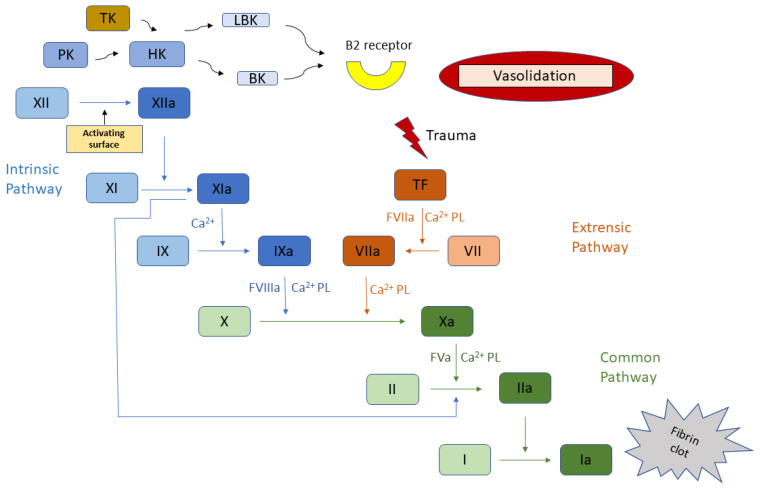
Kininogens are multidomain glycoproteins found in the blood of most vertebrates. They are important in the blood coagulation cascade pathways - in intrinsic pathway activation leading to thrombin generation partially independently from tissue factor dependent extrinsic pathway, connecting blood coagulation with the kallikrein-kinin system. Nothing is known about the shape on atomic level therefore the endeavor to obtain the good-quality spatial structure of kininogens is important for a better understanding of their role in disease and treatment. Application of cryo-EM is important for solving the spatial structure of kininogens, drawing new frontiers in understanding the function and opening new pathways for drug development.
Overview
The claims and statistics of this paper haven’t been checked yet.
Free: it reads the open-access text and checks the first 5 claims that cite a source we can check. Create a free account to check every claim.
Integrity signals
Registry
Cites
Statistics
Figures
Verification
Claims the paper makes
The claims and statistics of this paper haven’t been checked yet.
Free: it reads the open-access text and checks the first 5 claims that cite a source we can check. Create a free account to check every claim.
Self-check
Percentages, sums and reported differences re-computed from the paper’s own numbers.
The self-check needs the paper’s full text.
Citations
Cites
Highly accurate protein structure prediction with AlphaFold
Jumper, J., Evans, R., Pritzel, A., Green, T., Figurnov, M., Ronneberger, O., Tunyasuvunakool, K., Bates, R., Žídek, A., Potapenko, A., et al. (2021) · Nature · doi:10.1038/s41586-021-03819-2 · Cited by 43,764
Metadata
- Authors
- Ponczek, M. B.
- Venue
- International Journal of Molecular Sciences
- Publisher
- MDPI AG
- Published
- 2021-11-01
- Volume
- 22
- Issue
- 24
- Pages
- 13370-13370
- ISSN
- 1422-0067 (ISSN-L)
- PMC
- PMC8706920
- OpenAlex
- W4200368767
- Cited by
- 46
- References
- 1
- Citations by year
- 2026: 11 · 2025: 10 · 2024: 3 · 2023: 15 · 2022: 6 · 2021: 1
- FWCI
- 0.89
- Type
- journal article
- Language
- en
- Open access
- gold
- doi.org
- Locations
- International Journal of Molecular Sciences (publishedVersion, cc-by)
- Preprints.org (acceptedVersion, cc-by)
- PubMed Central (publishedVersion, cc-by)
- PubMed (publishedVersion)
- DOAJ (DOAJ: Directory of Open Access Journals) (submittedVersion, cc-by-sa)
- Funders
- Saint Louis University
- National Institutes of Health
- University of California, San Francisco
- National Center for Research Resources (P41RR001081)
- Topics
- Health Sciences › Medicine › Hematology › Coagulation, Bradykinin, Polyphosphates, and Angioedema
- Life Sciences › Immunology and Microbiology › Immunology › Complement system in diseases
- Life Sciences › Biochemistry, Genetics and Molecular Biology › Structural Biology › Enzyme Structure and Function
- Keywords
- high molecular weight kininogen, intrinsic coagulation pathway, thrombin generation, bradykinin, protein structure, cryo-electron microscopy
- MeSH terms
- Animals, Bradykinin, Humans, Kallikreins, Kininogens, Structure-Activity Relationship, Kininogen, High-Molecular-Weight, Cryoelectron Microscopy
About these checks
Registry, retraction, Cites and statistics results are computed, not judged, with one exception: a printed reference that no index lists is read once by a model before it counts as a citation error. Claims are extracted by a model and kept only when their quote appears verbatim in the text; each cited source is then checked, with a model’s help, for whether it says what the claim relies on. Those verdicts can be wrong — read the claim’s quote and the cited source before relying on one.
Statistics and arithmetic are recomputed, not judged.
Confidence bands are shown only for fields calibrated on our annotated test set. None is calibrated yet, so no band is shown.
What counts as a claim ›How we measure confidence ›How we check this ›
Are you an author, or do you see a problem with this page? Request a review
Data sources
Bibliographic data: Semantic Scholar, OpenAlex, Crossref.
Contains information from the Semantic Scholar Academic Graph Datasets, made available under the ODC Attribution License (ODC-BY 1.0).
Semantic Scholar’s data is described in: Kinney, R., et al. (2023). The Semantic Scholar Open Data Platform. arXiv:2301.10140.
