

The DOI matches its Crossref record; 1 of the 1 references it cites were found in a registry or an index.
Comparison of Different Label-free Techniques for the Semi-absolute Quantification of Protein Abundance
Open accessPreprint — published as 10.3390/proteomes10010002 · Paper page
Abstract
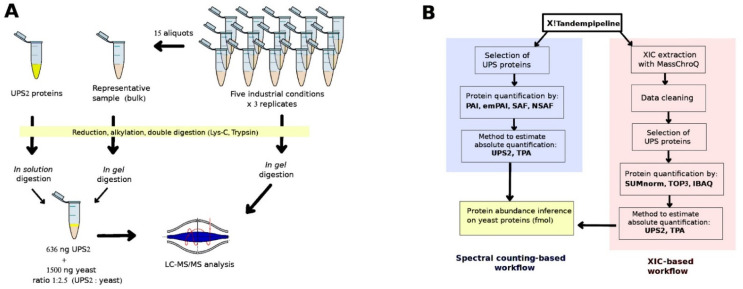
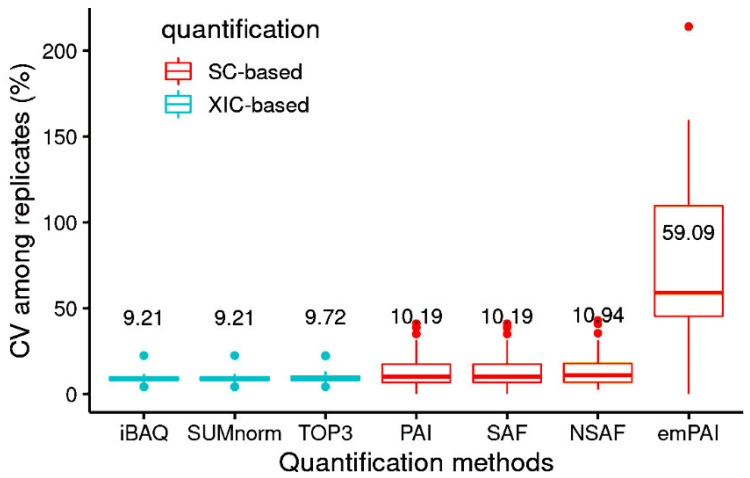
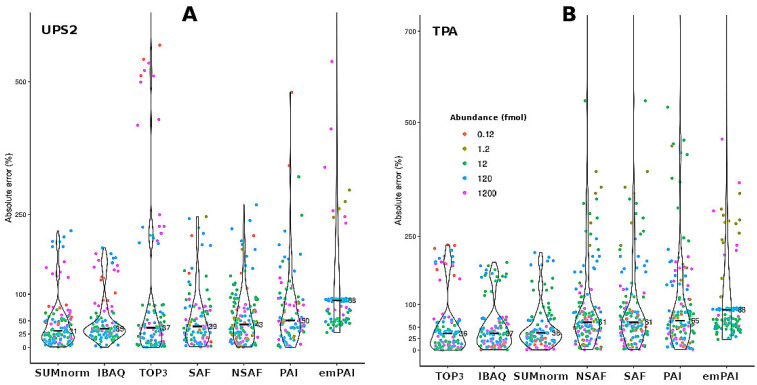
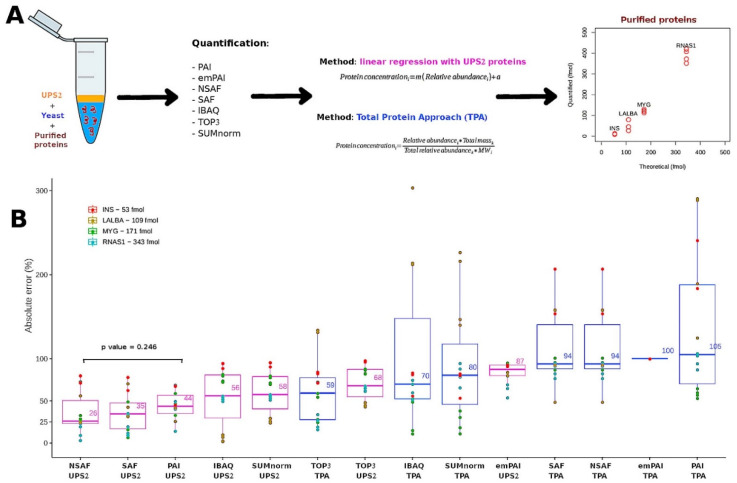
In proteomics, it is essential to quantify proteins in absolute terms if we wish compare results among studies and integrate high-throughput biological data into genome-scale metabolic models. While labeling target peptides with stable isotopes allows protein abundance to be accurately quantified, the utility of this technique is constrained by the low number of quantifiable proteins that it yields. Recently, label-free shotgun proteomics has become the “gold standard” for carrying out global assessments of biological samples containing thousands of proteins. However, this tool must be further improved if we wish to accurately quantify absolute levels of proteins. Here, we used different label-free quantification techniques to estimate absolute protein abundance in the model yeast Saccharomyces cerevisiae. More specifically, we evaluated the performance of seven different quantification methods, based either on spectral counting (SC) or extracted-ion chromatogram (XIC), which were applied to samples from five different proteome backgrounds. We also compared the accuracy and reproducibility of two strategies for transforming relative abundance into absolute abundance: a UPS2-based strategy and the total protein approach (TPA). This study mentions technical challenges related to UPS2 use and proposes ways of addressing them, including utilizing a smaller, more highly optimized amount of UPS2. Overall, three SC-based methods (PAI, SAF, and NSAF) yielded the best results because they struck a good balance between experimental performance and protein quantification.
Overview
The claims and statistics of this paper haven’t been checked yet.
Run the check — free, no account needed. It reads the open-access text and checks the sources it cites.
Integrity signals
Registry
Cites
Statistics
Figures
Verification
Claims the paper makes
The claims and statistics of this paper haven’t been checked yet.
Run the check — free, no account needed. It reads the open-access text and checks the sources it cites.
Self-check
Percentages, sums and reported differences re-computed from the paper’s own numbers.
The self-check needs the paper’s full text.
Citations
Cites
Global quantification of mammalian gene expression control
Schwanhäusser, B., Busse, D., Li, N., Dittmar, G., Schuchhardt, J., Wolf, J., Chen, W., & Selbach, M. (2011) · Nature · doi:10.1038/nature10098 · Cited by 6,566
Metadata
- Authors
- Millán-Oropeza, A., Blein-Nicolas, M., Monnet, V., Zivy, M., & Henry, C.
- Affiliations
- AgroParisTech (FR)
- Centre National de la Recherche Scientifique (FR)
- Corresponding author
- Millán-Oropeza, Aarón
- Venue
- Proteomes
- Publisher
- MDPI AG
- Published
- 2021-12-13
- Volume
- 10
- Issue
- 1
- Pages
- 2-2
- ISSN
- 2227-7382 (ISSN-L)
- PMC
- PMC8788469
- OpenAlex
- W4226251097
- Cited by
- 29
- References
- 1
- Citations by year
- 2026: 5 · 2025: 8 · 2024: 8 · 2023: 6 · 2022: 2
- FWCI
- 2.17
- Type
- journal article
- Language
- en
- Open access
- gold
- doi.org
- Locations
- Proteomes (publishedVersion, cc-by)
- Preprints.org (acceptedVersion, cc-by)
- PubMed Central (publishedVersion, cc-by)
- PubMed (publishedVersion)
- HAL (submittedVersion, other-oa)
- DOAJ (DOAJ: Directory of Open Access Journals) (submittedVersion, cc-by-sa)
- Funders
- Infrastructures en Biologie Santé et Agronomie
- European Commission (720824, HORIZON2020)
- Centre National de la Recherche Scientifique
- Institut National de Recherche pour l'Agriculture, l'Alimentation et l'Environnement
- Topics
- Physical Sciences › Chemistry › Spectroscopy › Advanced Proteomics Techniques and Applications
- Life Sciences › Biochemistry, Genetics and Molecular Biology › Molecular Biology › Bioinformatics and Genomic Networks
- Life Sciences › Biochemistry, Genetics and Molecular Biology › Molecular Biology › Advanced Biosensing Techniques and Applications
- Keywords
- absolute protein quantification, label-free quantification, spectral counting, extracted ion chromatograms, protein abundance, Saccharomyces cerevisiae, proteomics, genome-scale metabolic models
About these checks
Registry, retraction, Cites and statistics results are computed, not judged, with one exception: a printed reference that no index lists is read once by a model before it counts as a citation error. Claims are extracted by a model and kept only when their quote appears verbatim in the text; each cited source is then checked, with a model’s help, for whether it says what the claim relies on. Those verdicts can be wrong — read the claim’s quote and the cited source before relying on one.
Statistics and arithmetic are recomputed, not judged.
Confidence bands are shown only for fields calibrated on our annotated test set. None is calibrated yet, so no band is shown.
What counts as a claim ›How we measure confidence ›How we check this ›
Are you an author, or do you see a problem with this page? Request a review
How to cite
Cite CoChat for the checks on this page, and the paper for its own findings.
- This page
- CoChat. (2026). Citation check: Comparison of Different Label-free Techniques for the Semi-absolute Quantification of Protein Abundance. https://app.cochat.ai/papers/10.20944/preprints202112.0212.v1
- The paper
- Millán-Oropeza, A., Blein-Nicolas, M., Monnet, V., Zivy, M., & Henry, C. (2021). Comparison of Different Label-free Techniques for the Semi-absolute Quantification of Protein Abundance. Proteomes. https://doi.org/10.20944/preprints202112.0212.v1
