

The DOI matches its Crossref record; 1 of the 1 references it cites were found in a registry or an index.
Recent Advances in β-glucosidase Engineering: A Brief Review
Open accessPreprint — published as 10.3390/molecules28134990 · Paper page
Abstract
β-glucosidases (BGLs) play a crucial role in the degradation of lignocellulosic biomass as well as in industrial applications such as pharmaceuticals, foods, and flavors. However, the application of BGLs has been largely hindered by issues such as low enzyme activity, product inhibition, low stability, etc. Many approaches have been developed to engineer BGLs to improve these enzymatic characteristics to facilitate industrial production. In this article, we review the recent advances in BGL engineering in the field, including the efforts from our laboratory. We summarize and discuss the BGL engineering studies according to the targeted functions as well as the specific strategies used for BGL engineering.
Overview
The claims and statistics of this paper haven’t been checked yet.
Run the check — free, no account needed. It reads the open-access text and checks the sources it cites.
Integrity signals
Registry
Cites
Statistics
Figures
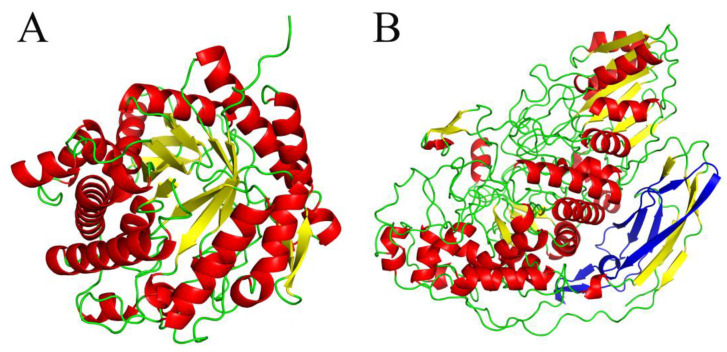
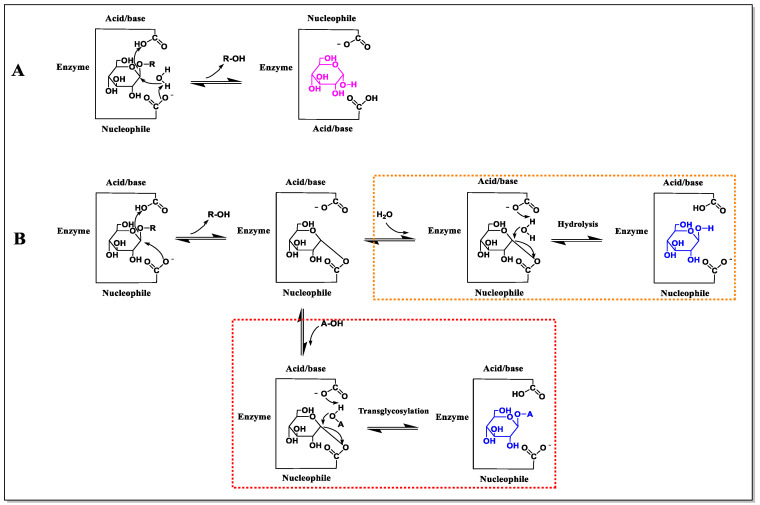
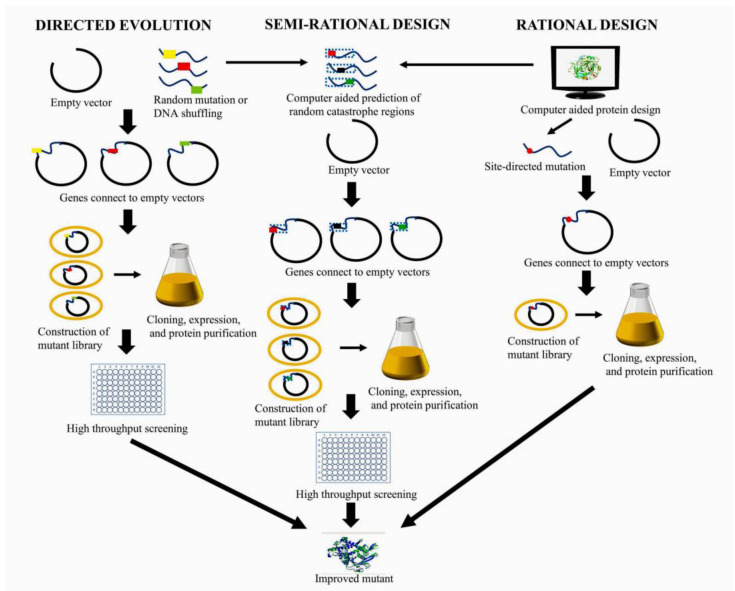
Verification
Claims the paper makes
The claims and statistics of this paper haven’t been checked yet.
Run the check — free, no account needed. It reads the open-access text and checks the sources it cites.
Self-check
Percentages, sums and reported differences re-computed from the paper’s own numbers.
The self-check needs the paper’s full text.
Citations
Cites
Highly accurate protein structure prediction with AlphaFold
Jumper, J., Evans, R., Pritzel, A., Green, T., Figurnov, M., Ronneberger, O., Tunyasuvunakool, K., Bates, R., Žídek, A., Potapenko, A., et al. (2021) · Nature · doi:10.1038/s41586-021-03819-2 · Cited by 43,764
Metadata
- Authors
- Zhao, X., Huang, Y., Ouyang, B., Wang, G., Zhang, N., & Zuo, J.
- Affiliations
- Jiangxi Normal University (CN)
- Corresponding author
- Zhao, Xihua
- Huang, Yunhong
- Venue
- Molecules
- Publisher
- MDPI AG
- Published
- 2023-06-05
- Volume
- 28
- Issue
- 13
- Pages
- 4990-4990
- ISSN
- 1420-3049 (ISSN-L)
- PMC
- PMC10343665
- OpenAlex
- W4382060579
- Cited by
- 55
- References
- 1
- Citations by year
- 2026: 18 · 2025: 18 · 2024: 17 · 2023: 2
- FWCI
- 1.64
- Type
- journal article
- Language
- en
- Open access
- gold
- doi.org
- Locations
- Molecules (publishedVersion, cc-by)
- Preprints.org (acceptedVersion, cc-by)
- PubMed Central (publishedVersion, cc-by)
- PubMed (publishedVersion)
- DOAJ (DOAJ: Directory of Open Access Journals) (submittedVersion, cc-by-sa)
- Funders
- University of Michigan
- National Natural Science Foundation of China (22068014, 21666010)
- Jiangxi Normal University
- Topics
- Life Sciences › Biochemistry, Genetics and Molecular Biology › Biotechnology › Enzyme Production and Characterization
- Life Sciences › Biochemistry, Genetics and Molecular Biology › Molecular Biology › Enzyme Catalysis and Immobilization
- Physical Sciences › Engineering › Biomedical Engineering › Biofuel production and bioconversion
- Keywords
- β-glucosidase, enzyme engineering, lignocellulose degradation, enzyme stability, product inhibition, enzyme activity enhancement, industrial enzymes, sequence engineering, structural engineering
- MeSH terms
- beta-Glucosidase
About these checks
Registry, retraction, Cites and statistics results are computed, not judged, with one exception: a printed reference that no index lists is read once by a model before it counts as a citation error. Claims are extracted by a model and kept only when their quote appears verbatim in the text; each cited source is then checked, with a model’s help, for whether it says what the claim relies on. Those verdicts can be wrong — read the claim’s quote and the cited source before relying on one.
Statistics and arithmetic are recomputed, not judged.
Confidence bands are shown only for fields calibrated on our annotated test set. None is calibrated yet, so no band is shown.
What counts as a claim ›How we measure confidence ›How we check this ›
Are you an author, or do you see a problem with this page? Request a review
