

Cellular responses and functions of α7 nicotinic acetylcholine receptor activation in the brain: a narrative review
Open accessThe DOI matches its Crossref record; 119 of the 119 references it cites were found in a registry or an index.
Abstract
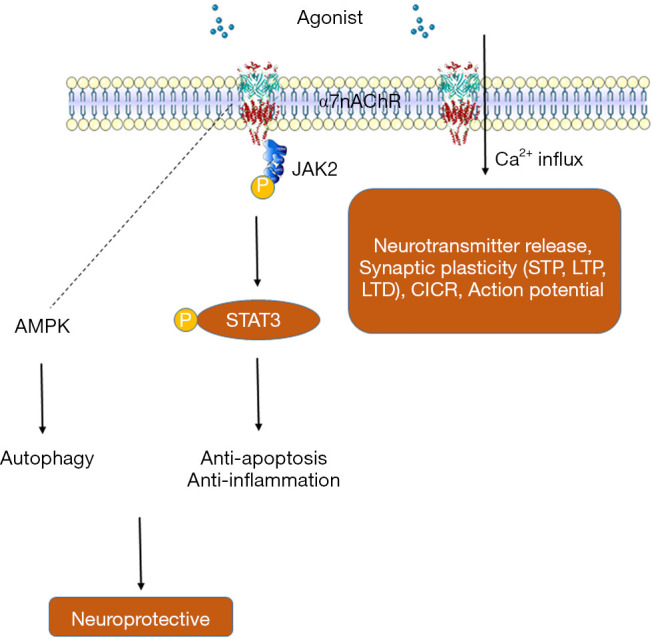
The α7 nicotinic acetylcholine receptor (α7nAChR) has been studied for many years since its discovery. Although many functions and characteristics of brain α7nAChR are widely understood, much remains to be elucidated. The α7nAChR is widely expressed in the central nervous system, not only in neurons but also in astrocytes, microglia, and endothelial cells. α7nAChR can be activated by endogenous agonist like acetylcholine or exogenous agonists like nicotine and PNU282987. Its agonists can be divided into selective agonists and non-selective agonists. The activation of α7nAChR results in a series of physiological processes which have both short-term and long-term effects on cells, for example, calcium influx, neurotransmitter release, synaptic plasticity, and excitatory transmission. It also induces other downstream events, such as inflammation, autophagy, necrosis, transcription, and apoptosis. The cellular responses to α7nAChR activation vary according to cell types and conditions. For example, α7nAChR activation in pyramidal neurons leads to long-term potentiation, while α7nAChR activation in GABAergic interneurons leads to long-term depression. Studies have also shown some contradictory phenomena, which requires further study for clarification. Herein, the cellular responses of α7nAChR activation are summarized, and the functions of α7nAChR in neurons and non-neuronal cells are discussed. We also summarized contradictory conclusions to show where we stand and where to go for future studies.
Overview
The claims and statistics of this paper haven’t been checked yet.
Free: it reads the open-access text and checks the first 5 claims that cite a source we can check. Create a free account to check every claim.
Integrity signals
Registry
Cites
Statistics
Figures
Verification
Claims the paper makes
The claims and statistics of this paper haven’t been checked yet.
Free: it reads the open-access text and checks the first 5 claims that cite a source we can check. Create a free account to check every claim.
Claims other papers make about this one
Each is checked against this paper’s own text: does it say what the citing paper says it does?
The source backs part of the claim, not all of it — or backs it for a different population, condition or comparison.
In the citing paper
“For the cholinergic system, selective α7nAChR agonists (PNU-282987) can more precisely activate the CAP and inhibit microglial activation [12].”
From Research Advances in the Pathogenesis of Sepsis-Associated Encephalopathy (2026) · cites this paper as [12]
Experimental — accuracy not yet measuredThe check wasn’t confident either way, so it gives no verdict — never disputed.
In the citing paper
“First, BBB permeability: many promising preclinical targets tend to exhibit poor CNS penetration, requiring doses that may risk peripheral toxicity [12,13,22].”
From Research Advances in the Pathogenesis of Sepsis-Associated Encephalopathy (2026) · cites this paper as [12]
Experimental — accuracy not yet measured
Self-check
Percentages, sums and reported differences re-computed from the paper’s own numbers.
The self-check needs the paper’s full text.
Citations
Cites
A new generation of Ca2+ indicators with greatly improved fluorescence properties.
Grynkiewicz, G., Poenie, M., & Tsien, R. Y. (1985) · Journal of Biological Chemistry · doi:10.1016/s0021-9258(19)83641-4 · Cited by 21,607
Guidelines for the use and interpretation of assays for monitoring autophagy (3rd edition).
Klionsky, D. J., Abdelmohsen, K., Abe, A., Abedin, M. J., Abeliovich, H., Acevedo Arozena, A., Adachi, H., Adams, C. M., Adams, P. D., Adeli, K., et al. (2016) · Autophagy · doi:10.1080/15548627.2015.1100356 · Cited by 5,894
Astrocyte-endothelial interactions at the blood-brain barrier
Abbott, N. J., Rönnbäck, L., & Hansson, E. (2006) · Nature Reviews Neuroscience · doi:10.1038/nrn1824 · Cited by 5,595
Nicotinic acetylcholine receptor α7 subunit is an essential regulator of inflammation
Wang, H., Yu, M., Ochani, M., Amella, C. A., Tanovic, M., Susarla, S., Li, J. H., Wang, H., Yang, H., Ulloa, L., et al. (2003) · Nature · doi:10.1038/nature01339 · Cited by 3,228
Synaptic Plasticity and Memory: An Evaluation of the Hypothesis
Martin, S. J., Grimwood, P. D., & Morris, R. G. M. (2000) · Annual Review of Neuroscience · doi:10.1146/annurev.neuro.23.1.649 · Cited by 2,794 · cited 1×
“Accumulating evidence suggests that it is one of the most important neurological foundations of learning and memory (38-40).”
Tripartite synapses: glia, the unacknowledged partner
Araque, A., Parpura, V., Sanzgiri, R. P., & Haydon, P. G. (1999) · Trends in Neurosciences · doi:10.1016/s0166-2236(98)01349-6 · Cited by 2,529 · cited 1×
“…to the regulation of neurotransmitters, the maintenance of the blood-brain barrier (BBB), the formation of the tripartite synapse, metabolic support, glucose sensing, the regulation of ion concentration in the extracellular space, and the repair of CNS injury through glial scar formation (87-95).”
Astrocyte scar formation aids central nervous system axon regeneration
Anderson, M. A., Burda, J. E., Ren, Y., Ao, Y., O’Shea, T. M., Kawaguchi, R., Coppola, G., Khakh, B. S., Deming, T. J., & Sofroniew, M. V. (2016) · Nature · doi:10.1038/nature17623 · Cited by 1,851
Crystal structure of an ACh-binding protein reveals the ligand-binding domain of nicotinic receptors
Brejc, K., van Dijk, W. J., Klaassen, R. V., Schuurmans, M., van der Oost, J., Smit, A. B., & Sixma, T. K. (2001) · Nature · doi:10.1038/35077011 · Cited by 1,759
Seguela, P., Wadiche, J., Dineley-Miller, K., Dani, J., & Patrick, J. (1993) · The Journal of Neuroscience · doi:10.1523/jneurosci.13-02-00596.1993 · Cited by 1,471
Neurotransmitter Release: The Last Millisecond in the Life of a Synaptic Vesicle
Südhof, T. C. (2013) · Neuron · doi:10.1016/j.neuron.2013.10.022 · Cited by 1,197 · cited 1×
“The whole process is an instantaneous response to the action potential, which lasts only a millisecond (31).”
Cited by
Neuroprotective Activities of Curcumin in Parkinson’s Disease: A Review of the Literature
Nebrisi, E. E. (2021) · International Journal of Molecular Sciences · doi:10.3390/ijms222011248 · Cited by 163
Yue, Q., & Hoi, M. P. M. (2023) · Neural Regeneration Research · doi:10.4103/1673-5374.367832 · Cited by 107
Liu, H., Zhang, X., Shi, P., Yuan, J., Jia, Q., Pi, C., Chen, T., Xiong, L., Chen, J., Tang, J., et al. (2023) · Journal of Neuroinflammation · doi:10.1186/s12974-023-02768-z · Cited by 92
Melchiorri, D., Merlo, S., Micallef, B., Borg, J.-J., & Dráfi, F. (2023) · Frontiers in Pharmacology · doi:10.3389/fphar.2023.1196413 · Cited by 70
Zhuo, C., Tian, H., Song, X., Jiang, D., Chen, G., Cai, Z., Ping, J., Cheng, L., Zhou, C., & Chen, C. (2023) · Schizophrenia · doi:10.1038/s41537-023-00370-z · Cited by 68
Role of the Cholinergic Anti-Inflammatory Reflex in Central Nervous System Diseases
Ramos-Martínez, I. E., Rodriguez, M. C., Cerbón, M. A., Ramos-Martínez, J. C., & Ramos-Martínez, E. G. (2021) · International Journal of Molecular Sciences · doi:10.3390/ijms222413427 · Cited by 65
Sanjay, S., Sood, R., Jaiswal, V., Kang, S.-U., Park, M., & Lee, H. (2024) · Redox Biology · doi:10.1016/j.redox.2024.103197 · Cited by 57
Interactions between the Autonomic Nervous System and the Immune System after Stroke
Zhu, L., Huang, L., Le, A. C. T., Wang, T. J., Zhang, J., Chen, X., Wang, J., Wang, J., & Jiang, C. Q. (2022) · Comprehensive physiology · doi:10.1002/cphy.c210047 · Cited by 40
Recent advances in liposomes and peptide-based therapeutics for glioblastoma treatment
Jourdain, M. A., & Eyer, J. (2024) · Journal of Controlled Release · doi:10.1016/j.jconrel.2024.10.037 · Cited by 35
Role of Alpha-7-Nicotinic Acetylcholine Receptor in Alzheimer's Disease
Singh, S., Agrawal, N., & Goyal, A. (2023) · CNS & Neurological Disorders - Drug Targets · doi:10.2174/1871527322666230627123426 · Cited by 35
Neuronal Glial Crosstalk: Specific and Shared Mechanisms in Alzheimer’s Disease
Chavda, V. K., Singh, K., Patel, V., Mishra, M., & Mishra, A. K. (2022) · Brain Sciences · doi:10.3390/brainsci12010075 · Cited by 32
Obesity-Related Brain Cholinergic System Impairment in High-Fat-Diet-Fed Rats
Martinelli, I., Tayebati, S. K., Roy, P., Bonaventura, M. V. M. D., Moruzzi, M., Cifani, C., Amenta, F., & Tomassoni, D. (2022) · Nutrients · doi:10.3390/nu14061243 · Cited by 32
Nicotinic Acetylcholine Receptors in Glial Cells as Molecular Target for Parkinson’s Disease
Soares, É. N., Costa, A. C. D. S., Ferrolho, G. D. J., Ureshino, R. P., Getachew, B., Costa, S. L., da Silva, V. D. A., & Tizabi, Y. (2024) · Cells · doi:10.3390/cells13060474 · Cited by 29
Tae, H., & Adams, D. J. (2023) · Pharmacological Research · doi:10.1016/j.phrs.2023.106747 · Cited by 28
Kumar, S., Akhila, P. V., & Suchiang, K. (2023) · Free Radical Biology and Medicine · doi:10.1016/j.freeradbiomed.2023.10.408 · Cited by 28
Nebrisi, E. E., Lozon, Y., & Öz, M. (2025) · International Journal of Molecular Sciences · doi:10.3390/ijms26073210 · Cited by 24
Translational implications of CHRFAM7A, an elusive human-restricted fusion gene
Ihnatovych, I., Saddler, R.-A., Süle, N., & Szigeti, K. (2024) · Molecular Psychiatry · doi:10.1038/s41380-023-02389-1 · Cited by 22
Nicotinic receptors in airway disease
Borkar, N. A., Thompson, M. A., Bartman, C. M., Khalfaoui, L., Sine, S. M., Sathish, V., Prakash, Y. S., & Pabelick, C. M. (2023) · American Journal of Physiology-Lung Cellular and Molecular Physiology · doi:10.1152/ajplung.00268.2023 · Cited by 21
Altered Brain Cholinergic and Synaptic Markers in Obese Zucker Rats
Martinelli, I., Tomassoni, D., Roy, P., Amenta, F., & Tayebati, S. K. (2021) · Cells · doi:10.3390/cells10102528 · Cited by 21
Lykhmus, O., Tzeng, W.-Y., Koval, L., Uspenska, K., Zirdum, E., Kalashnyk, O., Garaschuk, O., & Skok, M. (2024) · Biomedicine & Pharmacotherapy · doi:10.1016/j.biopha.2024.117255 · Cited by 14
Guzmán-Vallejos, M. S., Ramírez-Cando, L., Aguayo, L. G., & Ballaz, S. (2024) · Neurotoxicity Research · doi:10.1007/s12640-024-00697-0 · Cited by 11
Abraham, S. M., Suresh, S., & Komal, P. (2025) · Cellular and Molecular Neurobiology · doi:10.1007/s10571-025-01586-6 · Cited by 10
The Neuroprotective Properties of Thymol and Carvacrol: A Review Study
Asle‐Rousta, M. (2024) · The Natural Products Journal · doi:10.2174/0122103155288752240219095244 · Cited by 8
Nicotinic acetylcholine receptors-targeting drug discovery
Zhang, D., Zheng, H., Cui, K., Li, Y., Liu, C., Mao, J., Zheng, J., & Wan, Y. (2026) · European Journal of Medicinal Chemistry · doi:10.1016/j.ejmech.2026.118679 · Cited by 7
Astrocyte-Neuron Interactions in Substance Use Disorders
Harder, E. V., Franklin, J. P., VanRyzin, J. W., & Reissner, K. J. (2024) · Advances in neurobiology · doi:10.1007/978-3-031-64839-7_7 · Cited by 7
Yang, H., Morgan, T. S., Petruzzelli, S., Hashimoto, O., Hepler, T. D., Tynan, A., Chaudhry, S., Brines, M. L., Andersson, U., Chavan, S. S., et al. (2025) · Molecular Medicine · doi:10.1186/s10020-025-01387-z · Cited by 7
Mugisha, S., Baba, S. A., Labhsetwar, S., Dave, D., Zakeri, A., Klemke, R. L., & Desgrosellier, J. S. (2025) · Oncogene · doi:10.1038/s41388-025-03276-5 · Cited by 7
Borkar, N. A., Thompson, M. A., Kelley, B., Shiferaw, B. T., Hamrick, S. K., Sathish, V., Prakash, Y. S., & Pabelick, C. M. (2025) · American Journal of Respiratory Cell and Molecular Biology · doi:10.1165/rcmb.2024-0194oc · Cited by 7
McCamy, K. M., Rees, K. A., & Winzer‐Serhan, U. H. (2022) · Cytokine · doi:10.1016/j.cyto.2022.156005 · Cited by 6
Isaev, A. B., Bychkov, M. L., Kulbatskii, D. S., Andreev-Andrievskiy, A. A., Александрович, М. М., Shulepko, M. A., Shlepova, O. V., Loktyushov, E. V., Латанов, А. В., Kirpichnikov, M. P., et al. (2024) · Cell Death Discovery · doi:10.1038/s41420-024-02211-z · Cited by 5
Emerging computational motifs: Lessons from the retina
Matsumoto, A., & Yonehara, K. (2023) · Neuroscience Research · doi:10.1016/j.neures.2023.06.003 · Cited by 5
Singh, S., Goyal, A., & Agrawal, N. (2023) · Chemistry & Biodiversity · doi:10.1002/cbdv.202300306 · Cited by 5
Zheng, L., & Duan, S.-L. (2025) · World Journal of Gastroenterology · doi:10.3748/wjg.v31.i44.109440 · Cited by 4
Yang, Y., Song, Y., Xu, W., Ai, Z., Zhu, G., Yang, M., Zheng, Q., Xu, H., Liu, Y., Ping, Y., et al. (2025) · Journal of Ethnopharmacology · doi:10.1016/j.jep.2025.119667 · Cited by 4
Self-citationAbdel-Aziz, N., El-Bahkery, A. M., & Ibrahim, E. A. (2025) · Molecular Biology Reports · doi:10.1007/s11033-025-10255-2 · Cited by 4
The Possible Mechanistic Basis of Individual Susceptibility to Spike Protein Injury
Halma, M. T. J., Vottero, P., Thorp, J. A., Peers, T., Tuszyński, J. A., & Marik, P. E. (2025) · Advances in Virology · doi:10.1155/av/7990876 · Cited by 3
Bidirectional relationships between depression and asthma
Duchene, B., & Dixon, A. E. (2025) · Expert Review of Respiratory Medicine · doi:10.1080/17476348.2025.2600111 · Cited by 3
Neves, A. M., Leal, S. M., Fonseca, B. M., & Sá, S. I. (2025) · International Journal of Molecular Sciences · doi:10.3390/ijms26136144 · Cited by 3
Winzer‐Serhan, U. H., Ramakrishnan, S., Li, Y., Mada, S., & Reddy, D. S. (2026) · Experimental Neurology · doi:10.1016/j.expneurol.2026.115892 · Cited by 2
Clitoria ternatea as a potential candidate in treating Alzheimer’s disease
Chin, J. Y., Sucedaram, Y., Hassan, Z., & Kumaran, K. R. (2026) · Pharmacological Research - Natural Products · doi:10.1016/j.prenap.2026.100602 · Cited by 2
Proteome profile of the cerebellum from α7 nicotinic acetylcholine receptor deficient mice
Caban, K. M., Seßenhausen, P., Stöckl, J. B., Popper, B., Mayerhofer, A., & Fröhlich, T. (2024) · PROTEOMICS · doi:10.1002/pmic.202300384 · Cited by 2
Puliatti, G., Renna, P., Battistoni, M., Piacentini, R., Ripoli, C., & Grassi, C. (2026) · Scientific Reports · doi:10.1038/s41598-026-46279-2 · Cited by 2
Delgado, M., Schuepbach, R. A., & Bartussek, J. (2025) · Frontiers in Neurology · doi:10.3389/fneur.2025.1556456 · Cited by 2
Unraveling Amentoflavone's Therapeutic Potential in Alzheimer's Disease: A Preclinical Assessment
Singh, S., Agrawal, N., & Goyal, A. (2024) · Combinatorial Chemistry & High Throughput Screening · doi:10.2174/0113862073301291240229102657 · Cited by 2
Abdel-Aziz, N., Elkady, A. A., & Elgazzar, E. M. (2021) · Research Square · doi:10.21203/rs.3.rs-901368/v1 · Cited by 2
Research Advances in the Pathogenesis of Sepsis-Associated Encephalopathy
Tan, H., Su, W., & Niu, Z. (2026) · International Journal of Molecular Sciences · doi:10.3390/ijms27125390 · Cited by 1
“First, BBB permeability: many promising preclinical targets tend to exhibit poor CNS penetration, requiring doses that may risk peripheral toxicity [12,13,22].”
Nicotine Exposure During Gestation: From Placental Dysfunction to Long‐Term Neurobehavioral Outcomes
Dave, H., Maru, S., & Johar, K. (2026) · Birth Defects Research · doi:10.1002/bdr2.70115 · Cited by 1
Chen, W., Chen, Z., Nepal, C., Pan, X., Shi, W.-X., Li, Y., Xiao, D., Jones, W., Moos, M., Dong, Y., et al. (2026) · bioRxiv (Cold Spring Harbor Laboratory) · doi:10.64898/2026.06.19.729385 · Cited by 1
Montelukast altered BDNF and CHRNA7 gene expression were associated with behavioral changes in rats.
Haider, K., Hummadi, Y. M. K. A. M., Guaim, R. M., & Ahmeid, M. S. (2025) · F1000Research · doi:10.12688/f1000research.169688.1 · Cited by 1
The Alpha 7 Nicotinic Acetylcholine Receptor Does Not Affect Neonatal Brain Injury
Hammarlund, M. E., Ek, C. J., Akar, S., Karlsson, A., Pattanaik, B., Mjörnstedt, F., Svedin, P., Ardalan, M., Rocha‐Ferreira, E., Mallard, C. E., et al. (2022) · Biomedicines · doi:10.3390/biomedicines10082023 · Cited by 1
Er, A., Çelik, S., Özel, A. E., & Akyüz, S. (2026) · Scientific Reports · doi:10.1038/s41598-026-66302-w · Cited by 1
Molecular mechanisms of nicotinic acetylcholine receptors in mood dysregulation
Murthy, M. K., & Samal, D. (2026) · Progress in Neuro-Psychopharmacology and Biological Psychiatry · doi:10.1016/j.pnpbp.2026.111880
Zhu, H., Chen, Y., Song, X., Chen, Z., Zhang, J., Pu, X., Wang, J., & Rong, P. (2026) · Brain Behavior and Immunity · doi:10.1016/j.bbi.2026.106980
Swiderski, J., Gadanec, L. K., Hearth, S., Rowlands, B. D., Murphy, A. J., Apostolopoulos, V., & Zulli, A. (2026) · Frontiers in Pharmacology · doi:10.3389/fphar.2026.1756039
Neves, A. M. T. (2025) · Portuguese National Funding Agency for Science, Research and Technology (RCAAP Project by FCT) · doi:10.34626/gvrk-4840
Kalinovskii, A. P., Osmakov, D. I., Logashina, Y. A., Andreev, Y. A., & Трухан, В. М. (2026) · Pharmaceutics · doi:10.3390/pharmaceutics18111397
Al-Dhahi, A. S., Al-Kuraishy, H. M., Mohamed, A. A., Salama, M. M., alanazi, Y. S., Fawzy, M. N., & Batiha, G. E. (2026) · Life Sciences · doi:10.1016/j.lfs.2026.124706
Cardenal, C. V., Mahfooz, K., Garcia‐Ratés, S., Hasan, S., & Greenfield, S. A. (2026) · Biomedicine & Pharmacotherapy · doi:10.1016/j.biopha.2026.119125
Izumi, Y., Niwa, K., Kamei, Y., Akaike, A., Kōyama, Y., & Kume, T. (2026) · European Journal of Pharmacology · doi:10.1016/j.ejphar.2026.179180
Differential effects of α7nAChR activation in a murine model of asthma
Borkar, N. A., Lee, K. K., Thompson, M. A., Bartman, C. M., Nesbitt, L. L., Hamrick, S. K., Fang, Y. H., Prakash, Y. S., & Pabelick, C. M. (2026) · American Journal of Physiology-Lung Cellular and Molecular Physiology · doi:10.1152/ajplung.00119.2025
Tae, H., Ortells, M. O., Targowska‐Duda, K. M., Manetti, D., Romanelli, M. N., Adams, D. J., & Arias, H. R. (2025) · Biochemical Pharmacology · doi:10.1016/j.bcp.2025.117463
Avstrikova, M. (2023) · theses.fr (ABES) · doi:10.70675/2eafd2ccz1610z4669z9ac0zfdb86e86c3c2
Dali, L., Abdulmajeed, A. Z., Al‐Hadithy, S., Salih, A. M., & Salih, M. J. (2026) · Discover Neuroscience · doi:10.1186/s13064-026-00351-9
Cota, A. A. B. (2024) · LA Referencia (Red Federada de Repositorios Institucionales de Publicaciones Científicas)
Vincze, K., Hathy, E., Pesti, K., Vőfély, G., Szabó, E., Tordai, C., Homolya, L., Nemoda, Z., Mike, A., Apáti, Á., et al. (2026) · Research Square · doi:10.21203/rs.3.rs-9081171/v1
Ren, X., Guan, D., Xue, F., Zhang, F., Sun, J., Zheng, Y. Q., Huang, H., Xu, Z.-Q. D., Zhang, J., Wang, W., et al. (2026) · Protein & Cell · doi:10.1093/procel/pwag004
Self-citationα7ニコチン受容体サブタイプ刺激によるミクログリアのエフェロサイトーシス様活性化の誘導と神経保護作用の解析
Sueyoshi, M. (2025) · Institutional Repositories DataBase (IRDB) · doi:10.34445/0002000268
The expression and function of nAChRs in human T cells
Laforest, B. (2024) · Lu Zone Ul (Laurentian University)
Xu, J., Sun, X. R., Xu, D., Ge, Y., & Ming, L. (2026) · Journal of Pharmaceutical Innovation · doi:10.1007/s12247-026-10679-8
Rees, K. A. (2025) · OakTrust (Texas A&M University Libraries)
Hasan, M. Y., Roslan, A. A., Azmi, N., Ibrahim, N. M., Arulsamy, A., Lee, V. L. L., Siran, R., & Mahadi, M. K. (2025) · Sains Malaysiana · doi:10.17576/jsm-2025-5410-10
Liu, R., Shang, J., Gao, K., Li, W., Wang, S., & Lü, L. (2026) · Archives of Toxicology · doi:10.1007/s00204-026-04374-3
Metadata
- Authors
- Xu, Z.-Q., Zhang, W.-J., Su, D.-F., Zhang, G.-Q., & Miao, C.-Y.
- Affiliations
- Second Military Medical University (CN)
- Dongyang People's Hospital (CN)
- Corresponding author
- Miao, Chao-Yu
- Venue
- Annals of Translational Medicine
- Publisher
- AME Publishing Company
- Published
- 2021-03
- Volume
- 9
- Issue
- 6
- Pages
- 509-509
- ISSN
- 2305-5839 (ISSN-L)
- 2305-5847
- PMC
- PMC8039675
- OpenAlex
- W3136133139
- Cited by
- 60
- References
- 117
- Citations by year
- 2026: 16 · 2025: 13 · 2024: 12 · 2023: 10 · 2022: 6 · 2021: 3
- FWCI
- 0.81
- Type
- journal article
- Language
- en
- Open access
- diamond
- doi.org
- Licence
- cc-by-nc-nd
- Locations
- Annals of Translational Medicine (publishedVersion, cc-by-nc-nd)
- PubMed Central (publishedVersion, cc-by-nc-nd)
- PubMed (publishedVersion)
- Topics
- Life Sciences › Biochemistry, Genetics and Molecular Biology › Molecular Biology › Nicotinic Acetylcholine Receptors Study
- Life Sciences › Neuroscience › Cellular and Molecular Neuroscience › Neuroscience and Neuropharmacology Research
- Life Sciences › Pharmacology, Toxicology and Pharmaceutics › Pharmacology › Pharmacological Receptor Mechanisms and Effects
- Keywords
- alpha7 nicotinic acetylcholine receptor, receptor activation, brain, acetylcholine agonists, nicotine, PNU-282987, calcium influx, neurotransmitter release, synaptic plasticity, excitatory synaptic transmission, inflammation, autophagy, apoptosis, long-term potentiation, long-term depression, pyramidal neurons, GABAergic interneurons, astrocytes, microglia, endothelial cells
About these checks
Registry, retraction, Cites and statistics results are computed, not judged, with one exception: a printed reference that no index lists is read once by a model before it counts as a citation error. Claims are extracted by a model and kept only when their quote appears verbatim in the text; each cited source is then checked, with a model’s help, for whether it says what the claim relies on. Those verdicts can be wrong — read the claim’s quote and the cited source before relying on one.
Statistics and arithmetic are recomputed, not judged.
Confidence bands are shown only for fields calibrated on our annotated test set. None is calibrated yet, so no band is shown.
What counts as a claim ›How we measure confidence ›How we check this ›
Are you an author, or do you see a problem with this page? Request a review
Data sources
Bibliographic data: Semantic Scholar, OpenAlex, Crossref.
Contains information from the Semantic Scholar Academic Graph Datasets, made available under the ODC Attribution License (ODC-BY 1.0).
Semantic Scholar’s data is described in: Kinney, R., et al. (2023). The Semantic Scholar Open Data Platform. arXiv:2301.10140.
