

Data-Driven Phase-Aware Knowledge Distillation for Stiff Chemical Reaction Networks
Open accessThe DOI matches its Crossref record; 38 of the 38 references it cites were found in a registry or an index; none of the 33 sources its claims cite is checked for support yet.
Abstract
Many natural processes involve dynamics that span multiple widely separated timescales. Classical simplification strategies such as the Quasi-Steady-State Approximation and Partial-Equilibrium Approximation remain limited by their reliance on expert-guided assumptions and manual timescale identification. Here we introduce Phase-Aware Knowledge Distillation (PAKD), a fully data-driven framework that unifies surrogate teacher learning, unsupervised dynamical-phase discovery, and knowledge distillation. A high-fidelity teacher surrogate captures the full stiff dynamics. An unsupervised Hidden Markov Model then autonomously infers latent dynamical phases and their characteristic lifetimes from the teacher's trajectories. A compact student model subsequently distills the teacher's essential behaviors at substantially reduced computational cost. Validated on Michaelis–Menten enzyme kinetics, POLLU atmospheric chemistry network, Fisher–KPP reaction-diffusion equation, and a real-world MCF7 breast cancer signaling dataset, PAKD accurately reproduces key dynamics where classical approximations struggle, offering a principled, assumption-free route to model reduction across computational chemistry, system biology, and beyond.
Overview
CoChat Summary
TL;DR
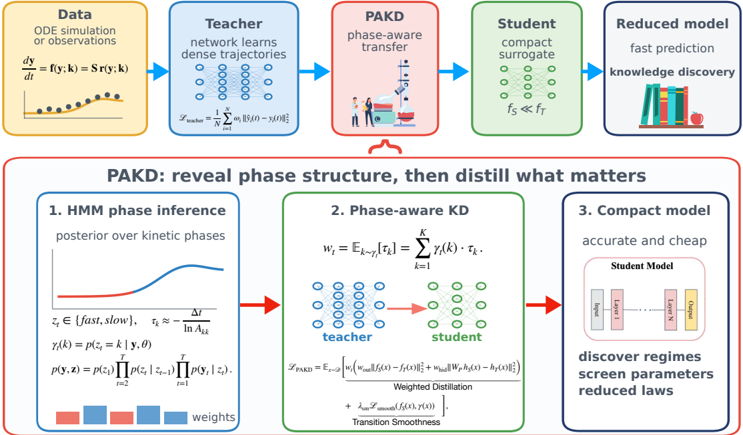
PAKD is a fully data-driven pipeline that trains a high-fidelity teacher surrogate, uses an unsupervised HMM to infer latent fast/slow phases, and distills a compact student with phase-lifetime weights. Across Michaelis-Menten, POLLU, Fisher-KPP, and MCF7 signaling, it reproduces key dynamics and reduces stiffness/computation where QSSA struggles.
Key findings
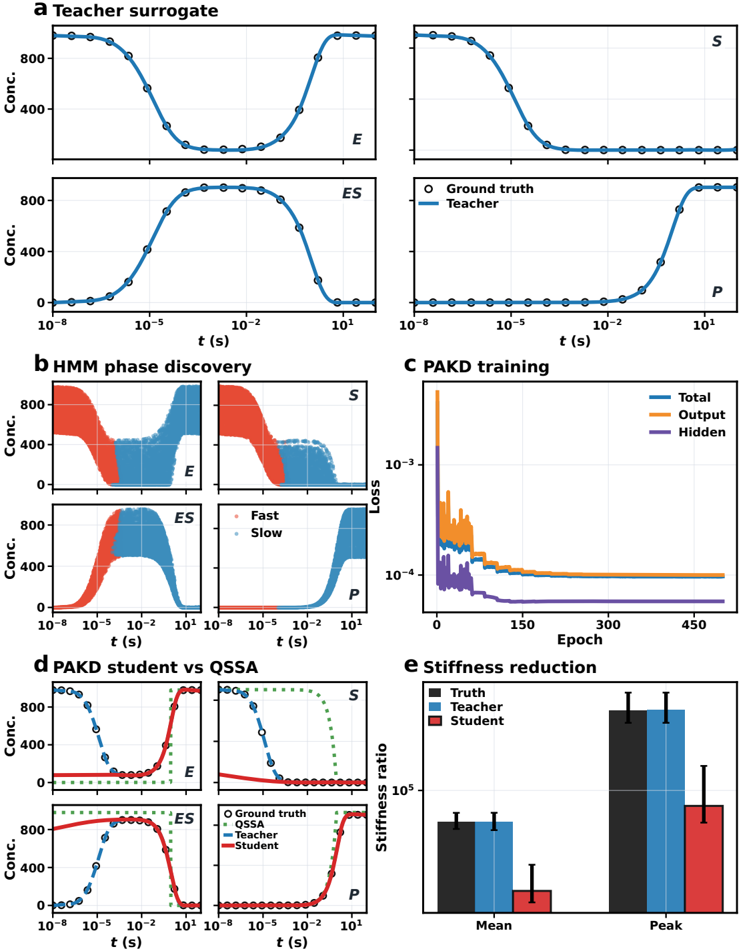
- Michaelis-Menten: the teacher matches the stiff-solver reference for S, E, ES, and P across eight decades in time; the HMM recovers a fast-transient and a slow-relaxation phase; the student lowers mean and peak effective stiffness by orders of magnitude versus both teacher and ground truth, while QSSA deviates in the fast-transient regime. Training converges over 450 epochs (Fig. 2c).
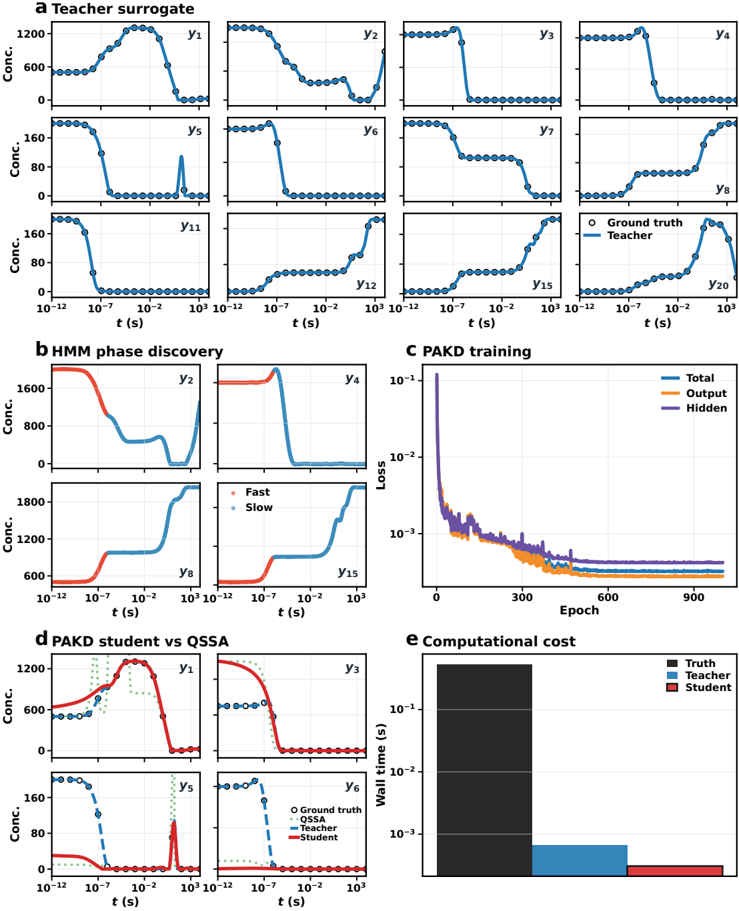
- POLLU: the benchmark has 20 coupled species and 25 irreversible mass-action reactions spanning 15 orders of magnitude in timescale (10^-12 s to beyond 10^3 s); the teacher tracks the BDF reference across the full 15-decade horizon; the HMM finds a fast radical-burst phase and slow relaxation phase; the student avoids QSSA’s spurious oscillations in y1 and y5 and overshoots in y3 and y6, with computational cost orders of magnitude lower than BDF and teacher inference; distillation converges in about 900 epochs.
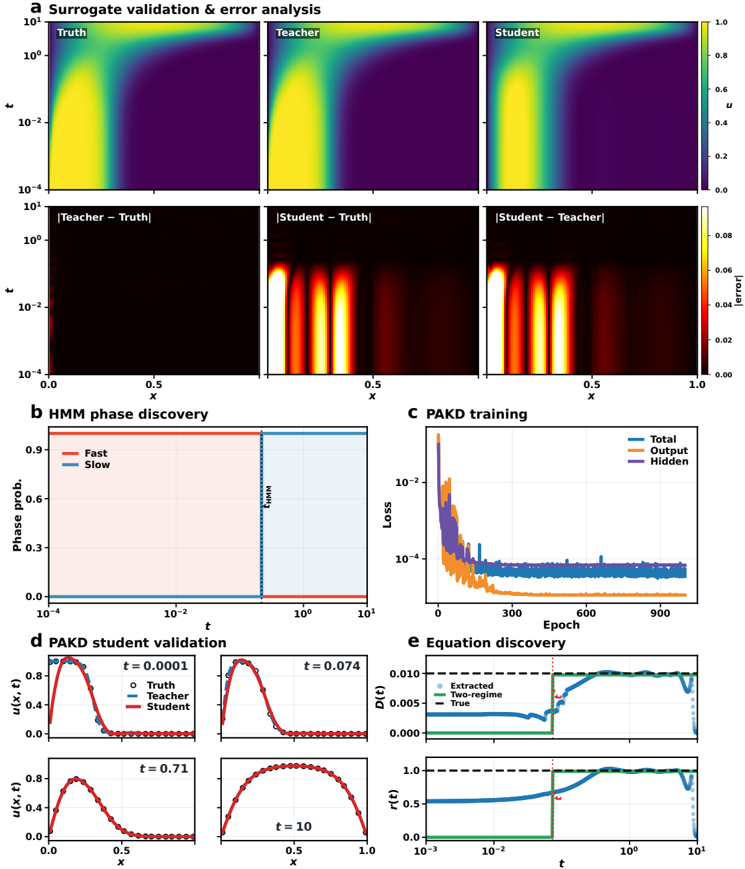
- Fisher-KPP: with N = 100 interior grid points, D = 10^-2, and a sharp initial front (x_s = 0.3, δ = 0.05), the HMM resolves a transition at t*_HMM ≈ 0.21; the student tracks the BDF reference after separation; equation discovery recovers D_slow ≈ 9.76 × 10^-3 and r_slow ≈ 0.989 with relative errors below 2.5%; distillation converges over about 900 epochs.
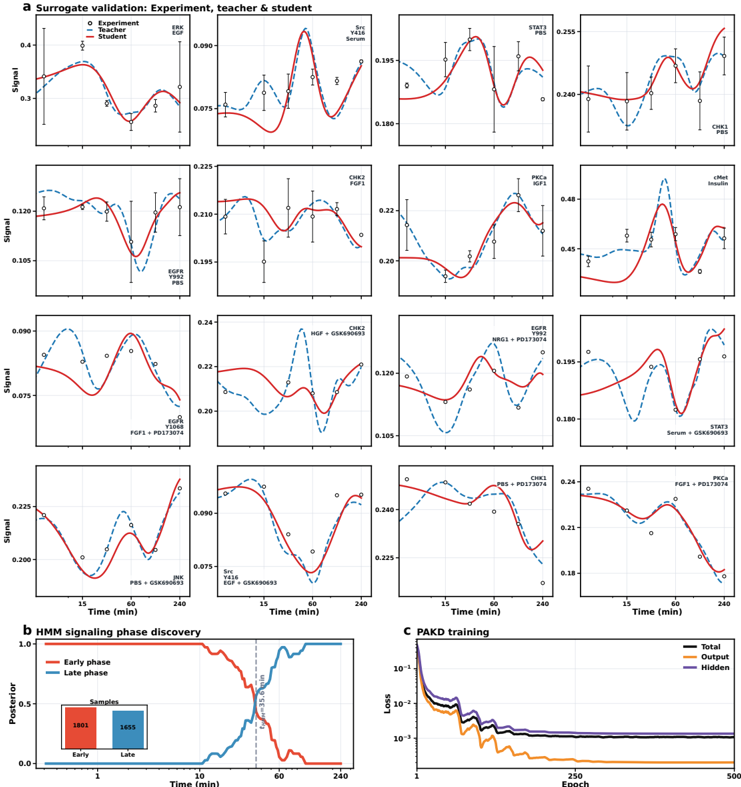
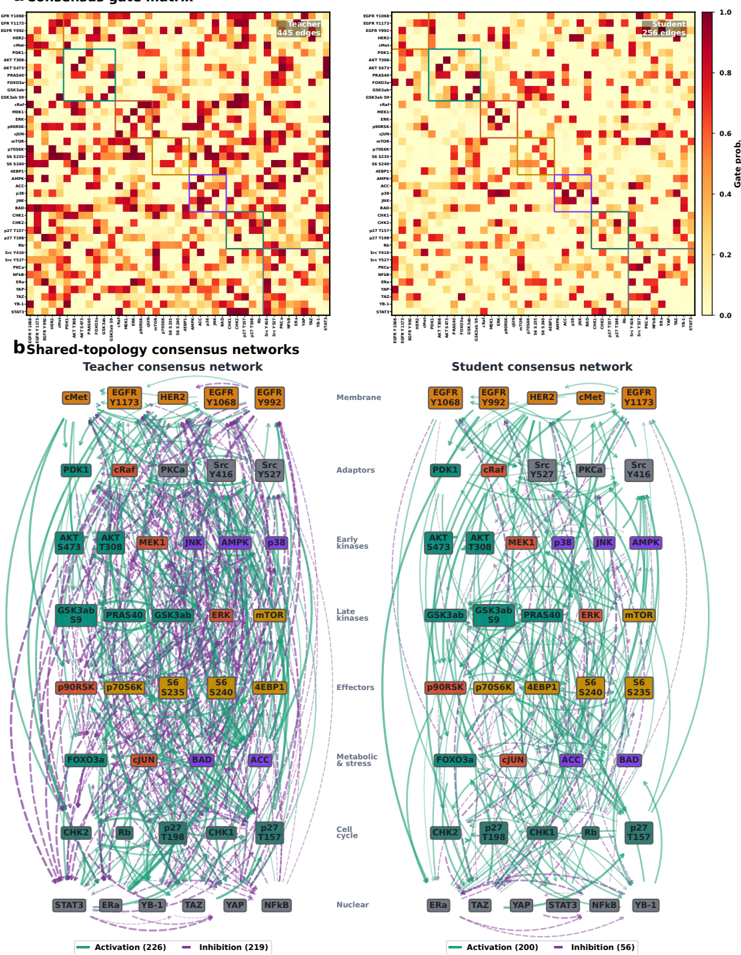
- MCF7: on HPN-DREAM data with 41 signaling proteins, 36 combinatorial perturbation conditions (8 stimuli × 3 inhibitor backgrounds), and 7 time points from 0 to 240 min, the HMM transition occurs at t*_HMM ≈ 35.6 min, with 1,801 early-phase and 1,655 late-phase samples out of 3,456; the student compresses the consensus network from 445 to 256 edges, prunes inter-module edges by 46% (366 → 197), reduces cell-cycle edges from 9 to 4, retains 200 of 226 activation edges but prunes inhibition edges from 219 to 56, and converges in 500 epochs; top interactions include the bidirectional AKT T308↔S473 loop (g ≈ 0.999, Hill coefficients n = 4.22 and 6.01).
Methods
- Teacher surrogate: a residual MLP with three hidden layers of width 128, GELU activations, and skip connections; it predicts ŷ(t) = f_T(y0, t) and is trained with a weighted MSE whose per-species weights are inversely proportional to typical species magnitude, using Adam with weight decay 10^-5 and a learning-rate scheduler; inputs and outputs are log-transformed and normalized, and the teacher generates dense log-spaced trajectories.
- Unsupervised phase discovery: a Gaussian-emission HMM with K = 2 latent phases is fit to teacher trajectories via Baum-Welch (EM); posterior responsibilities γ_t(k) are obtained by forward-backward recursion, and phase lifetimes are estimated as τ_k ≈ -Δt / ln A_kk, where Δt is the median sampling interval.
- PAKD distillation: phase-aware weights are w_t = Σ_k γ_t(k) · τ_k; the loss combines weighted output matching, hidden-representation alignment through a learnable projection W_P, and a smoothness regularization weighted by posterior entropy; the student is a residual MLP with a single 128-unit hidden layer, optimized with Adam (lr 10^-3, weight decay 10^-5) and ReduceLROnPlateau with patience 50. For MCF7, the paper additionally fits gated Hill-type ODEs with differentiable topology.
Limitations
- Paper-stated: the discrete phase model may be sensitive to the number of states and emission assumptions, and richer unsupervised regime models could capture gradual transitions and hierarchical timescales; because distillation optimizes the student against the teacher, teacher bias can propagate, making teacher calibration and uncertainty-aware weighting important future directions; a deeper theoretical characterization of when and why distillation yields numerically smoother surrogates remains open.
- Evident from the text: all experiments use K = 2 phases, and no sensitivity analysis over K or alternative emission assumptions is reported; teacher-bias propagation is acknowledged but not quantified.
Model-written summary. Check it against the paper before relying on it.
Integrity signals
Registry
Cites
Statistics
Figures
Verification
Claims the paper makes
0 Valid · 4 Not valid · 19 Not checked · 94 Own results and interpretations
A result the paper reports from its own data — it cites no other source for it, so there is none to check. The quote shows it is in the paper.
In the paper
“Compared to the teacher model, the student's topology is markedly reduced across the inner and outer protein layers of the cellular reaction cycle.”
§ Data-Driven Phase-Aware Knowledge Distillation for Stiff Chemical Reaction Networks > Supplementary Information.
plainstates a cause- Asserted: passes — The authors put it forward as true.
- Checkable: passes — It can be checked against evidence.
- Load-bearing: passes — The paper’s conclusions depend on it.
- Based: passes — The paper gives a reason why it holds.
A result the paper states — it cites no source for it, so there is none to check. The quote shows it is in the paper.
In the paper
“Notably, the student achieves comparable t quality with fewer high-con dence edges than the teacher.”
§ Data-Driven Phase-Aware Knowledge Distillation for Stiff Chemical Reaction Networks > Discussion
plain- Asserted: passes — The authors put it forward as true.
- Checkable: passes — It can be checked against evidence.
- Load-bearing: passes — The paper’s conclusions depend on it.
- Based: passes — The paper gives a reason why it holds.
A result the paper reports from its own data — it cites no other source for it, so there is none to check. The quote shows it is in the paper.
In the paper
“Inter-module edges are reduced by 46% (366 → 197), whereas core signaling modules (PI3K-AKT, MAPK-ERK, mTOR) are largely preserved.”
§ Data-Driven Phase-Aware Knowledge Distillation for Stiff Chemical Reaction Networks > Supplementary Information.
plainstates a cause- Asserted: passes — The authors put it forward as true.
- Checkable: passes — It can be checked against evidence.
- Load-bearing: passes — The paper’s conclusions depend on it.
- Based: passes — The paper gives a reason why it holds.
A result the paper states — it cites no source for it, so there is none to check. The quote shows it is in the paper.
In the paper
“Although both methods aim to reduce complexity, QSSA enforces the quasi-steady-state assumption from t = 0, leading to systematic deviations in the fast-transient regime, most visible in the dynamics of S and ES.”
§ Data-Driven Phase-Aware Knowledge Distillation for Stiff Chemical Reaction Networks > Michaelis-Menten enzyme kinetics: from teacher delity to sti ness reduction
plainstates a cause- Asserted: passes — The authors put it forward as true.
- Checkable: passes — It can be checked against evidence.
- Load-bearing: passes — The paper’s conclusions depend on it.
- Based: passes — The paper gives a reason why it holds.
None of the sources cited for this claim could be matched to a paper, so there is nothing to check it against.
In the paper
“Overall, the extracted consensus architecture demonstrates strong concordance with established pathway topologies documented in the literature [34][35][36].”
§ Data-Driven Phase-Aware Knowledge Distillation for Stiff Chemical Reaction Networks > MCF7 breast cancer signaling
What the sources say
- Not matchedcites [34]
The reference list we hold has no entry [34].
- Not matchedcites [35]
The reference list we hold has no entry [35].
- Not matchedcites [36]
The reference list we hold has no entry [36].
boostedstates an association- Asserted: passes — The authors put it forward as true.
- Checkable: passes — It can be checked against evidence.
- Load-bearing: passes — The paper’s conclusions depend on it.
- Based: passes — The paper gives a reason why it holds.
- Not matched
54 more claims
Create a free account to see all 117 claims and every source verdict.
- Probably not a substantial claim. 21
- It may state two separate claims as one. 41
Self-check
Percentages, sums and reported differences re-computed from the paper’s own numbers.
Rated minor: it would not touch a result — a value no result rests on, a p-value that stays on the same side of the significance level, or a conflict that is clerical, resolved elsewhere in the paper, or outside its own findings.
In the paper
“across 36 combinatorial perturbation conditions (8 stimuli × 3 inhibitor backgrounds)”
§ Data-Driven Phase-Aware Knowledge Distillation for Stiff Chemical Reaction Networks > MCF7 breast cancer signaling
Reported 36 · recomputed 24
Citations
Cites
Maximum Likelihood from Incomplete Data Via the EM Algorithm
Dempster, A. P., Laird, N. M., & Rubin, D. B. (1977) · Journal of the Royal Statistical Society Series B: Statistical Methodology · doi:10.1111/j.2517-6161.1977.tb01600.x · Cited by 50,444
A tutorial on hidden Markov models and selected applications in speech recognition
Rabiner, L. R. (1989) · Proceedings of the IEEE · doi:10.1109/5.18626 · Cited by 22,743
Distilling the Knowledge in a Neural Network
Hinton, G., Vinyals, O., & Dean, J. (2015) · arXiv · doi:10.48550/arxiv.1503.02531 · Cited by 14,204
AKT/PKB signaling: navigating downstream
Manning, B. D., & Cantley, L. C. (2007) · Cell · doi:10.1016/j.cell.2007.06.009 · Cited by 6,115
Dynamic mode decomposition of numerical and experimental data
SCHMID, P. J. (2010) · Journal of Fluid Mechanics · doi:10.1017/s0022112010001217 · Cited by 5,915
Inhibition of glycogen synthase kinase-3 by insulin mediated by protein kinase B
Cross, D. A. E., Alessi, D. R., Cohen, P., Andjelkovich, M., & Hemmings, B. A. (1995) · Nature · doi:10.1038/378785a0 · Cited by 5,244
Discovering governing equations from data by sparse identification of nonlinear dynamical systems
Brunton, S. L., Proctor, J. L., & Kutz, J. N. (2016) · Proceedings of the National Academy of Sciences · doi:10.1073/pnas.1517384113 · Cited by 4,796
Baum, L. E., Petrie, T., Soules, G., & Weiss, N. (1970) · The Annals of Mathematical Statistics · doi:10.1214/aoms/1177697196 · Cited by 4,297
Knowledge Distillation: A Survey
Gou, J., Yu, B., Maybank, S. J., & Tao, D. (2021) · International Journal of Computer Vision · doi:10.1007/s11263-021-01453-z · Cited by 3,931
Approximation of Large-Scale Dynamical Systems
Antoulas, A. C. (2005) · Society for Industrial and Applied Mathematics eBooks · doi:10.1137/1.9780898718713 · Cited by 3,655
Research works printed but not linked: 4
- Kim, S., Ji, W., Deng, S., Ma, Y., Rackauckas, C.: Sti neural ordinary di er- ential equations. Chaos: An Interdisciplinary Journal of Nonlinear Science 31(9) (2021)
- Gu, Y., Dong, L., Wei, F., Huang, M.: Minillm: Knowledge distillation of large language models. In: International Conference on Learning Representations, vol. 2024, pp. 32694-32717 (2024)
- Zagoruyko, S., Komodakis, N.: Paying more attention to attention: Improv- ing the performance of convolutional neural networks via attention trans- fer. In: International Conference on Learning Representations (2017). https://openreview.net/forum?id=Sks9_ajex
- Bishop, C.M.: Pattern Recognition and Machine Learning, Softcover reprint of the original 1st edition 2006 (corrected at 8th printing 2009) edn. Information science and statistics. Springer, New York, NY (2016)
Cited by
Still being checked.
Metadata
- Authors
- Yang, W., Ran, S., & Hong, L.
- Affiliations
- Beijing Institute of Mathematical Sciences and Applications (CN)
- Sun Yat-sen University (CN)
- Corresponding author
- Yang, Wuyue
- Venue
- Research Square
- Published
- 2026-08-27
- OpenAlex
- W7204442903
- Cited by
- 0
- References
- 37
- Type
- posted content
- Language
- en
- Open access
- green
- doi.org
- Locations
- Research Square (submittedVersion, cc-by)
- Funders
- National Natural Science Foundation of China (2021YFA0719200, 12301617)
- Topics
- Physical Sciences › Physics and Astronomy › Statistical and Nonlinear Physics › Model Reduction and Neural Networks
- Life Sciences › Biochemistry, Genetics and Molecular Biology › Molecular Biology › Gene Regulatory Network Analysis
- Physical Sciences › Physics and Astronomy › Statistical and Nonlinear Physics › Nonlinear Dynamics and Pattern Formation
- Keywords
- model reduction, hidden Markov models, quasi-steady-state approximation, time-scale separation
About these checks
Registry, retraction, Cites and statistics results are computed, not judged, with one exception: a printed reference that no index lists is read once by a model before it counts as a citation error. Claims are extracted by a model and kept only when their quote appears verbatim in the text; each cited source is then checked, with a model’s help, for whether it says what the claim relies on. Those verdicts can be wrong — read the claim’s quote and the cited source before relying on one.
A language model drew the claims from the paper on 2026-11-19, under version 3 of the claim definition (model deepseek-v4.1-flash, prompt extract-v3).
A second model labelled each claim on 2026-11-19 (model jev-1.13-20260917, definition revision gold-guideline-v0.2).
Statistics and arithmetic are recomputed, not judged.
Confidence bands are shown only for fields calibrated on our annotated test set. None is calibrated yet, so no band is shown.
What counts as a claim ›How we measure confidence ›How we check this ›
Are you an author, or do you see a problem with this page? Request a review
How to cite
Cite CoChat for the checks on this page, and the paper for its own findings.
- This page
- CoChat. (2026). Citation check: Data-Driven Phase-Aware Knowledge Distillation for Stiff Chemical Reaction Networks. https://app.cochat.ai/papers/10.21203/rs.3.rs-10546497/v1
- The paper
- Yang, W., Ran, S., & Hong, L. (2026). Data-Driven Phase-Aware Knowledge Distillation for Stiff Chemical Reaction Networks. Research Square. https://doi.org/10.21203/rs.3.rs-10546497/v1
Data sources
Bibliographic data: Semantic Scholar, OpenAlex, Crossref.
Contains information from the Semantic Scholar Academic Graph Datasets, made available under the ODC Attribution License (ODC-BY 1.0).
Semantic Scholar’s data is described in: Kinney, R., et al. (2023). The Semantic Scholar Open Data Platform. arXiv:2301.10140.
