

The DOI matches its Crossref record; 38 of the 38 references it cites were found in a registry or an index.
Current status and factors influencing readiness to return to work among young and middle-aged stroke patients in China
Open accessPreprint — published as 10.1038/s41598-024-53262-2
Abstract
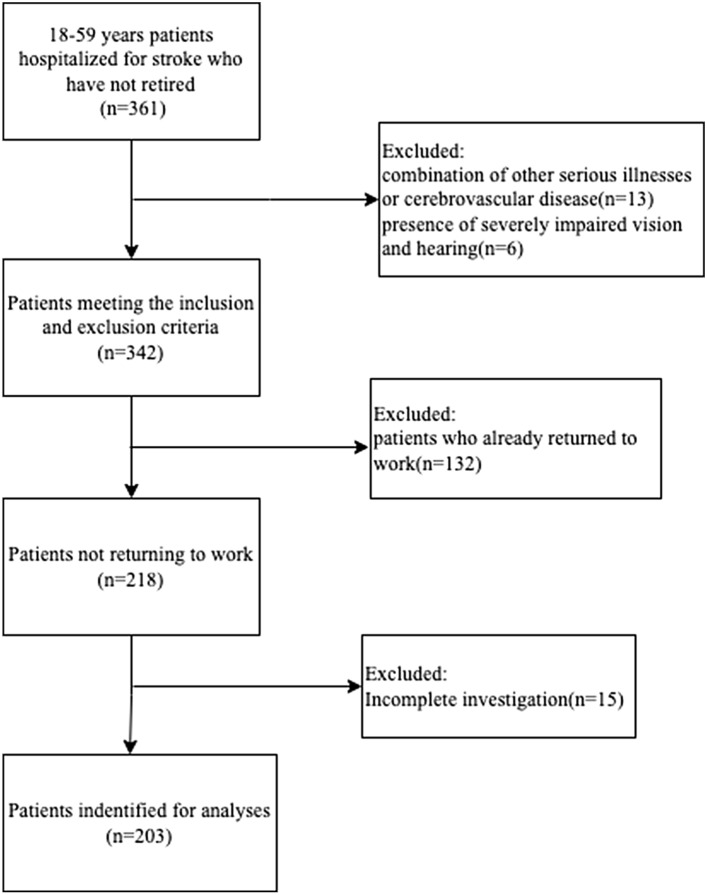
Objectives: Stroke is affecting an increasing number of individuals of working age, and accurate assessment of the readiness to return to work can help to determine the timing of return to work and facilitate an early return to society. The objective of this study was to investigate the current state of readiness to return to work and the factors influencing it among young and middle-aged stroke patients in China. Materials & Methods: A sample of young and middle-aged stroke patients hospitalized in a tertiary hospital in Henan Province between December 2021 and May 2022 were included in this study. A general information questionnaire and the Readiness to Return to Work Scale, Social Support Rating Scale, Stroke Rehabilitation Self-Efficacy Scale, and Fatigue Severity Scale were administered to the patients. Results: Of the 203 patients successfully surveyed, 60 (29.6%) were in the pre-intention stage, 35 (17.2%) in the intention stage, 81 (39.9%) in the action-readiness-self-assessment stage, and 27 (13.3%) in the action-readiness-action stage. A logistic regression analysis showed that education level, monthly income, time to start rehabilitation exercise, social support, rehabilitation self-efficacy, and fatigue severity were the main factors affecting the readiness of young and middle-aged stroke patients to return to work. Conclusion: The readiness of young and middle-aged stroke patients to return to work needs to be increased further. Healthcare professionals should consider the influencing factors of readiness to return to work and design targeted intervention programmes to facilitate successful return to work and normal life.
Overview
The claims and statistics of this paper haven’t been checked yet.
Run the check — free, no account needed. It reads the open-access text and checks the sources it cites.
Integrity signals
Registry
Cites
Statistics
Figures
Verification
Claims the paper makes
The claims and statistics of this paper haven’t been checked yet.
Run the check — free, no account needed. It reads the open-access text and checks the sources it cites.
Self-check
Percentages, sums and reported differences re-computed from the paper’s own numbers.
The self-check needs the paper’s full text.
Citations
Cites
Feigin, V. L., Stark, B. A., Johnson, C. O., Roth, G. A., Bisignano, C., Gebreheat, G., Abbasifard, M., Abbasi‐Kangevari, M., Abd-Allah, F., Abedi, V., et al. (2021) · The Lancet Neurology · doi:10.1016/s1474-4422(21)00252-0 · Cited by 8,602
Krupp, L. B. (1989) · Archives of Neurology · doi:10.1001/archneur.1989.00520460115022 · Cited by 6,172
Feigin, V. L., Forouzanfar, M. H., Krishnamurthi, R., Mensah, G. A., Connor, M., Bennett, D. A., Moran, A. E., Sacco, R. L., Anderson, L., Truelsen, T., et al. (2014) · The Lancet · doi:10.1016/s0140-6736(13)61953-4 · Cited by 3,899
Zhou, M., Wang, H., Zeng, X., Yin, P., Zhu, J. W., Chen, W., Li, X., Wang, L., Wang, L., Liu, Y., et al. (2019) · The Lancet · doi:10.1016/s0140-6736(19)30427-1 · Cited by 3,671
Post-Stroke Fatigue: Epidemiology, Clinical Characteristics and Treatment
Acciarresi, M., Bogousslavsky, J., & Paciaroni, M. (2014) · European Neurology · doi:10.1159/000363763 · Cited by 1,423
Jones, F., Partridge, C. J., & Reid, F. (2008) · Journal of Clinical Nursing · doi:10.1111/j.1365-2702.2008.02333.x · Cited by 218
Return to work after young stroke: A systematic review
Edwards, J. D., Kapoor, A., Linkewich, E., & Swartz, R. H. (2017) · International Journal of Stroke · doi:10.1177/1747493017743059 · Cited by 202
Sustainable Return to Work: A Systematic Review Focusing on Personal and Social Factors
Etuknwa, A., Daniels, K., & Eib, C. (2019) · Journal of Occupational Rehabilitation · doi:10.1007/s10926-019-09832-7 · Cited by 202
Xie, W., Zhou, P., Sun, Y., Meng, X., Dai, Z., Sun, G., & Sun, X. (2018) · Cells · doi:10.3390/cells7120270 · Cited by 179
Post-stroke fatigue and return to work: a 2-year follow-up
Andersen, G., Christensen, D., Kirkevold, M., & Johnsen, S. P. (2011) · Acta Neurologica Scandinavica · doi:10.1111/j.1600-0404.2011.01557.x · Cited by 152
Mild traumatic brain injury and fatigue: A prospective longitudinal study
Norrie, J. D., Heitger, M. H., LEATHEM, J. M., Anderson, T., Jones, R. D., & Flett, R. A. (2010) · Brain Injury · doi:10.3109/02699052.2010.531687 · Cited by 151
Franche, R., Corbière, M., Lee, H., Breslin, F. C., & Hepburn, C. G. (2007) · Journal of Occupational Rehabilitation · doi:10.1007/s10926-007-9097-9 · Cited by 147
Validity and reliability of fatigue severity scale in stroke
Taşkıran, Ö. Ö., Batur, E. B., Yüksel, S., Cengiz, M., & Karataş, G. K. (2018) · Topics in Stroke Rehabilitation · doi:10.1080/10749357.2018.1550957 · Cited by 125
Paciaroni, M., & Acciarresi, M. (2019) · Stroke · doi:10.1161/strokeaha.119.023552 · Cited by 98
Meta-Synthesis of Qualitative Research on Facilitators and Barriers of Return to Work After Stroke
Schwarz, B., Claros-Salinas, D., & Streibelt, M. (2017) · Journal of Occupational Rehabilitation · doi:10.1007/s10926-017-9713-2 · Cited by 92
Lo, S. H. S., Chang, A. M., & Chau, J. P. C. (2018) · Stroke · doi:10.1161/strokeaha.117.019437 · Cited by 87
Income and education as predictors of return to working life among younger stroke patients
Trygged, S., Ahačić, K., & Kåreholt, I. (2011) · BMC Public Health · doi:10.1186/1471-2458-11-742 · Cited by 81
Critical Factors Related to Return to Work After Stroke: A Qualitative Study
Hartke, R. J., Trierweiler, R., & Bode, R. K. (2011) · Topics in Stroke Rehabilitation · doi:10.1310/tsr1804-341 · Cited by 79
Barriers and facilitators associated with return to work after stroke: a qualitative meta-synthesis
Brannigan, C., Galvin, R., Walsh, M. E., Loughnane, C., Morrissey, E.-J., Macey, C., Delargy, M., & Horgan, F. (2016) · Disability and Rehabilitation · doi:10.3109/09638288.2016.1141242 · Cited by 76
White, C., Green, R. A., Ferguson, S., Anderson, S. L., Howe, C., Sun, J., & Buys, N. J. (2019) · Journal of Occupational Rehabilitation · doi:10.1007/s10926-018-09826-x · Cited by 75
Post-stroke fatigue: a scoping review
Aali, G., Drummond, A. E., das Nair, R., & Shokraneh, F. (2020) · F1000Research · doi:10.12688/f1000research.22880.2 · Cited by 68
Pihlaja, R., Uimonen, J., Mustanoja, S., Tatlisumak, T., & Poutiainen, E. (2014) · Journal of Psychosomatic Research · doi:10.1016/j.jpsychores.2014.08.011 · Cited by 63
Doucet, T., Müller, F., Verdun-Esquer, C., Debelleix, X., & Brochard, P. (2012) · Annals of Physical and Rehabilitation Medicine · doi:10.1016/j.rehab.2012.01.007 · Cited by 60
Yen, H.-C., Jeng, J., Chen, W., Pan, G.-S., Chuang, W.-Y., Lee, Y., & Teng, T. (2019) · Neurorehabilitation and neural repair · doi:10.1177/1545968319893294 · Cited by 57
Increased Stroke Burdens Among the Low-Income Young and Middle Aged in Rural China
Ning, X., Sun, J., Jiang, R., Lu, H., Bai, L., Shi, M., Tu, J., Wu, Y., Wang, J., & Zhang, J. (2016) · Stroke · doi:10.1161/strokeaha.116.014897 · Cited by 54
Factors predictive of return to work after stroke in patients with mild−moderate disability in India
Bonner, B., Pillai, R. S., Sarma, P. S., Lipska, K. J., Pandian, J. D., & Sylaja, P. N. (2015) · European Journal of Neurology · doi:10.1111/ene.12887 · Cited by 51
Return to Work 2–5 Years After Stroke: A Cross Sectional Study in a Hospital-Based Population
Arwert, H. J., Schults, M.-L., Meesters, J. J. L., Wolterbeek, R., Boiten, J., & Vlieland, T. P. M. V. (2016) · Journal of Occupational Rehabilitation · doi:10.1007/s10926-016-9651-4 · Cited by 49
Return-to-work challenges following a work-related mild TBI: The injured worker perspective
Mansfield, E. D., Stergiou‐Kita, M., Cassidy, J. D., Bayley, M. T., Mantis, S., Kristman, V. L., Kirsh, B. H., Gómez, M., Jeschke, M. G., Vartanian, O. A., et al. (2015) · Brain Injury · doi:10.3109/02699052.2015.1053524 · Cited by 41
Rutkowski, N. A., Sabri, E., & Yang, C. P. (2021) · PLoS ONE · doi:10.1371/journal.pone.0255538 · Cited by 38
Associations Between the Readiness for Return to Work Scale and Return to Work: A Prospective Study
Aasdahl, L., Pape, K., Jensen, C., Vasseljen, O., Braathen, T. N., Johnsen, R., & Fimland, M. S. (2017) · Journal of Occupational Rehabilitation · doi:10.1007/s10926-017-9705-2 · Cited by 36
Employee experience of workplace supervisor contact and support during long-term sickness absence
Buys, N. J., Selander, J., & Sun, J. (2017) · Disability and Rehabilitation · doi:10.1080/09638288.2017.1410584 · Cited by 34
Return to work predictors of stroke survivors and their spousal caregivers
Schulz, C. H., Godwin, K. M., Hersch, G. I., Hyde, L. K., Irabor, J. J., & Ostwald, S. K. (2017) · Work · doi:10.3233/wor-172544 · Cited by 24
Braathen, T. N., Brage, S., Tellnes, G., Øyeflaten, I., Chris, J., & Eftedal, M. (2014) · Journal of Occupational Rehabilitation · doi:10.1007/s10926-013-9497-y · Cited by 18
van Dongen, C. H., Goossens, P. H., van Zee, I. E., Verpoort, K. N., Vlieland, T. P. M. V., & van Velzen, J. M. (2017) · Journal of Occupational Rehabilitation · doi:10.1007/s10926-017-9738-6 · Cited by 18
Post-stroke fatigue: a scoping review
Aali, G., Drummond, A. E., das Nair, R., & Shokraneh, F. (2020) · F1000Research · doi:10.12688/f1000research.22880.1 · Cited by 18
De-xi, W. (2007) · Zhonghua wuli yixue zazhi · Cited by 9
Reliability and validity of Chinese version of the Stroke Self-Efficacy Questionnaire
Yang, Y., Wang, Y., & Wang, Q. (2015) · The Journal of practical nursing · doi:10.3760/cma.j.issn.1672-7088.2015.05.019 · Cited by 9
Xiao, L., Gao, Y.-L., Zeng, K., & Zhang, L. (2019) · Disability and Rehabilitation · doi:10.1080/09638288.2019.1636314 · Cited by 7
Research works printed but not linked: 9
- Sun X,Wang W.A nationwide epidemiological sample survey on cerebrovascular disease in China. Chin J Contemp Neurol Neurosurg. 2018;18(02):83–88.
- Chen M, Wang S, Feng X, et al. Risk factors for stroke in high-risk populations of different ages and genders. Pract Prevent Med. 2020;27(04):451–454.
- Gao Y, Zhang J.Determination of Sample Size in Logistic Regression Analysis. J Evid Based Med. 2018;18(2):122–124.
- Zhao M.Study on readiness and maintenance for return-to-work and construction of predication model among young and middle-age patients after stroke. Qingdao University. 2021.
- Cao HL.The Chinese Localization of the Readiness for Return to work Scale and the Application in Breast Cancer Patients. Zhengzhou University. 2018.
- Xiao S. Theoretical basis and research application of Social Support Rating Scale. Clin Psychol Med. 1994;(02):98–100.
- Zhao ML, Wang AM.The Readiness for Return-to-work and Its Associated Factors of Young and Middle-age Non-returned Patients after Stroke[J].Chinese And Foreign Medical Research,2021, 19 (15): 150–153.
- Chen Q, Guo Y, Zhou J.Current status of returning to work and its influencing factors among young and middle-aged patients with stroke. Pract Prevent Med. 2021;28(06):699–702.
- Liang LL, Xu MY, Wang LJ, et al.Correlation between rehabilitation self-efficacy and activities of daily living, post traumatic growth in middle and young-age patients with stroke. Chongqing Med J ,2018;47(30):3928–3932.
Cited by
Sorted by citations
Sun, Y., Zhang, R., Hu, D., Wang, Y., Wen, C., & Ma, H. (2025) · BMC Geriatrics · doi:10.1186/s12877-025-06304-x · Cited by 10
Mussa, R., Ambler, G., Özkan, H., Mitchell, J., Banerjee, G., Leff, A. P., McLernon, S., Perry, R. J., Simister, R. J., Chandratheva, A., et al. (2025) · Journal of Neurology Neurosurgery & Psychiatry · doi:10.1136/jnnp-2025-336411 · Cited by 5
Liu, J., Hong, Y., Tian, J., & Qu, L. (2024) · BMC Gastroenterology · doi:10.1186/s12876-024-03437-y · Cited by 5
Factors associated with post-stroke fatigue among stroke survivors: a cross-sectional study
Dong, Y., Tang, L., Badrin, S., Badrin, S., & Wu, J. (2025) · PeerJ · doi:10.7717/peerj.19052 · Cited by 3
Huo, Q., Pu, Y., Deng, H., Li, S., & Feng, X. (2025) · Journal of Cancer Survivorship · doi:10.1007/s11764-025-01914-1 · Cited by 2
Metadata
- Authors
- Liu, Z., Li, J., Liu, F., Guan, N., Li, Y., Zhang, Y., Hou, L., & Jiang, Q.
- Affiliations
- First Affiliated Hospital of Henan University of Traditional Chinese Medicine (CN)
- Henan University (CN)
- Henan Provincial People's Hospital (CN)
- Corresponding author
- Jiang, Qiuhuan
- Venue
- Scientific Reports
- Publisher
- Research Square Platform LLC
- Published
- 2022-12-02
- Volume
- 14
- Issue
- 1
- Pages
- 2841-2841
- ISSN
- 2045-2322 (ISSN-L)
- PMC
- PMC10838315
- OpenAlex
- W4391509819
- Cited by
- 15
- References
- 38
- Citations by year
- 2026: 6 · 2025: 8 · 2024: 1
- FWCI
- 2.37
- Type
- journal article
- Language
- en
- Open access
- gold
- doi.org
- Locations
- Scientific Reports (publishedVersion, cc-by)
- Research Square (acceptedVersion, cc-by)
- PubMed Central (publishedVersion, cc-by)
- PubMed (publishedVersion)
- DOAJ (DOAJ: Directory of Open Access Journals) (submittedVersion, cc-by-sa)
- Funders
- Health Commission of Henan Province
- Topics
- Health Sciences › Medicine › Rehabilitation › Stroke Rehabilitation and Recovery
- Health Sciences › Health Professions › Physical Therapy, Sports Therapy and Rehabilitation › Medical Practices and Rehabilitation
- Social Sciences › Education › Disability Education and Employment
- Keywords
- stroke, return to work, young and middle-aged adults, social support, fatigue severity, educational attainment, income, rehabilitation timing, work reintegration
- MeSH terms
- Stroke Rehabilitation, Health Personnel, Humans, Middle Aged, Surveys and Questionnaires, Sick Leave, Stroke, Return to Work
About these checks
Registry, retraction, Cites and statistics results are computed, not judged, with one exception: a printed reference that no index lists is read once by a model before it counts as a citation error. Claims are extracted by a model and kept only when their quote appears verbatim in the text; each cited source is then checked, with a model’s help, for whether it says what the claim relies on. Those verdicts can be wrong — read the claim’s quote and the cited source before relying on one.
Statistics and arithmetic are recomputed, not judged.
Confidence bands are shown only for fields calibrated on our annotated test set. None is calibrated yet, so no band is shown.
What counts as a claim ›How we measure confidence ›How we check this ›
Are you an author, or do you see a problem with this page? Request a review
