

Assessing the Accuracy and Reliability of AI-Generated Medical Responses: An Evaluation of the Chat-GPT Model
Open accessThe DOI matches its Crossref record; 12 of the 12 references it cites were found in a registry or an index.
Abstract
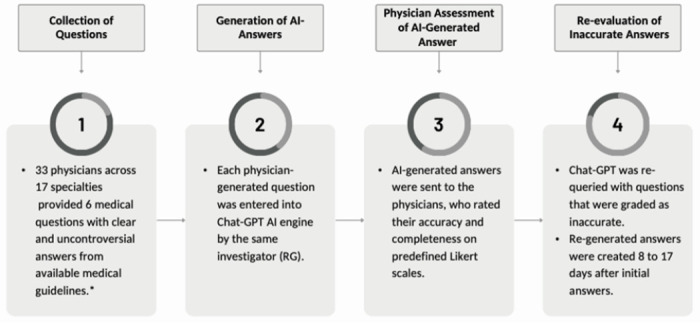
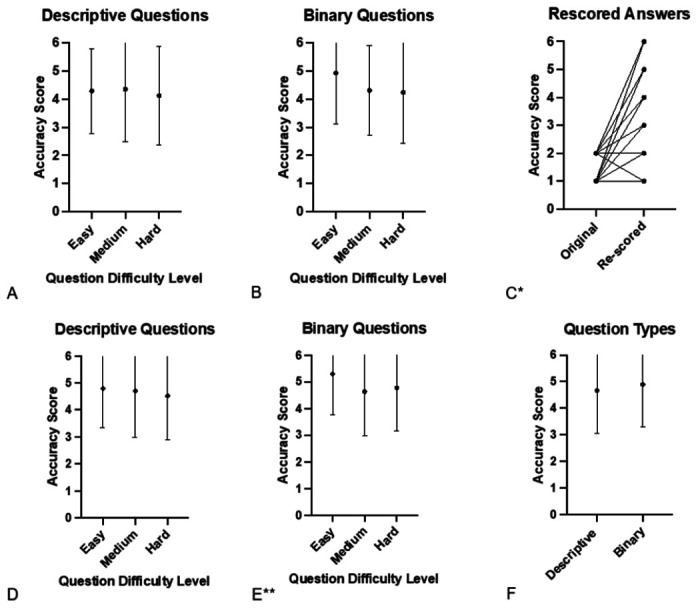
Background: Natural language processing models such as ChatGPT can generate text-based content and are poised to become a major information source in medicine and beyond. The accuracy and completeness of ChatGPT for medical queries is not known. Methods: Thirty-three physicians across 17 specialties generated 284 medical questions that they subjectively classified as easy, medium, or hard with either binary (yes/no) or descriptive answers. The physicians then graded ChatGPT-generated answers to these questions for accuracy (6-point Likert scale; range 1 – completely incorrect to 6 – completely correct) and completeness (3-point Likert scale; range 1 – incomplete to 3 - complete plus additional context). Scores were summarized with descriptive statistics and compared using Mann-Whitney U or Kruskal-Wallis testing. Results: Across all questions (n=284), median accuracy score was 5.5 (between almost completely and completely correct) with mean score of 4.8 (between mostly and almost completely correct). Median completeness score was 3 (complete and comprehensive) with mean score of 2.5. For questions rated easy, medium, and hard, median accuracy scores were 6, 5.5, and 5 (mean 5.0, 4.7, and 4.6; p=0.05). Accuracy scores for binary and descriptive questions were similar (median 6 vs. 5; mean 4.9 vs. 4.7; p=0.07). Of 36 questions with scores of 1-2, 34 were re-queried/re-graded 8-17 days later with substantial improvement (median 2 vs. 4; p<0.01). Conclusions: ChatGPT generated largely accurate information to diverse medical queries as judged by academic physician specialists although with important limitations. Further research and model development are needed to correct inaccuracies and for validation.
Overview
The claims and statistics of this paper haven’t been checked yet.
Free: it reads the open-access text and checks the first 5 claims that cite a source we can check. Create a free account to check every claim.
Integrity signals
Registry
Cites
Statistics
Figures
Verification
Claims the paper makes
The claims and statistics of this paper haven’t been checked yet.
Free: it reads the open-access text and checks the first 5 claims that cite a source we can check. Create a free account to check every claim.
Claims other papers make about this one
Each is checked against this paper’s own text: does it say what the citing paper says it does?
The source backs part of the claim, not all of it — or backs it for a different population, condition or comparison.
In the citing paper
“The same study reported that median accuracy scores were higher than mean scores in data analysis and that ChatGPT had a margin of error [29].”
From Is there any room for ChatGPT AI bot in speech-language pathology? (2025) · cites this paper as [29]
Experimental — accuracy not yet measuredThe source backs part of the claim, not all of it — or backs it for a different population, condition or comparison.
In the citing paper
“The output generated by Chat GPT is dependent on the complexity and clarity of the input, continuous evaluation of generated output will be required to ensure safe implementation in clinical settings [32, 33].”
From Artificial Intelligence (AI) – Powered Documentation Systems in Healthcare: A Systematic Review (2025) · cites this paper as [33]
Experimental — accuracy not yet measuredThe cited source says what the claim attributes to it.
In the citing paper
“it was found that more than 50% of ChatGPT responses to 180 questions created by 33 physicians had a high level of accuracy and comprehensiveness.”
From Is there any room for ChatGPT AI bot in speech-language pathology? (2025) · cites this paper as [29]
The cited source says what the claim attributes to it.
In the citing paper
“Despite some limited validation efforts, ChatGPT still requires further error correction [74].”
From Ethical Considerations of Using ChatGPT in Health Care (2023) · cites this paper as [74]
In the citing paper
“Overall, findings call into question previous claims that ChatGPT “has promise for providing accurate and comprehensive medical information” (18), and has “potential to provide first aid to young adults struggling with mental health issues” (19).”
From ChatGPT is not ready yet for use in providing mental health assessment and interventions (2024) · cites this paper as [18]
1 more claim about this paper
Create a free account to see every claim other papers make about this one.
Self-check
Percentages, sums and reported differences re-computed from the paper’s own numbers.
The self-check needs the paper’s full text.
Citations
Cites
Language Models are Few-Shot Learners
Brown, T. B., Mann, B., Ryder, N., Subbiah, M., Kaplan, J., Dhariwal, P., Neelakantan, A., Shyam, P., Sastry, G., Askell, A., et al. (2020) · arXiv · doi:10.48550/arxiv.2005.14165 · Cited by 23,372 · cited 2×
“5), an LLM with over 175 billion parameters (2).”
BackgroundAdvances in neural information processing systems 7
Cios, K., & Shields, M. (1997) · Neurocomputing · doi:10.1016/s0925-2312(97)90018-7 · Cited by 22,059
Kaugeranna, R., Kaugeranna, E., & Aion, (. S. 4. 6. (2023) · DROPS (Schloss Dagstuhl – Leibniz Center for Informatics) · doi:10.4230/lipics.giscience.2023.43 · Cited by 13,690
Kung, T. H., Cheatham, M., ChatGPT, Medenilla, A., Sillos, C., De Leon, L., Elepaño, C., Madriaga, M., Aggabao, R., Diaz-Candido, G., et al. (2022) · doi:10.1101/2022.12.19.22283643 · Cited by 4,115
Kung, T. H., Cheatham, M., Medenilla, A., Sillos, C., De Leon, L., Elepaño, C., Madriaga, M., Aggabao, R., Diaz-Candido, G., Maningo, J., et al. (2023) · PLOS Digital Health · doi:10.1371/journal.pdig.0000198 · Cited by 4,115 · cited 3×
“ChatGPT performed at or near the passing threshold for United States Medical Licensing Exam (USMLE) without any specialized training, suggesting its potential for medical education and clinical decision support (4, 5).”
BackgroundChatGPT is fun, but not an author
Thorp, H. H. (2023) · Science · doi:10.1126/science.adg7879 · Cited by 1,437
Deep reinforcement learning from human preferences
Christiano, P., Leike, J., Brown, T. B., Martic, M., Legg, S., & Amodei, D. (2017) · arXiv · doi:10.48550/arxiv.1706.03741 · Cited by 1,058
ChatGPT and other large language models are double-edged swords
Shen, Y., Heacock, L., Elias, J., Hentel, K. D., Reig, B., Shih, G., & Moy, L. (2023) · Radiology · doi:10.1148/radiol.230163 · Cited by 1,008 · cited 2×
“Compared to traditional supervised deep learning models, large language models can learn from data more e ciently with a two-stage training process, starting with self-supervised learning on vast amounts of unannotated data, then ne-tuned on smaller, task-speci c, annotated datasets so they can perform on end-user-spe…”
BackgroundChatGPT listed as author on research papers: many scientists disapprove
Stokel-Walker, C. (2023) · Nature · doi:10.1038/d41586-023-00107-z · Cited by 868
Flanagin, A., Bibbins-Domingo, K., Berkwits, M., & Christiansen, S. L. (2023) · JAMA · doi:10.1001/jama.2023.1344 · Cited by 420
Using AI to write scholarly publications
Hosseini, M., Rasmussen, L. M., & Resnik, D. B. (2024) · Accountability in Research · doi:10.1080/08989621.2023.2168535 · Cited by 286
On the cusp: considering the impact of artificial intelligence language models in healthcare
Goodman, R. S., Patrinely, J. R., Osterman, T., Wheless, L., & Johnson, D. B. (2023) · Med · doi:10.1016/j.medj.2023.02.008 · Cited by 100
Self-citation
Research works printed but not linked: 2
- [5]Gilson A, Safranek C, Huang T, Socrates V, Chi L, Taylor RA, How Well Does ChatGPT Do When Taking the Medical Licensing Exams? The Implications of Large Language Models for Medical Education and Knowledge Assessment. medRxiv. 2022: 2022.12. 23.22283901.
- [6]Shen Y, Heacock L, Elias J, Hentel KD, Reig B, Shih G, ChatGPT and Other Large Language Models Are Double-edged Swords. Radiology. 2023: 230163. 36700838
Cited by
A Survey on Evaluation of Large Language Models
Chang, Y., Wang, X., Wang, J., Wu, Y., Yang, L., Zhu, K., Chen, H., Yi, X., Wang, C., Wang, Y., et al. (2024) · ACM Transactions on Intelligent Systems and Technology · doi:10.1145/3641289 · Cited by 4,254
“, 2023), and many other QA situations (Hamidi and Roberts, 2023; Johnson et al., 2023).”
BackgroundA Survey on Evaluation of Large Language Models
Chang, Y., Wang, X., Wang, J., Wu, Y., Yang, L., Zhu, K., Chen, H., Yi, X., Wang, C., Wang, Y., et al. (2023) · arXiv · doi:10.48550/arxiv.2307.03109 · Cited by 3,159
The Role of AI in Hospitals and Clinics: Transforming Healthcare in the 21st Century
Maleki Varnosfaderani, S., & Forouzanfar, M. (2024) · Bioengineering · doi:10.3390/bioengineering11040337 · Cited by 931
“AI in radiology is not only about detecting abnormalities; it also helps in quantifying disease progression [96], assessing response to treatment [97], and predicting patient outcomes [98].”
BackgroundEthical Considerations of Using ChatGPT in Health Care
Wang, C., Liu, S., Yang, H., Guo, J., Wu, Y., & Liu, J. (2023) · Journal of Medical Internet Research · doi:10.2196/48009 · Cited by 541
“Despite some limited validation efforts, ChatGPT still requires further error correction [74].”
ChatGPT in healthcare: A taxonomy and systematic review
Li, J., Dada, A., Puladi, B., Kleesiek, J., & Egger, J. (2024) · Computer Methods and Programs in Biomedicine · doi:10.1016/j.cmpb.2024.108013 · Cited by 452
Metadata
- Authors
- Johnson, D., Goodman, R., Patrinely, J., Stone, C., Zimmerman, E., Donald, R., Chang, S., Berkowitz, S., Finn, A., Jahangir, E., Scoville, E., Reese, T., Friedman, D., Bastarache, J., Heijden, Y. V. D., Wright, J., Carter, N., Alexander, M., Choe, J., Chastain, C., Zic, J., Horst, S., Turker, I., Agarwal, R., Osmundson, E., Idrees, K., Kiernan, C., Padmanabhan, C., Bailey, C., Schlegel, C., Chambless, L., Gibson, M., Osterman, T., & Wheless, L.
- Affiliations
- Vanderbilt University Medical Center (US)
- Vanderbilt University (US)
- Vanderbilt University Medical Center
- Corresponding author
- Johnson, Douglas
- ORCID
- Johnson, Douglas
- Goodman, Rachel
- Patrinely, J
- Stone, Cosby
- Donald, Rebecca
- Chang, Sam
- Berkowitz, Sean
- Finn, Avni
- Jahangir, Eiman
- Scoville, Elizabeth
- Reese, Tyler
- Friedman, Debra
- Bastarache, Julie
- Alexander, Matthew
- Choe, Jennifer
- Chastain, Cody
- Horst, Sara
- Turker, Isik
- Idrees, Kamran
- Padmanabhan, Chandrasekhar
- Bailey, Christina
- Schlegel, Cameron
- Chambless, Lola
- Osterman, Travis
- Wheless, Lee
- Venue
- Research Square
- Published
- 2023-02-28
- PMC
- PMC10002821
- OpenAlex
- W4322622443
- Cited by
- 598
- References
- 8
- Citations by year
- 2026: 63 · 2025: 185 · 2024: 249 · 2023: 100
- Type
- posted content
- Language
- en
- Open access
- green
- doi.org
- Locations
- Research Square (acceptedVersion, cc-by)
- PubMed (publishedVersion)
- PubMed Central (submittedVersion, cc-by)
- Funders
- National Heart, Lung, and Blood Institute (R01HL151523, U01HL156620)
- National Cancer Institute (UG3CA265846, R01CA225005, UG3CA260318, R01CA240093, R01CA227481, K12CA090625, P30CA068485, U54CA163072)
- National Institute of Diabetes and Digestive and Kidney Diseases (K08DK133691)
- Topics
- Health Sciences › Medicine › Health Informatics › Artificial Intelligence in Healthcare and Education
- Health Sciences › Health Professions › Health Information Management › Artificial Intelligence in Healthcare
- Physical Sciences › Computer Science › Information Systems › Information Retrieval and Search Behavior
- Keywords
- ChatGPT, large language models, medical question answering, AI-generated medical information, accuracy assessment
About these checks
Registry, retraction, Cites and statistics results are computed, not judged, with one exception: a printed reference that no index lists is read once by a model before it counts as a citation error. Claims are extracted by a model and kept only when their quote appears verbatim in the text; each cited source is then checked, with a model’s help, for whether it says what the claim relies on. Those verdicts can be wrong — read the claim’s quote and the cited source before relying on one.
Statistics and arithmetic are recomputed, not judged.
Confidence bands are shown only for fields calibrated on our annotated test set. None is calibrated yet, so no band is shown.
What counts as a claim ›How we measure confidence ›How we check this ›
Are you an author, or do you see a problem with this page? Request a review
Data sources
Bibliographic data: Semantic Scholar, OpenAlex, Crossref.
Contains information from the Semantic Scholar Academic Graph Datasets, made available under the ODC Attribution License (ODC-BY 1.0).
Semantic Scholar’s data is described in: Kinney, R., et al. (2023). The Semantic Scholar Open Data Platform. arXiv:2301.10140.
