

The DOI matches its Crossref record; 1 of the 1 references it cites were found in a registry or an index.
Detection of Sybil & DDoS Attacks in VANET using Intelligent Technique
Abstract
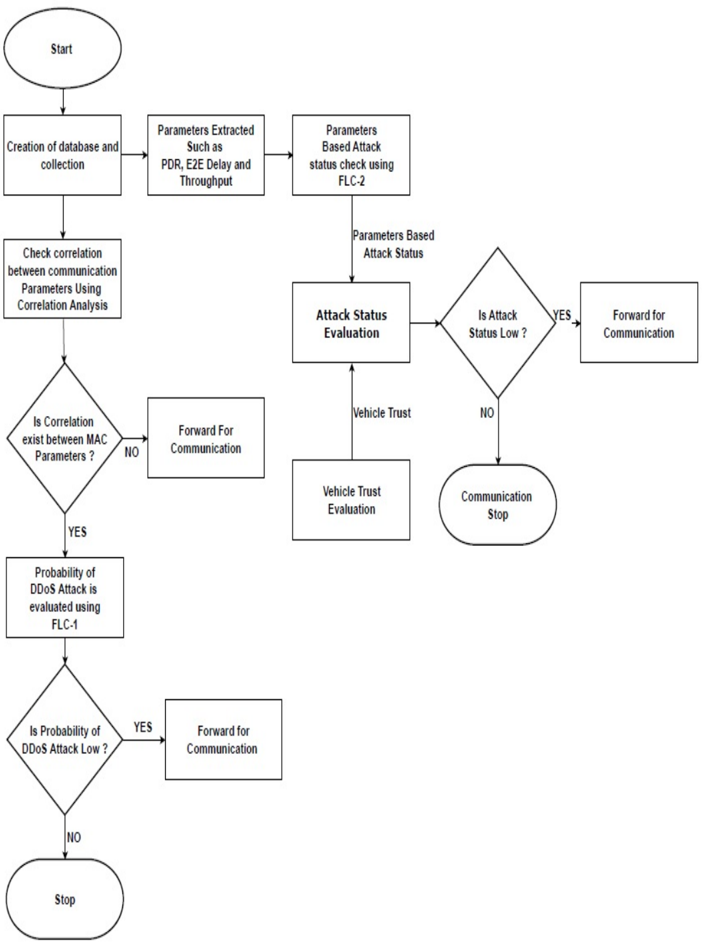
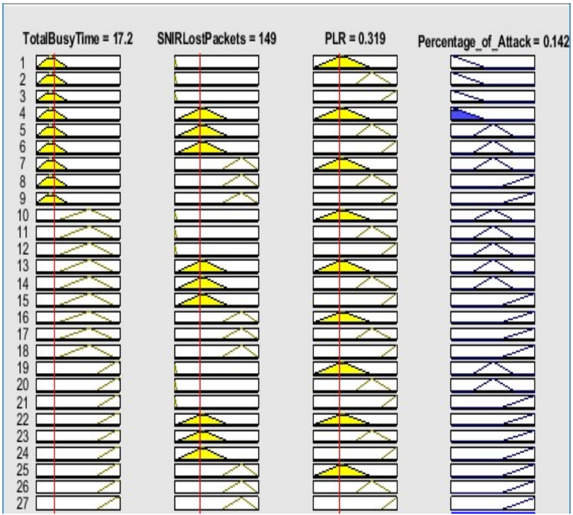
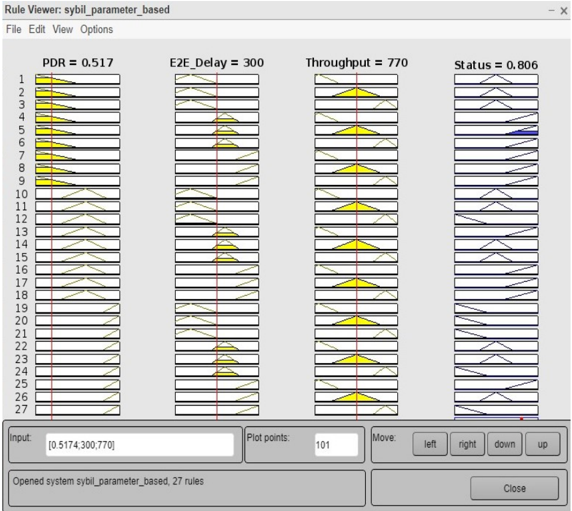
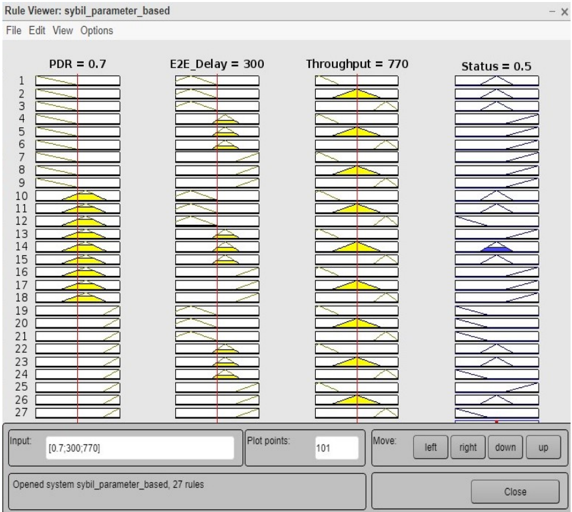
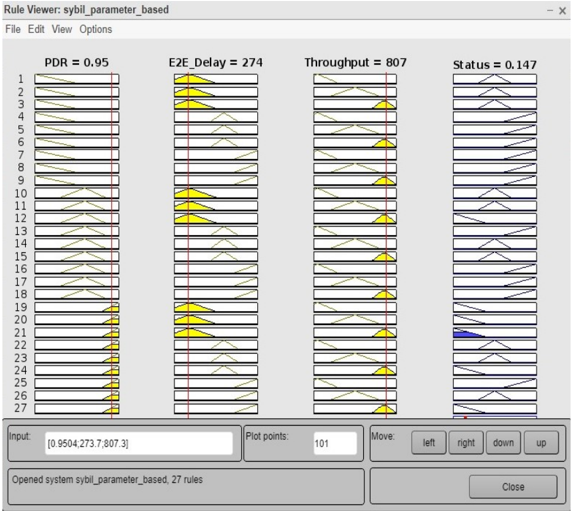
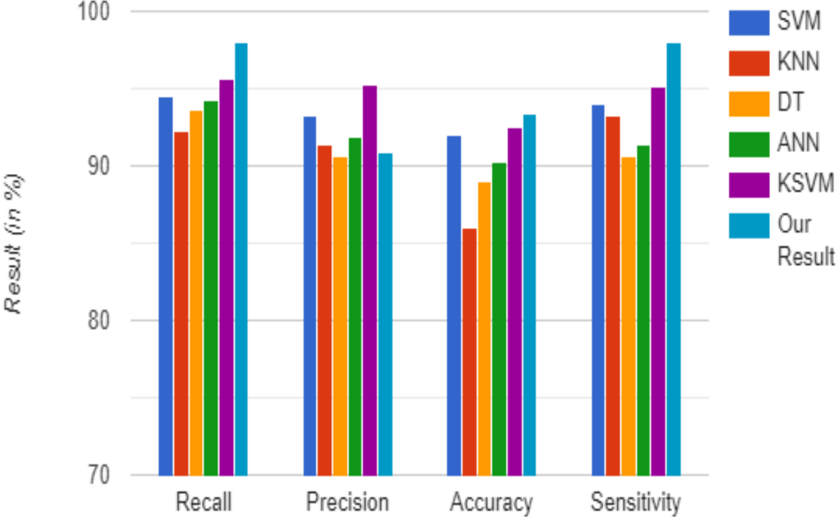
Vehicular Adhoc network (VANET) are more prone to various types of attacks. Sybil attack is the most dangerous attack in vehicular adhoc network as it creates multiple fake identities and creates traffic congestion.Fake identities are used to enter the network illegally.On the other hand, distributed denial of service (DDoS) attack intentionally blocks the users from accessing any online services. It temporarily disrupts or interrupts the service of the hosting server. These types of attacks in VANET cause severe damage to vehicles, passengers travelling in the vehicles by inducing traffic congestion, and may also cause minor or fatal accidents.Hence, it is highly essential to early detect such attacks in VANET to protect the vehicles and human kind. In this work, a novel model is proposed using fuzzy logic controllers (FLCs) to detect both the Sybil and the DDoS attacks in VANET. Furthermore, performance of attack detection is also analysed and compared with the existing techniques. The proposed model yields better accuracy, sensitivity, and recall value compared to the existing techniques. Margin of error for the attack detection is also estimated for 95% of the confidence interval.
Overview
The claims and statistics of this paper haven’t been checked yet.
Run the check — free, no account needed. It reads the open-access text and checks the sources it cites.
Integrity signals
Registry
Cites
Statistics
Figures
Verification
Claims the paper makes
The claims and statistics of this paper haven’t been checked yet.
Run the check — free, no account needed. It reads the open-access text and checks the sources it cites.
Self-check
Percentages, sums and reported differences re-computed from the paper’s own numbers.
The self-check needs the paper’s full text.
Citations
Cites
Security Attacks and Solutions in Vehicular Ad Hoc Networks: A Survey
Hoa La, V., & Cavalli, A. (2014) · International Journal on AdHoc Networking Systems · doi:10.5121/ijans.2014.4201 · Cited by 161
Research works printed but not linked: 21
- M. Sachdeva, G. Singh, K. Kumar, and K. Singh, "Ddos incidents and their impact: A review." Int. Arab J. Inf. Technol., vol. 7, no. 1, pp. 14-20, 2010.
- R. Van Der Heijden, "Security architectures in v2v and v2i communication," in Proc. 20th Student Conf. IT, 2010, pp. 1-10.
- M. N. Mejri, J. Ben-Othman, and M. Hamdi, "Survey on vanet security challenges and possible cryptographic solutions," Vehicular Communications, vol. 1, no. 2, pp. 53-66, 2014.
- G. Samara, W. A. Al-Salihy, and R. Sures, "Security analysis of vehicular ad hoc nerworks (vanet)," in 2010 second international conference on network applications, protocols and ser- vices. IEEE, 2010, pp. 55-60.
- Z. Xia, S. Lu, J. Li, and J. Tang, "Enhancing ddos flood attack detection via intelligent fuzzy logic," Informatica, vol. 34, no. 4, 2010.
- P. B. Pajila, E. G. Julie, and Y. H. Robinson, "Fbdr-fuzzy based ddos attack detection and recovery mechanism for wireless sensor networks," Wireless Personal Communications, pp. 1-31, 2022.
- A. Haydari and Y. Yilmaz, "Real-time detection and mitigation of ddos attacks in intelligent transportation systems," in 2018 21st International Conference on Intelligent Transportation Systems (ITSC). IEEE, 2018, pp. 157-163.
- S. Shamshirband, A. Patel, N. B. Anuar, M. L. M. Kiah, and A. Abraham, "Cooperative game theoretic approach using fuzzy q-learning for detecting and preventing intrusions in wireless sensor networks," Engineering Applications of Artificial Intelligence, vol. 32, pp. 228-241, 2014.
- I. M. Tas, B. G. Unsalver, and S. Baktir, "A novel sip based distributed reflection denial-of- service attack and an effective defense mechanism," IEEE access, vol. 8, pp. 112 574-112 584, 2020.
- P. Shah and T. Kasbe, "Detecting sybil attack, black hole attack and dos attack in vanet using rsa algorithm," in 2021 Emerging Trends in Industry 4.0 (ETI 4.0). IEEE, 2021, pp. 1-7.
- A. Singh and P. Sharma, "A novel mechanism for detecting dos attack in vanet using enhanced attacked packet detection algorithm (eapda)," in 2015 2nd international conference on recent advances in engineering & computational sciences (RAECS). IEEE, 2015, pp. 1-5.
- G. Guette and B. Ducourthial, "On the sybil attack detection in vanet," in 2007 IEEE inter- national conference on Mobile Adhoc and sensor systems. IEEE, 2007, pp. 1-6.
- M. Maleknasab Ardakani, M. A. Tabarzad, and M. A. Shayegan, "Detecting sybil attacks in vehicular ad hoc networks using fuzzy logic and arithmetic optimization algorithm," The Journal of Supercomputing, vol. 78, no. 14, pp. 16 303-16 335, 2022.
- C. Iwendi, M. Uddin, J. A. Ansere, P. Nkurunziza, J. H. Anajemba, and A. K. Bashir, "On detection of sybil attack in large-scale vanets using spider-monkey technique," IEEE Access, vol. 6, pp. 47 258-47 267, 2018.
- G. D. Putra and S. Sulistyo, "Trust based approach in adjacent vehicles to mitigate sybil attacks in vanet," in Proceedings of the 2017 International Conference on Software and e- Business, 2017, pp. 117-122.
- J. Grover, M. S. Gaur, V. Laxmi, and N. K. Prajapati, "A sybil attack detection approach using neighboring vehicles in vanet," in Proceedings of the 4th international conference on Security of information and networks, 2011, pp. 151-158.
- B. A. Bensaber, C. G. P. Diaz, and Y. Lahrouni, "Design and modeling an adaptive neuro- fuzzy inference system (anfis) for the prediction of a security index in vanet," Journal of Computational Science, vol. 47, p. 101234, 2020.
- U. Bhanja, "An attack resistance model for trustworthiness evaluation in vanet," in 2020 IEEE 17th India Council International Conference (INDICON), 2020, pp. 1-7.
- S. T. Getaneh, "Enhanced security mechanism to detect sybil attacks in vanets," Ph.D. dis- sertation, Doctoral dissertation, 2019.
- J. Grover, M. S. Gaur, and V. Laxmi, "Trust establishment techniques in vanet," Wireless Networks and Security: Issues, Challenges and Research Trends, pp. 273-301, 2013.
- N. Kadam and R. S. Krovi, "Machine learning approach of hybrid ksvn algorithm to detect ddos attack in vanet," International Journal of Advanced Computer Science and Applications, vol. 12, no. 7, 2021.
Cited by
A Hybrid Deep Learning Model for Detection and Mitigation of DDoS Attacks in VANETs
Jayakrishna, N., & Prasanth, N. N. (2025) · Scientific Reports · doi:10.1038/s41598-025-15215-1 · Cited by 20
Metadata
- Authors
- Bhanja, U., Majhi, A., Sahoo, S., & Parida, D.
- Affiliations
- Professor of ETC, Indira Gandhi Institute of Technology
- Indira Gandhi Institute of Technology
- Publisher
- Research Square Platform LLC
- Published
- 2023-07-27
- Cited by
- 0
- References
- 1
- Type
- Preprint
About these checks
Registry, retraction, Cites and statistics results are computed, not judged, with one exception: a printed reference that no index lists is read once by a model before it counts as a citation error. Claims are extracted by a model and kept only when their quote appears verbatim in the text; each cited source is then checked, with a model’s help, for whether it says what the claim relies on. Those verdicts can be wrong — read the claim’s quote and the cited source before relying on one.
Statistics and arithmetic are recomputed, not judged.
Confidence bands are shown only for fields calibrated on our annotated test set. None is calibrated yet, so no band is shown.
What counts as a claim ›How we measure confidence ›How we check this ›
Are you an author, or do you see a problem with this page? Request a review
How to cite
Cite CoChat for the checks on this page, and the paper for its own findings.
- This page
- CoChat. (2026). Citation check: Detection of Sybil & DDoS Attacks in VANET using Intelligent Technique. https://app.cochat.ai/papers/10.21203/rs.3.rs-3187938/v1
- The paper
- Bhanja, U., Majhi, A., Sahoo, S., & Parida, D. (2023). Detection of Sybil & DDoS Attacks in VANET using Intelligent Technique. https://doi.org/10.21203/rs.3.rs-3187938/v1
Data sources
Bibliographic data: Semantic Scholar, OpenAlex, Crossref.
Contains information from the Semantic Scholar Academic Graph Datasets, made available under the ODC Attribution License (ODC-BY 1.0).
Semantic Scholar’s data is described in: Kinney, R., et al. (2023). The Semantic Scholar Open Data Platform. arXiv:2301.10140.
