

The DOI matches its Crossref record; 1 of the 1 references it cites were found in a registry or an index.
Engineering TadA ortholog-derived cytosine base editor without motif preference and adenosine activity limitation
Open accessPreprint — published as 10.1038/s41467-024-52485-1 · Paper page
Abstract
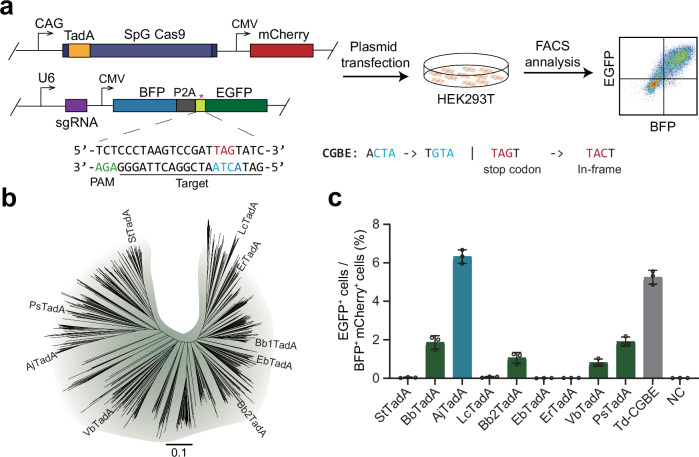
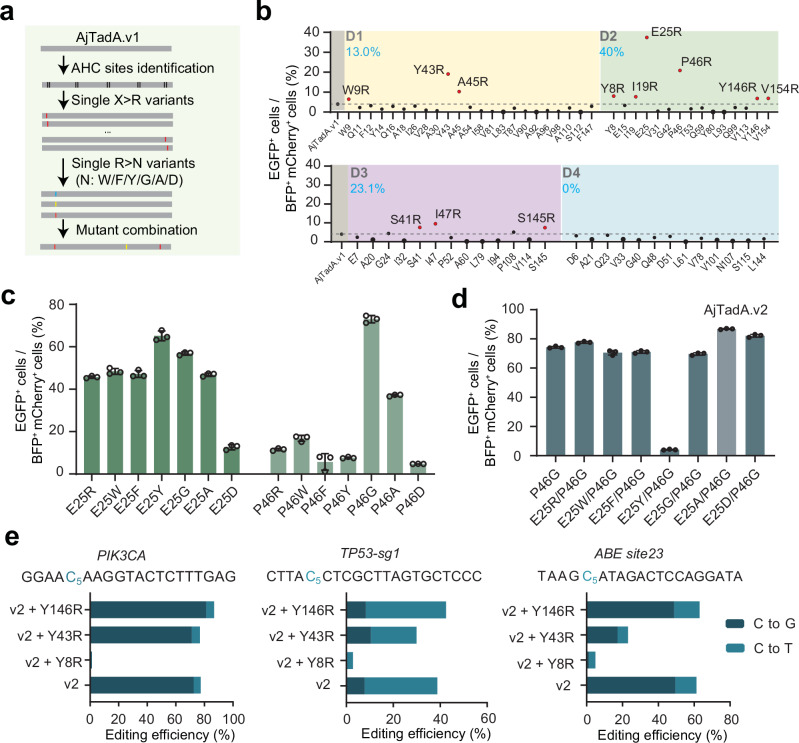
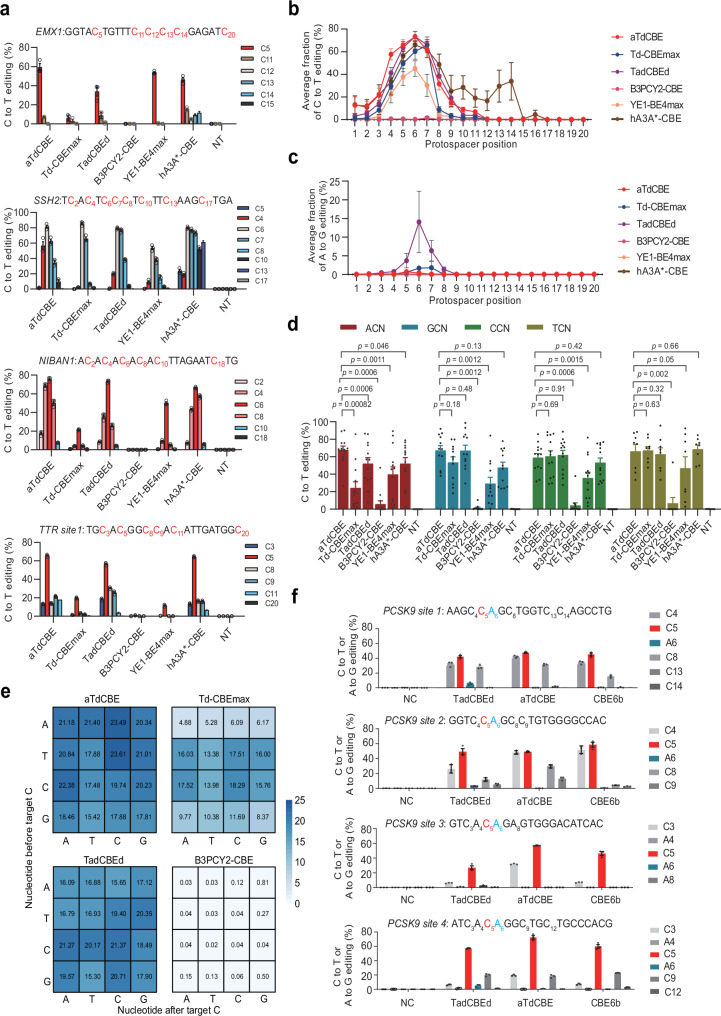
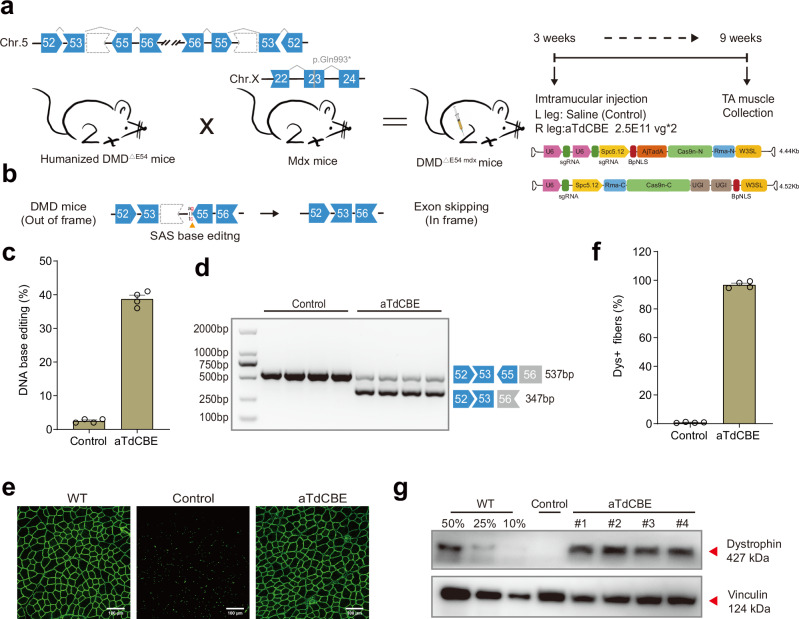
The engineered TadA variants used in cytosine base editors (CBEs) present unique advantages, including a smaller size and fewer off-target effects compared to cytosine base editors that rely on natural deaminases. However, the current TadA variants demonstrate a preference for base editing in DNA with specific motif sequences and possess dual deaminase activity, acting on both cytosine and adenosine in adjacent positions, limiting their application scope. To address these issues, we employed TadA orthologs screening and multi sequence alignment (MSA)-guided protein engineering techniques to create a highly effective cytosine base editor (aTdCBE) without motif and adenosine deaminase activity limitations. Notably, the delivery of aTdCBE to a humanized mouse model of Duchenne muscular dystrophy (DMD) mice achieved robust exon 55 skipping and restoration of dystrophin expression. Our advancement in engineering TadA ortholog for cytosine editing enrich the base editing toolkits for gene-editing therapy and other potential applications.
Overview
The claims and statistics of this paper haven’t been checked yet.
Run the check — free, no account needed. It reads the open-access text and checks the sources it cites.
Integrity signals
Registry
Cites
Statistics
Figures
Verification
Claims the paper makes
The claims and statistics of this paper haven’t been checked yet.
Run the check — free, no account needed. It reads the open-access text and checks the sources it cites.
Self-check
Percentages, sums and reported differences re-computed from the paper’s own numbers.
The self-check needs the paper’s full text.
Citations
Cites
Highly accurate protein structure prediction with AlphaFold
Jumper, J., Evans, R., Pritzel, A., Green, T., Figurnov, M., Ronneberger, O., Tunyasuvunakool, K., Bates, R., Žídek, A., Potapenko, A., et al. (2021) · Nature · doi:10.1038/s41586-021-03819-2 · Cited by 43,764
Research works printed but not linked: 33
- Komor AC et al (2016) Programmable editing of a target base in genomic DNA without double-stranded DNA cleavage. Nature 533:420–424. 10.1038/nature17946 · DOI · Paper page
- Anzalone AV et al (2020) Genome editing with CRISPR-Cas nucleases, base editors, transposases and prime editors. Nat Biotechnol 38:824–844. 10.1038/s41587-020-0561-9 · DOI · Paper page
- Zuo E et al (2019) Cytosine base editor generates substantial off-target single-nucleotide variants in mouse embryos. Science 364:289–292. 10.1126/science.aav9973 · DOI · Paper page
- Jin S et al (2019) Cytosine, but not adenine, base editors induce genome-wide off-target mutations in rice. Science 364:292–295. 10.1126/science.aaw7166 · DOI · Paper page
- Zhou C et al (2019) Off-target RNA mutation induced by DNA base editing and its elimination by mutagenesis. Nature 571:275–278. 10.1038/s41586-019-1314-0 · DOI · Paper page
- Grünewald J et al (2019) Transcriptome-wide off-target RNA editing induced by CRISPR-guided DNA base editors. Nature 569:433–437. 10.1038/s41586-019-1161-z · DOI · Paper page
- Yan N et al (2023) Cytosine base editors induce off-target mutations and adverse phenotypic effects in transgenic mice. Nat Commun 14:1784. https://doi.org/10.1038/s41467-023-37508-7 · DOI
- Kim HS et al (2019) Adenine base editors catalyze cytosine conversions in human cells. Nat Biotechnol 37:1145–1148. 10.1038/s41587-019-0254-4 · DOI
- Chen L et al (2023) Re-engineering the adenine deaminase TadA-8e for efficient and specific CRISPR-based cytosine base editing. Nat Biotechnol 41:663–672. 10.1038/s41587-022-01532-7 · DOI · Paper page
- Lam DK et al (2023) Improved cytosine base editors generated from TadA variants. Nat Biotechnol 41:1686–1697. 10.1038/s41587-022-01611-9 · DOI
- Neugebauer ME et al (2023) Evolution of an adenine base editor into a small, efficient cytosine base editor with low off-target activity. Nat Biotechnol 41:673–685. 10.1038/s41587-022-01533-6 · DOI
- Zhang S et al (2023) TadA orthologs enable both cytosine and adenine editing of base editors. Nat Commun 14. 10.1038/s41467-023-36003-3 · DOI
- Ogden TH et al (2006) Multiple sequence alignment accuracy and phylogenetic inference. Syst Biol 55:314–328. 10.1080/10635150500541730 · DOI
- Baek M et al (2021) Accurate prediction of protein structures and interactions using a three-track neural network. Science 373:871–876. 10.1126/science.abj8754 · DOI · Paper page
- Hopf TA et al (2017) Mutation effects predicted from sequence co-variation. Nat Biotechnol 35:128–135. 10.1038/nbt.3769 · DOI · Paper page
- Frazer J et al (2021) Disease variant prediction with deep generative models of evolutionary data. Nature 599:91–95. 10.1038/s41586-021-04043-8 · DOI · Paper page
- McGaw C et al (2022) Engineered Cas12i2 is a versatile high-efficiency platform for therapeutic genome editing. Nat Commun 13:2833. 10.1038/s41467-022-30465-7 · DOI
- Zhang H et al (2023) An engineered xCas12i with high activity, high specificity, and broad PAM range. Protein Cell 14:538–543. 10.1093/procel/pwac052 · DOI
- Saito M et al (2023) Fanzor is a eukaryotic programmable RNA-guided endonuclease. Nature 620:660–668. 10.1038/s41586-023-06356-2 · DOI
- Han D et al (2023) Development of miniature base editors using engineered IscB nickase. Nat Methods 20:1029–1036. 10.1038/s41592-023-01898-9 · DOI
- Roberts TC et al (2023) Therapeutic approaches for Duchenne muscular dystrophy. Nat Rev Drug Discov 22:917–934. 10.1038/s41573-023-00775-6 · DOI
- Bladen CL et al (2015) The TREAT-NMD DMD global database: analysis of more than 7,000 Duchenne muscular dystrophy mutations. Hum Mutat 36:395–402. https://doi.org/10.1002/humu.22758 · DOI
- Altschul SF et al (1990) Basic local alignment search tool. J Mol Biol 215:403–410. 10.1016/S0022-2836(05)80360-2 · DOI · Paper page
- Nakamura T et al (2018) Parallelization of MAFFT for large-scale multiple sequence alignments. Bioinformatics 34:2490–2492. 10.1093/bioinformatics/bty121 · DOI
- Tamura K et al (2021) MEGA11: molecular evolutionary genetics analysis version 11. Mol Biol Evol 38:3022–3027. 10.1093/molbev/msab120 · DOI
- Clement K et al (2019) CRISPResso2 provides accurate and rapid genome editing sequence analysis. Nat Biotechnol 37:224–226. 10.1038/s41587-019-0032-3 · DOI
- Bae S et al (2014) Cas-OFFinder: a fast and versatile algorithm that searches for potential off-target sites of Cas9 RNA-guided endonucleases. Bioinformatics 30:1473–1475. 10.1093/bioinformatics/btu048 · DOI · Paper page
- Doman JL et al (2020) Evaluation and minimization of Cas9-independent off-target DNA editing by cytosine base editors. Nat Biotechnol 38:620–628. 10.1038/s41587-020-0414-6 · DOI · Paper page
- Bolger AM et al (2014) Trimmomatic: a flexible trimmer for Illumina sequence data. Bioinformatics 30:2114–2120. 10.1093/bioinformatics/btu170 · DOI · Paper page
- Kim D et al (2019) Graph-based genome alignment and genotyping with HISAT2 and HISAT-genotype. Nat Biotechnol 37:907–915. 10.1038/s41587-019-0201-4 · DOI · Paper page
- Flati T et al (2020) HPC-REDItools: a novel HPC-aware tool for improved large scale RNA-editing analysis. BMC. Bioinformatics. 21, 353, doi:10.1186/s12859-020-03562-x Methods Computational analysis of TadA orthologs Firstly, we downloaded 15167 TadA protein sequences from NCBI database. We further used BLASTP to remove redundant proteins with identity over than 90%24. Then, we performed multiple sequence alignment using MAFFT25. MEGA11 were used to construct phylogenetic tree26. Calculate_AHC.pl were used to identify highly conservative residues and AHC residues. Plasmid constructions Human Codon-optimized orthologous TadAs were synthesized commercially (GenScript Co., Ltd) and cloned to generate pT7_NLS-TadA-Cas9-NLS_pA_pCBH_mCherry_pA plasmid by NEBuilder (New England Biolabs). All sequences are listed in Supplementary Table 1. Mammalian cell culture, transfection and flow cytometry analysis The HEK293T cells were cultured in Dulbecco’s modified Eagle’s medium (Gibco, 11965-092) supplemented with 10% fetal bovine serum (Gibco, 10099-141C), and 1% Pen-Strep-Glutamine (100×) (Gibco, 10378-016) at 37°C with 5% CO2 in a cell incubator. For TadA variants screening, HEK293T cells cultured in 24-well plates were co-transfected with 1.0 µg of tagBFP-*EGFP reporter plasmid and TadA-mCherry plasmid in a molar ratio of 1:1 with Polyetherimide (PEI). After 48 hours, mCherry, BFP and EGFP fluorescence were analyzed by Beckman CytoFlex flow-cytometer. To evaluate genome editing in endogenous sites, cells were harvested at 48 hours after transfection and sorted by BD FACS Aria III flow cytometer. FACS data were analyzed with FlowJo X (v10.0.7). Detection of gene editing frequency · DOI
- To evaluate the specificity of TadA base editors, the Cas-OFFinder was employed to predict the potential off-target sites28. Search queries covered both Cas9 spacer sequence and PAM of the on-target site. The PAM of research was set to NGG and the mismatches were set to less than 5. All other parameters were left as default. The potential off-target sites were amplified and deep sequenced for analysis
- All cell experimental results are presented as mean ± s.d, while all animal experimental results are presented as mean ± s.e.m. Unpaired two-tailed Student’s t-test was used for comparisons and P-value < 0.05 was considered to be statistically significant. The experiments were not randomized and the investigators were not blinded to allocation during experiments and outcome assessment. GraphPad Prism (v 9.0.0) was used for statistics (www.graphpad.com/).
Metadata
- Authors
- Zhou, Y., Li, G., Dong, X., Luo, J., Li, T., Zhao, G., Zhang, H., Zhou, J., Cui, S., Zeng, Z., Wang, H., Wang, Y., Yu, Y., Yuan, Y., Xu, C., & Huang, J.
- Affiliations
- HuidaGene Therapeutics Inc., Shanghai, China.
- Huigene Therapeutics Inc.
- Chinese Academy of Medical Sciences & Peking Union Medical College (CN)
- HuidaGene Therapeutics Inc.
- HUIDAGENE Therapeutics Co., Ltd.
- Lingang Laboratory, Shanghai Center for Brain Science and Brain-Inspired Technology
- Corresponding author
- Zhou, Yingsi
- Xu, Chunlong
- Huang, Jinhai
- ORCID
- Venue
- Nature Communications
- Published
- 2024-02-27
- Volume
- 15
- Issue
- 1
- Pages
- 8090-8090
- ISSN
- 2041-1723 (ISSN-L)
- PMC
- PMC11405849
- OpenAlex
- W4402581033
- Cited by
- 9
- References
- 1
- Citations by year
- 2026: 2 · 2025: 7
- FWCI
- 1.22
- Type
- journal article
- Language
- en
- Open access
- gold
- doi.org
- Licence
- Locations
- Nature Communications (publishedVersion, cc-by-nc-nd)
- Research Square (acceptedVersion, cc-by)
- PubMed Central (publishedVersion, cc-by-nc-nd)
- PubMed (publishedVersion)
- RePEc: Research Papers in Economics (submittedVersion)
- DOAJ (DOAJ: Directory of Open Access Journals) (submittedVersion, cc-by-sa)
- Funders
- National Natural Science Foundation of China ([2021], 82271048, 22S11900200, 82301215)
- Government of Jiangsu Province
- Science and Technology Commission of Shanghai Municipality (22S11900200, 23XD1420500)
- Chinese Academy of Agricultural Sciences
- Jiangsu Provincial Key Research and Development Program (BE2021372)
- Topics
- Life Sciences › Biochemistry, Genetics and Molecular Biology › Molecular Biology › CRISPR and Genetic Engineering
- Life Sciences › Biochemistry, Genetics and Molecular Biology › Molecular Biology › RNA regulation and disease
- Life Sciences › Biochemistry, Genetics and Molecular Biology › Genetics › Virus-based gene therapy research
- Keywords
- TADA, cytosine base editors, adenosine deaminase activity, protein engineering, exon skipping, Duchenne muscular dystrophy, dystrophin expression, gene editing therapy, off-target effects
- MeSH terms
- Gene Editing, Adenosine, Adenosine Deaminase, Animals, Cytosine, Disease Models, Animal, Exons, Humans, Protein Engineering, Dystrophin, Muscular Dystrophy, Duchenne, Escherichia coli Proteins, Mice, HEK293 Cells, CRISPR-Cas Systems
About these checks
Registry, retraction, Cites and statistics results are computed, not judged, with one exception: a printed reference that no index lists is read once by a model before it counts as a citation error. Claims are extracted by a model and kept only when their quote appears verbatim in the text; each cited source is then checked, with a model’s help, for whether it says what the claim relies on. Those verdicts can be wrong — read the claim’s quote and the cited source before relying on one.
Statistics and arithmetic are recomputed, not judged.
Confidence bands are shown only for fields calibrated on our annotated test set. None is calibrated yet, so no band is shown.
What counts as a claim ›How we measure confidence ›How we check this ›
Are you an author, or do you see a problem with this page? Request a review
