

AlphaFold Database Structure Extractor: A web server and API to download AlphaFold structures using common protein accessions
Open accessPreprint — published as 10.1186/s12859-025-06303-0 · Paper page
The DOI matches its Crossref record; 1 of the 1 references it cites were found in a registry or an index.
Abstract
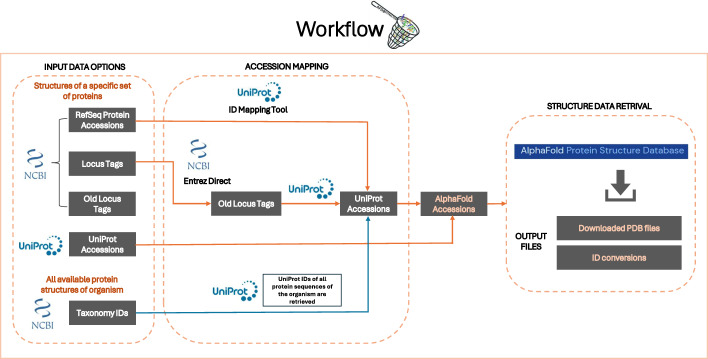
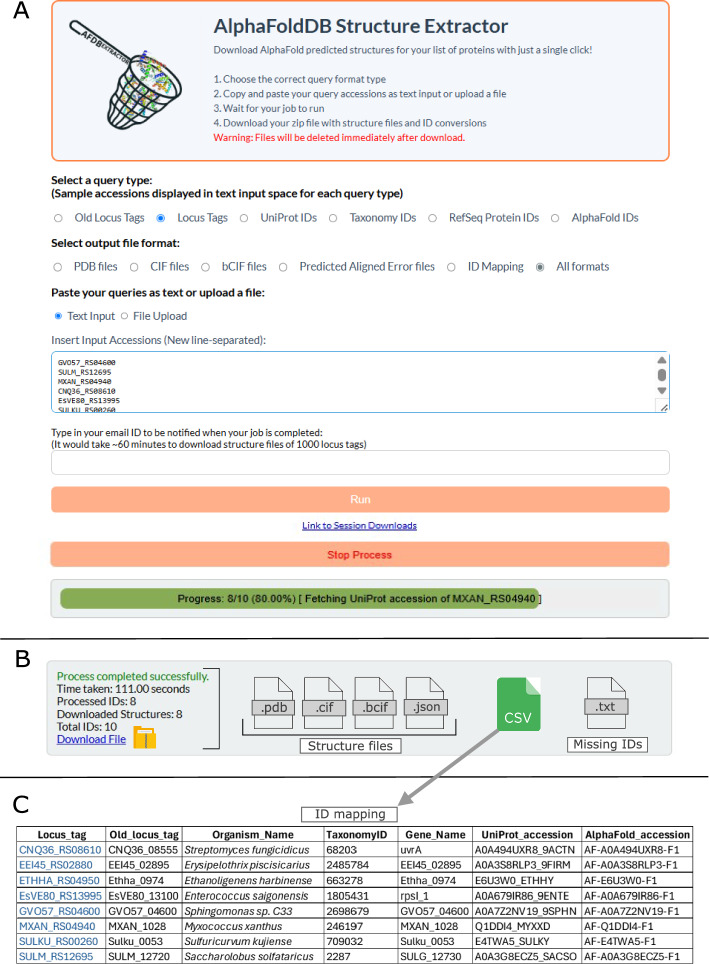
The AlphaFoldDB Structure Extractor is an open-access web server and API toolkit designed to facilitate the bulk download of predicted protein structures from the AlphaFold Database using well-known accession numbers. Addressing the current limitations in extracting structures beyond a restricted list of model organisms and a threshold number, this tool accepts diverse input identifiers, such as NCBI Taxonomy ID, RefSeq accessions, locus tags, and UniProt or AlphaFold accessions, and maps them to UniProt and AlphaFold IDs for structure retrieval. Users can download structure files in PDB, mmCIF, bCIF, or PAE JSON formats. The tool also generates an accompanying ID mapping file to trace input identifiers back to standard accession numbers and reports unmapped IDs separately. An API methodology is also provided for programmatic access, enabling integration into bioinformatics pipelines. AlphaFoldDB Structure Extractor streamlines the structure procurement process from AlphaFold database, empowering researchers in structural and functional genomics with minimal computational expertise. Availability and implementation: AlphaFoldDB Structure Extractor is freely available as a webserver at https://project.iith.ac.in/sharmaglab/alphafoldextractor/ for downloading structure coordinate files based on the user-provided input of protein accessions. The tool can be accessed programmatically using the API service we have provided.
Overview
The claims and statistics of this paper haven’t been checked yet.
Free: it reads the open-access text and checks the first 5 claims that cite a source we can check. Create a free account to check every claim.
Integrity signals
Registry
Cites
Statistics
Figures
Verification
Claims the paper makes
The claims and statistics of this paper haven’t been checked yet.
Free: it reads the open-access text and checks the first 5 claims that cite a source we can check. Create a free account to check every claim.
Self-check
Percentages, sums and reported differences re-computed from the paper’s own numbers.
The self-check needs the paper’s full text.
Citations
Cites
Highly accurate protein structure prediction with AlphaFold
Jumper, J., Evans, R., Pritzel, A., Green, T., Figurnov, M., Ronneberger, O., Tunyasuvunakool, K., Bates, R., Žídek, A., Potapenko, A., et al. (2021) · Nature · doi:10.1038/s41586-021-03819-2 · Cited by 43,764
Research works printed but not linked: 8
- Bertoline LMF, et al. Before and after AlphaFold2: An overview of protein structure prediction. Front Bioinf. 2023;3:1120370. · DOI · Paper page
- Consortium TU, et al. UniProt: the Universal Protein Knowledgebase in 2025. Nucleic Acids Res. 2025;53:D609–17. · DOI · Paper page
- Kendrew JC, et al. A Three-Dimensional Model of the Myoglobin Molecule Obtained by X-Ray Analysis. Nat 1958. 1958;181:4610:181, 662–6.
- Laine E, et al. Protein sequence-to-structure learning: Is this the end (-to-end revolution)? Proteins. 2021;89(12):1770–86. · DOI · Paper page
- Lander ES. The New Genomics: Global Views of Biology. Sci (1979). 1996;274:536–9.
- O’Leary NA, et al. Reference sequence (RefSeq) database at NCBI: current status, taxonomic expansion, and functional annotation. Nucleic Acids Res. 2016;44:D733–45. · DOI · Paper page
- Sayers EW, et al. Database resources of the National Center for Biotechnology Information. Nucleic Acids Res. 2024;52:D33–43. · DOI · Paper page
- Standley DM, et al. The evolution of structural genomics. Biophys Rev. 2022;14:1247. · DOI
Metadata
- Authors
- Saraf, N., Karthick, V., & Sharma, G.
- Affiliations
- Indian Institute of Technology Hyderabad (IN)
- Indian Institute of Technology Hyderabad
- Corresponding author
- Sharma, Gaurav
- Venue
- BMC Bioinformatics
- Published
- 2025-05-06
- Volume
- 26
- Issue
- 1
- Pages
- 305-305
- ISSN
- 1471-2105 (ISSN-L)
- PMC
- PMC12751494
- OpenAlex
- W4416675739
- Cited by
- 4
- References
- 1
- Citations by year
- 2026: 4
- FWCI
- 1.20
- Type
- journal article
- Language
- en
- Open access
- gold
- doi.org
- Licence
- Locations
- BMC Bioinformatics (publishedVersion, cc-by-nc-nd)
- Research Square (acceptedVersion, cc-by)
- PubMed (publishedVersion)
- PubMed Central (publishedVersion, cc-by-nc-nd)
- DOAJ (DOAJ: Directory of Open Access Journals) (submittedVersion, cc-by-sa)
- Funders
- Science and Engineering Research Board
- Topics
- Life Sciences › Biochemistry, Genetics and Molecular Biology › Molecular Biology › Protein Structure and Dynamics
- Life Sciences › Biochemistry, Genetics and Molecular Biology › Structural Biology › Enzyme Structure and Function
- Life Sciences › Biochemistry, Genetics and Molecular Biology › Molecular Biology › Machine Learning in Bioinformatics
- Keywords
- AlphaFold, protein structure prediction, web server, API, reference sequences, UniProt, locus tags, ID mapping, Protein Data Bank, mmCIF, structural genomics
- MeSH terms
- Protein Conformation, Proteins, Software, User-Computer Interface, Protein Folding, Computational Biology, Internet, Databases, Protein
About these checks
Registry, retraction, Cites and statistics results are computed, not judged, with one exception: a printed reference that no index lists is read once by a model before it counts as a citation error. Claims are extracted by a model and kept only when their quote appears verbatim in the text; each cited source is then checked, with a model’s help, for whether it says what the claim relies on. Those verdicts can be wrong — read the claim’s quote and the cited source before relying on one.
Statistics and arithmetic are recomputed, not judged.
Confidence bands are shown only for fields calibrated on our annotated test set. None is calibrated yet, so no band is shown.
What counts as a claim ›How we measure confidence ›How we check this ›
Are you an author, or do you see a problem with this page? Request a review
How to cite
Cite CoChat for the checks on this page, and the paper for its own findings.
- This page
- CoChat. (2026). Citation check: AlphaFold Database Structure Extractor: A web server and API to download AlphaFold structures using common protein accessions. https://app.cochat.ai/papers/10.21203/rs.3.rs-6583051/v1
- The paper
- Saraf, N., Karthick, V., & Sharma, G. (2025). AlphaFold Database Structure Extractor: A web server and API to download AlphaFold structures using common protein accessions. BMC Bioinformatics. https://doi.org/10.21203/rs.3.rs-6583051/v1
Data sources
Bibliographic data: Semantic Scholar, OpenAlex, Crossref.
Contains information from the Semantic Scholar Academic Graph Datasets, made available under the ODC Attribution License (ODC-BY 1.0).
Semantic Scholar’s data is described in: Kinney, R., et al. (2023). The Semantic Scholar Open Data Platform. arXiv:2301.10140.
