

The DOI matches its Crossref record; 1 of the 1 references it cites were found in a registry or an index.
Brain CT Registration Using Hybrid Supervised Convolutional Neural Network
Open accessPreprint — published as 10.1186/s12938-021-00971-8 · Paper page
Abstract
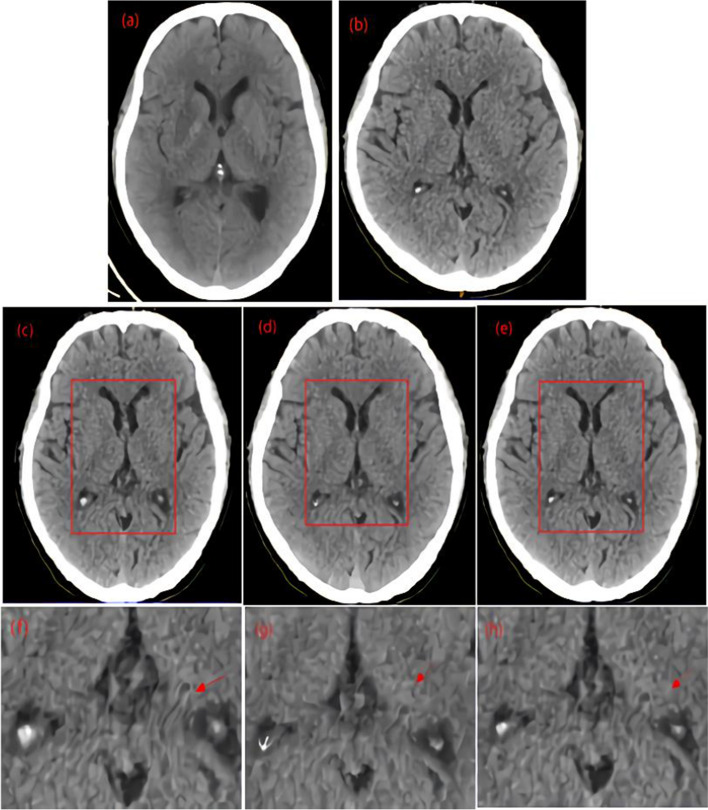
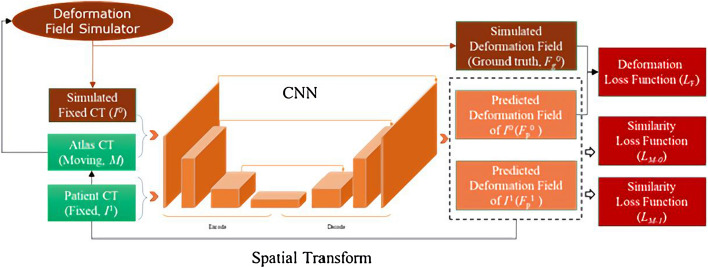
Background: Brain computed tomography (CT) image registration is an essential step in the image evaluation of acute cerebrovascular disease (ACVD). Due to the complexity of human brain morphology, low brain CT soft-tissue resolution, low gray/white matter contrast, and the large anatomy variation across individuals, it is still a great challenge to perform brain CT registration accurately and rapidly. This study developed a hybrid supervised convolutional neural network (HSCN-Net) which may be used for assessment of ACVD in brain CT.Method: HSCN-Net generates synthetic deformation fields by a simulator to solve the lack of registration gold standard. The simulator are used to generate multi-scale deformation fields to overcome the registration challenge of large deformation. HSCN-Net adopts a hybrid loss function constituted by deformation field and image similarity to improve registration accuracy and generalization ability. In this work, one hundred and one brain CT images were included for HSCN-Net training and evaluation, and the results were compared with Demons and VoxelMorph. Qualitative analysis by visual evaluation, as well as quantitative analysis by Endpoint Error (EPE) between deformation fields, image Normalized Mutual Information (NMI), and Dice coefficient were carried out to access the model performance.Results: Qualitative analysis of HSCN-Net was similar to that of Demons, and both were superior to that of VoxelMorph. Moreover, HSCN-Net was more competent for large and smooth deformations. For quantitative evaluation, the EPE mean of HSCN-Net (3.29 mm) was lower than that of Demons (3.47 mm) and VoxelMorph (5.12 mm); the Dice mean of HSCN-Net was 0.96, which was better than that of Demons (0.90) and VoxelMorph (0.87); and the NMI mean of HSCN-Net (0.83) was slightly lower than that of Demons(0.84) but higher than that of VoxelMorph (0.81). In addition, the mean registration time of HSCN-Net (17.86 s) was lower than that of VoxelMorph (18.53 s) and Demons (147.21 s).Conclusion: The proposed hybrid supervised convolution registration network can achieve accurate and rapid brain CT registration. It is helpful for improving image evaluation of ACVD, thereby assisting clinicians in diagnosis and treatment decision-making.
Overview
The claims and statistics of this paper haven’t been checked yet.
Run the check — free, no account needed. It reads the open-access text and checks the sources it cites.
Integrity signals
Registry
Cites
Statistics
Figures
Verification
Claims the paper makes
The claims and statistics of this paper haven’t been checked yet.
Run the check — free, no account needed. It reads the open-access text and checks the sources it cites.
Self-check
Percentages, sums and reported differences re-computed from the paper’s own numbers.
The self-check needs the paper’s full text.
Citations
Cites
Quicksilver: Fast predictive image registration – A deep learning approach
Yang, X., Kwitt, R., Styner, M., & Niethammer, M. (2017) · NeuroImage · doi:10.1016/j.neuroimage.2017.07.008 · Cited by 630
Metadata
- Authors
- Yuan, H., Yang, M., Qian, S., Wang, W., Jia, X., & Huang, F.
- Affiliations
- Neusoft (China) (CN)
- Neusoft Medical Systems Co., Ltd. (China) (CN)
- Shenyang Advanced Medical Equipment Technology Incubation Center,Co.Ltd.
- Corresponding author
- Yang, MingLei
- Venue
- BioMedical Engineering OnLine
- Publisher
- Research Square Platform LLC
- Published
- 2021-08-09
- Volume
- 20
- Issue
- 1
- Pages
- 131-131
- ISSN
- 1475-925X (ISSN-L)
- PMC
- PMC8715595
- OpenAlex
- W4225781432
- Cited by
- 4
- References
- 1
- Citations by year
- 2026: 1 · 2024: 1 · 2023: 1 · 2022: 1
- FWCI
- 0.27
- Type
- journal article
- Language
- en
- Open access
- gold
- doi.org
- Locations
- BioMedical Engineering OnLine (publishedVersion, cc-by)
- Research Square (acceptedVersion, cc-by)
- PubMed Central (publishedVersion, cc-by)
- PubMed (publishedVersion)
- DOAJ (DOAJ: Directory of Open Access Journals) (submittedVersion, cc-by-sa)
- Funders
- Shenyang Science and Technology Bureau
- Topics
- Physical Sciences › Computer Science › Computer Vision and Pattern Recognition › Medical Image Segmentation Techniques
- Physical Sciences › Computer Science › Computer Vision and Pattern Recognition › Brain Tumor Detection and Classification
- Health Sciences › Medicine › Health Informatics › Artificial Intelligence in Healthcare and Education
- Keywords
- image registration, hybrid loss function, acute cerebrovascular disease, demons, VoxelMorph, endpoint error, registration speed, brain CT images
- MeSH terms
- Algorithms, Brain, Humans, Image Processing, Computer-Assisted, Tomography, X-Ray Computed, Neural Networks, Computer
About these checks
Registry, retraction, Cites and statistics results are computed, not judged, with one exception: a printed reference that no index lists is read once by a model before it counts as a citation error. Claims are extracted by a model and kept only when their quote appears verbatim in the text; each cited source is then checked, with a model’s help, for whether it says what the claim relies on. Those verdicts can be wrong — read the claim’s quote and the cited source before relying on one.
Statistics and arithmetic are recomputed, not judged.
Confidence bands are shown only for fields calibrated on our annotated test set. None is calibrated yet, so no band is shown.
What counts as a claim ›How we measure confidence ›How we check this ›
Are you an author, or do you see a problem with this page? Request a review
