

Comparable temperature-dependent predatory impacts of two invasive crayfish, Pontastacus leptodactylus and Pacifastacus leniusculus
Open accessPreprint — published as 10.1007/s10530-026-03864-w · Paper page
The DOI matches its Crossref record; its reference list is not available.
Abstract
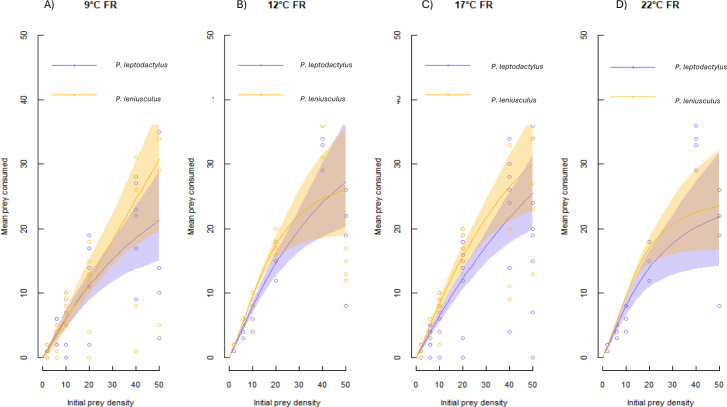
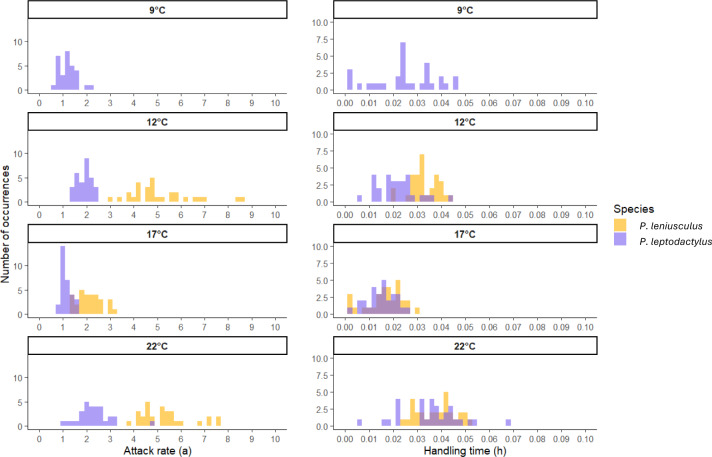
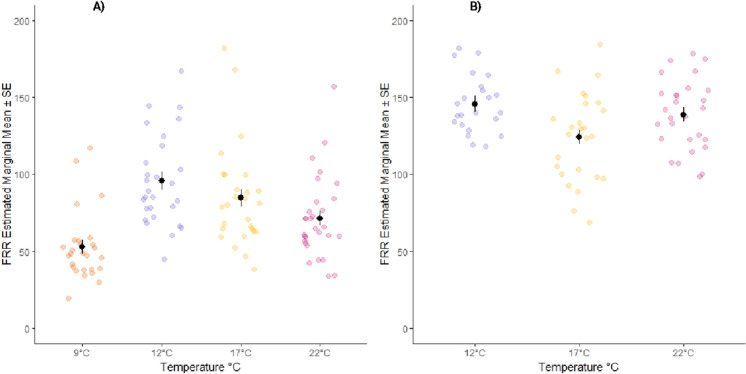
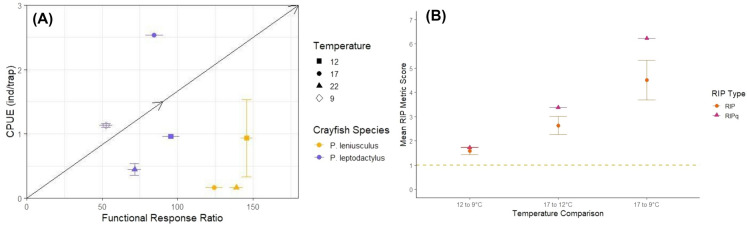
Narrow-clawed crayfish ( Pontastacus leptodactylus ) are an emergent invasive species, with limited data regarding their potential ecological impacts. Predicting ecological impact in current and future climate conditions is essential to inform policy and management actions. Therefore, we determined temperature-dependent predation of P. leptodactylus compared to the well-studied Signal crayfish ( Pacifastacus leniusculus ) on native prey Gammarus pulex , along a seasonal gradient (9℃, 12℃, 17℃, and 22℃) using functional response. Both species exerted strong predatory impact on G. pulex at all temperatures, however, when field abundance was considered P. leptodactylus have a higher relative impact driven by higher field abundance for our sampled populations. P. leptodactylus relative impact potential will increase with temperature up to ~ 17℃ and was exacerbated when prey ( G. pulex ) response to temperature change was incorporated, due to decreased prey abundance at higher temperatures. Our findings indicate P. leptodactylus overlooked potential as a damaging invader, both currently and in the future, and highlight the importance of considering resource and consumer response to changing climate in impact assessments. We recommend that stakeholders consider renewed management appraisals for populations of P. leptodactylus to reduce spread and population size to minimise ecological harm.
Overview
The claims and statistics of this paper haven’t been checked yet.
Free: it reads the open-access text and checks the first 5 claims that cite a source we can check. Create a free account to check every claim.
Integrity signals
Registry
Cites
Statistics
Figures
Verification
Claims the paper makes
The claims and statistics of this paper haven’t been checked yet.
Free: it reads the open-access text and checks the first 5 claims that cite a source we can check. Create a free account to check every claim.
Self-check
Percentages, sums and reported differences re-computed from the paper’s own numbers.
The self-check needs the paper’s full text.
Citations
No citation lists for this paper
No citation lists for this paper yet — checked again daily.
References 71
Research works printed but not linked: 68
- Alexander ME, Dick JTA, Weyl OLF et al (2014) Existing and emerging high impact invasive species are characterized by higher functional responses than natives. Biol Lett 10:20130946. https://doi.org/10.1098/rsbl.2013.0946 · DOI · Paper page
- Balian E, Segers H, Lévêque C, Martens K (2008) The Freshwater Animal Diversity Assessment: An overview of the results. Hydrobiologia 595:627–637. https://doi.org/10.1007/s10750-007-9246-3 · DOI · Paper page
- Bellard C, Cassey P, Blackburn TM (2016) Alien species as a driver of recent extinctions. Biol Lett 12:20150623. https://doi.org/10.1098/rsbl.2015.0623 · DOI · Paper page
- Blackburn TM, Bellard C, Ricciardi A (2019) Alien versus native species as drivers of recent extinctions. Front Ecol Environ 17:203–207. https://doi.org/10.1002/fee.2020 · DOI · Paper page
- Boets P, Laverty C, Fukuda S et al (2019) Intra- and intercontinental variation in the functional responses of a high impact alien invasive fish. Biol Invasions 21:1751–1762. https://doi.org/10.1007/s10530-019-01932-y · DOI
- Bolker B (2008) Ecological Models and Data in R. Princeton University Press
- Bollache L, Dick JTA, Farnsworth KD, Montgomery WI (2007) Comparison of the functional responses of invasive and native amphipods. Biol Lett 4:166–169. https://doi.org/10.1098/rsbl.2007.0554 · DOI
- Bradley BA, Beaury EM, Fusco EJ, Lopez BE (2023) Invasive Species Policy Must Embrace a Changing Climate. Bioscience 73:124–133. https://doi.org/10.1093/biosci/biac097 · DOI
- Chicatun V, Sheppard NLM, Ricciardi A (2024) Intraspecific variation in the functional response of an invasive crayfish under different temperatures. Can J Zool 102:746–758. https://doi.org/10.1139/cjz-2024-0006 · DOI
- Chybowski Ł (2013) Absolute fecundity of two populations of signal crayfish, Pacifastacus leniusculus (Dana). Fish Aquat Life 21:357–362. https://doi.org/10.2478/aopf-2013-0036 · DOI
- Cìlbìz M (2020) Pleopodal fecundity of narrow-clawed crayfish (Pontastacus leptodactylus Eschscholtz, 1823). Invertebr Reprod Dev 64:208–218. https://doi.org/10.1080/07924259.2020.1762771 · DOI
- Cox JG, Lima SL (2006) Naiveté and an aquatic–terrestrial dichotomy in the effects of introduced predators. Trends Ecol Evol 21:674–680. https://doi.org/10.1016/j.tree.2006.07.011 · DOI · Paper page
- Crooks JA (2005) Lag times and exotic species: The ecology and management of biological invasions in slow-motion1. Écoscience 12:316–329. https://doi.org/10.2980/i1195-6860-12-3-316.1 · DOI · Paper page
- Cuthbert RN, Briski E (2021) Temperature, not salinity, drives impact of an emerging invasive species. Sci Total Environ 780:146640. https://doi.org/10.1016/j.scitotenv.2021.146640 · DOI
- Cuthbert RN, Dickey JWE, Coughlan NE et al (2019) The Functional Response Ratio (FRR): advancing comparative metrics for predicting the ecological impacts of invasive alien species. Biol Invasions. https://doi.org/10.1007/s10530-019-02002-z · DOI
- Darwall W, Bremerich V, De Wever A et al (2018) The Alliance for Freshwater Life: A global call to unite efforts for freshwater biodiversity science and conservation. Aquat Conserv Mar Freshw Ecosyst 28:1015–1022. https://doi.org/10.1002/aqc.2958 · DOI · Paper page
- Dick JTA, Alexander ME, Jeschke JM et al (2014) Advancing impact prediction and hypothesis testing in invasion ecology using a comparative functional response approach. Biol Invasions 16:735–753. https://doi.org/10.1007/s10530-013-0550-8 · DOI · Paper page
- Dick JTA, Laverty C, Lennon JJ et al (2017) Invader Relative Impact Potential: a new metric to understand and predict the ecological impacts of existing, emerging and future invasive alien species. J Appl Ecol 54:1259–1267. https://doi.org/10.1111/1365-2664.12849 · DOI · Paper page
- Dickey JWE, Cuthbert RN, South J et al (2020) On the RIP: using Relative Impact Potential to assess the ecological impacts of invasive alien species. NeoBiota 55:27–60. https://doi.org/10.3897/neobiota.55.49547 · DOI
- Doherty TS, Glen AS, Nimmo DG et al (2016) Invasive predators and global biodiversity loss. Proc Natl Acad Sci 113:11261–11265. https://doi.org/10.1073/pnas.1602480113 · DOI · Paper page
- Dunoyer L, Dijoux L, Bollache L, Lagrue C (2014) Effects of crayfish on leaf litter breakdown and shredder prey: are native and introduced species functionally redundant? Biol Invasions 16:1545–1555. https://doi.org/10.1007/s10530-013-0590-0 · DOI
- Edmonds NJ, Riley WD, Maxwell DL (2011) Predation by Pacifastacus leniusculus on the intra-gravel embryos and emerging fry of Salmo salar. Fish Manag Ecol 18:521–524. https://doi.org/10.1111/j.1365-2400.2011.00797.x · DOI
- Faria L, Cuthbert R, Dickey J et al (2025) Non-native species have higher consumption rates than their native counterparts. Biol Rev Camb Philos Soc. https://doi.org/10.1111/brv.13179 · DOI
- Foucreau N, Cottin D, Piscart C, Hervant F (2014) Physiological and metabolic responses to rising temperature in Gammarus pulex (Crustacea) populations living under continental or Mediterranean climates. Comp Biochem Physiol Mol Integr Physiol 168:69–75. https://doi.org/10.1016/j.cbpa.2013.11.006 · DOI · Paper page
- Fox J, Weisberg S _An R Companion to Applied Regression_, Third edition. Sage, Thousand Oaks CA., < (2019) https://www.john-fox.ca/Companion/
- Galib S (2020) THE ECOLOGICAL IMPACTS OF SIGNAL CRAYFISH IN UPLAND STREAM ECOSYSTEMS. Durham University, Doctoral
- Gherardi F, Aquiloni L, Diéguez-Uribeondo J, Tricarico E (2011) Managing invasive crayfish: is there a hope? Aquat Sci 73:185–200. https://doi.org/10.1007/s00027-011-0181-z · DOI · Paper page
- Harwood M, Stebbing PD, Dunn AM et al (2025) Rapid assessment of population dynamics and monitoring methods for invasive narrow clawed crayfish Pontastacus leptodactylus in a freshwater reservoir. Knowl Manag Aquat Ecosyst 22. https://doi.org/10.1051/kmae/2025017 · DOI
- Hodson J, South J, Cancellario T, Guareschi S (2024) Multi-method distribution modelling of an invasive crayfish (Pontastacus leptodactylus) at Eurasian scale. https://doi.org/10.1007/s10750-024-05641-z. Hydrobiologia · DOI
- Holdich DM, James J, Jackson C, Peay S (2014) The North American signal crayfish, with particular reference to its success as an invasive species in Great Britain. Ethol Ecol Evol 26:232–262. https://doi.org/10.1080/03949370.2014.903380 · DOI
- Holdich DM, Reynolds J, Souty-Grosset C, Sibley P (2008) A review of the ever increasing threat to European crayfish from non-indigenous crayfish species. Knowl Manag Aquat Ecosyst. http://dx.doi.org/101051/kmae/2009025 11
- Hynes HBN (1955) The Reproductive Cycle of Some British Freshwater Gammaridae. J Anim Ecol 24:352–387. https://doi.org/10.2307/1718 · DOI · Paper page
- Jackson MC, Jones T, Milligan M et al (2014) Niche differentiation among invasive crayfish and their impacts on ecosystem structure and functioning. Freshw Biol 59:1123–1135. https://doi.org/10.1111/fwb.12333 · DOI
- Juliano SA (1998) Nonlinear Curve Fitting: Predation and Functional Response Curves. Design and Analysis of Ecological Experiments. Chapman and Hall/CRC
- Kelly DW, Dick JTA, Montgomery WI (2002) The functional role of Gammarus(Crustacea, Amphipoda): shredders, predators, or both? Hydrobiologia 485:199–203. https://doi.org/10.1023/A:1021370405349 · DOI · Paper page
- Kir M, Ege ÇINARİ, Can SUNARM, Topuz M (2025) Acclimation, thermal tolerance and aerobic metabolism of narrow-clawed crayfish, Pontastacus leptodactylus (Eschscholtz, 1823). J Therm Biol 104045. https://doi.org/10.1016/j.jtherbio.2025.104045 · DOI
- Kumschick S, Gaertner M, Vilà M et al (2015) Ecological Impacts of Alien Species: Quantification, Scope, Caveats, and Recommendations. Bioscience 65:55–63. https://doi.org/10.1093/biosci/biu193 · DOI · Paper page
- Laverty C, Green KD, Dick JTA et al (2017) Assessing the ecological impacts of invasive species based on their functional responses and abundances. Biol Invasions 19:1653–1665. https://doi.org/10.1007/s10530-017-1378-4 · DOI
- Lowe J, Bernie D, Bett P et al (2018) UKCP18 Overview report. Met Office Hadley Centre
- Mathers KL, White JC, Fornaroli R, Chadd R (2020a) Flow regimes control the establishment of invasive crayfish and alter their effects on lotic macroinvertebrate communities. J Appl Ecol 57:886–902. https://doi.org/10.1111/1365-2664.13584 · DOI
- Mathers KL, White JC, Guareschi S et al (2020b) Invasive crayfish alter the long-term functional biodiversity of lotic macroinvertebrate communities. Funct Ecol 34:2350–2361. https://doi.org/10.1111/1365-2435.13644 · DOI
- Meehan ML, Lindo Z (2023) Mismatches in thermal performance between ectothermic predators and prey alter interaction strength and top-down control. Oecologia 201:1005–1015. https://doi.org/10.1007/s00442-023-05372-3 · DOI
- Moorhouse TP, Macdonald DW (2015) Are invasives worse in freshwater than terrestrial ecosystems? WIREs Water 2:1–8. https://doi.org/10.1002/wat2.1059 · DOI
- Navel S, Mermillod-Blondin F, Montuelle B et al (2010) Interactions between fauna and sediment control the breakdown of plant matter in river sediments. Freshw Biol 55:753–766. https://doi.org/10.1111/j.1365-2427.2009.02315.x · DOI
- O’Hea Miller SB, Davis AR, Wong MYL (2024) The Impacts of Invasive Crayfish and Other Non-Native Species on Native Freshwater Crayfish: A Review. Biology 13:610. https://doi.org/10.3390/biology13080610 · DOI
- Öhlund G, Hedström P, Norman S et al (2015) Temperature dependence of predation depends on the relative performance of predators and prey. Proc R Soc B Biol Sci 282:20142254. https://doi.org/10.1098/rspb.2014.2254 · DOI
- Padilla DK, Williams SL (2004) Beyond ballast water: aquarium and ornamental trades as sources of invasive species in aquatic ecosystems. Front Ecol Environ 2:131–138. https://doi.org/10.1890/1540-9295(2004)002[0131:BBWAAO]2.0.CO;2 · doi:10.1890/1540-9295(
- Pintanel P, Tejedo M, Salinas-Ivanenko S et al (2021) Predators like it hot: Thermal mismatch in a predator–prey system across an elevational tropical gradient. J Anim Ecol 90:1985–1995. https://doi.org/10.1111/1365-2656.13516 · DOI
- Pritchard DW, Paterson RA, Bovy HC, Barrios-O’Neill D (2017) frair: an R package for fitting and comparing consumer functional responses. Methods Ecol Evol 8:1528–1534. https://doi.org/10.1111/2041-210X.12784 · DOI · Paper page
- Real LA (1977) The Kinetics of Functional Response. Am Nat 111:289–300. https://doi.org/10.1086/283161 · DOI · Paper page
- Reid AJ, Carlson AK, Creed IF et al (2019) Emerging threats and persistent conservation challenges for freshwater biodiversity. Biol Rev 94:849–873. https://doi.org/10.1111/brv.12480 · DOI · Paper page
- Ricciardi A, Hoopes M, Marchetti M, Lockwood J (2013) Progress toward understanding the ecological impacts of nonnative species. Ecol Monogr 83:263–282. https://doi.org/10.1890/13-0183.1 · DOI · Paper page
- Rogers D (1972) Random Search and Insect Population Models. J Anim Ecol 41:369–383. https://doi.org/10.2307/3474 · DOI · Paper page
- Sala OE, Stuart Chapin F III et al (2000) Global Biodiversity Scenarios for the Year 2100. Science 287:1770–1774. https://doi.org/10.1126/science.287.5459.1770 · DOI · Paper page
- Simberloff D (2021) Maintenance management and eradication of established aquatic invaders. Hydrobiologia 848:2399–2420. https://doi.org/10.1007/s10750-020-04352-5 · DOI
- South J, Dickey JWE, Cuthbert RN, Dick JTA (2022) Combining resource population dynamics into impact assessments of native and invasive species under abiotic change. Ecol Indic 142:109260. https://doi.org/10.1016/j.ecolind.2022.109260 · DOI
- South J, Mccard M, Khosa D et al (2019) The effect of prey identity and substrate type on the functional response of a globally invasive crayfish. https://doi.org/10.3897/neobiota.52.39245. NeoBiota 52: · DOI
- Strayer DL (2010) Alien species in fresh waters: ecological effects, interactions with other stressors, and prospects for the future. Freshw Biol 55:152–174. https://doi.org/10.1111/j.1365-2427.2009.02380.x · DOI · Paper page
- Strayer DL, Dudgeon D (2010) Freshwater biodiversity conservation: recent progress and future challenges. J North Am Benthol Soc 29:344–358. https://doi.org/10.1899/08-171.1 · DOI · Paper page
- Strayer DL, Eviner VT, Jeschke JM, Pace ML (2006) Understanding the long-term effects of species invasions. Trends Ecol Evol 21:645–651. https://doi.org/10.1016/j.tree.2006.07.007 · DOI · Paper page
- Teesalu P, Muuga J-M, Hurt M et al (2025) Effects of temperature on marbled crayfish (Procambarus virginalis, Lyko 2017) invasion ecology. Hydrobiologia 852:3541–3558. https://doi.org/10.1007/s10750-025-05828-y · DOI
- Uiterwaal SF, DeLong JP (2020) Functional responses are maximized at intermediate temperatures. Ecology 101:e02975. https://doi.org/10.1002/ecy.2975 · DOI
- Urban MC, Bocedi G, Hendry AP et al (2016) Improving the forecast for biodiversity under climate change. Science 353:aad8466. https://doi.org/10.1126/science.aad8466 · DOI · Paper page
- Vári Á, Podschun SA, Erős T et al (2022) Freshwater systems and ecosystem services: Challenges and chances for cross-fertilization of disciplines. Ambio 51:135–151. https://doi.org/10.1007/s13280-021-01556-4 · DOI · Paper page
- Vellinger C, Felten V, Sornom P et al (2012) Behavioural and Physiological Responses of Gammarus pulex Exposed to Cadmium and Arsenate at Three Temperatures: Individual and Combined Effects. PLoS ONE 7:e39153. https://doi.org/10.1371/journal.pone.0039153 · DOI
- Vucic-Pestic O, Birkhofer K, Rall BC et al (2010a) Habitat structure and prey aggregation determine the functional response in a soil predator–prey interaction. Pedobiologia 53:307–312. https://doi.org/10.1016/j.pedobi.2010.02.003 · DOI
- Vucic-Pestic O, Rall BC, Kalinkat G, Brose U (2010b) Allometric functional response model: body masses constrain interaction strengths. J Anim Ecol 79:249–256. https://doi.org/10.1111/j.1365-2656.2009.01622.x · DOI · Paper page
- Welton JS, Clarke RT (1980) Laboratory Studies on the Reproduction and Growth of the Amphipod, Gammarus pulex (L). J Anim Ecol 49:581–592. https://doi.org/10.2307/4265 · DOI
Metadata
- Authors
- Hodson, J., Harwood, M., Choy, K., Cadley, E., Newman, A.-J., & South, J.
- Affiliations
- University of Leeds (GB)
- Corresponding author
- Hodson, James
- South, Josie
- Venue
- Biological Invasions
- Published
- 2025-12-25
- Volume
- 28
- Issue
- 7
- Pages
- 161-161
- ISSN
- 1387-3547 (ISSN-L)
- PMC
- PMC13328125
- OpenAlex
- W7167034203
- Cited by
- 0
- References
- 71
- FWCI
- 0.00
- Type
- journal article
- Language
- en
- Open access
- hybrid
- doi.org
- Locations
- Biological Invasions (publishedVersion, cc-by)
- Research Square (acceptedVersion, cc-by)
- PubMed (publishedVersion)
- PubMed Central (publishedVersion, cc-by)
- White Rose Research Online (University of Leeds, The University of Sheffield, University of York) (submittedVersion)
- Funders
- UK Research and Innovation (MR/X035662/1)
- University of Leeds
- Laidlaw Foundation
- Natural Environment Research Council
- Topics
- Physical Sciences › Environmental Science › Ecology › Crustacean biology and ecology
- Physical Sciences › Environmental Science › Global and Planetary Change › Marine Ecology and Invasive Species
- Physical Sciences › Environmental Science › Nature and Landscape Conservation › Fish Ecology and Management Studies
- Keywords
- Pontastacus leptodactylus, Pacifastacus leniusculus, invasive crayfish, narrow-clawed crayfish, Gammarus pulex, functional response, climate change, prey abundance
About these checks
Registry, retraction, Cites and statistics results are computed, not judged, with one exception: a printed reference that no index lists is read once by a model before it counts as a citation error. Claims are extracted by a model and kept only when their quote appears verbatim in the text; each cited source is then checked, with a model’s help, for whether it says what the claim relies on. Those verdicts can be wrong — read the claim’s quote and the cited source before relying on one.
Statistics and arithmetic are recomputed, not judged.
Confidence bands are shown only for fields calibrated on our annotated test set. None is calibrated yet, so no band is shown.
What counts as a claim ›How we measure confidence ›How we check this ›
Are you an author, or do you see a problem with this page? Request a review
How to cite
Cite CoChat for the checks on this page, and the paper for its own findings.
- This page
- CoChat. (2026). Citation check: Comparable temperature-dependent predatory impacts of two invasive crayfish, Pontastacus leptodactylus and Pacifastacus leniusculus. https://app.cochat.ai/papers/10.21203/rs.3.rs-8038263/v1
- The paper
- Hodson, J., Harwood, M., Choy, K., Cadley, E., Newman, A.-J., & South, J. (2025). Comparable temperature-dependent predatory impacts of two invasive crayfish, Pontastacus leptodactylus and Pacifastacus leniusculus. Biological Invasions. https://doi.org/10.21203/rs.3.rs-8038263/v1
Data sources
Bibliographic data: Semantic Scholar, OpenAlex, Crossref.
Contains information from the Semantic Scholar Academic Graph Datasets, made available under the ODC Attribution License (ODC-BY 1.0).
Semantic Scholar’s data is described in: Kinney, R., et al. (2023). The Semantic Scholar Open Data Platform. arXiv:2301.10140.
