

Compound heterozygosity of EXOSC2 ‘missense’ variants causes a bi-allelic decrease in protein expression through novel unexpected pathomechanisms
Open accessThe DOI matches its Crossref record; 41 of the 41 references it cites were found in a registry or an index; none of the 19 sources its claims cite is checked for support yet.
Abstract
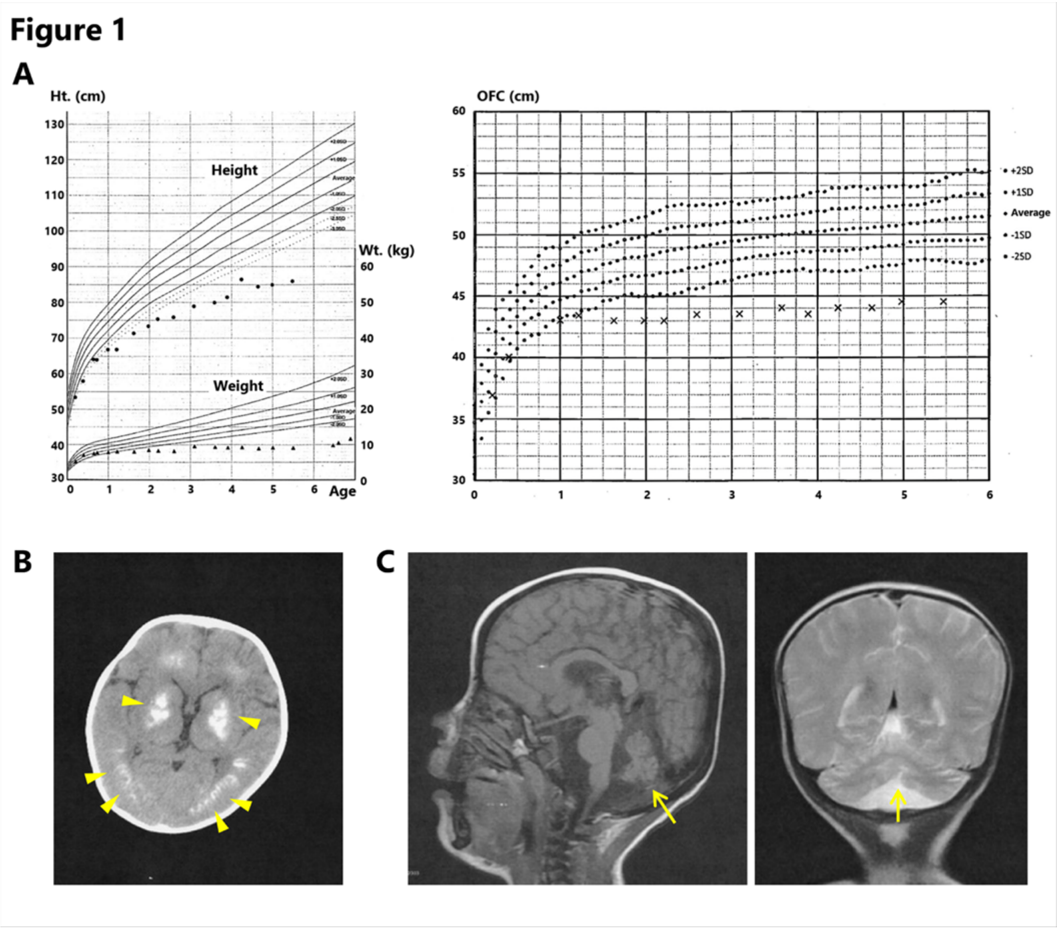
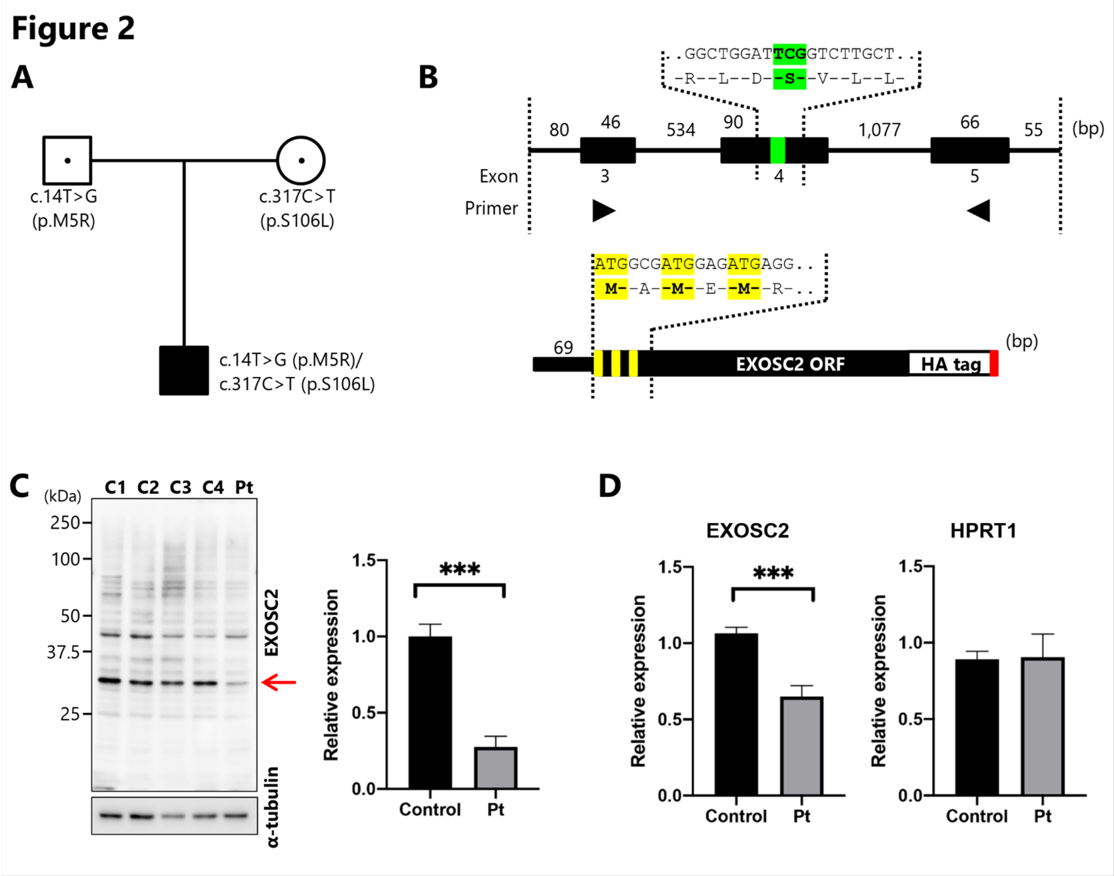
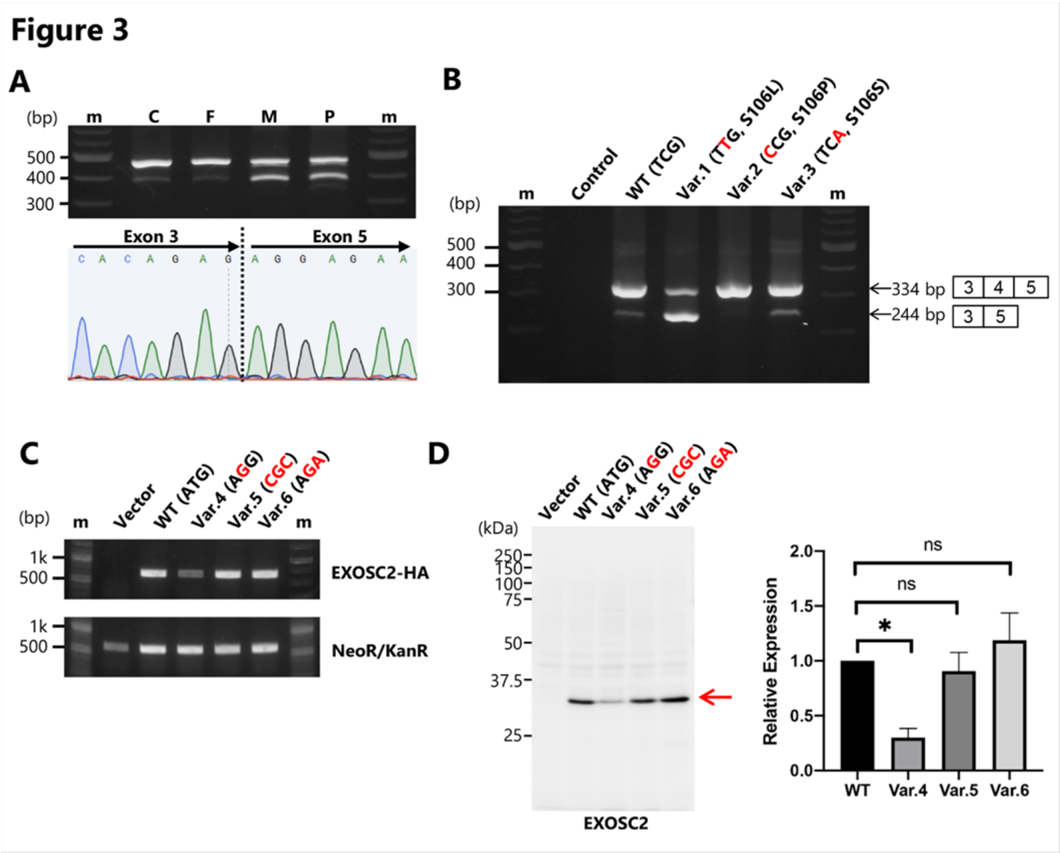
EXOSC2 encodes one of the 11 components of the RNA exosome complex degrading various types of RNA. Pathogenic variants of some EXOSC genes cause genetic disorders with similar phenotypes, including intellectual disability (ID), microcephaly, and pontocerebellar hypoplasia. However, little is known regarding EXOSC2 . We report detailed analyses of compound heterozygosity of novel EXOSC2 variants, comprising paternally-inherited c.14T > G (p.M5R) and maternally-inherited c.317C > T (p.S106L), identified in a patient with ID, epilepsy, and microcephaly. Although the two variants appeared ‘missense,’ they respectively decreased protein EXOSC2 expression through novel pathomechanisms. c.14T > G may have decreased EXOSC2 expression by impaired efficiency during translational initiation. Interestingly, other synonymous codons didn’t decrease the expression, suggesting the decreased expression depended on the nucleotide change instead of residue change. The second variant, c.317C > T, caused unexpected exon 4 skipping, leading to decreased EXOSC2 expression, although the nucleotide 317C was in the middle of exon 4. Since the exon skipping didn’t occur due to other changes in nucleotides adjacent to c.317C, only c.317C > T critically reduced the function of the exon enhancer element. Altogether, we identified two novel pathomechanisms explaining the decrease in EXOSC2 expression. These findings suggest the possibility that we may overlook such kind of variants decreasing gene expression, which could cause disorders. Additionally, the etiology of the current case is a decline of one of the 11 components of the exosome, similar to previously-reported disorders by other genes in the EXOSC family, with overlapping clinical features. Thus, these disorders may be integrated into a new disease concept termed “ RNA exosomepathy .”
Overview
CoChat Summary
TL;DR
This preprint reports a patient with intellectual disability, epilepsy, and microcephaly carrying compound heterozygous EXOSC2 variants, c.14T>G (p.M5R) and c.317C>T (p.S106L), both initially classified as missense. Functional analyses show each variant decreases EXOSC2 expression by distinct mechanisms—impaired translational initiation and exon 4 skipping—supporting a bi-allelic loss-of-expression pathomechanism and a proposed “RNA exosomepathy” disease concept.
Key findings
- WES identified compound heterozygous EXOSC2 variants: paternally inherited NM_001282708.1:c.14T>G (p.Met5Arg) in exon 1 and maternally inherited c.317C>T (p.Ser106Leu) in exon 4. In patient LCL, EXOSC2 protein was 27.6% lower than four healthy controls, and EXOSC2 mRNA was approximately 68% (p < 0.02) of three controls.
- c.317C>T caused exon 4 skipping (90 nucleotides; predicted in-frame deletion of 30 amino acids) in the mother and proband; minigene assays showed strong exon 4 skipping for c.317C>T, while c.316T>C (p.S106P) and c.318G>A (p.S106S) caused only slight skipping. ESE finder predicted only c.317C>T lost an SF/ASF (IgM-BRCA1) binding site; the shorter protein was not detected, suggesting instability.
- c.14T>G decreased EXOSC2 mRNA and protein in a nucleotide-dependent manner: synonymous arginine codons CGC and AGA did not decrease expression, and a 78-bp decoy RNA containing the variant did not rescue p.M5R protein, suggesting translational inhibition via altered mRNA secondary structure rather than non-coding RNA degradation.
- In silico predictions were controversial (e.g., SpliceAI did not predict c.317C>T splicing change; PolyPhen-2 judged c.14T>G benign while PROVEAN/SIFT judged it deleterious). Structural modeling suggested M5R slightly destabilizes EXOSC2 and adds polar bonds to EXOSC7, while S106L loses a predicted polar bond facing RNA. The authors propose “RNA exosomepathy” for overlapping EXOSC-family disorders.
Methods
- Design: single-proband case report with family study and functional validation. The proband was a 6-year-7-month-old boy with ID, developmental delay, epilepsy, and multiple congenital dysmorphologies; parents were non-consanguineous. LCLs were established from patient and parents; HEK293 cells were used for minigene and expression-vector assays.
- Genomic analysis: WES with 150 bp paired-end reads, average coverage 100× across the targeted exome; alignment/variant calling with BWA-MEM and GATK v3.5 (hs37d5); rare variants filtered at MAF < 0.01. Sanger sequencing confirmed variants.
- Functional/structural analyses: RT-PCR and real-time PCR (normalized to TBP; HPRT1 internal control), western blotting, minigene splicing assay for EXOSC2 exons 3–5 (1,948 bp), EXOSC2-HA expression vectors in HEK293, in silico predictors, and structural modeling using PDB 6D6Q, FoldX, and PyMOL.
Limitations
- The paper does not include a formal limitations section. It states that little is known regarding EXOSC2, few EXOSC2 cases have been reported, and the limited number of reported cases makes comprehensive understanding with other EXOSC family genes difficult; it also notes that in silico predictions were controversial and not all EXOSC-family variants were validated.
- Evident from the text: findings rest on a single proband and family, with no replication cohort; functional assays use patient LCLs and HEK293 overexpression/minigene systems rather than endogenous neural tissue, and the exon-4-skipping protein was not detected.
- Evident from the text: the proposed mRNA secondary-structure mechanism for c.14T>G is inferred from lack of decoy rescue and not directly demonstrated; the study reports no generated datasets.
Model-written summary. Check it against the paper before relying on it.
Integrity signals
Registry
Cites
Statistics
Figures
Verification
Claims the paper makes
0 Valid · 0 Not valid · 18 Not checked · 54 Own results and interpretations
A result the paper reports from its own data — it cites no other source for it, so there is none to check. The quote shows it is in the paper.
In the paper
“In conclusion, we successfully identi ed two unexpected mechanisms underlying the decrease in EXOSC2 protein expression that were di cult for the in silico predictors to estimate.”
§ Compound heterozygosity of EXOSC2 'missense' variants causes a bi-allelic decrease in protein expression through novel unexpected pathomechanisms > Discussion
plainstates a causeSingle case- Asserted: passes — The authors put it forward as true.
- Checkable: passes — It can be checked against evidence.
- Load-bearing: passes — The paper’s conclusions depend on it.
- Based: passes — The paper gives a reason why it holds.
A result the paper reports from its own data — it cites no other source for it, so there is none to check. The quote shows it is in the paper.
In the paper
“The amino acids surrounding the variants were wellconserved among species (Fig. S2).”
§ Compound heterozygosity of EXOSC2 'missense' variants causes a bi-allelic decrease in protein expression through novel unexpected pathomechanisms > Results
boosted- Asserted: passes — The authors put it forward as true.
- Checkable: passes — It can be checked against evidence.
- Load-bearing: unclear — It is unclear whether the paper’s conclusions depend on it.
- Based: passes — The paper gives a reason why it holds.
A result the paper reports from its own data — it cites no other source for it, so there is none to check. The quote shows it is in the paper.
In the paper
“We found that a shorter PCR product was strongly expressed in the mother and the patient (Fig. 3A).”
§ Compound heterozygosity of EXOSC2 'missense' variants causes a bi-allelic decrease in protein expression through novel unexpected pathomechanisms > Results
plainSingle case- Asserted: passes — The authors put it forward as true.
- Checkable: passes — It can be checked against evidence.
- Load-bearing: passes — The paper’s conclusions depend on it.
- Based: passes — The paper gives a reason why it holds.
A result the paper reports from its own data — it cites no other source for it, so there is none to check. The quote shows it is in the paper.
In the paper
“Sequence analysis of the short PCR product exhibited a skipping of exon 4 including c.317C > T, comprising 90 nucleotides.”
§ Compound heterozygosity of EXOSC2 'missense' variants causes a bi-allelic decrease in protein expression through novel unexpected pathomechanisms > Results
plainSingle case- Asserted: passes — The authors put it forward as true.
- Checkable: passes — It can be checked against evidence.
- Load-bearing: passes — The paper’s conclusions depend on it.
- Based: passes — The paper gives a reason why it holds.
A result the paper reports from its own data — it cites no other source for it, so there is none to check. The quote shows it is in the paper.
In the paper
“Both of the 'missence' variants decreased EXOSC2 expression.”
§ Compound heterozygosity of EXOSC2 'missense' variants causes a bi-allelic decrease in protein expression through novel unexpected pathomechanisms > Discussion
plainstates a causeSingle case- Asserted: passes — The authors put it forward as true.
- Checkable: passes — It can be checked against evidence.
- Load-bearing: passes — The paper’s conclusions depend on it.
- Based: passes — The paper gives a reason why it holds.
24 more claims
Create a free account to see all 72 claims and to verify the 2 references still open.
- It may state two separate claims as one. 28
- Probably not a substantial claim. 19
- The quote only partly states this claim. 1
Citations
Cites
Richards, S., Aziz, N., Bale, S., Bick, D., Das, S., Gastier-Foster, J., Grody, W. W., Hegde, M., Lyon, E., Spector, E., et al. (2015) · Genetics in Medicine · doi:10.1038/gim.2015.30 · Cited by 32,594
Vandesompele, J., De Preter, K., Pattyn, F., Poppe, B., Van Roy, N., De Paepe, A., & Speleman, F. (2002) · Genome Biology · doi:10.1186/gb-2002-3-7-research0034 · Cited by 20,038
ESEfinder: a web resource to identify exonic splicing enhancers
Cartegni, L. (2003) · Nucleic Acids Research · doi:10.1093/nar/gkg616 · Cited by 1,603
Endonucleolytic cleavage of eukaryotic mRNAs with stalls in translation elongation
Doma, M. K., & Parker, R. (2006) · Nature · doi:10.1038/nature04530 · Cited by 760
Pejaver, V., Byrne, A. B., Feng, B.-J., Pagel, K. A., Mooney, S. D., Karchin, R., O’Donnell-Luria, A., Harrison, S. M., Tavtigian, S. V., Greenblatt, M. S., et al. (2022) · The American Journal of Human Genetics · doi:10.1016/j.ajhg.2022.10.013 · Cited by 589
Smith, P. J., Zhang, C., Wang, J., Chew, S. L., Zhang, M. Q., & Krainer, A. R. (2006) · Human Molecular Genetics · doi:10.1093/hmg/ddl171 · Cited by 515
FoldX 5.0: working with RNA, small molecules and a new graphical interface
Delgado, J., Radusky, L. G., Cianferoni, D., & Serrano, L. (2019) · Bioinformatics · doi:10.1093/bioinformatics/btz184 · Cited by 514
Burley, S. K., Bhatt, R., Bhikadiya, C., Bi, C., Biester, A., Biswas, P., Bittrich, S., Blaumann, S., Brown, R., Chao, H., et al. (2025) · Nucleic Acids Research · doi:10.1093/nar/gkae1091 · Cited by 329
Lim, K. H., Ferraris, L., Filloux, M. E., Raphael, B. J., & Fairbrother, W. G. (2011) · Proceedings of the National Academy of Sciences · doi:10.1073/pnas.1101135108 · Cited by 282
Wan, J., Yourshaw, M., Mamsa, H., Rudnik-Schöneborn, S., Menezes, M. P., Hong, J. E., Leong, D. W., Senderek, J., Salman, M. S., Chitayat, D., et al. (2012) · Nature Genetics · doi:10.1038/ng.2254 · Cited by 257
Cited by
Still being checked.
Metadata
- Authors
- Hayashi, S., Yamada, K., Mori, T., Suzuki, Y., Nishio, Y., OGI, T., & Inaba, M.
- Affiliations
- Institute for Developmental Research (JP)
- Aichi Developmental Disability Center (JP)
- Nagoya University (JP)
- Corresponding author
- Hayashi, Shin
- Venue
- Research Square
- Published
- 2026-03-13
- OpenAlex
- W7135223567
- Cited by
- 0
- References
- 40
- Type
- posted content
- Language
- en
- Open access
- green
- doi.org
- Locations
- Research Square (submittedVersion, cc-by)
- Funders
- Japan Agency for Medical Research and Development
- Japan Society for the Promotion of Science (24K10523, 24K11014)
- Topics
- Life Sciences › Biochemistry, Genetics and Molecular Biology › Genetics › Genomics and Rare Diseases
- Life Sciences › Biochemistry, Genetics and Molecular Biology › Molecular Biology › RNA Research and Splicing
- Life Sciences › Biochemistry, Genetics and Molecular Biology › Genetics › Genetics and Neurodevelopmental Disorders
- Keywords
- compound heterozygosity, RNA exosome, missense mutations, exon skipping, intellectual disability, microcephaly, epilepsy
About these checks
Registry, retraction, Cites and statistics results are computed, not judged, with one exception: a printed reference that no index lists is read once by a model before it counts as a citation error. Claims are extracted by a model and kept only when their quote appears verbatim in the text; each cited source is then checked, with a model’s help, for whether it says what the claim relies on. Those verdicts can be wrong — read the claim’s quote and the cited source before relying on one.
A language model drew the claims from the paper on 2026-11-22, under version 3 of the claim definition (model deepseek-v4.1-flash, prompt extract-v3).
A second model labelled each claim on 2026-11-22 (model jev-1.13-20260917, definition revision gold-guideline-v0.2).
Statistics and arithmetic are recomputed, not judged.
Confidence bands are shown only for fields calibrated on our annotated test set. None is calibrated yet, so no band is shown.
What counts as a claim ›How we measure confidence ›How we check this ›
Are you an author, or do you see a problem with this page? Request a review
How to cite
Cite CoChat for the checks on this page, and the paper for its own findings.
- This page
- CoChat. (2026). Citation check: Compound heterozygosity of EXOSC2 ‘missense’ variants causes a bi-allelic decrease in protein expression through novel unexpected pathomechanisms. https://app.cochat.ai/papers/10.21203/rs.3.rs-9039053/v1
- The paper
- Hayashi, S., Yamada, K., Mori, T., Suzuki, Y., Nishio, Y., OGI, T., & Inaba, M. (2026). Compound heterozygosity of EXOSC2 ‘missense’ variants causes a bi-allelic decrease in protein expression through novel unexpected pathomechanisms. Research Square. https://doi.org/10.21203/rs.3.rs-9039053/v1
Data sources
Bibliographic data: Semantic Scholar, OpenAlex, Crossref.
Contains information from the Semantic Scholar Academic Graph Datasets, made available under the ODC Attribution License (ODC-BY 1.0).
Semantic Scholar’s data is described in: Kinney, R., et al. (2023). The Semantic Scholar Open Data Platform. arXiv:2301.10140.
