

Establishment and Function of Cover Crops Interseeded into Corn
The DOI matches its Crossref record; 31 of the 31 references it cites were found in a registry or an index.
Abstract
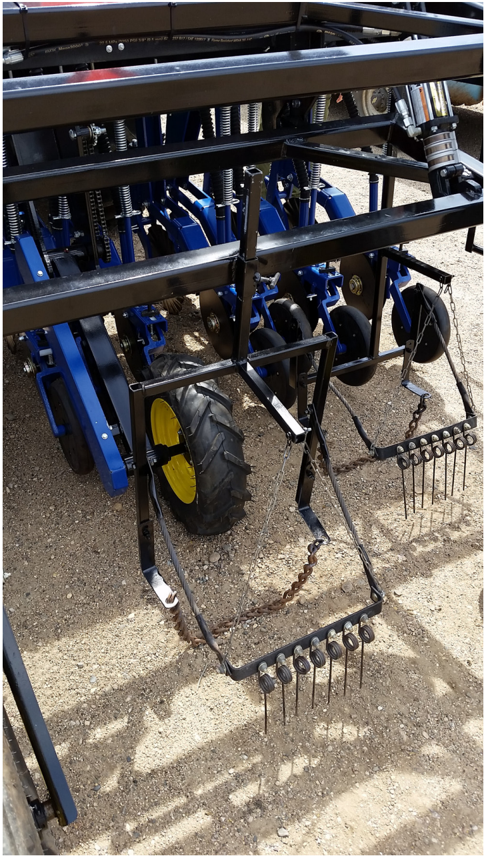
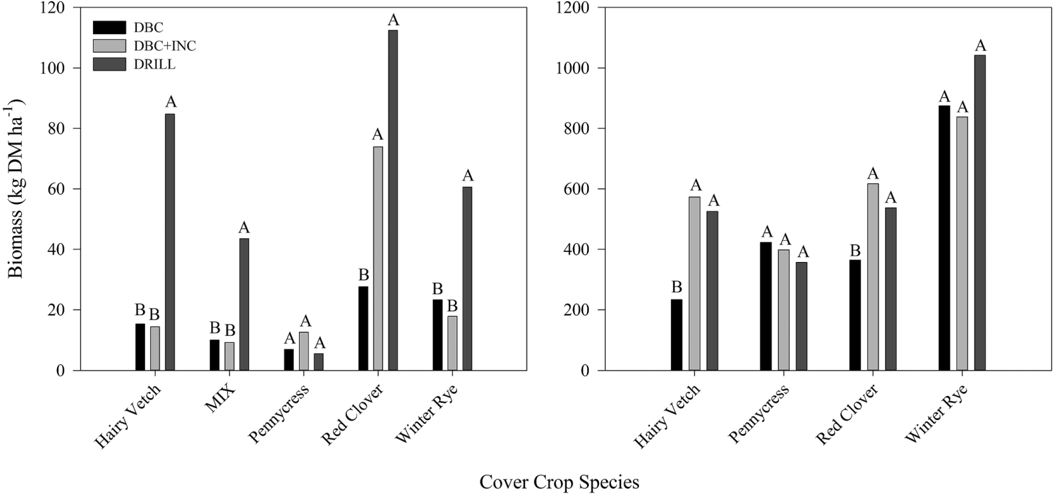
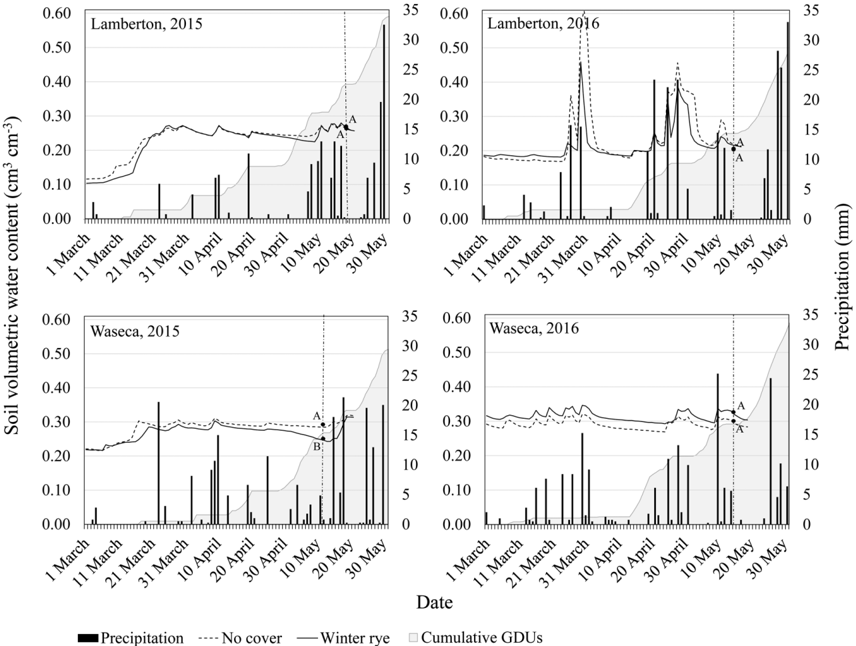
Cover crops can provide ecological services and improve the resilience of annual cropping systems; however, cover crop use is low in corn ( Zea mays L.)–soybean [ Glycine max (L.) Merr.] rotations in the upper Midwest due to challenges with establishment. Our objective was to compare three planting methods to establish cover crops (winter rye [ Secale cereale L. ‘Rymin’], red clover [ Trifolium pretense L. ‘Medium’], hairy vetch [ Vicia villosa Roth], field pennycress [ Thlaspi arvense L. ‘MN‐106’], and a mixture of oat [ Avena sativa L.], pea [ Pisum sativum L.], and tillage radish [ Raphanus sativus L.]) (MIX) in corn at the seven‐leaf collar stage. Planting methods included directed broadcast into the inter‐row (DBC), directed broadcast with light incorporation (DBC+INC), and a high‐clearance drill (DRILL). The DRILL method achieved greater fall biomass than DBC for all species except pennycress, and DRILL and DBC+INC increased red clover and hairy vetch spring biomass compared with DBC. Cover crops did not affect corn grain or silage yield and reduced yield of the subsequent soybean crop by 0.4 Mg ha −1 (10%) only when poor termination of hairy vetch occurred at one site. Cover crops with >390 kg ha −1 of spring biomass reduced soil nitrate‐N compared with the no‐cover control. These results support that cover crops can be interseeded into corn at the seven‐leaf collar stage in the upper Midwest to reduce soil nitrate‐N while maintaining corn and subsequent soybean yields; however, effective cover crop termination is critical to avoid competition with the subsequent soybean crop.
Overview
The claims and statistics of this paper haven’t been checked yet.
Free: it reads the open-access text and checks the first 5 claims that cite a source we can check. Create a free account to check every claim.
Integrity signals
Registry
Cites
Statistics
Figures
Verification
Claims the paper makes
The claims and statistics of this paper haven’t been checked yet.
Free: it reads the open-access text and checks the first 5 claims that cite a source we can check. Create a free account to check every claim.
Claims other papers make about this one
Each is checked against this paper’s own text: does it say what the citing paper says it does?
In the citing paper
“The close relationship between biomass and GDD in our study suggests we avoided growth limitations because we applied manure and because our no-till drilling is a more reliable seeding method than broadcasting (Fisher et al., 2011; Noland et al., 2018).”
From Fall cover crop nitrogen uptake drives reductions in winter-spring leaching (2022) · cites this paper as Noland et al., 2018
Self-check
Percentages, sums and reported differences re-computed from the paper’s own numbers.
The self-check needs the paper’s full text.
Citations
Cites
An Analysis of Transformations
Box, G. E. P., & Cox, D. R. (1964) · Journal of the Royal Statistical Society Series B: Statistical Methodology · doi:10.1111/j.2517-6161.1964.tb00553.x · Cited by 15,052
A decimal code for the growth stages of cereals
ZADOKS, J. C., CHANG, T. T., & KONZAK, C. F. (1974) · Weed Research · doi:10.1111/j.1365-3180.1974.tb01084.x · Cited by 10,173
Blake, G. R., & Hartge, K. H. (1986) · SSSA Book Series · doi:10.2136/sssabookser5.1.2ed.c13 · Cited by 1,651
Cover Crops and Ecosystem Services: Insights from Studies in Temperate Soils
Blanco‐Canqui, H., Shaver, T. M., Lindquist, J. L., Shapiro, C. A., Elmore, R. W., Francis, C. A., & Hergert, G. W. (2015) · Agronomy Journal · doi:10.2134/agronj15.0086 · Cited by 1,189
USING WINTER COVER CROPS TO IMPROVE SOIL AND WATER QUALITY
Dabney, S. M., Delgado, J. A., & Reeves, D. W. (2001) · Communications in Soil Science and Plant Analysis · doi:10.1081/css-100104110 · Cited by 1,035
MITSCH, W. J., DAY, J. W., WENDELL GILLIAM, J., GROFFMAN, P. M., HEY, D. L., RANDALL, G. W., & Wang, N. (2001) · BioScience · doi:10.1641/0006-3568(2001)051[0373:rnlttg]2.0.co;2 · Cited by 789
Nitrogen Release from Grass and Legume Cover Crop Monocultures and Bicultures
Ranells, N. N., & Wagger, M. G. (1996) · Agronomy Journal · doi:10.2134/agronj1996.00021962008800050015x · Cited by 326
Cover Cropping to Reduce Nitrate Loss through Subsurface Drainage in the Northern U.S. Corn Belt
Strock, J. S., Porter, P. M., & Russelle, M. P. (2004) · Journal of Environmental Quality · doi:10.2134/jeq2004.1010 · Cited by 304
Cover crop and soil quality interactions in agroecosystems
Reicosky, D. C., & Forcella, F. (1998) · Journal of Soil and Water Conservation · doi:10.1080/00224561.1998.12457223 · Cited by 210
Spectral estimation of absorbed photosynthetically active radiation in corn canopies
Gallo, K. P., Daughtry, C. S. T., & Bauer, M. E. (1985) · Remote Sensing of Environment · doi:10.1016/0034-4257(85)90096-3 · Cited by 204
Are cover crops being used in the US corn belt?
Singer, J. W., Nusser, S. M., & Alf, C. J. (2007) · Journal of Soil and Water Conservation · doi:10.1080/00224561.2007.12435983 · Cited by 159
Randall, G. W., Vetsch, J. A., & Huffman, J. R. (2003) · Journal of Environmental Quality · doi:10.2134/jeq2003.1764 · Cited by 153
Soil Water Dynamics under Winter Rye Cover Crop in Central Iowa
Qi, Z., & Helmers, M. J. (2010) · Vadose Zone Journal · doi:10.2136/vzj2008.0163 · Cited by 119
Effect of Seeding Rate and Planting Arrangement on Rye Cover Crop and Weed Growth
Boyd, N. S., Brennan, E. B., Smith, R., & Yokota, R. (2009) · Agronomy Journal · doi:10.2134/agronj2008.0059 · Cited by 118
Why Early Season Weed Control Is Important in Maize
Page, E. R., Cerrudo, D., Westra, P. H., Loux, M. M., Smith, K., Foresman, C., Wright, H. A., & Swanton, C. J. (2012) · Weed Science · doi:10.1614/ws-d-11-00183.1 · Cited by 108
Wells, M. S., Reberg-Horton, C. S., Smith, A. N., & Grossman, J. (2013) · Agronomy Journal · doi:10.2134/agronj2012.0396 · Cited by 100
Self-citationField Pennycress Production and Weed Control in a Double Crop System with Soybean in Minnesota
Johnson, G. A., Kantar, M. B., Betts, K. J., & Wyse, D. L. (2015) · Agronomy Journal · doi:10.2134/agronj14.0292 · Cited by 96
Potential for a Rye Cover Crop to Reduce Nitrate Loss in Southwestern Minnesota
Feyereisen, G. W., Wilson, B. N., Sands, G. R., Strock, J. S., & Porter, P. M. (2006) · Agronomy Journal · doi:10.2134/agronj2005.0134 · Cited by 95
Factors Affecting Successful Establishment of Aerially Seeded Winter Rye
Wilson, M. L., Baker, J. M., & Allan, D. L. (2013) · Agronomy Journal · doi:10.2134/agronj2013.0133 · Cited by 84
Self-citationCorn Belt Assessment of Cover Crop Management and Preferences
Singer, J. W. (2008) · Agronomy Journal · doi:10.2134/agronj2008.0151 · Cited by 77
Nitrate Leaching from Winter Cereal Cover Crops Using Undisturbed Soil‐Column Lysimeters
Meisinger, J. J., & Ricigliano, K. (2017) · Journal of Environmental Quality · doi:10.2134/jeq2016.09.0372 · Cited by 69
Soil aggregate sequestration of cover crop root and shoot-derived nitrogen
Kavdır, Y., & Smucker, A. J. M. (2005) · Plant and Soil · doi:10.1007/s11104-004-5294-x · Cited by 66
Establishment and Impact of Cover Crops Intersown into Corn
Belfry, K. D., & Van Eerd, L. L. (2016) · Crop Science · doi:10.2135/cropsci2015.06.0351 · Cited by 62
Enhancing soil nitrogen mineralization and corn yield with overseeded cover crops
Jones, M., Harwood, R. R., Dehne, N. C., Smeenk, J., & Parker, E. (1998) · Journal of Soil and Water Conservation · doi:10.1080/00224561.1998.12457226 · Cited by 16
Abdin, O. A., Coulman, B. E., Cloutier, D. C., Faris, M. A., & Smith, D. L. (1997) · Journal of Agronomy and Crop Science · doi:10.1111/j.1439-037x.1997.tb01143.x
Corn and Cover Crop Response to Corn Density in an Interseeding System
Baributsa, D., Foster, E. F., Thelen, K. D., Kravchenko, A., Mutch, D. R., & Ngouajio, M. (2008) · Agronomy Journal · doi:10.2134/agronj2007.0110
Boyd, N. S., & Acker, R. C. V. (2003) · Weed Science · doi:10.1614/p2002-111
The Critical Period of Weed Control in Grain Corn (Zea mays)
Hall, M. R., Swanton, C. J., & Anderson, G. (1992) · Weed Science · doi:10.1017/s0043174500051882
Canopy Reduction and Legume Interseeding in Irrigated Continuous Corn
Humphreys, M. T., Freeman, K. W., Mullen, R. W., Keahey, D. A., Teal, R. K., & Raun, W. R. (2003) · Journal of Plant Nutrition · doi:10.1081/pln-120020374
THE QUANTITATIVE MINERAL NUTRIENT REQUIREMENTS OF PLANTS
Macy, P. (1936) · PLANT PHYSIOLOGY · doi:10.1104/pp.11.4.749
Research works printed but not linked: 9
- Gilliam, J.W., and R.W. Skaggs. 1986. Controlled agricultural drainage to maintain water quality. J. Irrig. Drain. Eng. 112:254-263. doi:10.1061/(ASCE)0733-9437(1986)112:3(254) · doi:10.1061/(asce)0733-9437(1986)112:3(254
- 10.1061/(ASCE)0733‐9437(1986)112:3(254) · doi:10.1061/(asce)0733-9437(1986)112:3(254
- Hakansson, I., J. Arvidsson, A. Etana, T. Rydberg, and T. Keller. 2013. Effects of seedbed properties on crop emergence: Temporal effects of temperature and sowing depth in seed- beds with favourable properties. Acta Agric. Scand., Sect. B. 61:458-468.
- Nathan, M., and R. Gelderman. 2015. Recommended chemical soil test procedures for the North Central region. SB 1001. Missouri Agric. Exp. Stn. Univ. of Missouri, Columbia.
- Page, E.R., D. Cerrudo, P. Westra, M. Loux, K. Smith, C. Fores- man, et al. 2012. Why early season weed control is important in maize. Weed Sci. 60:423-430. doi:10.1614/WS-D-11-00183. · doi:10.1614/ws-d-11-00183
- Palhano, M.G., J.K. Norsworthy, L.T. Barber, and R.C. Scott. 2015. Chemical termination options for cover crops prior to planting soybean. In: J. Ross, editor, Arkansas soybean research studies 2015. Res. Ser. 637. Arkansas Agric. Exp. Stn., Fayetteville. p. 115-116.
- SARE-CTIC. 2016. Cover crop survey: 2015-2016 annual report. Conserv. Technol. Inf. Ctr., Sust. Agric. Res. Educ., Am. Seed Trade Assoc. http://www.sare.org/Learning-Center/ Topic-Rooms/Cover-Crops/Cover-Crop-Surveys (accessed 18 June 2017).
- SAS Institute. 2013. The SAS system for Windows. Release 9.4. SAS Inst., Cary, NC.
- USDA-NASS Cropland Data Layer. 2016. Published crop-specific data layer. USDA-NASS, Washington, DC. http://nassgeo- data.gmu.edu/CropScape/ (accessed 18 June 2017)
Cited by
Abdalla, M., Hastings, A., Cheng, K., Yue, Q., Chadwick, D., Espenberg, M., Truu, J., Rees, R. M., & Smith, P. (2019) · Global Change Biology · doi:10.1111/gcb.14644 · Cited by 747
“Noland et al. (2018) found that to reduce soil NO3 while maintaining corn and subsequent soybean yields, cover crops should be inter‐seeded into corn at the seven‐leaf collar stage.”
BackgroundImproving soil physical properties through the use of cover crops: A review
Haruna, S. I., Anderson, S. H., Udawatta, R. P., Gantzer, C. J., Phillips, N. C., Cui, S., & Gao, Y. (2020) · Agrosystems, Geosciences & Environment · doi:10.1002/agg2.20105 · Cited by 235
Fall cover crop nitrogen uptake drives reductions in winter-spring leaching
Sedghi, N., & Weil, R. (2022) · Journal of Environmental Quality · doi:10.1002/jeq2.20342 · Cited by 21
Metadata
- Authors
- Noland, R. L., Wells, M. S., Sheaffer, C. C., Baker, J. M., Martinson, K. L., & Coulter, J. A.
- Affiliations
- Dep. of Agronomy and Plant Genetics Univ. of Minnesota 411 Borlaug Hall, 1991 Upper Buford Circle St. Paul MN 55108
- USDAARS St. Paul MN
- Dep. of Animal Science Univ. of Minnesota St. Paul MN
- Venue
- Crop Science
- Publisher
- Wiley
- Published
- 2018-03
- Volume
- 58
- Issue
- 2
- Pages
- 863-873
- ISSN
- 0011-183X
- 1435-0653
- Cited by
- 98
- References
- 31
- Language
- en
- Funders
- Minnesota Department of Agriculture Clean Water Fund
About these checks
Registry, retraction, Cites and statistics results are computed, not judged, with one exception: a printed reference that no index lists is read once by a model before it counts as a citation error. Claims are extracted by a model and kept only when their quote appears verbatim in the text; each cited source is then checked, with a model’s help, for whether it says what the claim relies on. Those verdicts can be wrong — read the claim’s quote and the cited source before relying on one.
Statistics and arithmetic are recomputed, not judged.
Confidence bands are shown only for fields calibrated on our annotated test set. None is calibrated yet, so no band is shown.
What counts as a claim ›How we measure confidence ›How we check this ›
Are you an author, or do you see a problem with this page? Request a review
Data sources
Bibliographic data: Semantic Scholar, OpenAlex, Crossref.
Contains information from the Semantic Scholar Academic Graph Datasets, made available under the ODC Attribution License (ODC-BY 1.0).
Semantic Scholar’s data is described in: Kinney, R., et al. (2023). The Semantic Scholar Open Data Platform. arXiv:2301.10140.
