

Foundation Models for Generalist Geospatial Artificial Intelligence
Open accessThe DOI matches its DataCite record; 61 of the 61 references it cites were found in a registry or an index; 7 of the 25 sources its claims cite were checked for support.
Abstract
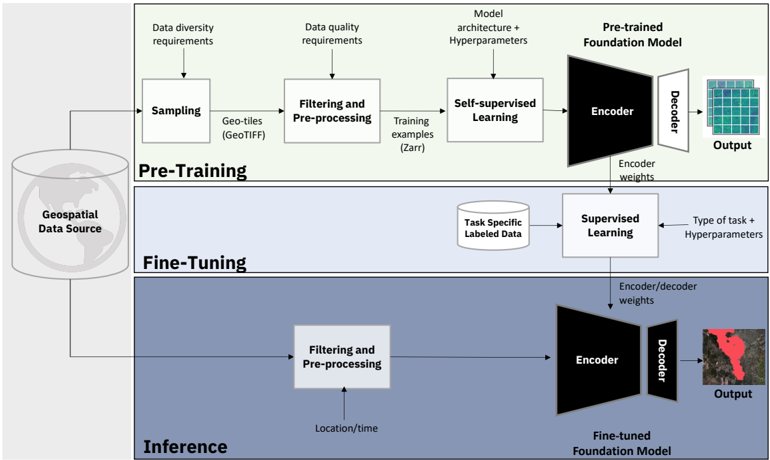
Significant progress in the development of highly adaptable and reusable Artificial Intelligence (AI) models is expected to have a significant impact on Earth science and remote sensing. Foundation models are pre-trained on large unlabeled datasets through self-supervision, and then fine-tuned for various downstream tasks with small labeled datasets. This paper introduces a first-of-a-kind framework for the efficient pre-training and fine-tuning of foundational models on extensive geospatial data. We have utilized this framework to create Prithvi, a transformer-based geospatial foundational model pre-trained on more than 1TB of multispectral satellite imagery from the Harmonized Landsat-Sentinel 2 (HLS) dataset. Our study demonstrates the efficacy of our framework in successfully fine-tuning Prithvi to a range of Earth observation tasks that have not been tackled by previous work on foundation models involving multi-temporal cloud gap imputation, flood mapping, wildfire scar segmentation, and multi-temporal crop segmentation. Our experiments show that the pre-trained model accelerates the fine-tuning process compared to leveraging randomly initialized weights. In addition, pre-trained Prithvi compares well against the state-of-the-art, e.g., outperforming a conditional GAN model in multi-temporal cloud imputation by up to 5pp (or 5.7%) in the structural similarity index. Finally, due to the limited availability of labeled data in the field of Earth observation, we gradually reduce the quantity of available labeled data for refining the model to evaluate data efficiency and demonstrate that data can be decreased significantly without affecting the model's accuracy. The pre-trained 100 million parameter model and corresponding fine-tuning workflows have been released publicly as open source contributions to the global Earth sciences community through Hugging Face.
Overview
CoChat Summary
TL;DR
The paper introduces a framework for pre-training and fine-tuning geospatial foundation models and uses it to build Prithvi, a 100M-parameter transformer pre-trained on over 1TB of multispectral HLS satellite imagery. Prithvi is fine-tuned for cloud gap imputation, flood mapping, wildfire scar segmentation, and crop segmentation, showing faster fine-tuning and data efficiency compared with randomly initialized or task-specific baselines.
Key findings
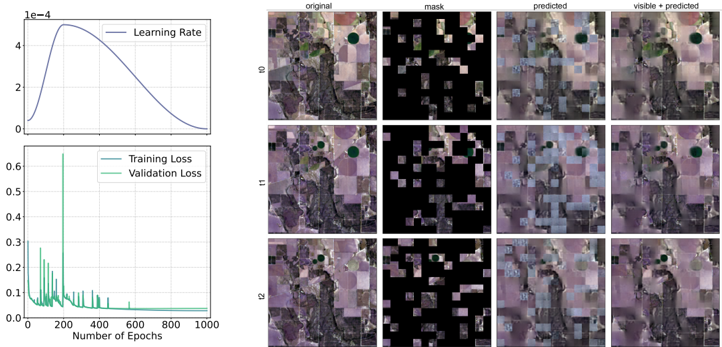
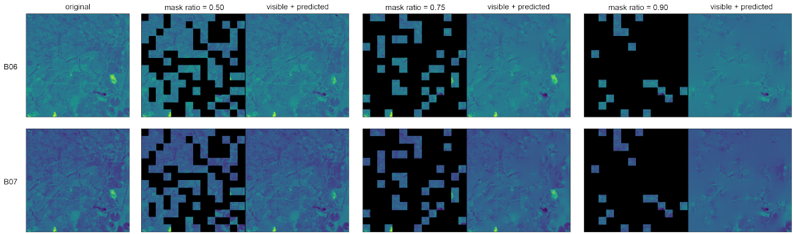
- Pre-training converged with a minimum training MSE of 0.0283 and validation loss of 0.0364; the model reconstructed masked multispectral and temporal data even at high masking ratios.
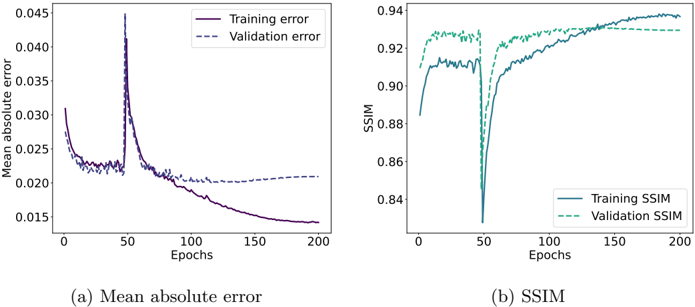
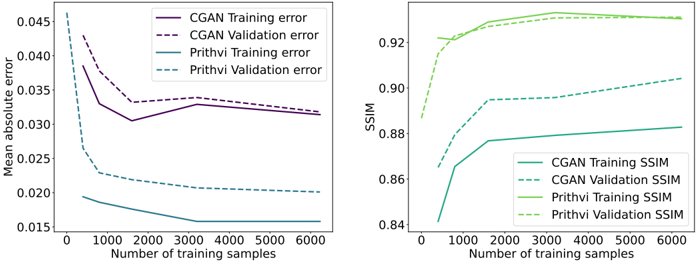
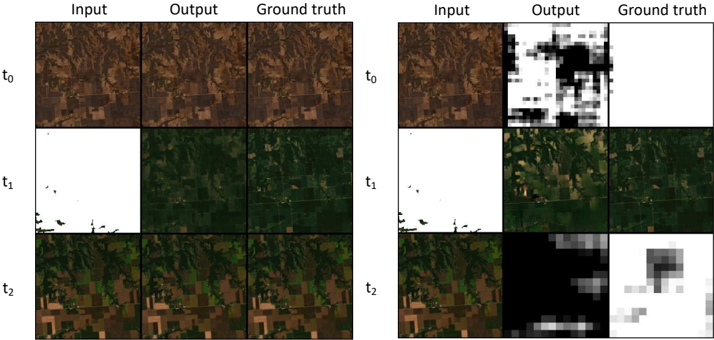
- For multi-temporal cloud gap imputation, Prithvi outperformed a conditional GAN baseline, including by up to 5pp (or 5.7%) in SSIM in the abstract, and still outperformed the CGAN fine-tuned on the full 6,231 samples when Prithvi used only 400 fine-tuning samples, by 1.2% in SSIM.
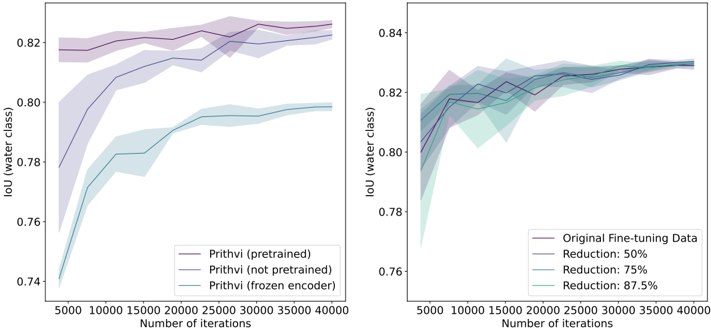
- For flood mapping on Sen1Floods11, pretrained Prithvi reached water-class IoU 81.26 after 50 epochs versus 80.67 without pretraining, and 82.99 after 500 epochs versus 82.97 without pretraining; reducing labeled images from 252 to 126 gave similar performance, and reducing by close to 90% still converged to over 80% IoU on average.
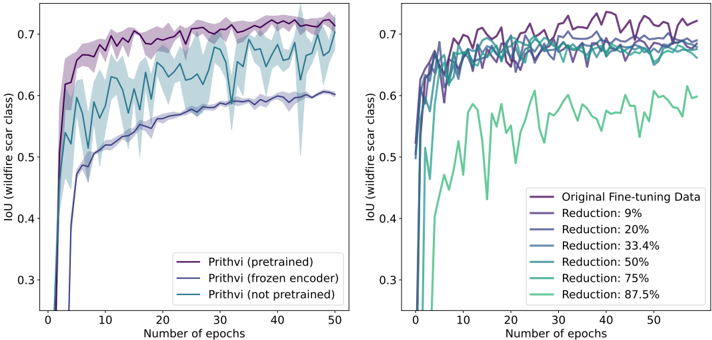
- For wildfire scar segmentation, pretrained Prithvi achieved fire-scar IoU 73.62, surpassing a U-Net baseline by 2.61pp and a ViT baseline by 4.58pp; for multi-temporal crop segmentation, Prithvi had mean accuracy 64.06% versus U-Net 61.91% and mean IoU 0.426 versus 0.420, with no significant IoU difference.
Methods
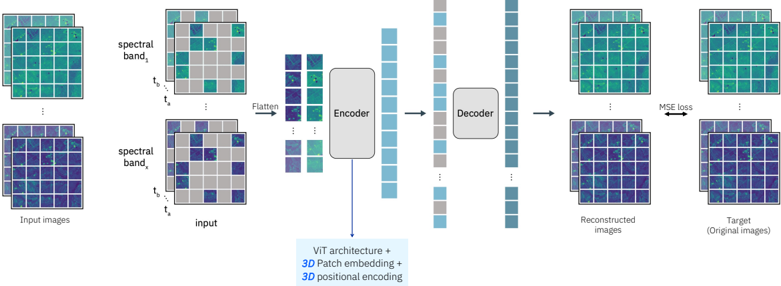
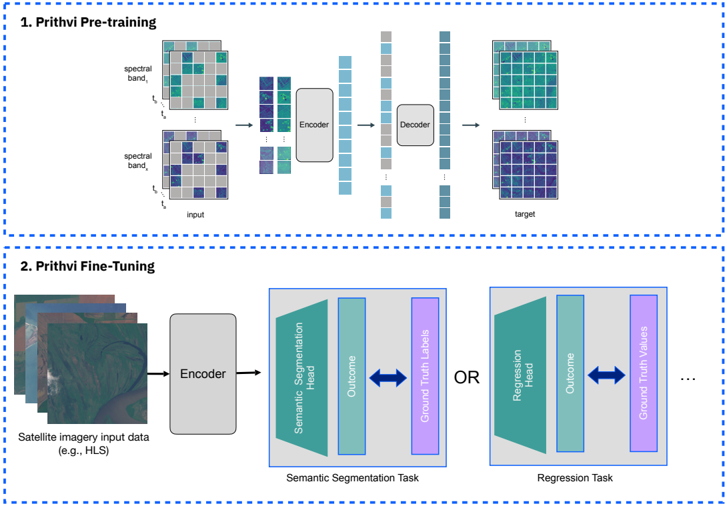
- Prithvi uses a masked autoencoder (MAE) with a ViT backbone, modified with 3D positional and 3D patch embeddings for spatiotemporal multispectral inputs; pre-training used six HLS bands, 224×224 images, patch size 1×16×16, AdamW, batch size 1024, and 1000 epochs on up to 64 NVIDIA A100 GPUs.
- Pre-training data came from the Harmonized Landsat-Sentinel 2 (HLS) dataset, with stratified sampling based on geospatial statistics, cloud/no-data filtering, and Zarr-based data loading; the paper reports using more than 1TB of HLS data.
- Downstream fine-tuning used task-specific lightweight decoder heads and datasets including 7,852 cloud gap imputation chips, Sen1Floods11 flood mapping data (4,831 512×512 chips), 805 wildfire scar scenes, and 3,854 multi-temporal crop segmentation chips; evaluation used IoU, F1, accuracy, RMSE, MAE, and SSIM.
Limitations
- The paper states that pre-training focused on the USA region, used a time step of 3, and one year of data, and that the model did not demonstrate significantly improved performance in handling seasonal changes.
- The paper states that in specific downstream tasks Prithvi did not surpass state-of-the-art models, and that crop segmentation showed no significant IoU difference from U-Net; it also notes potential improvement for data from the same distribution.
- The paper states the model is relatively small at 100M parameters and trained only on U.S. data, with future work needed on global HLS data, larger models, other backbones such as 3D Swin transformers, additional bands, and high-resolution imagery; evident from the text, only 6 of up to 15 HLS channels were used in pre-training.
Model-written summary. Check it against the paper before relying on it.
Integrity signals
Registry
Cites
Statistics
Figures
Verification
Claims the paper makes
5 Valid · 4 Not valid · 15 Not checked · 82 Own results and interpretations
The cited sources support only part of this claim — read each source’s verdict below.
In the paper
“However, Prithvi strongly outperforms the U-Net on data from unseen geographical regions (i.e., 8.6% in the IoU on the water class).”
What the sources say
- Partly supportedcites [63] [63] Li, W., Lee, H., Wang, S., Hsu, C.-Y., Arundel, S.T.: Assessment of IBM and NASA's Geospatial Foundation Model in Flood Inundation Mapping. Preprint Available on arXiv:2309.14500 (2023) sourceExperimental — accuracy not yet measured
The Results and Analysis section reports that Prithvi outperformed U-Net on data from the unseen Bolivia region. It describes a nearly 4% gap in mean IoU and mean accuracy, but the passages in our copy do not establish the claimed 8.6% difference in water-class IoU; a search for that figure and the unseen-region results table did not resolve it. (LLM, conf=0.87)
boostedstates a cause- Asserted: passes — The authors put it forward as true.
- Checkable: passes — It can be checked against evidence.
- Load-bearing: passes — The paper’s conclusions depend on it.
- Based: passes — The paper gives a reason why it holds.
- Partly supported
A result the paper reports from its own data — it cites no other source for it, so there is none to check. The quote shows it is in the paper.
In the paper
“we gradually reduce the quantity of available labeled data for refining the model to evaluate data efficiency and demonstrate that data can be decreased significantly without affecting the model's accuracy.”
boosted- Asserted: passes — The authors put it forward as true.
- Checkable: passes — It can be checked against evidence.
- Load-bearing: passes — The paper’s conclusions depend on it.
- Based: passes — The paper gives a reason why it holds.
A result the paper reports from its own data — it cites no other source for it, so there is none to check. The quote shows it is in the paper.
In the paper
“Importantly, Prithvi outperforms the CGAN (finetuned on the entire dataset of 6,231 samples) even when only leveraging 400 samples in the finetuning process by 1.2% in SSIM.”
plainstates a causen = 400- Asserted: passes — The authors put it forward as true.
- Checkable: passes — It can be checked against evidence.
- Load-bearing: passes — The paper’s conclusions depend on it.
- Based: passes — The paper gives a reason why it holds.
- Rests on an assumption not shown here.
A result the paper reports from its own data — it cites no other source for it, so there is none to check. The quote shows it is in the paper.
In the paper
“In Figure 9a, we observe that pretraining Prithvi on HLS data of 30m resolution strongly accelerates the fine-tuning process for flood mapping on 10m resolution compared to the same architecture without pretraining.”
boostedstates a cause- Asserted: passes — The authors put it forward as true.
- Checkable: passes — It can be checked against evidence.
- Load-bearing: passes — The paper’s conclusions depend on it.
- Based: passes — The paper gives a reason why it holds.
A result the paper reports from its own data — it cites no other source for it, so there is none to check. The quote shows it is in the paper.
In the paper
“pretrained Prithvi compares well against the state-of-the-art on downstream tasks, e.g., outperforming a conditional GAN model in multi-temporal cloud imputation by up to 5pp (or 5.7%) in the structural similarity index.”
plainstates a cause- Asserted: passes — The authors put it forward as true.
- Checkable: passes — It can be checked against evidence.
- Load-bearing: passes — The paper’s conclusions depend on it.
- Based: passes — The paper gives a reason why it holds.
61 more claims
Create a free account to see all 106 claims and to verify the 5 references still open.
- Probably not a substantial claim. 20
- It may state two separate claims as one. 30
Claims other papers make about this one
Each is checked against this paper’s own text: does it say what the citing paper says it does?
The source backs part of the claim, not all of it — or backs it for a different population, condition or comparison.
In the citing paper
“This dataset 8 was also used for testing Prithvi-EO-1.0, where the model showed stateof-the-art performance [9].”
From Prithvi-EO-2.0: A Versatile Multitemporal Foundation Model for Earth Observation Applications (2026) · cites this paper as [9]
Experimental — accuracy not yet measuredThe source backs part of the claim, not all of it — or backs it for a different population, condition or comparison.
In the citing paper
“This dataset was used for testing Prithvi-EO-1.0, where the model showed beyond-stateof-the-art performance [9].”
From Prithvi-EO-2.0: A Versatile Multitemporal Foundation Model for Earth Observation Applications (2026) · cites this paper as [9]
Experimental — accuracy not yet measuredThe source backs part of the claim, not all of it — or backs it for a different population, condition or comparison.
In the citing paper
“The crop segmentation task was one of the datasets used to evaluate Prithvi-EO-1.0, where the model showed state-of-the-art performance [9], [33].”
From Prithvi-EO-2.0: A Versatile Multitemporal Foundation Model for Earth Observation Applications (2026) · cites this paper as [9]
Experimental — accuracy not yet measured
Self-check
Percentages, sums and reported differences re-computed from the paper’s own numbers.
Each contradiction between two passages listed here was confirmed by an independent check.
Rated minor: it would not touch a result — a value no result rests on, a p-value that stays on the same side of the significance level, or a conflict that is clerical, resolved elsewhere in the paper, or outside its own findings.
In the paper
§ 5.2 Downstream Modeling Considerations · p. 12
“fine-tune over a maximum of 60 epochs for flood mapping”
§ 6.2.2 Flood Mapping · p. 16
“Top performance of Prithvi was obtained after 500 epochs”
Citations
Cites
U-Net: Convolutional Networks for Biomedical Image Segmentation
Ronneberger, O., Fischer, P., & Brox, T. (2015) · Lecture notes in computer science · doi:10.1007/978-3-319-24574-4_28 · Cited by 99,404 · cited 1×
“The first of these is the U-Net, a convolutional neural network proposed by Ronneberger et al. [15] in 2015.”
BackgroundAn Image is Worth 16x16 Words: Transformers for Image Recognition at Scale
Dosovitskiy, A., Beyer, L., Kolesnikov, A., Weissenborn, D., Zhai, X., Unterthiner, T., Dehghani, M., Minderer, M., Heigold, G., Gelly, S., et al. (2020) · arXiv · doi:10.48550/arxiv.2010.11929 · Cited by 47,472 · cited 1×
“Its encoder, based on the Vision Trans-former (ViT) [19] model, processes only visible patches, optimizing computational efficiency.”
MethodSwin Transformer: Hierarchical Vision Transformer using Shifted Windows
Liu, Z., Lin, Y., Cao, Y., Hu, H., Wei, Y., Zhang, Z., Lin, S., & Guo, B. (2021) · 2021 IEEE/CVF International Conference on Computer Vision (ICCV) · doi:10.1109/iccv48922.2021.00986 · Cited by 35,534
Image-to-Image Translation with Conditional Adversarial Networks
Isola, P., Zhu, J.-Y., Zhou, T., & Efros, A. A. (2017) · 2017 IEEE Conference on Computer Vision and Pattern Recognition (CVPR) · doi:10.1109/cvpr.2017.632 · Cited by 22,930 · cited 1×
“As a baseline, we used a modified CGAN architecture derived from Pix2Pix [57] building on previous work [58].”
MethodMasked Autoencoders Are Scalable Vision Learners
He, K., Chen, X., Xie, S., Li, Y., Dollar, P., & Girshick, R. (2022) · 2022 IEEE/CVF Conference on Computer Vision and Pattern Recognition (CVPR) · doi:10.1109/cvpr52688.2022.01553 · Cited by 8,489 · cited 1×
“The Masked Autoencoder (MAE) [18] is designed to reconstruct original signals from partial observations.”
BackgroundGANs Trained by a Two Time-Scale Update Rule Converge to a Local Nash Equilibrium
Heusel, M., Ramsauer, H., Unterthiner, T., Nessler, B., & Hochreiter, S. (2017) · arXiv · doi:10.48550/arxiv.1706.08500 · Cited by 8,365 · cited 1×
“For all experiments using the CGAN model, different learning rates were used for the generator and discriminator [59].”
MethodRethinking Atrous Convolution for Semantic Image Segmentation
Chen, L.-C., Papandreou, G., Schroff, F., & Adam, H. (2017) · arXiv · doi:10.48550/arxiv.1706.05587 · Cited by 7,517
LLaMA: Open and Efficient Foundation Language Models
Touvron, H., Lavril, T., Izacard, G., Martinet, X., Lachaux, M.-A., Lacroix, T., Rozière, B., Goyal, N., Hambro, E., Azhar, F., et al. (2023) · arXiv · doi:10.48550/arxiv.2302.13971 · Cited by 4,602 · cited 1×
“In recent years, they have been shown to be a very effective approach for natural language processing [2] and computer vision tasks [3].”
BackgroundDOTA: A Large-Scale Dataset for Object Detection in Aerial Images
Xia, G.-S., Bai, X., Ding, J., Zhu, Z., Belongie, S., Luo, J., Datcu, M., Pelillo, M., & Zhang, L. (2018) · 2018 IEEE/CVF Conference on Computer Vision and Pattern Recognition · doi:10.1109/cvpr.2018.00418 · Cited by 3,414 · cited 1×
“There have also been recent proposals of foundation models for remote sensing [8, 9, 20] with a billion-parameter model being demonstrated [10].”
Deep learning in remote sensing applications: A meta-analysis and review
Ma, L., Liu, Y., Zhang, X., Ye, Y., Yin, G., & Johnson, B. A. (2019) · ISPRS Journal of Photogrammetry and Remote Sensing · doi:10.1016/j.isprsjprs.2019.04.015 · Cited by 2,456
Research works printed but not linked: 5
- [1][1] Alemohammad, H., Maskey, M., Estes, L., Gentine, P., Lunga, D., Fang, Z.: Advancing Application of Machine Learning Tools for NASA's Earth Observation Data (2020). https://www.earthdata.nasa.gov/s3fs-public/imported/NASA ML Workshop Report.pdf -
- [30][30] Yang, L., Tian, S., Yu, L., Ye, F., Qian, J., Qian, Y.: Deep Learning for Extracting Water Body From Landsat Imagery. International Journal of Innovative Computing, Information and Control 11 (06), 1913 (2015) -
- [49][49] Freitag, M.O., Albrecht, C.M., Marianno, F.J., Lu, S., Hamann, H.F., Schmude, J.W.: Efficient Querying Using Overview Layers of Geospatial-Temporal Data in a Data Analytics Platform. Google Patents. US Patent 11,360,970 (2022) -
- [52][52] He, K., Chen, X., Xie, S., Li, Y., Doll´ ar, P., Girshick, R.: Masked Autoencoders Are Scalable Vision Learners. In: Proceedings of the IEEE/CVF Conference on Computer Vision and Pattern Recognition, pp. 16000-16009 (2022) -
- [62][62] Ronneberger, O., Fischer, P., Brox, T.: U-net: Convolutional networks for biomedical image segmentation. In: Proceedings of the 18th International Conference on Medical Image Computing and Computer-Assisted Intervention (MICCAI), pp. 234-241 (2015) -
Cited by
Guo, X., Lao, J., Dang, B., Zhang, Y., Yu, L., Ru, L., Zhong, L., Huang, Z., Wu, K., Hu, D., et al. (2024) · 2024 IEEE/CVF Conference on Computer Vision and Pattern Recognition (CVPR) · doi:10.1109/cvpr52733.2024.02613 · Cited by 290
“Previous works on RSFM [1, 2, 4, 8, 19, 37, 51– 54, 57, 64, 66, 72, 73, 75, 77] have demonstrated their preliminary success on several specific datasets.”
Brown, C. F., Kazmierski, M. R., Pasquarella, V. J., Rucklidge, W. J., Samsikova, M., Zhang, C., Shelhamer, E., Lahera, E., Wiles, O., Ilyushchenko, S., et al. (2025) · arXiv · doi:10.48550/arxiv.2507.22291 · Cited by 172
Early warning of complex climate risk with integrated artificial intelligence
Reichstein, M., Benson, V., Blunk, J., Camps‐Valls, G., Creutzig, F., Fearnley, C. J., Han, B., Kornhuber, K., Rahaman, N., Schölkopf, B., et al. (2025) · Nature Communications · doi:10.1038/s41467-025-57640-w · Cited by 243
Self-citationA Billion-scale Foundation Model for Remote Sensing Images
Cha, K., Seo, J., & Lee, T. (2024) · IEEE Journal of Selected Topics in Applied Earth Observations and Remote Sensing · doi:10.1109/jstars.2024.3401772 · Cited by 94
The potential for AI to revolutionize conservation: a horizon scan
Reynolds, S. A., Beery, S., Burgess, N. D., Burgman, M. A., Butchart, S. H. M., Cooke, S. J., Coomes, D. A., Danielsen, F., Minin, E. D., Durán, A. P., et al. (2024) · Trends in Ecology & Evolution · doi:10.1016/j.tree.2024.11.013 · Cited by 176
“Pretrained foundation models (Box 1) can facilitate the monitoring of areas with restricted availability of training and validation data [52].”
Metadata
- Authors
- Jakubik, J., Roy, S., Phillips, C. E., Fraccaro, P., Godwin, D., Zadrozny, B., Szwarcman, D., Gomes, C., Nyirjesy, G., Edwards, B., Kimura, D., Simumba, N., Chu, L., Mukkavilli, S. K., Lambhate, D., Das, K., Bangalore, R., Oliveira, D., Muszynski, M., Ankur, K., Ramasubramanian, M., Gurung, I., Khallaghi, S., Hanxi, Li, Cecil, M., Ahmadi, M., Kordi, F., Alemohammad, H., Maskey, M., Ganti, R., Weldemariam, K., & Ramachandran, R.
- Affiliations
- Steve
- University of Alabama in Huntsville (US)
- IBM (United States) (US)
- Clark University (US)
- Marshall Space Flight Center (US)
- Corresponding author
- Roy, Sujit
- ORCID
- Jakubik, Johannes
- Roy, Sujit
- Fraccaro, Paolo
- Zadrozny, Bianca
- Szwarcman, Daniela
- Edwards, Blair
- Kimura, Daiki
- Simumba, Naomi
- Mukkavilli, S. Karthik
- Lambhate, Devyani
- Das, Kamal
- Ramasubramanian, Muthukumaran
- Gurung, Iksha
- Khallaghi, Sam
- Cecil, Michael
- Alemohammad, Hamed
- Maskey, Manil
- Ganti, Raghu
- Weldemariam, Kommy
- Ramachandran, Rahul
- Venue
- arXiv
- Publisher
- arXiv
- Published
- 2023
- ISSN
- 1556-5068 (ISSN-L)
- arXiv
- 2310.18660
- OpenAlex
- W4395055639
- Cited by
- 157
- References
- 58
- Citations by year
- 2026: 60 · 2025: 48 · 2024: 49
- Type
- posted content
- Language
- en
- Open access
- green
- doi.org
- Locations
- SSRN Electronic Journal (acceptedVersion)
- arXiv (Cornell University) (submittedVersion)
- arXiv (Cornell University)
- Topics
- Physical Sciences › Computer Science › Computer Vision and Pattern Recognition › Remote-Sensing Image Classification
- Physical Sciences › Computer Science › Computer Vision and Pattern Recognition › Advanced Neural Network Applications
- Physical Sciences › Environmental Science › Ecology › Remote Sensing in Agriculture
- Keywords
- geospatial foundation models, transformer pre-training, fine-tuning, multispectral satellite imagery, Harmonized Landsat Sentinel-2, flood mapping, crop segmentation, data efficiency, Earth observation
About these checks
Registry, retraction, Cites and statistics results are computed, not judged, with one exception: a printed reference that no index lists is read once by a model before it counts as a citation error. Claims are extracted by a model and kept only when their quote appears verbatim in the text; each cited source is then checked, with a model’s help, for whether it says what the claim relies on. Those verdicts can be wrong — read the claim’s quote and the cited source before relying on one.
The claim verdicts this report counts are experimental: their accuracy is not yet measured.
A language model drew the claims from the paper on 2026-10-10, under version 3 of the claim definition (model deepseek-v4.1-flash, prompt extract-v3).
A second model labelled each claim on 2026-10-10 (model jev-1.13-20260917, definition revision gold-guideline-v0.2).
Cited sources are checked with a language model’s help (gpt-6-sol).
Statistics and arithmetic are recomputed, not judged.
Confidence bands are shown only for fields calibrated on our annotated test set. None is calibrated yet, so no band is shown.
What counts as a claim ›How we measure confidence ›How we check this ›
Are you an author, or do you see a problem with this page? Request a review
How to cite
Cite CoChat for the checks on this page, and the paper for its own findings.
- This page
- CoChat. (2026). Citation check: Foundation Models for Generalist Geospatial Artificial Intelligence. https://app.cochat.ai/papers/10.48550/arxiv.2310.18660
- The paper
- Jakubik, J., Roy, S., Phillips, C. E., Fraccaro, P., Godwin, D., Zadrozny, B., Szwarcman, D., Gomes, C., Nyirjesy, G., Edwards, B., Kimura, D., Simumba, N., Chu, L., Mukkavilli, S. K., Lambhate, D., Das, K., Bangalore, R., Oliveira, D., Muszynski, M., . . . Ramachandran, R. (2023). Foundation Models for Generalist Geospatial Artificial Intelligence. arXiv. https://doi.org/10.48550/arxiv.2310.18660
Data sources
Bibliographic data: Semantic Scholar, OpenAlex, Crossref.
Contains information from the Semantic Scholar Academic Graph Datasets, made available under the ODC Attribution License (ODC-BY 1.0).
Semantic Scholar’s data is described in: Kinney, R., et al. (2023). The Semantic Scholar Open Data Platform. arXiv:2301.10140.
