

The DOI matches its Crossref record; 62 of the 62 references it cites were found in a registry or an index; 25 of the 34 sources its claims cite were checked for support.
Prithvi-EO-2.0: A Versatile Multitemporal Foundation Model for Earth Observation Applications
Open accessAbstract
This paper presents Prithvi-EO-2.0, a new geospatial foundation model that offers significant improvements over its predecessor, Prithvi-EO-1.0. Trained on 4.2 million global time series samples from NASA’s Harmonized Landsat and Sentinel-2 data archive at 30-m resolution, the new model incorporates temporal and location embeddings for enhanced performance across various geospatial tasks. Through extensive benchmarking with GEO-Bench, the model outperforms the previous Prithvi-EO model by 8% across a range of tasks. It also outperforms six other geospatial foundation models when benchmarked on remote sensing tasks from different domains and resolutions (i.e. from 0.1 m to 15 m). The results demonstrate the versatility of the model in both classical Earth observation and high-resolution applications. Early involvement of end-users and subject matter experts (SMEs) allowed constant feedback on model and dataset design, enabling customization across diverse SME-led applications in disaster response, land cover and crop mapping, and ecosystem dynamics monitoring. Prithvi-EO-2.0 is available as an open-source model on Hugging Face and IBM TerraTorch, with additional resources on GitHub. The project exemplifies the Trusted Open Science approach embraced by all involved organizations.
Overview
CoChat Summary
TL;DR
Prithvi-EO-2.0 is a 300M/600M-parameter geospatial foundation model pretrained with MAE on 4.2M global HLS 30-m multitemporal samples, adding temporal and location embeddings. It improves over Prithvi-EO-1.0 by up to 8% on GEO-Bench and outperforms six other GFMs across benchmark and SME-led downstream tasks.
Key findings
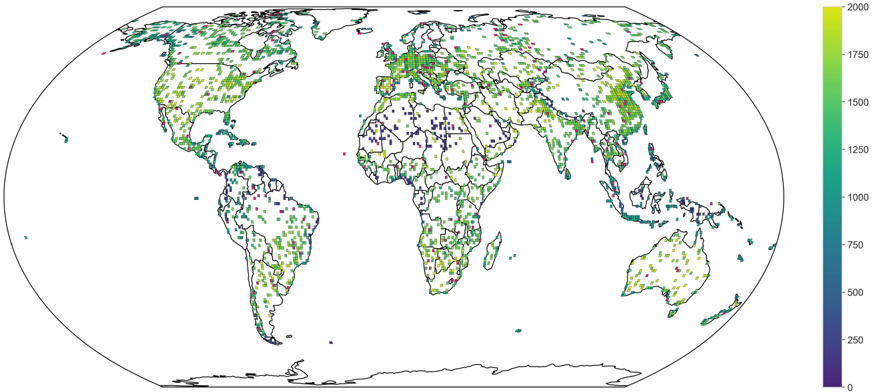
- Pretrained on 4.2M training and 46k validation 256×256 samples from NASA HLS at 30-m resolution, using four timestamps per sample; released in 300M and 600M parameter versions.
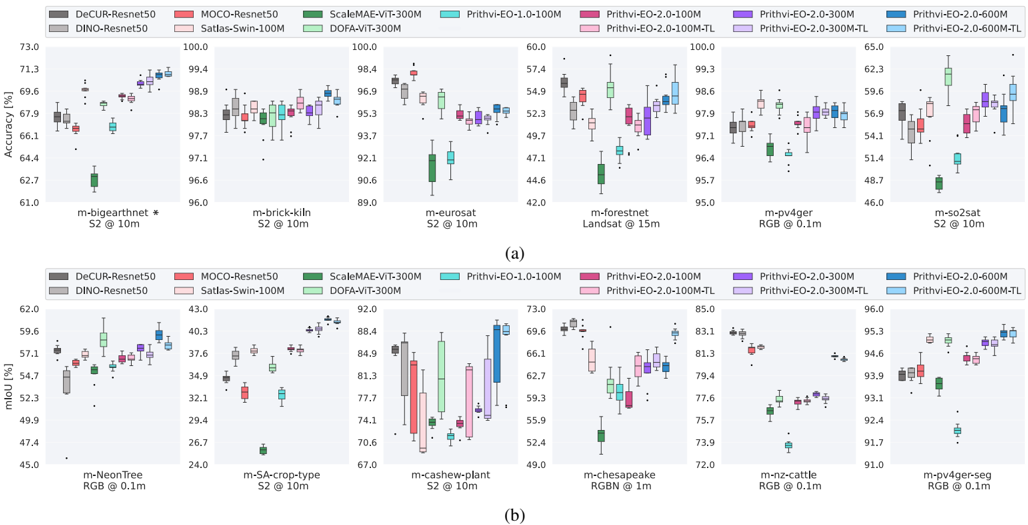
- On GEO-Bench, Prithvi-EO-2.0-600M-TL and Prithvi-EO-2.0-600M achieved the best combined performance across all 12 datasets; all Prithvi-EO-2.0 versions outperformed Prithvi-EO-1.0, with up to 8% improvement overall and a 3% overall gain for the 100M model over its predecessor.
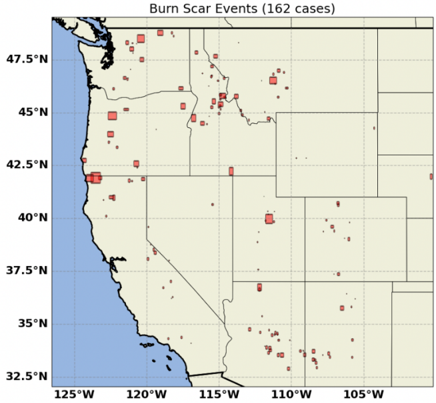
- Downstream gains include Sen1Floods11 water IoU 83.1 for Prithvi-EO-2.0-600M-TL vs. 79.6 for Prithvi-EO-1.0-100M; wildfire burn-scar IoU 83.2 vs. 76.8; L4S landslide mIoU 67.0 with only 50 training images for 600M vs. 59.7 for U-Net; US crop segmentation mIoU 50.7 vs. 42.6 for U-Net; and PASTIS 100% mIoU 53.4 vs. 52.9 for U-TAE.
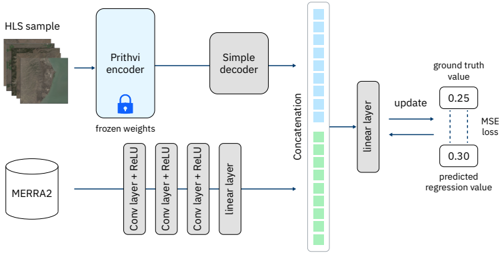
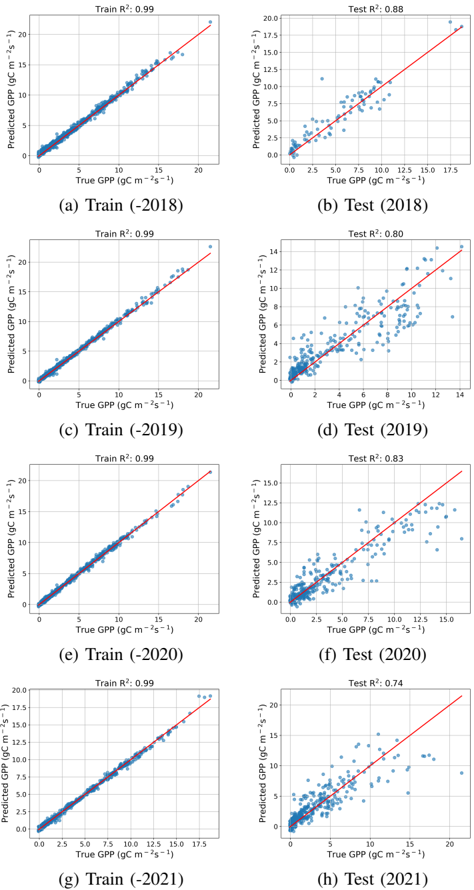
- For AGB estimation, the best Prithvi-EO-2.0-300M configuration reached test RMSE 33.40 with 12 Sentinel-2 timestamps and LoRA, while the baseline achieved 27.49; for GPP, Prithvi-EO-2.0-600M-TL reached R² up to 0.88 in 2018, outperforming random forest, XGBoost, and ResNet18 baselines.
Methods
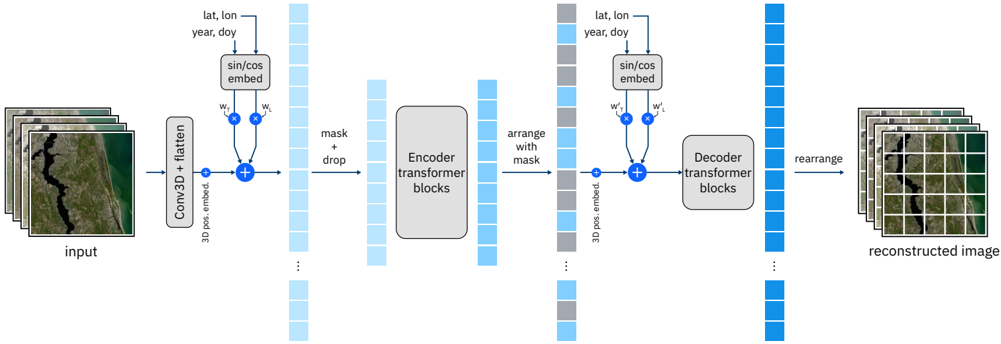
- Pretraining used a masked autoencoder with 3D patch and positional embeddings, plus learned time and location metadata biases with random dropping; models were ViT-L (300M) and ViT-H (600M), trained for 400 epochs on A100 GPUs, using 80 GPUs (~21,000 GPU-hours) for 300M and 240 GPUs (~58,000 GPU-hours) for 600M.
- The pretraining dataset was built from HLS six-band reflectance data (Blue, Green, Red, NIR, SWIR1, SWIR2) spanning 2014–2023, sampled by LULC class and ecoregion, with sequences of four images separated by one to six months, filtered for clouds and missing data, and split into 256×256 patches.
- Evaluation combined GEO-Bench benchmarking across 12 classification and segmentation datasets with 10 hyperparameter trials and 10 random seeds, plus SME-led downstream tasks in disaster response, land cover and crop mapping, and ecosystem dynamics; fine-tuning experiments required a single GPU.
Limitations
- Stated: future work is needed to compare with multimodal GFMs and to identify the benefits and limitations of incorporating additional modalities at the fine-tuning stage.
- Stated: incorporating SAR inputs did not improve biomass estimation in their setting, and adapting Prithvi-EO to SAR is challenging because of fundamental optical–SAR differences; fusing a separate SAR encoder with the pretrained Prithvi encoder could help.
- Evident: pretraining and the main benchmark are optical multispectral HLS/30-m focused, some GEO-Bench datasets lack temporal and location information, and the combined GEO-Bench score averages heterogeneous metrics (accuracy, F1, mIoU) into a single aggregate.
Model-written summary. Check it against the paper before relying on it.
Integrity signals
Registry
Cites
Statistics
Figures




Verification
Claims the paper makes
17 Valid · 9 Not valid · 3 Not checked · 125 Own results and interpretations
The sources with a verdict support this claim; the rest weren’t checked yet, have no full text we could read, or their verdicts aren’t rated yet.
In the paper
“although EO data is inherently multi-temporal, most GFMs do not account for this characteristic.”
What the sources say
- Supportedcites [4] Tseng, 2023, Lightweight, pre-trained transformers for remote sensing timeseries, arXiv:2304.14065 source
The Introduction says current self-supervised remote-sensing approaches treat the data as single-timestep images and therefore cannot use patterns that emerge when an area is monitored over time. This supports the citing sentence’s broad point that geospatial models commonly overlook EO data’s temporal character. (LLM, conf=0.88)
- Not checked — no full text of the sourcecites [5] source
plain- Asserted: passes — The authors put it forward as true.
- Checkable: passes — It can be checked against evidence.
- Load-bearing: passes — The paper’s conclusions depend on it.
- Based: passes — The paper gives a reason why it holds.
- Supported
The sources with a verdict support this claim; the rest weren’t checked yet, have no full text we could read, or their verdicts aren’t rated yet.
In the paper
“Those that do either process only point data or focus on long time series restricted to small patches or individual pixels [4], [5].”
What the sources say
- Supportedcites [4] Tseng, 2023, Lightweight, pre-trained transformers for remote sensing timeseries, arXiv:2304.14065 source
Section 3.1 (page unavailable) describes Presto’s 12-month pixel time series and says it receives single-pixel inputs. The Discussion & Conclusion (page unavailable) likewise identifies Presto as a pixel-timeseries model, supporting its use as an example of a multi-temporal model focused on individual pixels. (LLM, conf=0.88)
- Not checked — no full text of the sourcecites [5] source
plain- Asserted: passes — The authors put it forward as true.
- Checkable: passes — It can be checked against evidence.
- Load-bearing: passes — The paper’s conclusions depend on it.
- Based: passes — The paper gives a reason why it holds.
- Supported
Every source the paper cites for this claim was checked and supports it.
In the paper
“GEO-Bench offers a carefully curated collection of six classification and six semantic segmentation datasets [10], encompassing a range of spatial resolutions and domains (see Table I).”
What the sources say
- Supportedcites [10] source
The Introduction states that GEO-Bench comprises six image-classification and six semantic-segmentation tasks curated by domain experts for diversity. Table 1 in the Diversity of Tasks section lists the twelve datasets and shows differing spatial resolutions and application domains. (LLM, conf=0.94)
plain- Asserted: passes — The authors put it forward as true.
- Checkable: passes — It can be checked against evidence.
- Load-bearing: passes — The paper’s conclusions depend on it.
- Based: passes — The paper gives a reason why it holds.
- Supported
The cited sources support only part of this claim — read each source’s verdict below.
In the paper
“Through extensive benchmarking with GEO-Bench, the model outperforms the previous PrithviEO model by 8% across a range of tasks.”
What the sources say
- Partly supportedcites [10] sourceExperimental — accuracy not yet measured
Section 3 identifies GEO-Bench as a benchmark with six classification and six segmentation tasks, supporting its use as a benchmark across tasks. The experiments passage (Section 6.2.2; page unavailable) discusses other model baselines, but our copy does not report a Prithvi-EO-2.0 versus Prithvi-EO comparison or an 8% improvement; searches for those models and the figure found none. (LLM, conf=0.85)
plainstates a cause- Asserted: passes — The authors put it forward as true.
- Checkable: passes — It can be checked against evidence.
- Load-bearing: passes — The paper’s conclusions depend on it.
- Based: passes — The paper gives a reason why it holds.
- Partly supported
The sources with a verdict support this claim; the rest weren’t checked yet, have no full text we could read, or their verdicts aren’t rated yet.
In the paper
“For segmentation, Prithvi-EO-2.0-600M-TL and Prithvi-EO-2.0-600M show the highest performance, with a noticeable margin over the next best models, DeCUR [7] and DINO [12] ResNets.”
What the sources say
- Supportedcites [7] source
The citation is attached to DeCUR, identifying the model rather than sourcing the comparison with Prithvi. Sections 5.2 and 5.3 evaluate DeCUR on semantic segmentation tasks, and Section 5.3 describes transferring a ResNet50 backbone. (LLM, conf=0.91)
- Not checked — no full text of the sourcecites [12] source
plainstates an association- Asserted: passes — The authors put it forward as true.
- Checkable: passes — It can be checked against evidence.
- Load-bearing: passes — The paper’s conclusions depend on it.
- Based: passes — The paper gives a reason why it holds.
- Supported
69 more claims · 6 with their cited sources checked
Create a free account to see all 154 claims and every source verdict.
- Probably not a substantial claim. 38
- It may state two separate claims as one. 56
- The quote only partly states this claim. 3
Self-check
Percentages, sums and reported differences re-computed from the paper’s own numbers.
Each contradiction between two passages listed here was confirmed by an independent check.
Rated minor: it would not touch a result — a value no result rests on, a p-value that stays on the same side of the significance level, or a conflict that is clerical, resolved elsewhere in the paper, or outside its own findings.
In the paper
§ D. Ecosystem dynamics · p. 16
“The PrithviEO-2.0-600M-TL version achieved the highest scores among all models across all testing years.”
§ D. Ecosystem dynamics · p. 16
“| ResNet18 | 0.76 | 0.81 | 0.73 | 0.70 | | Prithvi-EO-2.0-300M | 0.84 | 0.77 | 0.77 | 0.70 | | Prithvi-EO-2.0-300M-TL | 0.84 | 0.76 | 0.74 | 0.69 | | Prithvi-EO-2.0-600M | 0.75 | 0.77 | 0.80 | 0.70 | | Prithvi-EO-2.0-600M-TL | 0.88 | 0.80 | 0.83 | 0.74 |”
Citations
Cites
Vaswani, A., Shazeer, N., Parmar, N., Uszkoreit, J., Jones, L., Gomez, A. N., Kaiser, L., & Polosukhin, I. (2017) · arXiv · doi:10.48550/arxiv.1706.03762 · Cited by 120,404 · cited 16×
“The resulting pretraining dataset includes 4.2M training and 46k validation samples, which are visualized in Figure 2.”
InfluentialU-Net: Convolutional Networks for Biomedical Image Segmentation
Ronneberger, O., Fischer, P., & Brox, T. (2015) · Lecture notes in computer science · doi:10.1007/978-3-319-24574-4_28 · Cited by 99,404 · cited 1×
“For classification tasks, all models were paired with a linear layer, while we used a U-Net architecture [16] for ResNets and UPerNet [17] decoder for transformer-based architectures, which represent the most adopted choices for these types of architectures.”
Exploiting Generative AI to Scale up Intelligent Tutoring Systems
Jakubův, J., Chvalovský, K., Goertzel, Z., Kaliszyk, C., Olšák, M., Piotrowski, B., Schulz, S., Suda, M., & Urban, J. (2023) · DROPS (Schloss Dagstuhl – Leibniz Center for Informatics) · doi:10.4230/lipics.itp.2023.19 · Cited by 76,658
An Image is Worth 16x16 Words: Transformers for Image Recognition at Scale
Dosovitskiy, A., Beyer, L., Kolesnikov, A., Weissenborn, D., Zhai, X., Unterthiner, T., Dehghani, M., Minderer, M., Heigold, G., Gelly, S., et al. (2020) · arXiv · doi:10.48550/arxiv.2010.11929 · Cited by 47,472
LoRA: Low-Rank Adaptation of Large Language Models
Hu, E. J., Shen, Y., Wallis, P., Allen-Zhu, Z., Li, Y., Wang, S., Wang, L., & Chen, W. (2021) · arXiv · doi:10.48550/arxiv.2106.09685 · Cited by 13,453 · cited 1×
“0-600M with temporal and location embeddings of 3.5 points on the IoU for the water class.”
InfluentialSelf-citationUNet++: A Nested U-Net Architecture for Medical Image Segmentation
Zhou, Z., Rahman Siddiquee, M. M., Tajbakhsh, N., & Liang, J. (2018) · Lecture Notes in Computer Science · doi:10.1007/978-3-030-00889-5_1 · Cited by 9,610 · cited 1×
“For a comparative study on the landslide mapping task, U-Net [28] and U-Net++ [29] were employed.”
Masked Autoencoders Are Scalable Vision Learners
He, K., Chen, X., Xie, S., Li, Y., Dollar, P., & Girshick, R. (2022) · 2022 IEEE/CVF Conference on Computer Vision and Pattern Recognition (CVPR) · doi:10.1109/cvpr52688.2022.01553 · Cited by 8,489 · cited 4×
“Positional embeddings are added to the full set of tokens and sent to the decoder’s series of transformer blocks to perform the image reconstruction task [9].”
InfluentialSGDR: Stochastic Gradient Descent with Warm Restarts
Loshchilov, I., & Hutter, F. (2016) · arXiv · doi:10.48550/arxiv.1608.03983 · Cited by 5,309
U-Net: Convolutional Networks for Biomedical Image SegmentationPreprint
Ronneberger, O., Fischer, P., & Brox, T. (2015) · arXiv (Cornell University) · doi:10.48550/arxiv.1505.04597 · Cited by 5,282
ViViT: A Video Vision Transformer
Arnab, A., Dehghani, M., Heigold, G., Sun, C., Lucic, M., & Schmid, C. (2021) · 2021 IEEE/CVF International Conference on Computer Vision (ICCV) · doi:10.1109/iccv48922.2021.00676 · Cited by 2,767 · cited 1×
“A full list can be found in Table 3 Table 3”
Research works printed but not linked: 1
- Napper, 2006, Burned Area Emergency Response Treatments Catalog
Cited by
The spread of non‐native species
Haubrock, P. J., Tarkan, A. S., Martín‐Forés, I., Katsanevakis, S., Sousa, R., Soto, I., Green, A. J., Kouba, A., Everts, T., Almela, V. D., et al. (2025) · Biological reviews/Biological reviews of the Cambridge Philosophical Society · doi:10.1002/brv.70121 · Cited by 43
Bai, L., Zhang, X., Qin, W., Long, J., Wang, H., Dong, X., & Du, S. (2025) · IEEE Geoscience and Remote Sensing Magazine · doi:10.1109/mgrs.2025.3588505 · Cited by 10
“0 [ 217], and A 2 -MAE [208] embed the RS location coordinates into the model training, attempting to use such a priori information to guide the model learning.”
Digital soil mapping in the era of big data and artificial Intelligence
Lin, Y., & Li, X. (2026) · Annals of GIS · doi:10.1080/19475683.2026.2665149 · Cited by 6
Longépé, N., Alemohammad, H., Anghelea, A., et al. (2025) · IEEE Geoscience and Remote Sensing Magazine · doi:10.1109/mgrs.2025.3592035 · Cited by 3
“0 [29] demonstrated a well-defined embedding space for land use/land cover classes and change detection tasks (e.g., burn scars), while PANGEA results showed that U-Net architectures with frozen backbones still outperform many general-purpose FMs, although this is not the case for the TerraMind…”
Self-citationFARM: Crop Yield Prediction via Regression on Prithvi’s Encoder for Satellite Sensing
Nejadshamsi, S., Zhang, Y., Porth, B., Zaki, S., Porth, L., & Khoshdel, V. (2026) · AgriEngineering · doi:10.3390/agriengineering8010002 · Cited by 3
“0-600M, are pre-trained on global satellite archives and provide generalizable representations that can be fine-tuned for downstream tasks, including agricultural prediction [25].”
Metadata
- Authors
- Szwarcman, D., Roy, S., Fraccaro, P., Gislason, T. E., Blumenstiel, B., Ghosal, R., de Oliveira, P. H., de Sousa Almeida, J. L., Sedona, R., Kang, Y., Chakraborty, S., Wang, S., Gomes, C., Kumar, A., Gaur, V., Truong, M., Godwin, D., Khallaghi, S., Lee, H., Hsu, C.-Y., Asanjan, A. A., Mujeci, B., Shidham, D., Balogun, R. O., Kolluru, V., Keenan, T., Arevalo, P., Li, W., Alemohammad, H., Olofsson, P., Mayer, T., Hain, C., Kennedy, R., Zadrozny, B., Bell, D., Cavallaro, G., Watson, C., Maskey, M., Ramachandran, R., & Moreno, J. B.
- Affiliations
- IBM (United States) (US)
- Marshall Space Flight Center (US)
- University of Iceland
- University of Alabama in Huntsville (US)
- IBM Research
- Forschungszentrum Jülich (DE)
- Virginia Tech (US)
- Universities Space Research Association (US)
- Arizona State University (US)
- Oregon State University (US)
- Clark University (US)
- University of California, Berkeley (US)
- Boston University
- University of Iceland (IS)
- ORCID
- Szwarcman, Daniela
- Roy, Sujit
- Fraccaro, Paolo
- Sedona, Rocco
- Kang, Yanghui
- Chakraborty, Srija
- Wang, Sizhe
- Kumar, Ankur
- Khallaghi, Sam
- Lee, Hyunho
- Hsu, Chia-Yu
- Asanjan, Ata Akbari
- Balogun, Rufai Omowunmi
- Kolluru, Venkatesh
- Keenan, Trevor
- Arevalo, Paulo
- Li, Wenwen
- Alemohammad, Hamed
- Olofsson, Pontus
- Mayer, Timothy
- Hain, Christopher
- Kennedy, Robert
- Zadrozny, Bianca
- Cavallaro, Gabriele
- Watson, Campbell
- Maskey, Manil
- Ramachandran, Rahul
- Venue
- IEEE Transactions on Geoscience and Remote Sensing
- Published
- 2026
- Volume
- 64
- Pages
- 1-20
- ISSN
- 0196-2892 (ISSN-L)
- 1558-0644
- OpenAlex
- W4417248811
- Semantic Scholar
- ac64dc7cc08ed44f1f0742b86dfd760ddf0578b3
- Cited by
- 100
- References
- 34
- Citations by year
- 2026: 81
- FWCI
- 40.73
- Type
- journal article
- Language
- en
- Open access
- hybrid
- doi.org
- Locations
- IEEE Transactions on Geoscience and Remote Sensing (publishedVersion, cc-by)
- JuSER (Forschungszentrum Jülich) (publishedVersion, other-oa)
- arXiv (Cornell University) (submittedVersion, cc-by)
- arXiv (Cornell University) (cc-by)
- Funders
- National Aeronautics and Space Administration (80MSFC22M004)
- Gauss Centre for Supercomputing e.V
- NASA (80NSSC24K1562)
- Topics
- Physical Sciences › Computer Science › Computer Vision and Pattern Recognition › Remote-Sensing Image Classification
- Physical Sciences › Environmental Science › Ecology › Remote Sensing in Agriculture
- Social Sciences › Geography, Planning and Development › Remote Sensing and Land Use
- Keywords
- geospatial foundation models, Landsat, Sentinel-2, temporal embeddings, location embeddings, high-resolution remote sensing, disaster response, land cover mapping, crop mapping, open-source models
About these checks
Registry, retraction, Cites and statistics results are computed, not judged, with one exception: a printed reference that no index lists is read once by a model before it counts as a citation error. Claims are extracted by a model and kept only when their quote appears verbatim in the text; each cited source is then checked, with a model’s help, for whether it says what the claim relies on. Those verdicts can be wrong — read the claim’s quote and the cited source before relying on one.
The claim verdicts this report counts are experimental: their accuracy is not yet measured.
A language model drew the claims from the paper on 2026-10-29, under version 3 of the claim definition (model deepseek-v4.1-flash, prompt extract-v3).
A second model labelled each claim on 2026-10-29 (model jev-1.13-20260917, definition revision gold-guideline-v0.2).
Cited sources are checked with a language model’s help (gpt-6-sol).
Statistics and arithmetic are recomputed, not judged.
Confidence bands are shown only for fields calibrated on our annotated test set. None is calibrated yet, so no band is shown.
What counts as a claim ›How we measure confidence ›How we check this ›
Are you an author, or do you see a problem with this page? Request a review
How to cite
Cite CoChat for the checks on this page, and the paper for its own findings.
- This page
- CoChat. (2026). Citation check: Prithvi-EO-2.0: A Versatile Multitemporal Foundation Model for Earth Observation Applications. https://app.cochat.ai/papers/10.1109/tgrs.2025.3642610
- The paper
- Szwarcman, D., Roy, S., Fraccaro, P., Gislason, T. E., Blumenstiel, B., Ghosal, R., de Oliveira, P. H., de Sousa Almeida, J. L., Sedona, R., Kang, Y., Chakraborty, S., Wang, S., Gomes, C., Kumar, A., Gaur, V., Truong, M., Godwin, D., Khallaghi, S., Lee, H., . . . Moreno, J. B. (2026). Prithvi-EO-2.0: A Versatile Multitemporal Foundation Model for Earth Observation Applications. IEEE Transactions on Geoscience and Remote Sensing. https://doi.org/10.1109/tgrs.2025.3642610
Data sources
Bibliographic data: Semantic Scholar, OpenAlex, Crossref.
Contains information from the Semantic Scholar Academic Graph Datasets, made available under the ODC Attribution License (ODC-BY 1.0).
Semantic Scholar’s data is described in: Kinney, R., et al. (2023). The Semantic Scholar Open Data Platform. arXiv:2301.10140.
