

Network Pharmacology Study of Bioactive Components and Molecular Mechanisms of the Glycoside Fraction from Picrorhiza scrophulariiflora Against Experimental Colitis
Open accessThe DOI matches its Crossref record; 55 of the 55 references it cites were found in a registry or an index.
Abstract
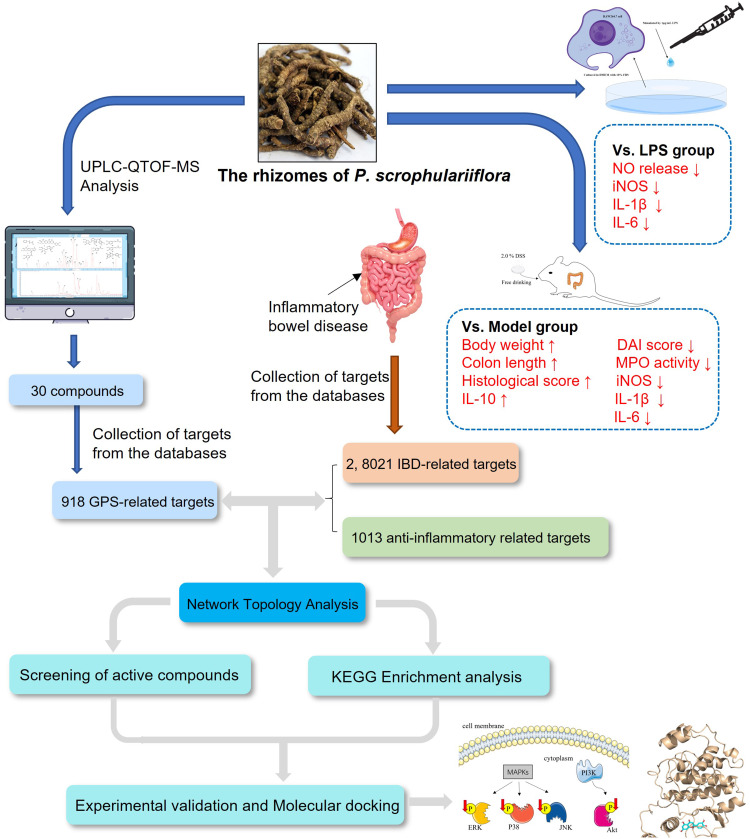
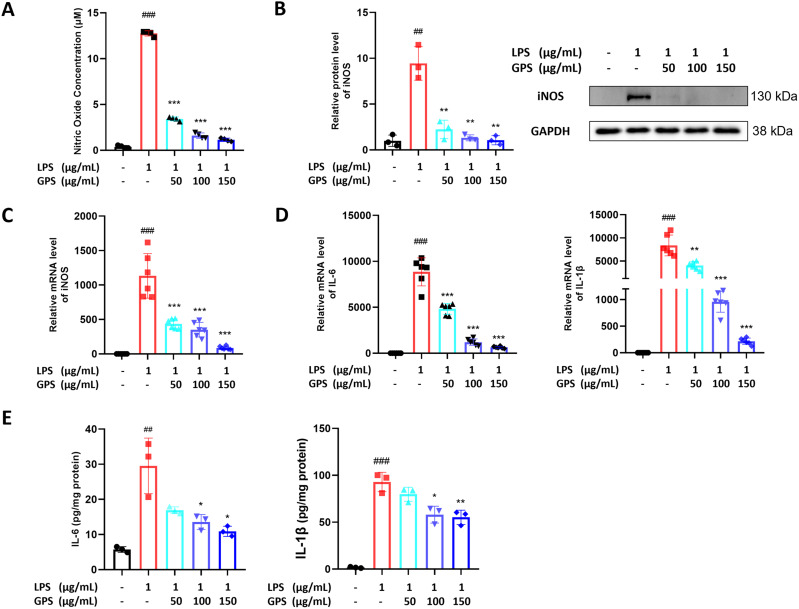
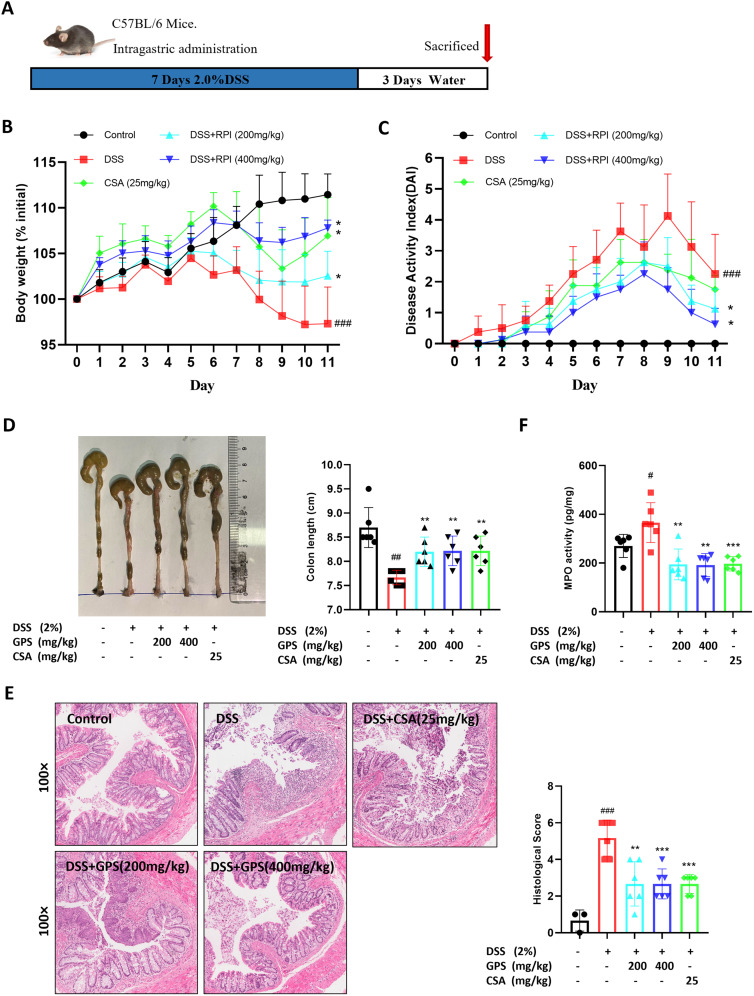
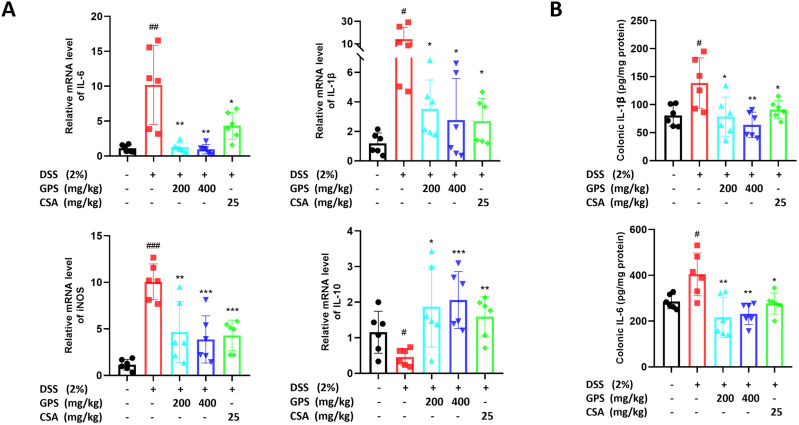
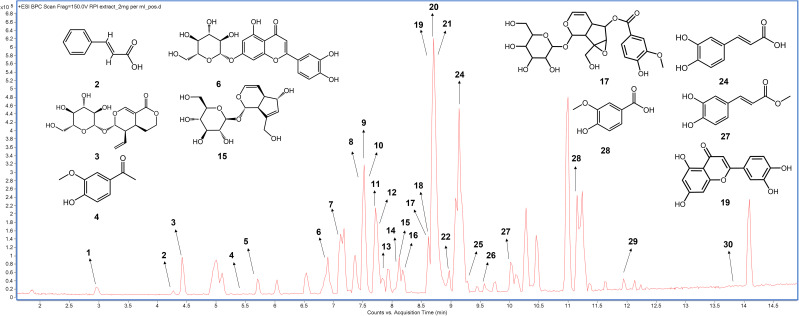
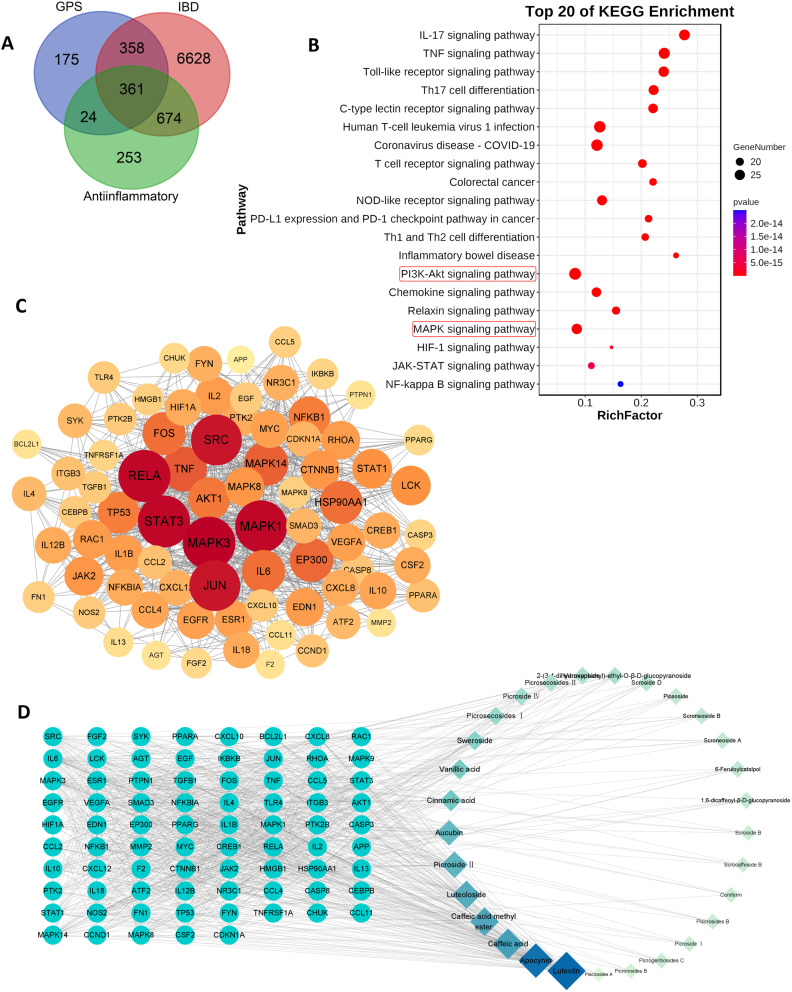
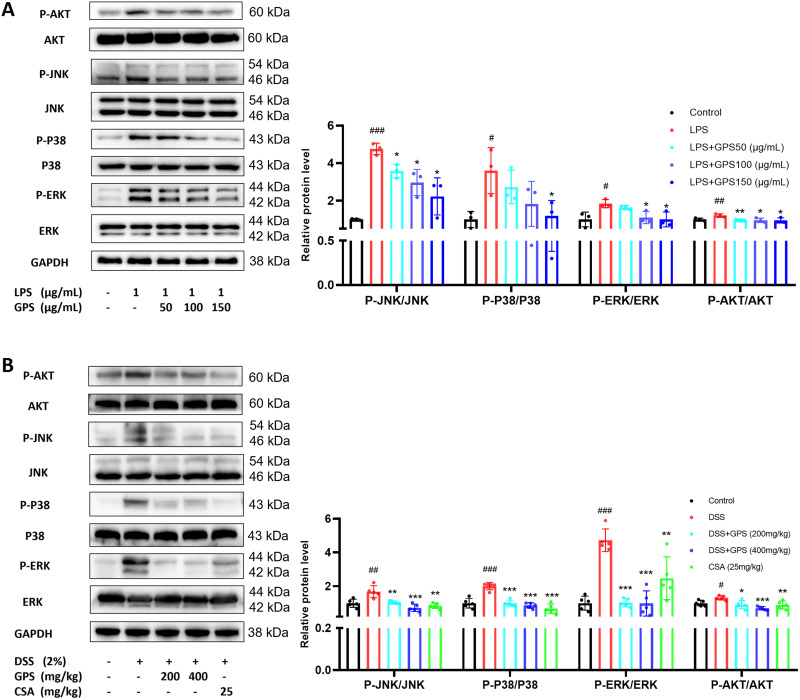
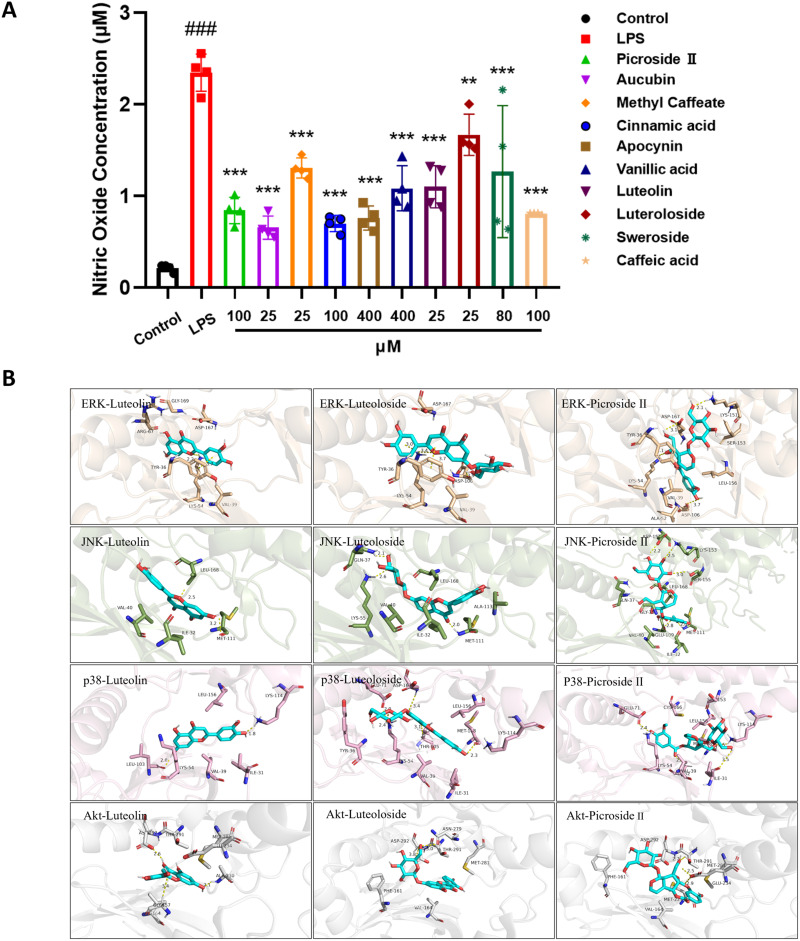
Purpose: (GPS) extract for the treatment of colitis using UPLC-QTOF-MS analysis, network pharmacology and experimental research. Methods: The active components of GPS extract were identified by UPLC-QTOF-MS analysis and extracted their targets from the databases, which was used for network pharmacology analysis. Kyoto Encyclopedia of genes and genomes (KEGG) pathway analysis was performed to discover potential therapeutic mechanisms, and the network pharmacology results were then validated by in vivo and in vitro experiments. Results: The results showed that GPS extract significantly alleviated the clinical signs of colitis, including body weight, disease activity index, colon shortening, and colon tissue damage, and inhibited the transcription and production of colonic IL-1β and IL-6 in DSS-induced colitis mice. In vitro, GPS extract also significantly suppressed nitric oxide (NO) production, iNOS expression, IL-1β and IL-6 transcription of LPS-activated RAW 264.7 cells. Network pharmacology integrated with experimental validation identified that GPS extract significantly suppressed Akt, p38, ERK, and JNK phosphorylation in vivo and in vitro, and luteolin, apocynin, caffeic acid, caffeic acid methyl ester, luteoloside, picroside II, aucubin, cinnamic acid, vanillic acid, and sweroside were the main components responsible for the anti-inflammatory effect of GPS. These findings demonstrate that the potential anti-inflammatory effect of GPS extract against colitis is achieved through suppressing PI3K/Akt and MAPK pathways, and that the abovementioned active components mainly exerted its anti-inflammatory effect. Conclusion: The therapeutic effect of GPS extract on colitis is related to PI3K/Akt and MAPK pathways, which is a promising remedy for colitis therapy.
Overview
The claims and statistics of this paper haven’t been checked yet.
Free: it reads the open-access text and checks the first 5 claims that cite a source we can check. Create a free account to check every claim.
Integrity signals
Registry
Cites
Statistics
Figures
Verification
Claims the paper makes
The claims and statistics of this paper haven’t been checked yet.
Free: it reads the open-access text and checks the first 5 claims that cite a source we can check. Create a free account to check every claim.
Claims other papers make about this one
Each is checked against this paper’s own text: does it say what the citing paper says it does?
The source backs part of the claim, not all of it — or backs it for a different population, condition or comparison.
In the citing paper
“Additionally, research has confirmed the potent anti-inflammatory effects of Picroside II, which are mediated through the regulation of the MAPK/NF-κB signaling pathway and the suppression of NLRP3 inflammasome activation. [38,39].”
From Picroside II suppresses chondrocyte pyroptosis through MAPK/NF-κB/NLRP3 signaling pathway alleviates osteoarthritis (2024) · cites this paper as [38]
Experimental — accuracy not yet measured
Self-check
Percentages, sums and reported differences re-computed from the paper’s own numbers.
The self-check needs the paper’s full text.
Citations
Cites
Macrophages in intestinal inflammation and resolution: a potential therapeutic target in IBD
Na, Y. R., Stakenborg, M., Seok, S. H., & Matteoli, G. (2019) · Nature Reviews Gastroenterology & Hepatology · doi:10.1038/s41575-019-0172-4 · Cited by 900 · cited 1×
“Activated macrophages by pathogens or inflammatory irritants secrete excessive proinflammatory cytokines to initiate the innate immune response and the consequential adaptive immune response that leads to inflammation.(35,36) Both clinical and animal studies have found that accumulated macrophages are observed in the…”
BackgroundKibble, M., Saarinen, N., Tang, J., Wennerberg, K., Mäkelä, S., & Aittokallio, T. (2015) · Natural Product Reports · doi:10.1039/c5np00005j · Cited by 489
Poornima, P., Kumar, J. D., Zhao, Q., Blunder, M., & Efferth, T. (2016) · Pharmacological Research · doi:10.1016/j.phrs.2016.06.018 · Cited by 248 · cited 1×
“It is well known that network pharmacology is a new approach based on the theory of system biology to analyze the network of biological systems and select specific signal nodes to elaborate the principle and law of the interaction between organism and drug.(41,42) Currently, network pharmacology is widely used to pred…”
BackgroundMacrophage immunometabolism in inflammatory bowel diseases: From pathogenesis to therapy
Pan, X., Zhu, Q., Pan, L.-L., & Sun, J. (2022) · Pharmacology & Therapeutics · doi:10.1016/j.pharmthera.2022.108176 · Cited by 243 · cited 1×
“Activated macrophages by pathogens or inflammatory irritants secrete excessive proinflammatory cytokines to initiate the innate immune response and the consequential adaptive immune response that leads to inflammation.(35,36) Both clinical and animal studies have found that accumulated macrophages are observed in the…”
BackgroundLiu, J., Liu, J., Tong, X., Peng, W., Wei, S., Sun, T., Wang, Y., Zhang, B., & Li, W. (2021) · Drug Design, Development and Therapy · doi:10.2147/dddt.s319786 · Cited by 241 · cited 1×
“0 kcal/mol, indicate a certain, good, or strong binding activity, respectively.(29) Finally, PyMOL-2.”
Sann, H., Erichsen, J. V., Hessmann, M., Pahl, A., & Hoffmeyer, A. (2013) · Life Sciences · doi:10.1016/j.lfs.2013.01.028 · Cited by 200
Wan, F., Zhong, R., Wang, M., Zhou, Y., Chen, Y., Yi, B., Hou, F., Liu, L., Zhao, Y. M., Chen, L., et al. (2021) · Frontiers in Microbiology · doi:10.3389/fmicb.2021.784211 · Cited by 174
The Beneficial Effect of Vanillic Acid on Ulcerative Colitis
Kim, S.-J., Kim, M.-C., Um, J.-Y., & Hong, S.-H. (2010) · Molecules · doi:10.3390/molecules15107208 · Cited by 173
Dietary interventions for induction and maintenance of remission in inflammatory bowel disease
Limketkai, B. N., Iheozor-Ejiofor, Z., Gjuladin-Hellon, T., Parian, A., Matarese, L. E., Bracewell, K., MacDonald, J. K., Gordon, M., & Mullin, G. E. (2019) · Cochrane Database of Systematic Reviews · doi:10.1002/14651858.cd012839.pub2 · Cited by 171 · cited 1×
“abovementioned IBD treatments have obvious defects, such as high side effects, high cost, repeated recurrence, and even aggravation.(5,6) Developing novel therapeutic strategies aimed at achieving durable clinical remission in the absence”
BackgroundXu, H., Zhang, Y., Wang, P., Zhang, J., Chen, H., Zhang, L., Du, X., Zhao, C., Wu, D., Liu, F., et al. (2021) · Acta Pharmaceutica Sinica B · doi:10.1016/j.apsb.2021.03.024 · Cited by 162 · cited 2×
“It is well known that network pharmacology is a new approach based on the theory of system biology to analyze the network of biological systems and select specific signal nodes to elaborate the principle and law of the interaction between organism and drug.41,42 Currently, network pharmacology is widely used to predic…”
Background
Research works printed but not linked: 1
- Zhang N, Wei DZ, Liu JW, Xin XJ. inventors; Methods for enrichment of iridoid glycosides in Picrocotyl Rhizoma. China Patent Application. 2022; 1: 76.
Cited by
Ashraf, M. V., Khan, S., Misri, S., Gaira, K. S., Rawat, S., Rawat, B., Khan, M. A. H., Shah, A. A., Asgher, M., & Ahmad, S. (2024) · Pharmaceuticals · doi:10.3390/ph17080975 · Cited by 102
Sweroside: unveiling broad therapeutic potential—from mechanistic insights to clinical potential
Peng, L., Zuo, M., Qiu, T. A., Lan, W., Wen, Y., & Ye, X. (2025) · Frontiers in Pharmacology · doi:10.3389/fphar.2025.1594278 · Cited by 18
Wang, F., Xiao, J., Li, M., He, Q., Wang, X., Pan, Z., Li, S., Wang, H., & Zhou, C. (2024) · PLOS ONE · doi:10.1371/journal.pone.0308731 · Cited by 12
Picroside II as a Potential Anti-Inflammatory Agent
Ren, Y., Liu, Z., Wei, L., Wang, Y., Wang, Y., Guo, Y., & Ma, Z. (2026) · Pharmaceutics · doi:10.3390/pharmaceutics18040499 · Cited by 3
“Wu et al. [60] employed UPLC-QTOF-MS, network pharmacology, and experimental validation to investigate the anti-inflammatory mechanisms of the glucoside fraction of Picrorhiza scrophulariiflora Pennell extract against colitis.”
Kim, A., Kim, S. Y., Jo, K., Son, E., Kim, C., Kim, D.-S., Hwang, Y., & Lee, Y. M. (2025) · Frontiers in Pharmacology · doi:10.3389/fphar.2025.1672111 · Cited by 2
Metadata
- Authors
- Wu, P., Chang, C., Zhu, G., Zhai, L., Zhang, X., Huan, Q., Gao, Z., Deng, H., Liang, Y., & Xiao, H.
- Affiliations
- Guiyang Medical University (CN)
- Hong Kong Baptist University (HK)
- Shenzhen University (CN)
- Peking University Shenzhen Hospital (CN)
- Corresponding author
- Liang, Yue
- Xiao, Haitao
- Venue
- Drug Design, Development and Therapy
- Publisher
- Informa UK Limited
- Published
- 2023-05
- Volume
- Volume 17
- Pages
- 1531-1546
- ISSN
- 1177-8881 (ISSN-L)
- PMC
- PMC10224697
- OpenAlex
- W4378086243
- Cited by
- 7
- References
- 55
- Citations by year
- 2025: 4 · 2024: 2 · 2023: 1
- FWCI
- 1.16
- Type
- journal article
- Language
- en
- Open access
- gold
- doi.org
- Licence
- Locations
- Drug Design Development and Therapy (publishedVersion, cc-by-nc)
- PubMed Central (publishedVersion, cc-by-nc)
- PubMed (publishedVersion)
- Dove Medical Press (Taylor and Francis Group) (submittedVersion, cc-by-nc)
- Funders
- Shenzhen Municipal Science and Technology Innovation Council
- Topics
- Health Sciences › Medicine › Gastroenterology › Inflammatory Bowel Disease
- Life Sciences › Agricultural and Biological Sciences › Plant Science › Phytochemistry and biological activity of medicinal plants
- Health Sciences › Medicine › Complementary and alternative medicine › Natural Compounds in Disease Treatment
- Keywords
- Picrorhiza scrophulariiflora, experimental colitis, DSS-induced colitis, anti-inflammatory activity, bioactive compounds, luteolin, picroside II, aucubin, PI3K/Akt signaling, MAPK signaling, IL-1β, interleukin-6, nitric oxide, RAW 264.7 macrophages, KEGG pathway enrichment
- MeSH terms
- Network Pharmacology, Animals, Anti-Inflammatory Agents, Colitis, Drugs, Chinese Herbal, Glycosides, Interleukin-6, Phosphatidylinositol 3-Kinases, Picrorhiza, Proto-Oncogene Proteins c-akt, Mice
About these checks
Registry, retraction, Cites and statistics results are computed, not judged, with one exception: a printed reference that no index lists is read once by a model before it counts as a citation error. Claims are extracted by a model and kept only when their quote appears verbatim in the text; each cited source is then checked, with a model’s help, for whether it says what the claim relies on. Those verdicts can be wrong — read the claim’s quote and the cited source before relying on one.
Statistics and arithmetic are recomputed, not judged.
Confidence bands are shown only for fields calibrated on our annotated test set. None is calibrated yet, so no band is shown.
What counts as a claim ›How we measure confidence ›How we check this ›
Are you an author, or do you see a problem with this page? Request a review
How to cite
Cite CoChat for the checks on this page, and the paper for its own findings.
- This page
- CoChat. (2026). Citation check: Network Pharmacology Study of Bioactive Components and Molecular Mechanisms of the Glycoside Fraction from Picrorhiza scrophulariiflora Against Experimental Colitis. https://app.cochat.ai/papers/10.2147/dddt.s407339
- The paper
- Wu, P., Chang, C., Zhu, G., Zhai, L., Zhang, X., Huan, Q., Gao, Z., Deng, H., Liang, Y., & Xiao, H. (2023). Network Pharmacology Study of Bioactive Components and Molecular Mechanisms of the Glycoside Fraction from Picrorhiza scrophulariiflora Against Experimental Colitis. Drug Design, Development and Therapy. https://doi.org/10.2147/dddt.s407339
Data sources
Bibliographic data: Semantic Scholar, OpenAlex, Crossref.
Contains information from the Semantic Scholar Academic Graph Datasets, made available under the ODC Attribution License (ODC-BY 1.0).
Semantic Scholar’s data is described in: Kinney, R., et al. (2023). The Semantic Scholar Open Data Platform. arXiv:2301.10140.
