

The DOI matches its Crossref record.
Visceral Adiposity Index and Lipid Accumulation Product as Effective Markers of Different Obesity Phenotypes in Korean Adults: A Cross-Sectional Analysis
Open accessAbstract
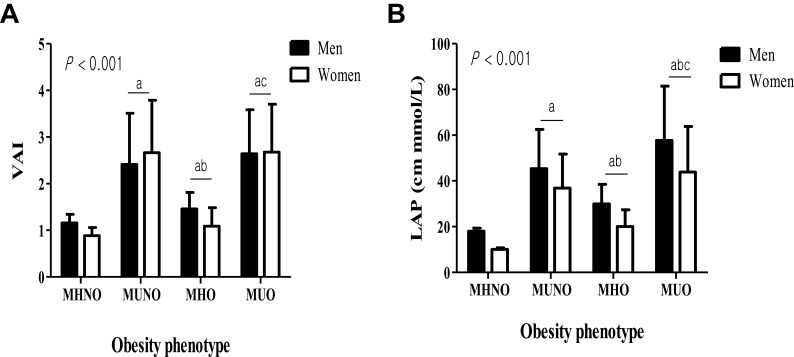
Purpose: The visceral adiposity index (VAI) and lipid accumulation product (LAP) are useful for assessing visceral obesity. However, these indices were developed for Caucasians, and it is necessary to confirm whether the VAI and LAP are appropriate indicators for identifying obesity phenotypes in Asians. This study investigated whether the VAI and LAP are effective indicators for diagnosing four obesity phenotypes in South Korean adults. Patients and Methods: This cross-sectional study enrolled 23,310 adult participants (age ≥20 years) who had undergone a health checkup at a general hospital in Gyeonggi-do, South Korea from January 2017 to December 2020. VAI and LAP were calculated based on the presented mathematical model according to sex. According to the metabolic health status and presence or absence of obesity, the obesity phenotypes were classified into 4 groups: metabolically healthy non-obese (N=14,240, 61.1%), metabolically unhealthy non-obese (N=477, 2.0%), metabolically healthy obese (MHO; N=6796, 29.2%), and metabolically unhealthy obesity (MUO; N=1797, 7.7%). Results: The receiver operating characteristics curve analysis showed VAI best predicted MUO among the four obesity phenotypes, whereas the LAP showed excellent discriminating ability for the MUO group (area under the curve 0.877, 0.849, and 0.921 and 0.923, 0.907, and 0.954 for all participants, men, and women, respectively). The optimal VAI cutoff values for identifying the MUO group were 1.83 in men and 1.58 in women, and the optimal cutoff values for the LAP were 41.45 in men and 23.83 in women, with a higher value for men. After adjusting for potential confounding factors, the VAI and LAP were associated with an increased risk in the MHO and MUO groups among the obesity phenotypes in both sexes. Conclusion: In South Korean adults, the VAI and LAP are closely related to the MUO phenotype in both sexes and are effective indices for predicting the MUO phenotype.
Overview
The claims and statistics of this paper haven’t been checked yet.
Run the check — free, no account needed. It reads the open-access text and checks the sources it cites.
Integrity signals
Registry
Cites
Statistics
Figures
Verification
Claims the paper makes
The claims and statistics of this paper haven’t been checked yet.
Run the check — free, no account needed. It reads the open-access text and checks the sources it cites.
Claims other papers make about this one
Each is checked against this paper’s own text: does it say what the citing paper says it does?
The source backs part of the claim, not all of it — or backs it for a different population, condition or comparison.
In the citing paper
“The VAI is an established marker of abdominal obesity and IR, integrating WC, triglyceride (TG) levels, and high-density lipoprotein cholesterol (HDL-C) to predict metabolic risk.”
From Visceral and Dysfunctional Adiposity Indices as Predictors of Insulin Resistance and Metabolic Syndrome in Women with Polycystic Ovary Syndrome: A Cross-Sectional Study (2025) · cites this paper as [9]
Experimental — accuracy not yet measuredThe source backs part of the claim, not all of it — or backs it for a different population, condition or comparison.
In the citing paper
“Similarly, the DAI has been developed as a more specific measure of adipose tissue dysfunction by combining WC, BMI, TG levels, and HDL-C [9,10,11].”
From Visceral and Dysfunctional Adiposity Indices as Predictors of Insulin Resistance and Metabolic Syndrome in Women with Polycystic Ovary Syndrome: A Cross-Sectional Study (2025) · cites this paper as [9]
Experimental — accuracy not yet measured
Self-check
Percentages, sums and reported differences re-computed from the paper’s own numbers.
The self-check needs the paper’s full text.
Citations
Cites
Still being checked.
Research works printed but not linked: 34
- Stefan, 2008, Arch Intern Med, 168, 1609, 10.1001/archinte.168.15.1609 · DOI · Paper page
- Khandekar, 2011, Nat Rev Cancer, 11, 886, 10.1038/nrc3174 · DOI
- Kahn, 2006, Nature, 444, 840, 10.1038/nature05482 · DOI · Paper page
- Van Gaal, 2006, Nature, 444, 875, 10.1038/nature05487 · DOI · Paper page
- Flegal, 2013, JAMA, 309, 71, 10.1001/jama.2012.113905 · DOI · Paper page
- Beleigoli, 2012, PLoS One, 7, e52111, 10.1371/journal.pone.0052111 · DOI
- Karelis, 2008, Lancet, 372, 1281, 10.1016/S0140-6736(08)61531-7 · DOI
- Hinnouho, 2013, Diabetes Care, 36, 2294, 10.2337/dc12-1654 · DOI
- Liu, 2019, Obes Facts, 12, 78, 10.1159/000495852 · DOI
- Phillips, 2013, PLoS One, 8, e76188, 10.1371/journal.pone.0076188 · DOI
- Du, 2015, Acta Diabetol, 52, 855, 10.1007/s00592-015-0715-2 · DOI
- Hwang, 2015, Int J Obes, 39, 1365, 10.1038/ijo.2015.75 · DOI
- Aydin, 2013, Eur Rev Med Pharmacol Sci, 17, 2295
- Biyik, 2019, Eur Rev Med Pharmacol Sci, 23, 2167
- Amato, 2010, Diabetes Care, 33, 920, 10.2337/dc09-1825 · DOI · Paper page
- Kahn, 2005, BMC Cardiovasc Disord, 5, 26, 10.1186/1471-2261-5-26 · DOI
- Bozorgmanesh, 2010, Lipids Health Dis, 9, 100, 10.1186/1476-511X-9-100 · DOI · Paper page
- Zhang, 2016, Int J Environ Res Public Health, 13, 428, 10.3390/ijerph13040428 · DOI
- Gordon-Larsen, 2013, Obesity, 21, E166, 10.1002/oby.20409 · DOI
- Moon, 2010, J Prev Med Public Health, 43, 213, 10.3961/jpmph.2010.43.3.213 · DOI
- Expert Panel on Detection, Evaluation, and Treatment of High Blood Cholesterol in Adults. Executive summary of the third report of The National Cholesterol Education Program (NCEP) expert panel on detection, evaluation, and treatment of high blood cholesterol in adults (Adult Treatment Panel III). JAMA. 2001;285:2486–2497. · DOI · Paper page
- WHO Expert Consultation. Appropriate body-mass index for Asian populations and its implications for policy and intervention strategies. Lancet. 2004;363:157–163. · DOI · Paper page
- Ozcelik, 2016, Eur Rev Med Pharmacol Sci, 20, 2475
- Hou, 2013, PLoS One, 8, e57319, 10.1371/journal.pone.0057319 · DOI
- Primeau, 2011, Int J Obes, 35, 971, 10.1038/ijo.2010.216 · DOI
- Choi, 2019, Korean J Fam Med, 40, 176, 10.4082/kjfm.18.0139 · DOI
- Park, 2001, Obes Res, 9, 381, 10.1038/oby.2001.49 · DOI
- Caterson, 2002, Best Pract Res Clin Endocrinol Metab, 16, 595, 10.1053/beem.2002.0228 · DOI
- Abruzzese, 2017, Horm Metab Res, 49, 23
- Ferreira, 2019, Public Health Nutr, 22, 1545, 10.1017/S136898001800335X · DOI
- Janghorbani, 2017, High Blood Press Cardiovasc Prev, 24, 157, 10.1007/s40292-017-0186-3 · DOI
- Shin, 2019, Diabetes Metab Syndr Obes, 12, 2251, 10.2147/DMSO.S217628 · DOI
- Motamed, 2016, J Endocrinol Invest, 39, 375, 10.1007/s40618-015-0369-5 · DOI
- Kahn, 2008, Int J Obes, 32, 136, 10.1038/sj.ijo.0803697 · DOI
Cited by
Sorted by citations
Keyif, B., & Yavuzcan, A. (2025) · Medicina · doi:10.3390/medicina61030424 · Cited by 11
Metadata
- Authors
- Yu, S. R., & Shin, K.-A.
- Affiliations
- Semyung University (KR)
- Shinsung University (KR)
- Corresponding author
- Shin, Kyung-A
- ORCID
- Shin, Kyung-A
- Venue
- Diabetes, Metabolic Syndrome and Obesity
- Publisher
- Informa UK Limited
- Published
- 2023-02
- Volume
- Volume 16
- Pages
- 495-504
- ISSN
- 1178-7007 (ISSN-L)
- PMC
- PMC9942502
- OpenAlex
- W4321255137
- Cited by
- 13
- References
- 0
- Citations by year
- 2026: 2 · 2025: 9 · 2024: 1 · 2023: 1
- FWCI
- 2.67
- Type
- journal article
- Language
- en
- Open access
- gold
- doi.org
- Licence
- Locations
- Diabetes Metabolic Syndrome and Obesity (publishedVersion, cc-by-nc)
- PubMed Central (publishedVersion, cc-by-nc)
- PubMed (publishedVersion)
- Dove Medical Press (Taylor and Francis Group) (submittedVersion, cc-by-nc)
- Topics
- Health Sciences › Medicine › Endocrinology, Diabetes and Metabolism › Diabetes, Cardiovascular Risks, and Lipoproteins
- Health Sciences › Medicine › Physiology (medical) › Body Composition Measurement Techniques
- Health Sciences › Medicine › Endocrinology, Diabetes and Metabolism › Adipokines, Inflammation, and Metabolic Diseases
- Keywords
- visceral adiposity index, lipid accumulation product, obesity phenotypes, metabolically healthy obesity, metabolically unhealthy obesity, visceral obesity, Asian adults, Korean adults, cut-off values, sex differences, metabolic health
About these checks
Registry, retraction, Cites and statistics results are computed, not judged, with one exception: a printed reference that no index lists is read once by a model before it counts as a citation error. Claims are extracted by a model and kept only when their quote appears verbatim in the text; each cited source is then checked, with a model’s help, for whether it says what the claim relies on. Those verdicts can be wrong — read the claim’s quote and the cited source before relying on one.
Statistics and arithmetic are recomputed, not judged.
Confidence bands are shown only for fields calibrated on our annotated test set. None is calibrated yet, so no band is shown.
What counts as a claim ›How we measure confidence ›How we check this ›
Are you an author, or do you see a problem with this page? Request a review
