

Multidisciplinary Care of Patients with Inherited Metabolic Diseases and Epilepsy: Current Perspectives
Open accessThe DOI matches its Crossref record; 85 of the 85 references it cites were found in a registry or an index.
Abstract
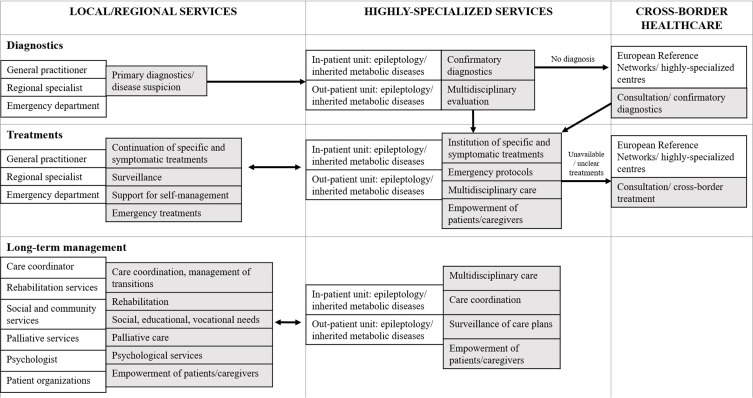
More than 650 inherited metabolic diseases may present with epilepsy or seizures. These diseases are often multisystem, life-long and induce complex needs of patients and families. Multidisciplinary care involves all stages of disease management: diagnostics, specific or symptomatic, acute and chronic treatments, and integrated care that takes into account not only medical, but also manifold psychosocial, educational, vocational and other needs of patients and their caregivers. Care coordination is indispensable to ensure smooth transitions of care across life and disease stages, including management of emergencies, transition from pediatric to adult services and palliative care. Care pathways are highly diverse and have to find the right balance between highly specialized and locally provided services. While multidisciplinary teams consist of many professionals, a named supervising physician in a highly specialized healthcare setting and a care coordinator are highly important. As the greatest burden of care always falls onto the shoulders of patients and/or families, patient empowerment should be a part of every care pathway and include provision of required information, involvement into common decision-making, patient's and family's education, support for self-management, liaison with peer support groups and emotional/ psychological support. Due to the rarity and complexity of these diseases, sufficient expertise may not be available in a national healthcare system and cross-border services (virtual or physical) in the recently developed European Reference Networks should be ensured through the proper organization of referral systems in each EU and EEA country. Finally, digital technologies are particularly important in the provision of services for patients with rare diseases and can significantly increase the availability of highly specialized services and expertise.
Overview
The claims and statistics of this paper haven’t been checked yet.
Free: it reads the open-access text and checks the first 5 claims that cite a source we can check. Create a free account to check every claim.
Integrity signals
Registry
Cites
Statistics
Figures
Verification
Claims the paper makes
The claims and statistics of this paper haven’t been checked yet.
Free: it reads the open-access text and checks the first 5 claims that cite a source we can check. Create a free account to check every claim.
Claims other papers make about this one
Each is checked against this paper’s own text: does it say what the citing paper says it does?
The source backs part of the claim, not all of it — or backs it for a different population, condition or comparison.
In the citing paper
“In children with inherited metabolic disease, the elementary healthcare provider is commonly either a pediatric neurologist or a metabolic pediatrician.”
From State of the Art and Challenges in Epilepsy—A Narrative Review (2023) · cites this paper as [43]
Experimental — accuracy not yet measuredThe cited source says what the claim attributes to it.
In the citing paper
“While in the changeover from pediatric to adult neurologist, the biggest issue may be exaggerated patient and/or family anxiety, which is entirely resolved with proper coordination, the transition between metabolic medicine specialists is usually difficult due to a deficit of adult specialists in this domain [43].”
From State of the Art and Challenges in Epilepsy—A Narrative Review (2023) · cites this paper as [43]
The cited source says what the claim attributes to it.
In the citing paper
“While in the changeover from pediatric to adult neurologist, the biggest issue may be exaggerated patient and/or family anxiety, which is entirely resolved with proper coordination, the transition between metabolic medicine specialists is usually difficult due to a deficit of adult specialists in this domain [43].”
From State of the Art and Challenges in Epilepsy—A Narrative Review (2023) · cites this paper as [43]
Self-check
Percentages, sums and reported differences re-computed from the paper’s own numbers.
The self-check needs the paper’s full text.
Citations
Cites
ILAE official report: a practical clinical definition of epilepsy
Fisher, R. S., Acevedo, C., Arzimanoglou, A., Bogacz, A., Cross, J. H., Elger, C. E., Engel, J., Forsgren, L., French, J. A., Glynn, M., et al. (2014) · Epilepsia · doi:10.1111/epi.12550 · Cited by 6,108
Fisher, R. S., Boas, W. V. E., Blume, W., Elger, C., Genton, P., Lee, P., & Engel, J. (2005) · Epilepsia · doi:10.1111/j.0013-9580.2005.66104.x · Cited by 3,671
Transition from child-centered to adult health-care systems for adolescents with chronic conditions
Blum, R. W., Garell, D., Hodgman, C. H., Jorissen, T. W., Okinow, N. A., Orr, D. P., & Slap, G. B. (1993) · Journal of Adolescent Health · doi:10.1016/1054-139x(93)90143-d · Cited by 1,533
Pediatric Self-management: A Framework for Research, Practice, and Policy
Modi, A. C., Pai, A. L., Hommel, K. A., Hood, K. K., Cortina, S., Hilliard, M. E., Guilfoyle, S. M., Gray, W. N., & Drotar, D. (2012) · Pediatrics · doi:10.1542/peds.2011-1635 · Cited by 560
An international classification of inherited metabolic disorders (ICIMD)
Ferreira, C. R., Rahman, S., Keller, M., Zschocke, J., & ICIMD Advisory Group (2021) · Journal of Inherited Metabolic Disease · doi:10.1002/jimd.12348 · Cited by 346
Epilepsy in pregnancy and reproductive outcomes: a systematic review and meta-analysis
Viale, L., Allotey, J., Cheong-See, F., Arroyo-Manzano, D., Mccorry, D., Bagary, M., Mignini, L., Khan, K. S., Zamora, J., & Thangaratinam, S. (2015) · The Lancet · doi:10.1016/s0140-6736(15)00045-8 · Cited by 306
INTERNATIONAL LEAGUE AGAINST EPILEPSY.: STATISTICS from England relative to EPILEPSY,
TURNER, W. A. (1913) · Epilepsia · doi:10.1111/j.1528-1157.1913.tb03091.x · Cited by 276
The Care Pathway Concept: concepts and theories: an introduction
Schrijvers, G., Hoorn, A. V., & Huiskes, N. (2012) · International Journal of Integrated Care · doi:10.5334/ijic.812 · Cited by 263
Disorders affecting vitamin B6 metabolism
Wilson, M. P., Plecko, B., Mills, P. B., & Clayton, P. T. (2019) · Journal of Inherited Metabolic Disease · doi:10.1002/jimd.12060 · Cited by 262
Loeber, J. G., Platis, D., Zetterström, R. H., Almashanu, S., Boemer, F., Bonham, J. R., Borde, P., Brincat, I., Cheillan, D., Dekkers, E., et al. (2021) · International Journal of Neonatal Screening · doi:10.3390/ijns7010015 · Cited by 243
Research works printed but not linked: 1
- NICE Citizens Council. Ultra Orphan Drugs. Citizens Council Reports No. 4. London: National Institute for Health and Care Excellence (NICE); 2004. 28230958
Cited by
State of the Art and Challenges in Epilepsy—A Narrative Review
Manole, A., Sirbu, C., Mititelu, M., Vasiliu, O., Lorusso, L., Sirbu, O., & Ionita Radu, F. (2023) · Journal of Personalized Medicine · doi:10.3390/jpm13040623 · Cited by 93
“metabolic medicine specialists is usually difficult due to a deficit of adult specialists in this domain [43].”
BackgroundSelf-management education for children with epilepsy and their caregivers. A scoping review
Leviton, A., Patel, A. D., & Loddenkemper, T. (2023) · Epilepsy & Behavior · doi:10.1016/j.yebeh.2023.109232 · Cited by 29
Chen, S., Zhao, L., Jin, X., Liu, Q., Xiao, Y., & Xu, H. (2025) · CNS Neuroscience & Therapeutics · doi:10.1111/cns.70238 · Cited by 24
“The pathogenesis of epilepsy is multifaceted, encompassing ge-netic factors and triggers such as brain and systemic diseases [3, 4].”
Spanos, S., Hutchinson, K., Ryder, T., Rapport, F., Goodwin, N., & Zurynski, Y. A. (2024) · International Journal of Integrated Care · doi:10.5334/ijic.7659 · Cited by 23
“Seven articles discussed the role of strong communication and knowledge exchange with PLWE and families [6, 19, 25, 33, 40, 44, 49].”
InfluentialIntegrated Approach to Diagnosis and Treatment in Clinical Medicine: Search for Optimal Solutions
Oliinyk, Y. O., Мальцев, Д. В., Shydlovska, O. A., Rudenko, M. L., & Savitskaya, M. (2024) · Journal of Pioneering Medical Science · doi:10.61091/jpms202413103 · Cited by 8
“These studies provide insights that are applicable on a global scale and shed light on the usefulness of integrating healthcare principles into the management of diverse diseases [35]–[37].”
Background
Metadata
- Authors
- Tumienė, B., del Toro Riera, M., Grikiniene, J., Samaitienė-Aleknienė, R., Praninskienė, R., Monavari, A. A., & Sykut-Cegielska, J.
- Affiliations
- Vilnius University (LT)
- University College Dublin (IE)
- Instytut Matki i Dziecka (PL)
- Venue
- Journal of Multidisciplinary Healthcare
- Publisher
- Informa UK Limited
- Published
- 2022-03
- Volume
- Volume 15
- Pages
- 553-566
- ISSN
- 1178-2390 (ISSN-L)
- PMC
- PMC8977775
- OpenAlex
- W4220781734
- Semantic Scholar
- 3aecaf5962ea15d7f2e60a4e67c99b661dce69e3
- Cited by
- 16
- References
- 85
- Citations by year
- 2026: 2 · 2025: 7 · 2024: 4 · 2023: 2 · 2022: 1
- FWCI
- 0.42
- Type
- journal article
- Language
- en
- Open access
- gold
- doi.org
- Licence
- Locations
- Journal of Multidisciplinary Healthcare (publishedVersion, cc-by-nc)
- PubMed Central (publishedVersion, cc-by-nc)
- PubMed (publishedVersion)
- Funders
- European Commission (ERN-2016, ERN-2016-Framework)
- Topics
- Life Sciences › Biochemistry, Genetics and Molecular Biology › Clinical Biochemistry › Metabolism and Genetic Disorders
- Health Sciences › Medicine › Clinical Neurology › Epilepsy research and treatment
- Life Sciences › Biochemistry, Genetics and Molecular Biology › Genetics › Genomics and Rare Diseases
- Keywords
- inborn errors of metabolism, epilepsy, seizures, multidisciplinary care, care coordination, transition to adult care, palliative care, care pathways, care coordinators, patient empowerment, family caregivers, psychosocial support, European Reference Networks, rare diseases, digital health technologies, referral systems
About these checks
Registry, retraction, Cites and statistics results are computed, not judged, with one exception: a printed reference that no index lists is read once by a model before it counts as a citation error. Claims are extracted by a model and kept only when their quote appears verbatim in the text; each cited source is then checked, with a model’s help, for whether it says what the claim relies on. Those verdicts can be wrong — read the claim’s quote and the cited source before relying on one.
Statistics and arithmetic are recomputed, not judged.
Confidence bands are shown only for fields calibrated on our annotated test set. None is calibrated yet, so no band is shown.
What counts as a claim ›How we measure confidence ›How we check this ›
Are you an author, or do you see a problem with this page? Request a review
Data sources
Bibliographic data: Semantic Scholar, OpenAlex, Crossref.
Contains information from the Semantic Scholar Academic Graph Datasets, made available under the ODC Attribution License (ODC-BY 1.0).
Semantic Scholar’s data is described in: Kinney, R., et al. (2023). The Semantic Scholar Open Data Platform. arXiv:2301.10140.
