

Modeling the transition from acute to chronic postsurgical pain in youth: A narrative review of epidemiologic, perioperative, and psychosocial factors
Open accessThe DOI matches its Crossref record; 42 of the 43 references it cites were found in a registry or an index.
Abstract
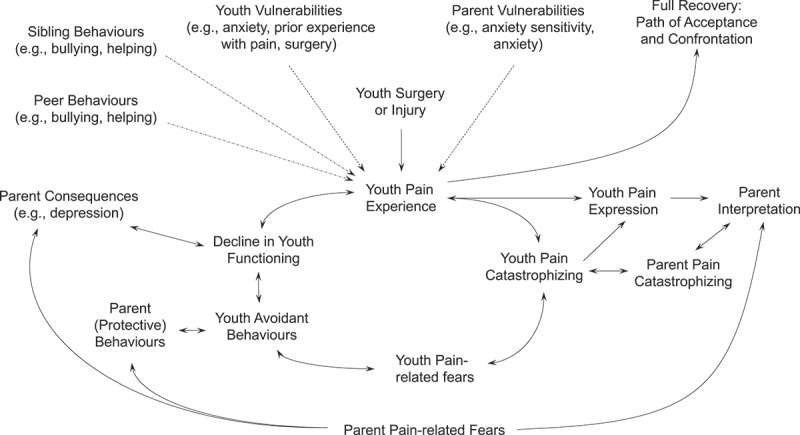
A growing number of studies have identified high rates of pediatric chronic postsurgical pain (CPSP) after major surgery. Pediatric CPSP is associated with pain-related distress and comorbid mental health outcomes, such as anxiety and depression. From a biopsychosocial perspective, youth factors, such as genetics, epigenetics, sex, presurgical pain, sleep, anxiety, and pain catastrophizing, as well as parent factors, such as cognitive appraisals of their child's pain expression and pain catastrophizing, converge and lead to chronic pain disability. A comprehensive and testable psychosocial model of the transition from acute to chronic pediatric postsurgical pain has not been developed. This narrative review begins by evaluating the epidemiology and trajectories of pediatric CPSP and moves on to examine the more influential psychosocial models that have been proposed to understand the development of pediatric CPSP. Much of the literature to date has been conducted on adolescents undergoing spinal fusion. To conceptualize the transition from acute to chronic pain in youth, a combined diathesis-stress and interpersonal fear avoidance model is presented. Novel areas of future research include the potential influence that siblings and peers have on a youth's development of CPSP as well as the influence of gender.
Overview
The claims and statistics of this paper haven’t been checked yet.
Free: it reads the open-access text and checks the first 5 claims that cite a source we can check. Create a free account to check every claim.
Integrity signals
Registry
Cites
Statistics
Figures
Verification
Claims the paper makes
The claims and statistics of this paper haven’t been checked yet.
Free: it reads the open-access text and checks the first 5 claims that cite a source we can check. Create a free account to check every claim.
Claims other papers make about this one
Each is checked against this paper’s own text: does it say what the citing paper says it does?
The source backs part of the claim, not all of it — or backs it for a different population, condition or comparison.
In the citing paper
“Research shows that presurgical psychosocial distress (e.g., child anxiety, child depression, child pain coping efficacy, and child and parental pain catastrophizing) increases the likelihood of CPSP. 13,14,17,18”
From Virtual psychoeducation for improvement of pain catastrophizing in pediatric presurgical patients and caregivers: a proof-of-concept study (2023) · cites this paper as [14]
Experimental — accuracy not yet measured
Self-check
Percentages, sums and reported differences re-computed from the paper’s own numbers.
The self-check needs the paper’s full text.
Citations
Cites
Ordinary magic: Resilience processes in development.
Masten, A. S. (2001) · American Psychologist · doi:10.1037/0003-066x.56.3.227 · Cited by 8,497
Fear-avoidance and its consequences in chronic musculoskeletal pain: a state of the art.
Vlaeyen, J. W. S., & Linton, S. J. (2000) · Pain · doi:10.1016/s0304-3959(99)00242-0 · Cited by 4,931
Fear of movement/(re)injury in chronic low back pain and its relation to behavioral performance
Vlaeyen, J. W. S., Kole-Snijders, A. M. J., Boeren, R. G. B., & van Eek, H. (1995) · Pain · doi:10.1016/0304-3959(94)00279-n · Cited by 2,446
Outline of a fear-avoidance model of exaggerated pain perception--I.
Lethem, J., Slade, P. D., Troup, J. D. G., & Bentley, G. (1983) · Behaviour Research and Therapy · doi:10.1016/0005-7967(83)90009-8 · Cited by 1,327
The IASP classification of chronic pain for ICD-11: chronic postsurgical or posttraumatic pain
Schug, S. A., Lavand'homme, P., Barke, A., Korwisi, B., Rief, W., Treede, R.-D., & Pain, T. I. T. F. T. C. O. C. (2019) · Pain · doi:10.1097/j.pain.0000000000001413 · Cited by 841
Transition from acute to chronic postsurgical pain: risk factors and protective factors
Katz, J., & Seltzer, Z. (2009) · Expert Review of Neurotherapeutics · doi:10.1586/ern.09.20 · Cited by 782 · cited 3×
“, amputation, thoracic surgery, Coronary Artery Bypass Graft (CABG) surgery) is a major factor in predicting postoperative pain outcomes, particularly as they relate to the development of neuropathic pain.(3) It may be that surgery type is also a predictor in children and adolescents; however, there are a few roadbloc…”
BackgroundSelf-citationTheunissen, M., Peters, M. L., Bruce, J., Gramke, H.-F., & Marcus, M. A. (2012) · The Clinical Journal of Pain · doi:10.1097/ajp.0b013e31824549d6 · Cited by 659
Haher, T. R., Gorup, J. M., Shin, T. M., Homel, P., Merola, A. A., Grogan, D. P., Pugh, L., Lowe, T. G., & Murray, M. (1999) · Spine · doi:10.1097/00007632-199907150-00008 · Cited by 479
Pediatric fear-avoidance model of chronic pain: Foundation, application and future directions
Asmundson, G. J., Noel, M., Petter, M., & Parkerson, H. A. (2012) · Pain Research and Management · doi:10.1155/2012/908061 · Cited by 237 · cited 3×
“Asmundson et al.22 proposed that this cycle involves parents, such that parents’ or caregivers’ psychological responses to their child’s psychological pain responses directly and indirectly impact their child’s escape avoidance behaviors, which then feed back into a neverending cycle.”
BackgroundMethodInfluentialA Diathesis‐Stress Model of Chronic Pain and Disability following Traumatic Injury
Turk, D. C. (2002) · Pain Research and Management · doi:10.1155/2002/252904 · Cited by 202
Research works printed but not linked: 1
- Pagé MG, Stinson J, Campbell F, Isaac L, Katz J. Identification of pain-related psychological risk factors for the development and maintenance of pediatric chronic postsurgical pain. J Pain Res. 2013; 6: 167– 80. doi: 10.2147/JPR.S40846. 23503375 PMC3594915 · DOI · Paper page
Cited by
Pergolizzi, J. V., LeQuang, J. A., Magnusson, P., & Varrassi, G. (2023) · Expert Review of Neurotherapeutics · doi:10.1080/14737175.2023.2284872 · Cited by 39
“Among the psychological factors associated with exacerbation of surgery-associated pain perceptions are: fear of surgery [44], anxiety, depression, and catastrophizing [107].”
BackgroundWhen thinking about pain contributes to suffering: the example of pain catastrophizing
Haythornthwaite, J. A., Campbell, C. M., & Edwards, R. R. (2024) · Pain · doi:10.1097/j.pain.0000000000003372 · Cited by 36
Rosenbloom, B. N., Frederiksen, S. D., Wang, V., Birnie, K. A., Park, C., Gordon, G., Rasic, N. F., Stinson, J., & Rabbitts, J. A. (2025) · Regional Anesthesia & Pain Medicine · doi:10.1136/rapm-2024-105697 · Cited by 27
Self-citationChronic Postsurgical Pain in Children and Adolescents: A Call for Action
Einhorn, L. M., Krishnan, P., Poirier, C., & Ingelmo, P. M. (2024) · Journal of Pain Research · doi:10.2147/jpr.s464009 · Cited by 25
Ceniza-Bordallo, G., Fraile, A. G., Martín‐Casas, P., Rabbitts, J. A., Li, R., Palermo, T. M., & López‐de‐Uralde‐Villanueva, I. (2024) · Pain · doi:10.1097/j.pain.0000000000003330 · Cited by 19
Metadata
- Authors
- Rosenbloom, B. N., & Katz, J.
- Affiliations
- Hospital for Sick Children (CA)
- York University (CA)
- Corresponding author
- Rosenbloom, Brittany N.
- Venue
- Canadian Journal of Pain
- Publisher
- Informa UK Limited
- Published
- 2022-06-09
- Volume
- 6
- Issue
- 2
- Pages
- 166-174
- ISSN
- 2474-0527 (ISSN-L)
- PMC
- PMC9196786
- OpenAlex
- W4220852206
- Cited by
- 28
- References
- 43
- Citations by year
- 2026: 3 · 2025: 11 · 2024: 8 · 2023: 4 · 2022: 2
- FWCI
- 1.61
- Type
- journal article
- Language
- en
- Open access
- gold
- doi.org
- Locations
- Canadian Journal of Pain (publishedVersion, cc-by)
- PubMed Central (publishedVersion, cc-by)
- PubMed (publishedVersion)
- DOAJ (DOAJ: Directory of Open Access Journals) (submittedVersion)
- Topics
- Health Sciences › Medicine › Pediatrics, Perinatology and Child Health › Pediatric Pain Management Techniques
- Health Sciences › Medicine › Anesthesiology and Pain Medicine › Anesthesia and Pain Management
- Health Sciences › Health Professions › Physical Therapy, Sports Therapy and Rehabilitation › Musculoskeletal pain and rehabilitation
- Keywords
- acute to chronic pain transition, psychosocial model, diathesis-stress model, spinal fusion, pain catastrophizing, anxiety, depression, sleep, epigenetics, gender differences
About these checks
Registry, retraction, Cites and statistics results are computed, not judged, with one exception: a printed reference that no index lists is read once by a model before it counts as a citation error. Claims are extracted by a model and kept only when their quote appears verbatim in the text; each cited source is then checked, with a model’s help, for whether it says what the claim relies on. Those verdicts can be wrong — read the claim’s quote and the cited source before relying on one.
Statistics and arithmetic are recomputed, not judged.
Confidence bands are shown only for fields calibrated on our annotated test set. None is calibrated yet, so no band is shown.
What counts as a claim ›How we measure confidence ›How we check this ›
Are you an author, or do you see a problem with this page? Request a review
How to cite
Cite CoChat for the checks on this page, and the paper for its own findings.
- This page
- CoChat. (2026). Citation check: Modeling the transition from acute to chronic postsurgical pain in youth: A narrative review of epidemiologic, perioperative, and psychosocial factors. https://app.cochat.ai/papers/10.1080/24740527.2022.2059754
- The paper
- Rosenbloom, B. N., & Katz, J. (2022). Modeling the transition from acute to chronic postsurgical pain in youth: A narrative review of epidemiologic, perioperative, and psychosocial factors. Canadian Journal of Pain. https://doi.org/10.1080/24740527.2022.2059754
Data sources
Bibliographic data: Semantic Scholar, OpenAlex, Crossref.
Contains information from the Semantic Scholar Academic Graph Datasets, made available under the ODC Attribution License (ODC-BY 1.0).
Semantic Scholar’s data is described in: Kinney, R., et al. (2023). The Semantic Scholar Open Data Platform. arXiv:2301.10140.
