

The DOI matches its Crossref record; 19 of the 19 references it cites were found in a registry or an index.
LASIK and PRK in hyperopic astigmatic eyes: is early retreatment advisable?
Open accessAbstract
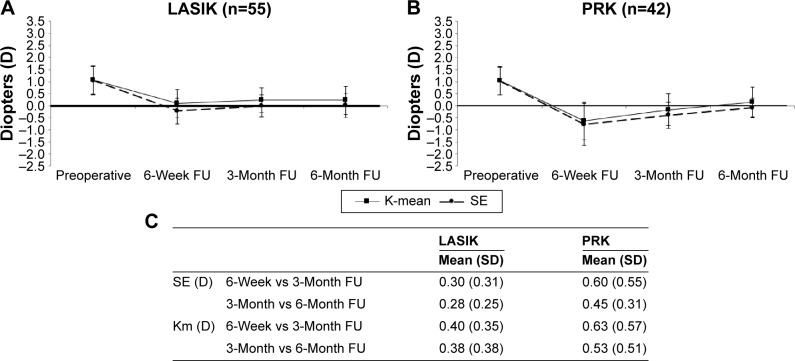
PURPOSE: To analyze the refractive and keratometric stability in hyperopic astigmatic laser in situ keratomileusis (LASIK) or photorefractive keratectomy (PRK) during the first 6 months after surgery. PATIENTS AND METHODS: This retrospective cross-sectional study included 97 hyperopic eyes; 55 were treated with LASIK and 42 with PRK. Excimer ablation for all eyes was performed using the ALLEGRETTO excimer laser platform using a mitomycin C for PRK and a mechanical microkeratome for LASIK. Keratometric and refractive data were analyzed during three consecutive follow-up intervals (6 weeks, 3 months, and 6 months). The corneal topography was obtained using Scheimpflug topography, and subjective refractions were acquired by expert optometrists according to a standardized protocol. RESULTS: After 3 months, mean keratometry and spherical equivalent were stable after LASIK, whereas PRK-treated eyes presented statistically significant (P<0.001) regression of hyperopia. In eleven cases, hyperopic regression of >1 D occurred. The optical zone diameter did not correlate with the development of regression. CONCLUSION: After corneal laser refractive surgery, keratometric changes are followed by refractive changes and they occur up to 6 months after LASIK and for at least 6 months after PRK, and therefore, caution should be applied when retreatment is planned during the 1st year after surgery because hyperopic refractive regression can lead to suboptimal visual outcome. Keratometric and refractive stability is earlier achieved after LASIK, and therefore, retreatment may be independent of late regression.
Overview
The claims and statistics of this paper haven’t been checked yet.
Run the check — free, no account needed. It reads the open-access text and checks the sources it cites.
Integrity signals
Registry
Cites
Statistics
Figures
Verification
Claims the paper makes
The claims and statistics of this paper haven’t been checked yet.
Run the check — free, no account needed. It reads the open-access text and checks the sources it cites.
Claims other papers make about this one
Each is checked against this paper’s own text: does it say what the citing paper says it does?
The source backs part of the claim, not all of it — or backs it for a different population, condition or comparison.
In the citing paper
“These enhanced features have improved the effectiveness and safety of LASIK surgery, thus making treatment possible for a broad range of patients, including those with moderate-to-relatively high hyperopia.”
From Treatment of moderate-to-high hyperopia with the WaveLight Allegretto 400 and EX500 excimer laser systems (2017) · cites this paper as [6]
Experimental — accuracy not yet measuredThe source backs part of the claim, not all of it — or backs it for a different population, condition or comparison.
In the citing paper
“This is because epithelial hyperplasia, the major cause of regression, occurs mostly during the first 6 months post-LASIK.5,6”
From Treatment of moderate-to-high hyperopia with the WaveLight Allegretto 400 and EX500 excimer laser systems (2017) · cites this paper as [6]
Experimental — accuracy not yet measured
Self-check
Percentages, sums and reported differences re-computed from the paper’s own numbers.
The self-check needs the paper’s full text.
Citations
Cites
Mrochen, M., Kaemmerer, M., Mierdel, P., & Seiler, T. (2001) · Journal of Cataract and Refractive Surgery · doi:10.1016/s0886-3350(00)00806-3 · Cited by 280
Biomechanics of the Cornea and Wavefront-guided Laser Refractive Surgery
Roberts, C. J. (2002) · Journal of Refractive Surgery · doi:10.3928/1081-597x-20020901-18 · Cited by 171
LASIK for hyperopia, hyperopic astigmatism, and mixed astigmatism
Varley, G. A., Huang, D., Rapuano, C. J., Schallhorn, S. C., Wachler, B. S. B., & Sugar, A. (2004) · Ophthalmology · doi:10.1016/j.ophtha.2004.05.016 · Cited by 169
Mathematical model of corneal surface smoothing after laser refractive surgery
Huang, D., Tang, M., & Shekhar, R. (2003) · American Journal of Ophthalmology · doi:10.1016/s0002-9394(02)01942-6 · Cited by 158
5-year follow-up of LASIK for hyperopia
Jaycock, P., O'Brart, D. P. S., Rajan, M. S., & Marshall, J. A. (2005) · Ophthalmology · doi:10.1016/j.ophtha.2004.09.017 · Cited by 128
Topographic and biomechanical differences between hyperopic and myopic laser in situ keratomileusis
Qazi, M. A., Roberts, C. J., Mahmoud, A. M., & Pepose, J. S. (2005) · Journal of Cataract & Refractive Surgery · doi:10.1016/j.jcrs.2004.10.043 · Cited by 89
Photorefractive Keratectomy and LASIK for the Correction of Hyperopia: 2-year Follow-up
Spadea, L., Sabetti, L., D'Alessandri, L., & Balestrazzi, E. (2006) · Journal of Refractive Surgery · doi:10.3928/1081-597x-20060201-09 · Cited by 76
Kanellopoulos, A. J., & Asimellis, G. (2014) · Journal of Refractive Surgery · doi:10.3928/1081597x-20140219-01 · Cited by 72
Tabbara, K. F., El-Sheikh, H. F., & Islam, S. M. M. (2001) · Journal of Refractive Surgery · doi:10.3928/1081-597x-20010301-05 · Cited by 51
Three-Year Follow-up of Hyperopic LASIK Using a 500-Hz Excimer Laser System
Plaza-Puche, A. B., Yébana, P., Arba‐Mosquera, S., & ALIO, J. L. (2015) · Journal of Refractive Surgery · doi:10.3928/1081597x-20150928-06 · Cited by 49
Research works printed but not linked: 1
- [5]Kanellopoulos J Asimellis G Longitudinal postoperative lasik epithelial thickness profile changes in correlation with degree of myopia correction J Refract Surg 2014 30 166 171 24576651
Cited by
Motwani, M., & Pei, R. (2017) · Clinical Ophthalmology · doi:10.2147/opth.s136061 · Cited by 19
“This is because epithelial hyperplasia, the major cause of regression, occurs mostly during the first 6 months post-LASIK.(5,6) Regression can be considered as C lin ic al O ph th al m ol og y do w nl oa de d fr om h ttp s: //w w w .”
Background
Metadata
- Authors
- Frings, A., Richard, G., Steinberg, J., Linke, S., Katz, T., & Druchkiv, V.
- Affiliations
- University Medical Center Hamburg-Eppendorf (DE)
- Venue
- Clinical Ophthalmology
- Publisher
- Informa UK Limited
- Published
- 2016-03
- Volume
- 10
- Pages
- 565
- ISSN
- 1177-5467 (ISSN-L)
- 1177-5483
- PMC
- PMC4820209
- OpenAlex
- W2327730217
- Cited by
- 29
- References
- 19
- Citations by year
- 2026: 2 · 2025: 2 · 2023: 3 · 2022: 2 · 2021: 2 · 2020: 2 · 2019: 8 · 2018: 4 · 2017: 4
- FWCI
- 4.63
- Type
- journal article
- Language
- en
- Open access
- gold
- doi.org
- Licence
- Locations
- Clinical ophthalmology (publishedVersion, cc-by-nc)
- PubMed Central (publishedVersion, cc-by-nc)
- PubMed (publishedVersion)
- DOAJ (DOAJ: Directory of Open Access Journals) (submittedVersion, cc-by-sa)
- Dove Medical Press (Taylor and Francis Group) (submittedVersion, cc-by-nc)
- Topics
- Health Sciences › Medicine › Ophthalmology › Corneal surgery and disorders
- Health Sciences › Medicine › Ophthalmology › Ophthalmology and Visual Impairment Studies
- Health Sciences › Medicine › Ophthalmology › Ocular Infections and Treatments
- Keywords
- LASIK, photorefractive keratectomy, hyperopic astigmatism, refractive stability, retreatment, excimer laser ablation, mitomycin C, optical zone diameter, corneal topography
About these checks
Registry, retraction, Cites and statistics results are computed, not judged, with one exception: a printed reference that no index lists is read once by a model before it counts as a citation error. Claims are extracted by a model and kept only when their quote appears verbatim in the text; each cited source is then checked, with a model’s help, for whether it says what the claim relies on. Those verdicts can be wrong — read the claim’s quote and the cited source before relying on one.
Statistics and arithmetic are recomputed, not judged.
Confidence bands are shown only for fields calibrated on our annotated test set. None is calibrated yet, so no band is shown.
What counts as a claim ›How we measure confidence ›How we check this ›
Are you an author, or do you see a problem with this page? Request a review
Data sources
Bibliographic data: Semantic Scholar, OpenAlex, Crossref.
Contains information from the Semantic Scholar Academic Graph Datasets, made available under the ODC Attribution License (ODC-BY 1.0).
Semantic Scholar’s data is described in: Kinney, R., et al. (2023). The Semantic Scholar Open Data Platform. arXiv:2301.10140.
