

The Mediating Roles of Time Management and Learning Strategic Approach in the Relationship Between Smartphone Addiction and Academic Procrastination
Open accessThe DOI matches its Crossref record; 17 of the 17 references it cites were found in a registry or an index.
Abstract
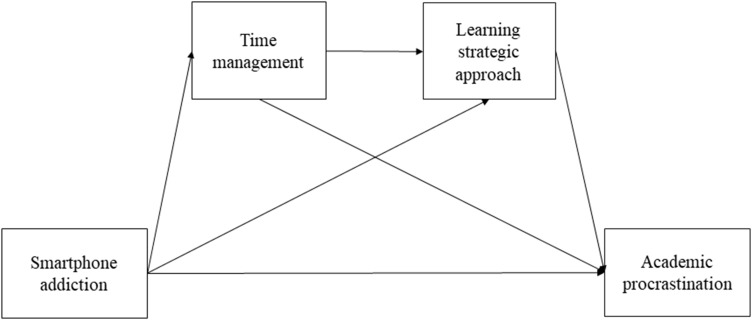
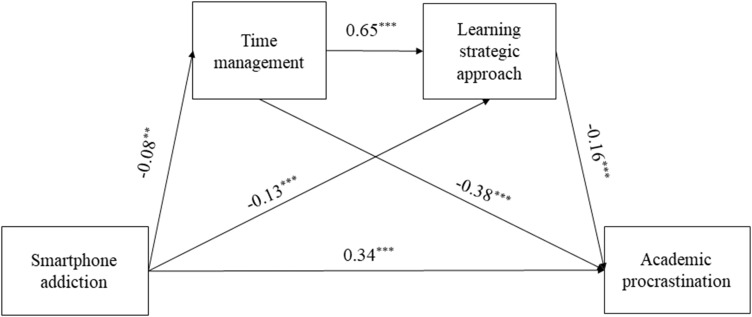
Purpose: Smartphone is an indispensable everyday tool for college students, while excessive usage of smartphones may lead to negative outcomes, such as academic procrastination. Previous research has suggested that smartphone addiction is a predisposing factor for procrastination. To further understand the above relationship, structural equation model analysis was used to examine the mediating effects of time management and learning strategic approach in the association with smartphone addiction and academic procrastination. Materials and Methods: A cross-sectional study was conducted in September 2021. A total of 1129 college students aged 18 to 22 participated in the present study was adopted the cluster random sampling method and the following tools were used: the Mobile Phone Addiction Index Scale, Time Management Disposition Scale, Revised Approaches to Studying Inventory, and Aitken Procrastination Scale. Results: Results indicated that smartphone addiction is positively linked to academic procrastination, while negatively linked to time management and learning strategic approach. Both time management and learning strategic approach were negatively linked to academic procrastination. Additionally, the results showed that time management and learning strategic approach serve sequential mediating roles in the association with smartphone addiction and academic procrastination among Chinese college students after controlling for age and sex (RMSEA = 0.045, SRMR = 0.035, TLI = 0.993, CFI = 0.979). Conclusion: Time management and learning strategic approach serve sequential mediating roles in the association with smartphone addiction and academic procrastination among Chinese college students. Therefore, intervention management that focusing on improving time management as well as strengthening learning strategic approach may be useful for reducing academic procrastination among college students.
Overview
The claims and statistics of this paper haven’t been checked yet.
Free: it reads the open-access text and checks the first 5 claims that cite a source we can check. Create a free account to check every claim.
Integrity signals
Registry
Cites
Statistics
Figures
Verification
Claims the paper makes
The claims and statistics of this paper haven’t been checked yet.
Free: it reads the open-access text and checks the first 5 claims that cite a source we can check. Create a free account to check every claim.
Claims other papers make about this one
Each is checked against this paper’s own text: does it say what the citing paper says it does?
The source backs part of the claim, not all of it — or backs it for a different population, condition or comparison.
In the citing paper
“When attentional control is weaker, the threshold for switching away from demanding academic work toward immediately rewarding stimuli is lowered, and the likelihood of voluntary delay is correspondingly increased”
From Algorithmic short-video music consumption and academic related functions: a three-wave longitudinal study of university students (2026) · cites this paper as Liu et al., 2022
Experimental — accuracy not yet measuredThe cited source says what the claim attributes to it.
In the citing paper
“Además, estas dos últimas variables también tienen roles mediadores secuenciales en la relación entre la adicción al teléfono inteligente y la procrastinación académica, luego de controlar tanto la edad como el género.”
From Uso de redes sociales y procrastinación en estudiantes universitarios: una revisión sistemática (2023) · cites this paper as Liu et al. (2022)
The cited source says what the claim attributes to it.
In the citing paper
“Los autores encontraron que la adicción al teléfono inteligente tiene una relación positiva con la procrastinación académica, así como una relación negativa con el manejo del tiempo y el enfoque de aprendizaje estratégico.”
From Uso de redes sociales y procrastinación en estudiantes universitarios: una revisión sistemática (2023) · cites this paper as Liu et al. (2022)
The cited source says what the claim attributes to it.
In the citing paper
“this study suggests that mobile phone addiction significantly predicts time management disposition among college students.”
From The relationship between mobile phone addiction and time management disposition among Chinese college students:A cross-lagged panel model (2024) · cites this paper as [20]
Self-check
Percentages, sums and reported differences re-computed from the paper’s own numbers.
The self-check needs the paper’s full text.
Citations
Cites
Steel, P. (2007) · Psychological bulletin · doi:10.1037/0033-2909.133.1.65 · Cited by 3,417 · cited 4×
“A strategic learning approach was considered a positive form of self-regulation, while procrastination was associated with low self-control and poor self-regulation.(7) Researchers examining procrastination within a self-regulated learning framework have found that using an effective learning strategy is negatively as…”
BackgroundResultInfluentialA Review of Self-regulated Learning: Six Models and Four Directions for Research
Panadero, E. (2017) · Frontiers in Psychology · doi:10.3389/fpsyg.2017.00422 · Cited by 2,915
Dysfunction of the prefrontal cortex in addiction: neuroimaging findings and clinical implications
Goldstein, R. Z., & Volkow, N. D. (2011) · Nature Reviews Neuroscience · doi:10.1038/nrn3119 · Cited by 2,749 · cited 1×
“Neuroimaging studies have also found that addictive behaviors can damage the prefrontal cortex and further impair higher cognitive function (ie, self-regulation).(11) Therefore, based on self-regulation learning theory, the current study aimed to test the relationship between smartphone addiction and academic procrast…”
BackgroundRelationships among smartphone addiction, stress, academic performance, and satisfaction with life
Samaha, M., & Hawi, N. S. (2016) · Computers in Human Behavior · doi:10.1016/j.chb.2015.12.045 · Cited by 1,246 · cited 4×
“procrastination.(1,4) Procrastination is the voluntary postponement of beginning with or completing a planned behavior despite the foreseeable negative consequences of postponing the behavior.”
BackgroundInfluentialLeung, L. (2008) · Journal of Children and Media · doi:10.1080/17482790802078565 · Cited by 733 · cited 1×
“Measures Smartphone Addiction The Mobile Phone Addiction Index Scale was adopted to measure smartphone addiction among Chinese college students.(23) The scale consists of 17 items, which include four dimensions: inability to control craving (7 items, for example, “Your friends and family complained about your use of t…”
MethodEntwistle, N. J., & Peterson, E. R. (2004) · International Journal of Educational Research · doi:10.1016/j.ijer.2005.08.009 · Cited by 642
Procrastination: associations with achievement goal orientation and learning strategies.
Howell, A. J., & Watson, D. C. (2007) · Personality and Individual Differences · doi:10.1016/j.paid.2006.11.017 · Cited by 453 · cited 4×
“Researchers examining procrastination within a self-regulated learning framework have found that using an effective learning strategy is negatively associated with academic procrastination.(13) In addition, though some studies have shown that problematic smartphone use is associated with deep and surface level approac…”
BackgroundResultInfluentialMaydeu-Olivares, A. (2017) · Structural Equation Modeling: A Multidisciplinary Journal · doi:10.1080/10705511.2016.1269606 · Cited by 377 · cited 1×
“Maximum likelihood estimation is virtually always utilized in such instances.(27) To examine whether the data fit the theory, the following fit indices were used: comparative fit index (CFI), Tucker-Lewis index (TLI), root-mean-square error of approximation (RMSEA), and standardized root mean square residual (SRMR).”
MethodComparing active delay and procrastination from a self-regulated learning perspective
Corkin, D. M., Yu, S. L., & Lindt, S. F. (2011) · Learning and Individual Differences · doi:10.1016/j.lindif.2011.07.005 · Cited by 186 · cited 3×
“Procrastination is the voluntary postponement of beginning with or completing a planned behavior despite the foreseeable negative consequences of postponing the behavior.(5) In a study on Chinese college students, Lian found that smartphone overuse was positively related to academic procrastination after controlling f…”
BackgroundResultInfluentialMetacognitive beliefs in addictive behaviours: A systematic review
Hamonniere, T., & Varescon, I. (2018) · Addictive Behaviors · doi:10.1016/j.addbeh.2018.05.018 · Cited by 172
Research works printed but not linked: 13
- Lian S, Liu S, Sun X, Zhou Z. Mobile phone addiction and college students’ procrastination: analysis of a moderated mediation model. Psychol Dev Educ. 2018; 34: 595– 604.
- Wolters CA, Brady AC. College students’ time management: a self-regulated learning perspective. Educ Psychol Rev. 2020; 2020: 1– 33.
- Zheng. Z, Liu. J, Huang. S, Jiang. Y, Liao. H. The relationship between high grade pupils’ parenting styles and academic procrastination: the mediating effect of time management disposition. Stud Psychol Behav. 2018; 16(6): 786– 792.
- Huang X, Zhang Z. The compiling of adolescence time management disposition inventory. Acta Psychol Sin. 2001; 33(04): 338– 343.
- Liao T, Lin C. The relationship between time management disposition and internet addiction disorder among college students. Mod Prev Med. 2011; 21: 4419– 4420.
- Khan AA, Khalid A, Iqbal R. Revealing the relationship between smartphone addiction and academic performance of students: evidences from higher educational Institutes of Pakistan. Pakistan Adm Rev. 2019; 3(2): 74– 83.
- Tsai MJ. The model of strategic e-learning: understanding and evaluating student e-learning from metacognitive perspectives. J Educ Techno Soc. 2009; 12(1): 34– 48.
- Han L, Liu A, Xiao M. The influence of college students’ fear of missing out on mobile phone addiction tendency: the mediating effect of learning style. Chin J Spec Educ. 2019; 12(12): 78– 82.
- Aitken ME. A Personality Profile of the College Student Procrastinator. University of Pittsburgh; 1982.
- Chen XL, Dai XY, Dong Q. A research of Aitken procrastination inventory applied to Chinese college students. Chin J Clin Psychol. 2008; 16(1): 22– 23.
- Byrne BM. Structural Equation Modeling with Mplus: Basic Concepts, Applications, and Programming. 1st Ed. Routledge; 2011.
- Przepiorka A, Blachnio A, Cudo A. Procrastination and problematic new media use: the mediating role of future anxiety. Curr Psychol. 2021; 21: 1– 9.
- Song M, Feng T. How time perspective influences procrastination: mediating roles of time discounting. Psychol Dev Edu. 2017; 19: 683– 690.
Cited by
Chen, G., & Lyu, C. (2024) · Personality and Individual Differences · doi:10.1016/j.paid.2024.112652 · Cited by 80
Yang, Y.-D., Zhou, C.-L., & Wang, Z. (2024) · Frontiers in Psychology · doi:10.3389/fpsyg.2024.1331691 · Cited by 70
The correlation between mobile phone addiction and procrastination in students: A meta-analysis
Zhou, X., Yang, F., Chen, Y., & Gao, Y. (2023) · Journal of Affective Disorders · doi:10.1016/j.jad.2023.11.020 · Cited by 57
Yang, G.-H., Cao, X.-X., Fu, Y., Wang, N.-D., & Lian, S.-L. (2024) · Frontiers in Psychiatry · doi:10.3389/fpsyt.2024.1365914 · Cited by 57
Jin, Y., Zhou, W., Zhang, Y., Yang, Z., & Hussain, Z. (2024) · Behavioral Sciences · doi:10.3390/bs14090820 · Cited by 50
“Previous studies found that procrastination was negatively associated with time management [36,37].”
BackgroundResult
Metadata
- Authors
- Liu, F., Xu, Y., Yang, T., Li, Z., Dong, Y., Chen, L., & Sun, X.
- Affiliations
- Ningbo University (CN)
- University of Science and Technology Liaoning (CN)
- Hunan University of Science and Technology (CN)
- Corresponding author
- Chen, Liang
- Venue
- Psychology Research and Behavior Management
- Publisher
- Informa UK Limited
- Published
- 2022-09
- Volume
- Volume 15
- Pages
- 2639-2648
- ISSN
- 1179-1578 (ISSN-L)
- PMC
- PMC9488603
- OpenAlex
- W4295957834
- Cited by
- 60
- References
- 17
- Citations by year
- 2026: 23 · 2025: 17 · 2024: 14 · 2023: 6
- FWCI
- 8.44
- Type
- journal article
- Language
- en
- Open access
- gold
- doi.org
- Licence
- Locations
- Psychology Research and Behavior Management (publishedVersion, cc-by-nc)
- PubMed Central (publishedVersion, cc-by-nc)
- PubMed (publishedVersion)
- DOAJ (DOAJ: Directory of Open Access Journals) (submittedVersion, cc-by-sa)
- Dove Medical Press (Taylor and Francis Group) (submittedVersion, cc-by-nc)
- Topics
- Social Sciences › Psychology › Clinical Psychology › Perfectionism, Procrastination, Anxiety Studies
- Social Sciences › Sociology and Political Science › Impact of Technology on Adolescents
- Social Sciences › Psychology › Developmental and Educational Psychology › Student Stress and Coping
- Keywords
- smartphone addiction, academic procrastination, time management, mediating effect, university students, mobile phone addiction, study habits
About these checks
Registry, retraction, Cites and statistics results are computed, not judged, with one exception: a printed reference that no index lists is read once by a model before it counts as a citation error. Claims are extracted by a model and kept only when their quote appears verbatim in the text; each cited source is then checked, with a model’s help, for whether it says what the claim relies on. Those verdicts can be wrong — read the claim’s quote and the cited source before relying on one.
Statistics and arithmetic are recomputed, not judged.
Confidence bands are shown only for fields calibrated on our annotated test set. None is calibrated yet, so no band is shown.
What counts as a claim ›How we measure confidence ›How we check this ›
Are you an author, or do you see a problem with this page? Request a review
Data sources
Bibliographic data: Semantic Scholar, OpenAlex, Crossref.
Contains information from the Semantic Scholar Academic Graph Datasets, made available under the ODC Attribution License (ODC-BY 1.0).
Semantic Scholar’s data is described in: Kinney, R., et al. (2023). The Semantic Scholar Open Data Platform. arXiv:2301.10140.
