

The DOI matches its Crossref record; the references it cites are not checked yet.
A Segmented Logistic Regression Approach to Evaluating Change in Caesarean Section Rate with Reform of Birth Planning Policy in Two Regions in China from 2012 to 2016
Open accessAbstract
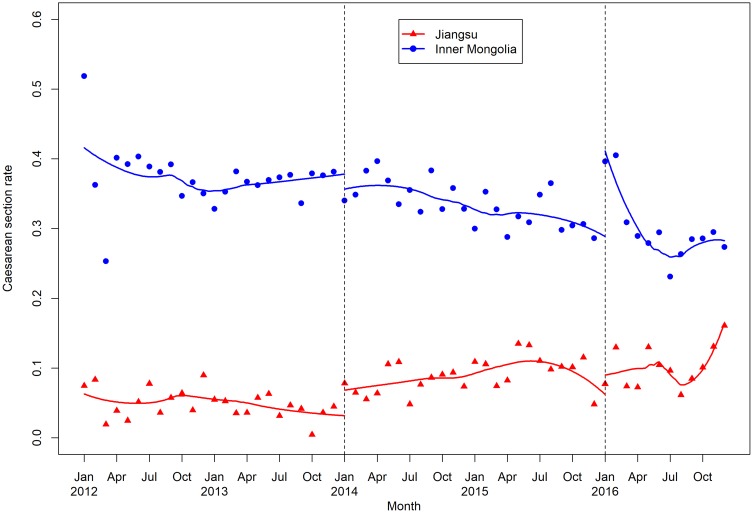
Objective: This study evaluated change in caesarean section rate with reform of birth planning policy in China from one-child to two-child policy. Methods: Study data were collected from patient-level hospital records of 59,668 pregnant women who visited three major urban hospitals in Jiangsu Province and Inner Mongolia Autonomous Region of China between January 2012 and December 2016. A segmented logistic regression approach was developed to evaluate the changes in caesarean section rate in these regions with the launch of China’s new partial and universal two-child policies in January 2014 and January 2016, respectively. Results: Jiangsu Province had a significantly lower non-emergency caesarean rate (Jiangsu 8.15% vs Inner Mongolia 34.03%, p < 0.001) and a much lower percentage of minority population (Jiangsu 6.99% vs Inner Mongolia 21.76%, p < 0.001) than Inner Mongolia Autonomous Region. In Jiangsu Province, no change in caesarean section rate was detected with the two-child policies (all p -values > 0.05), although the unadjusted trend change (0.038, 95% confidence interval or CI: [0.016, 0.060], p < 0.001) in log odds after the implementation of the partial two-child policy was statistically significant. In Inner Mongolia Autonomous Region, an immediate jump in caesarean section rate was discovered by the segmented logistic regression with the implementation of both the partial (unadjusted level change 0.297, CI: [0.105, 0.489], p = 0.002) and universal two-child policies (unadjusted level change 1.945, CI: [1.277, 2.614], p < 0.001); but the rate reverted to the previous level thereafter. Ethnicity, maternal age, maternal reproduction history, insurance coverage type, infant weight, and infant gender were the significant factors associated with caesarean section rate (for odds ratios, all p -values < 0.05). However, the significance of infant gender may stem from the large sample size of the study and is not clinically meaningful. Conclusion: Change in caesarean section rate was not observed with the launch of two-child policy in China. Keywords: one-child policy, two-child policy, caesarean section, segmented logistic regression
Overview
The claims and statistics of this paper haven’t been checked yet.
Run the check — free, no account needed. It reads the open-access text and checks the sources it cites.
Integrity signals
Registry
Cites
Statistics
Figures
Verification
Claims the paper makes
The claims and statistics of this paper haven’t been checked yet.
Run the check — free, no account needed. It reads the open-access text and checks the sources it cites.
Claims other papers make about this one
Each is checked against this paper’s own text: does it say what the citing paper says it does?
The source backs part of the claim, not all of it — or backs it for a different population, condition or comparison.
In the citing paper
“These tools identify distinct risk groups and reveal how interconnected beliefs, emotions, ideologies, and digital engagement cultivate susceptibility (Bhatnagar & Ghose, 2004;Kang et al., 2020;Outwater et al., 2003;Verma, 2013;Yan et al., 2018).”
From Deepfakes, Democracy, and the Ethics of Synthetic Media: A Synthesis of the SOLARIS Project (2026) · cites this paper as Kang et al., 2020
Experimental — accuracy not yet measured
Self-check
Percentages, sums and reported differences re-computed from the paper’s own numbers.
The self-check needs the paper’s full text.
Citations
The citation lists are queued
They are fetched later and appear here then.
References 28 · Cited by 11
Research works printed but not linked: 28
- Hesketh, 1997, Br Med J, 314, 1685, 10.1136/bmj.314.7095.1685 · DOI · Paper page
- Liang, 2018, BMJ, 360, k817, 10.1136/bmj.k817 · DOI
- Mi, 2014, Lancet, 383, 1463, 10.1016/S0140-6736(14)60716-9 · DOI
- Zhang, 2008, Obstetrics Gynecol, 111, 1077, 10.1097/AOG.0b013e31816e349e · DOI
- Feng, 2012, Bull World Health Organ, 90, 30, 10.2471/BLT.11.090399 · DOI
- Klemetti, 2010, Am J Obstet Gynecol, 202, 10.1016/j.ajog.2009.08.032 · DOI
- Sufang, 2007, Bull World Health Organ, 85, 755, 10.2471/BLT.00.000000 · DOI
- Feng, 2014, Int J Womens Health, 6, 59, 10.2147/IJWH.S41410 · DOI
- Belizán, 2007, Epidemiology, 18, 485, 10.1097/EDE.0b013e318068646a · DOI
- Blustein, 2015, BMJ, 350
- O’Neill, 2014, PLoS Med, 11, e1001670, 10.1371/journal.pmed.1001670 · DOI
- Sevelsted, 2015, Pediatrics, 135, e92, 10.1542/peds.2014-0596 · DOI · Paper page
- Rutayisire, 2016, BMC Pregnancy Childbirth, 16, 338, 10.1186/s12884-016-1131-5 · DOI
- Xu, 2017, J Psychosom Res, 97, 118, 10.1016/j.jpsychores.2017.04.016 · DOI
- Li, 2017, JAMA, 317, 69, 10.1001/jama.2016.18663 · DOI
- L Y K, 2001, Midwifery, 17, 314, 10.1054/midw.2001.0274 · DOI
- Zeng, 2016, Lancet, 388, 1930, 10.1016/S0140-6736(16)31405-2 · DOI · Paper page
- Cheng, 2016, BJOG, 123, 7, 10.1111/bjo.2016.123.issue-S3 · DOI
- Liang, 2018, Obstet Gynecol Surv, 73, 447, 10.1097/01.ogx.0000544558.91752.20 · DOI
- Zhu, 2015, Stud Labor Econ, 3, 110
- Wagner, 2002, J Clin Pharm Ther, 27, 299, 10.1046/j.1365-2710.2002.00430.x · DOI · Paper page
- Tibshirani, 1987, J Am Stat Assoc, 82, 559, 10.1080/01621459.1987.10478466 · DOI
- Feng, 2002, Med Soc, 15, 14
- Tang, 2006, Am J Obstet Gynecol, 195, 1527, 10.1016/j.ajog.2006.03.044 · DOI
- Wu, 2000, Birth, 27, 86, 10.1046/j.1523-536x.2000.00086.x · DOI
- Harris, 2007, Reprod Health Matters, 15, 114, 10.1016/S0968-8080(07)30315-7 · DOI
- Wang, 2017, Soc Sci Med, 173, 1, 10.1016/j.socscimed.2016.11.032 · DOI
- Zhang, 2018, Midwifery, 62, 42, 10.1016/j.midw.2018.03.013 · DOI
Metadata
- Authors
- Kang, L., Ye, S., Jing, K., Fan, Y., Chen, Q., Zhang, N., & Zhang, B.
- Affiliations
- Inner Mongolia Medical University (CN)
- Harvard University (US)
- Nanjing Drum Tower Hospital (CN)
- China Agricultural University (CN)
- University of Massachusetts Chan Medical School (US)
- Boston Children's Hospital (US)
- Corresponding author
- Zhang, Bo
- Venue
- Risk Management and Healthcare Policy
- Publisher
- Informa UK Limited
- Published
- 2020-03
- Volume
- Volume 13
- Pages
- 245-253
- ISSN
- 1179-1594 (ISSN-L)
- PMC
- PMC7092689
- OpenAlex
- W3010939196
- Cited by
- 11
- References
- 28
- Citations by year
- 2026: 1 · 2024: 1 · 2022: 2 · 2021: 2 · 2020: 5
- FWCI
- 1.38
- Type
- journal article
- Language
- en
- Open access
- gold
- doi.org
- Licence
- Locations
- Risk Management and Healthcare Policy (publishedVersion, cc-by-nc)
- Europe PMC (PubMed Central) (publishedVersion, cc-by-nc)
- PubMed Central (publishedVersion, cc-by-nc)
- PubMed (publishedVersion)
- Dove Medical Press (Taylor and Francis Group) (submittedVersion, cc-by-nc)
- Topics
- Health Sciences › Medicine › Obstetrics and Gynecology › Maternal and Perinatal Health Interventions
- Social Sciences › Gender Studies › Demographic Trends and Gender Preferences
- Health Sciences › Medicine › Public Health, Environmental and Occupational Health › Reproductive Health and Contraception
- Keywords
- cesarean section rate, two-child policy, one-child policy, policy reform, Jiangsu Province, Inner Mongolia, ethnic minorities, maternal factors, infant weight, infant gender, insurance coverage, maternal age, China, regional comparison, policy evaluation
About these checks
Registry, retraction, Cites and statistics results are computed, not judged, with one exception: a printed reference that no index lists is read once by a model before it counts as a citation error. Claims are extracted by a model and kept only when their quote appears verbatim in the text; each cited source is then checked, with a model’s help, for whether it says what the claim relies on. Those verdicts can be wrong — read the claim’s quote and the cited source before relying on one.
Statistics and arithmetic are recomputed, not judged.
Confidence bands are shown only for fields calibrated on our annotated test set. None is calibrated yet, so no band is shown.
What counts as a claim ›How we measure confidence ›How we check this ›
Are you an author, or do you see a problem with this page? Request a review
How to cite
Cite CoChat for the checks on this page, and the paper for its own findings.
- This page
- CoChat. (2026). Citation check: A Segmented Logistic Regression Approach to Evaluating Change in Caesarean Section Rate with Reform of Birth Planning Policy in Two Regions in China from 2012 to 2016. https://app.cochat.ai/papers/10.2147/rmhp.s230923
- The paper
- Kang, L., Ye, S., Jing, K., Fan, Y., Chen, Q., Zhang, N., & Zhang, B. (2020). A Segmented Logistic Regression Approach to Evaluating Change in Caesarean Section Rate with Reform of Birth Planning Policy in Two Regions in China from 2012 to 2016. Risk Management and Healthcare Policy. https://doi.org/10.2147/rmhp.s230923
