

SGLT2 Inhibitor Treatment Outcome in Nonalcoholic Fatty Liver Disease Complicated with Diabetes Mellitus: The Long-term Effects on Clinical Features and Liver Histopathology
Open accessThe DOI matches its Crossref record; 21 of the 21 references it cites were found in a registry or an index.
Abstract
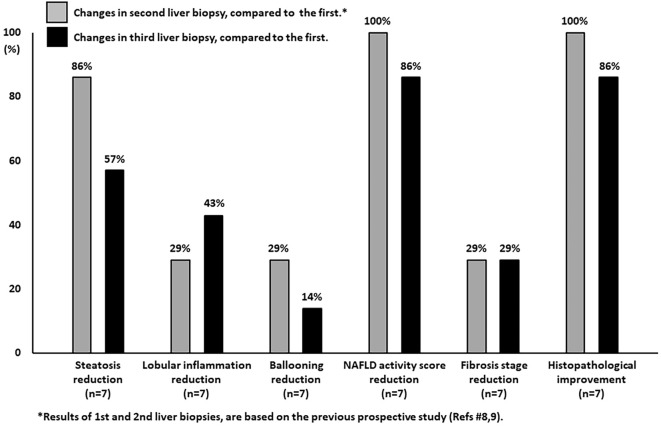
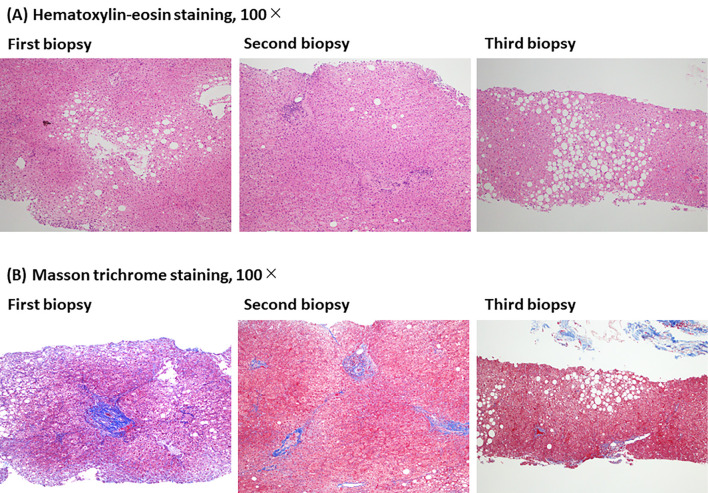
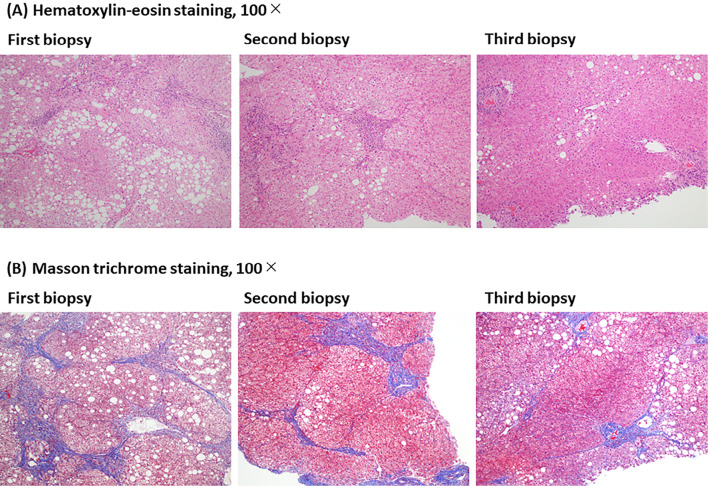
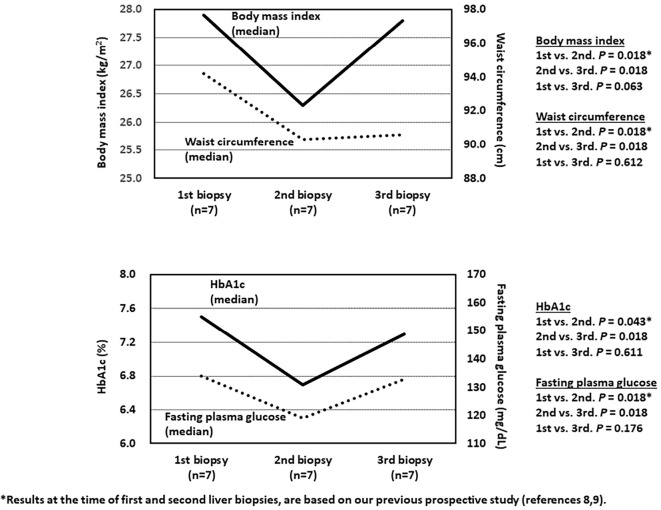
Objective The aim of this study was to determine the long-term effects of a sodium-glucose cotransporter 2 inhibitor (SGLT2i) in nonalcoholic fatty liver disease (NAFLD) patients with type 2 diabetes mellitus (T2DM) on the clinical features and liver histopathology. Methods In this retrospective study, the long-term histological impacts of SGLT2i in NAFLD patients with T2DM were investigated. Patients Seven patients with NAFLD and T2DM were treated for the long term with 100 mg/day canagliflozin, an SGLT2i, and liver biopsies were obtained at the 3 points of pretreatment, 24 weeks, and ≥1 year (third liver biopsy) after the start of treatment. Six of seven patients were evaluated with third liver biopsy at the point of three or more years. The primary outcome was liver histopathological changes (defined as a decrease in the NAFLD activity score of one point or more without worsening of the fibrosis stage, compared to pretreatment). Results All 7 patients showed worsening of body mass index and waist circumference at the third liver biopsy compared to 24 weeks. However, the scores of steatosis, lobular inflammation, ballooning, and fibrosis stage improved at the third liver biopsy in 57%, 43%, 14%, and 29% of the patients, respectively, compared to pretreatment. One of the seven patients showed histopathological worsening at the third liver biopsy compared to pretreatment, but the improvement was maintained in the other six patients. Conclusion The long-term treatment of NAFLD complicated by T2DM using an SGLT2i is associated with long-term improvement in liver histopathology despite the worsening of clinical features.
Overview
The claims and statistics of this paper haven’t been checked yet.
Free: it reads the open-access text and checks the first 5 claims that cite a source we can check. Create a free account to check every claim.
Integrity signals
Registry
Cites
Statistics
Figures
Verification
Claims the paper makes
The claims and statistics of this paper haven’t been checked yet.
Free: it reads the open-access text and checks the first 5 claims that cite a source we can check. Create a free account to check every claim.
Claims other papers make about this one
Each is checked against this paper’s own text: does it say what the citing paper says it does?
The cited source doesn’t support the claim as written.
In the citing paper
“However, an open-label trial investigating empagliflozin as an add-on to standard care versus placebo observed greater reductions in liver lipid content with empagliflozin despite comparable weight loss in both groups [156].”
From Obesity and MASLD: Is weight loss the (only) key to treat metabolic liver disease? (2024) · cites this paper as [156]
Checked by a reasoning model — may be wrong.
Experimental — accuracy not yet measured
Self-check
Percentages, sums and reported differences re-computed from the paper’s own numbers.
The self-check needs the paper’s full text.
Citations
Cites
Empagliflozin, Cardiovascular Outcomes, and Mortality in Type 2 Diabetes
Zinman, B., Wanner, C., Lachin, J. M., Fitchett, D., Bluhmki, E., Hantel, S., Mattheus, M., Devins, T., Johansen, O. E., Woerle, H. J., et al. (2015) · New England Journal of Medicine · doi:10.1056/nejmoa1504720 · Cited by 12,315
Design and validation of a histological scoring system for nonalcoholic fatty liver disease†
Kleiner, D. E., Brunt, E. M., Van Natta, M., Behling, C., Contos, M. J., Cummings, O. W., Ferrell, L. D., Liu, Y., Torbenson, M. S., Unalp‐Arida, A., et al. (2005) · Hepatology · doi:10.1002/hep.20701 · Cited by 10,791 · cited 2×
“NAS represented the sum of scores of steatosis, lobular inflammation, and hepatocyte ballooning (range, 0-8 points) (11).”
Canagliflozin and Cardiovascular and Renal Events in Type 2 Diabetes
Neal, B., Perkovic, V., Mahaffey, K. W., de Zeeuw, D., Fulcher, G., Erondu, N., Shaw, W., Law, G., Desai, M., & Matthews, D. R. (2017) · New England Journal of Medicine · doi:10.1056/nejmoa1611925 · Cited by 7,830
Nonalcoholic Fatty Liver Disease
Angulo, P. (2002) · New England Journal of Medicine · doi:10.1056/nejmra011775 · Cited by 5,228
Sterling, R. K., Lissen, E., Clumeck, N., Sola, R., Correa, M. C., Montaner, J., S. Sulkowski, M., Torriani, F. J., Dieterich, D. T., Thomas, D. L., et al. (2006) · Hepatology · doi:10.1002/hep.21178 · Cited by 5,021 · cited 1×
“…parameters that could affect the NAFLD prognosis using the Fib-4 index with the following formula: [age (year)×AST (aspartate aminotransferase) (U/L)]/[platelet count (10 9 /L)× √ alanine aminotransferase (ALT) (U/L)], which has been used previously to assess the progression of liver fibrosis (14).”
Nonalcoholic Steatohepatitis: A Proposal for Grading and Staging The Histological Lesions
Brunt, E. M., Janney, C. G., Di Bisceglie, A. M., Neuschwander-Tetri, B. A., & Bacon, B. R. (1999) · American Journal of Gastroenterology · doi:10.1111/j.1572-0241.1999.01377.x · Cited by 3,907
Pioglitazone, Vitamin E, or Placebo for Nonalcoholic Steatohepatitis
Sanyal, A. J., Chalasani, N., Kowdley, K. V., McCullough, A., Diehl, A. M., Bass, N. M., Neuschwander-Tetri, B. A., Lavine, J. E., Tonascia, J., Unalp, A., et al. (2010) · New England Journal of Medicine · doi:10.1056/nejmoa0907929 · Cited by 3,327 · cited 2×
“Second, there were two patients (Case 3 and 5) who had other additional antidiabetic drugs introduced between the second and third liver biopsies, although no other additional antidiabetic drugs with a high evidence level for NAFLD [e.g., Pioglitazone (20) and Glucagon-like peptide-1 receptor agonists (21)] were intro…”
Armstrong, M. J., Gaunt, P., Aithal, G. P., Barton, D., Hull, D., Parker, R., Hazlehurst, J. M., Guo, K., Abouda, G., Aldersley, M. A., et al. (2016) · The Lancet · doi:10.1016/s0140-6736(15)00803-x · Cited by 2,203 · cited 1×
“…(Case 3 and 5) who had other additional antidiabetic drugs introduced between the second and third liver biopsies, although no other additional antidiabetic drugs with a high evidence level for NAFLD [e.g., Pioglitazone (20) and Glucagon-like peptide-1 receptor agonists (21)] were introduced.”
Global challenges in liver disease
Williams, R. (2006) · Hepatology · doi:10.1002/hep.21347 · Cited by 788
Cefalu, W. T., Leiter, L. A., Yoon, K.-H., Arias, P., Niskanen, L., Xie, J., Balis, D. A., Canovatchel, W., & Meininger, G. (2013) · The Lancet · doi:10.1016/s0140-6736(13)60683-2 · Cited by 724
Sumida, Y. (2014) · World Journal of Gastroenterology · doi:10.3748/wjg.v20.i2.475 · Cited by 689
Bedossa, P. (2014) · Hepatology · doi:10.1002/hep.27173 · Cited by 625 · cited 1×
“NASH was defined according to the Fatty Liver: Inhibition of Progression (FLIP) algorithm (13).”
Nonalcoholic Fatty Liver Disease: Pathologic Patterns and Biopsy Evaluation in Clinical Research
Kleiner, D., & Brunt, E. (2012) · Seminars in Liver Disease · doi:10.1055/s-0032-1306421 · Cited by 402
Energy Balance After Sodium–Glucose Cotransporter 2 Inhibition
Ferrannini, G., Hach, T., Crowe, S., Sanghvi, A., Hall, K. D., & Ferrannini, E. (2015) · Diabetes Care · doi:10.2337/dc15-0355 · Cited by 359 · cited 1×
“The study of Ferrannini et al. (16) in patients with chronic glycosuria demonstrated that long-term treatment with SGLT2i (90 weeks) elicited an adaptive increase in energy intake, and the combination of SGLT2i with calorie restriction resulted, in at least some patients, in major weight loss (16).”
Lai, L.-L., Vethakkan, S. R., Nik Mustapha, N. R., Mahadeva, S., & Chan, W.-K. (2020) · Digestive Diseases and Sciences · doi:10.1007/s10620-019-5477-1 · Cited by 191 · cited 2×
“Similar re-sults using other SGLT2is were also reported by another group (significant improvements at 24 weeks in steatosis, ballooning and fibrosis] (10), highlighting the therapeutic potential of SGLT2is as effective agents against NAFLD complicated with T2DM.”
Akuta, N., Kawamura, Y., Watanabe, C., Nishimura, A., Okubo, M., Mori, Y., Fujiyama, S., Sezaki, H., Hosaka, T., Kobayashi, M., et al. (2019) · Hepatology Research · doi:10.1111/hepr.13304 · Cited by 107 · cited 4×
“The results of the first and second liver biopsies were based on our previous prospective clinical trial UMIN 000018166 (https://upload.umin.ac.jp/cgi-open-bin/ctr/index. cgi) (8, 9).”
InfluentialSelf-citationAkuta, N., Watanabe, C., Kawamura, Y., Arase, Y., Saitoh, S., Fujiyama, S., Sezaki, H., Hosaka, T., Kobayashi, M., Kobayashi, M., et al. (2017) · Hepatology Communications · doi:10.1002/hep4.1019 · Cited by 104
Self-citationFujii, H., Imajo, K., Yoneda, M., Nakahara, T., Hyogo, H., Takahashi, H., Hara, T., Tanaka, S., Sumida, Y., Eguchi, Y., et al. (2019) · Journal of Gastroenterology and Hepatology · doi:10.1111/jgh.14595 · Cited by 94 · cited 1×
“Higher levels of HOMA-IR, as a surrogate marker of insulin resistance, are a risk factor for severe fibrosis of NAFLD (17, 18).”
Sorrentino, P., Terracciano, L., D'Angelo, S., Ferbo, U., Bracigliano, A., & Vecchione, R. (2010) · American Journal of Gastroenterology · doi:10.1038/ajg.2009.587 · Cited by 88 · cited 1×
“Higher levels of HOMA-IR, as a surrogate marker of insulin resistance, are a risk factor for severe fibrosis of NAFLD (17, 18).”
Akuta, N., Kawamura, Y., Arase, Y., Saitoh, S., Fujiyama, S., Sezaki, H., Hosaka, T., Kobayashi, M., Kobayashi, M., Suzuki, Y., et al. (2018) · BMC Gastroenterology · doi:10.1186/s12876-018-0900-1 · Cited by 34
Self-citationAkuta, N., Kawamura, Y., Arase, Y., Saitoh, S., Fujiyama, S., Sezaki, H., Hosaka, T., Kobayashi, M., Kobayashi, M., Suzuki, Y., et al. (2019) · Hepatology Communications · doi:10.1002/hep4.1445 · Cited by 22
Self-citation
Cited by
Advancements in the treatment of non-alcoholic fatty liver disease (NAFLD)
Rong, L., Zou, J., Ran, W., Qi, X., Chen, Y., Cui, H., & Guo, J. (2023) · Frontiers in Endocrinology · doi:10.3389/fendo.2022.1087260 · Cited by 301
Tokushige, K., Ikejima, K., Ono, M., Eguchi, Y., Kamada, Y., Itoh, Y., Akuta, N., Yoneda, M., Iwasa, M., Yoneda, M., et al. (2021) · Journal of Gastroenterology · doi:10.1007/s00535-021-01796-x · Cited by 270
“Some reports have demonstrated that GLP-1 analogue and SGLT2 improve liver function and liver histological findings [79, 80, 85, 87, 88].”
BackgroundSelf-citationHeyens, L. J. M., Busschots, D., Koek, G. H., Robaeys, G., & Francque, S. (2021) · Frontiers in Medicine · doi:10.3389/fmed.2021.615978 · Cited by 234
Watanabe, S., Hashimoto, E., Ikejima, K., Uto, H., Ono, M., Sumida, Y., Seike, M., Takei, Y., Takehara, T., Tokushige, K., et al. (2015) · Hepatology Research · doi:10.1111/hepr.12511 · Cited by 200
SGLT-2 Inhibitors in NAFLD: Expanding Their Role beyond Diabetes and Cardioprotection
Androutsakos, T., Nasiri-Ansari, N., Bakasis, A.-D., Kyrou, I., Efstathopoulos, E., Randeva, H. S., & Kassi, E. (2022) · International Journal of Molecular Sciences · doi:10.3390/ijms23063107 · Cited by 165
“In some of these studies, improvement in hepatic fibrosis was found, using transient elastography (TE) or LB, even though this finding was not univocal [146,153,158,159,164,165,168].”
Metadata
- Authors
- Akuta, N., Kawamura, Y., Fujiyama, S., Sezaki, H., Hosaka, T., Kobayashi, M., Kobayashi, M., Saitoh, S., Suzuki, F., Suzuki, Y., Arase, Y., Ikeda, K., & Kumada, H.
- Affiliations
- Toranomon Hospital (JP)
- ORCID
- Venue
- Internal Medicine
- Published
- 2020-08-15
- Volume
- 59
- Issue
- 16
- Pages
- 1931-1937
- ISSN
- 0918-2918 (ISSN-L)
- 1349-7235
- PMC
- PMC7492114
- OpenAlex
- W3027707577
- Semantic Scholar
- 3bf4be242ba2131870d8a593250a7352d6c3e508
- Cited by
- 48
- References
- 21
- Citations by year
- 2026: 1 · 2025: 5 · 2024: 8 · 2023: 10 · 2022: 11 · 2021: 11
- FWCI
- 5.74
- Type
- journal article
- Language
- en
- Open access
- diamond
- doi.org
- Licence
- cc-by-nc-nd
- Locations
- Internal Medicine (publishedVersion, cc-by-nc-nd)
- PubMed Central (publishedVersion, cc-by-nc-nd)
- PubMed (publishedVersion)
- Funders
- Teikyo University School of Medicine
- Ministry of Health, Labour and Welfare (19HC1001)
- Topics
- Health Sciences › Medicine › Hepatology › Liver Disease Diagnosis and Treatment
- Health Sciences › Medicine › Endocrinology, Diabetes and Metabolism › Diabetes Treatment and Management
- Health Sciences › Medicine › Nephrology › Chronic Kidney Disease and Diabetes
- Keywords
- SGLT2 inhibitors, canagliflozin, non-alcoholic fatty liver disease, type 2 diabetes, liver histopathology, NAFLD activity score, liver fibrosis, steatosis, lobular inflammation, ballooning, long-term treatment outcomes
- MeSH terms
- Sodium-Glucose Transporter 2 Inhibitors, Adult, Biopsy, Body Weights and Measures, Diabetes Mellitus, Type 2, Female, Humans, Japan, Male, Middle Aged, Retrospective Studies, Treatment Outcome, Non-alcoholic Fatty Liver Disease
About these checks
Registry, retraction, Cites and statistics results are computed, not judged, with one exception: a printed reference that no index lists is read once by a model before it counts as a citation error. Claims are extracted by a model and kept only when their quote appears verbatim in the text; each cited source is then checked, with a model’s help, for whether it says what the claim relies on. Those verdicts can be wrong — read the claim’s quote and the cited source before relying on one.
Statistics and arithmetic are recomputed, not judged.
Confidence bands are shown only for fields calibrated on our annotated test set. None is calibrated yet, so no band is shown.
What counts as a claim ›How we measure confidence ›How we check this ›
Are you an author, or do you see a problem with this page? Request a review
Data sources
Bibliographic data: Semantic Scholar, OpenAlex, Crossref.
Contains information from the Semantic Scholar Academic Graph Datasets, made available under the ODC Attribution License (ODC-BY 1.0).
Semantic Scholar’s data is described in: Kinney, R., et al. (2023). The Semantic Scholar Open Data Platform. arXiv:2301.10140.
