

Digital Health Interventions in Dengue Surveillance to Detect and Predict Outbreak: A Scoping Review
Open accessThe DOI matches its Crossref record; 85 of the 85 references it cites were found in a registry or an index; 7 of the 21 sources its claims cite were checked for support.
Abstract
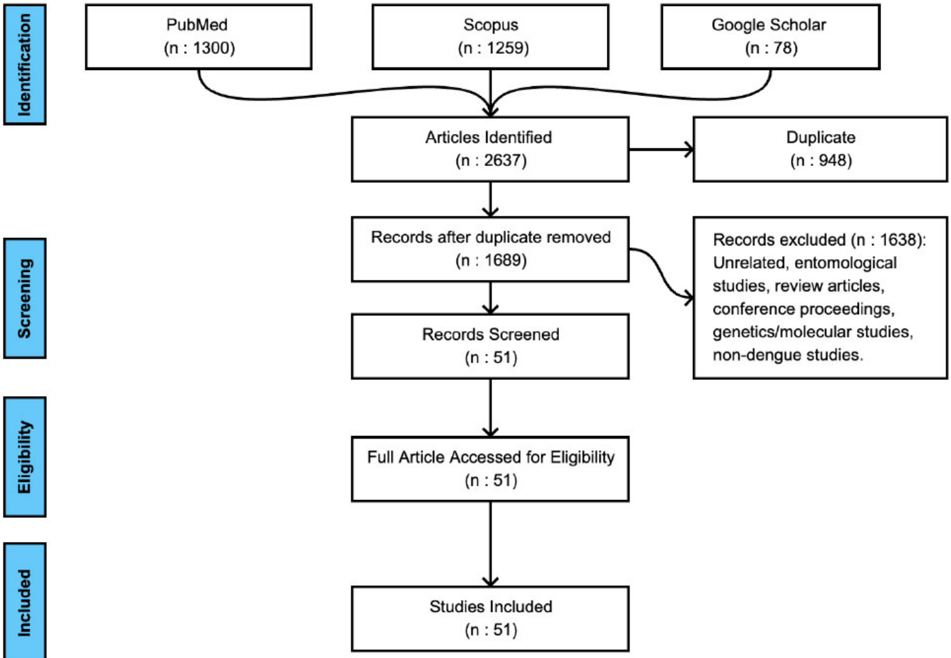
Background Dengue fever is a global concern, with half of the population at risk. Digital Health Interventions (DHIs) have been widely used in Dengue surveillance. Objective The objective of this review is to identify DHIs that have been used in Dengue surveillance. Methods A systematic literature search was performed on three primary databases: PubMed, Scopus, and Google Scholar. A total of 2637 studies, including duplicates, were found to be possibly pertinent to the study topic during the electronic search for the systematic literature review. After the screening of titles and abstracts, 51 studies remained eligible. Results The study analyzed 13 main categories of DHIs in Dengue surveillance, with Brazil, India, Sri Lanka, China, and Indonesia being the top five countries. Geographic Information System was the most used DHIs, followed by Machine Learning, Social Media, Mobile Applications, Google Trends, and Web Applications. DHIs were integrated, as evidenced by the deployment of many DHIs simultaneously in a single Dengue surveillance program. Conclusion Future research should concentrate on finding more efficient ways to combine all available data sources and approaches to improve data completeness and predictive model precision and identify Dengue outbreaks early.
Overview
CoChat Summary
## TL;DR
This scoping review maps digital health interventions (DHIs) used in dengue surveillance to detect, monitor, predict, and forecast outbreaks. It found 51 eligible studies from 2,637 records, with GIS the most common DHI category and Brazil, India, Sri Lanka, China, and Indonesia the most represented countries.
## Key findings
- The search identified 2,637 studies (including duplicates), and 51 studies remained eligible after title/abstract screening.
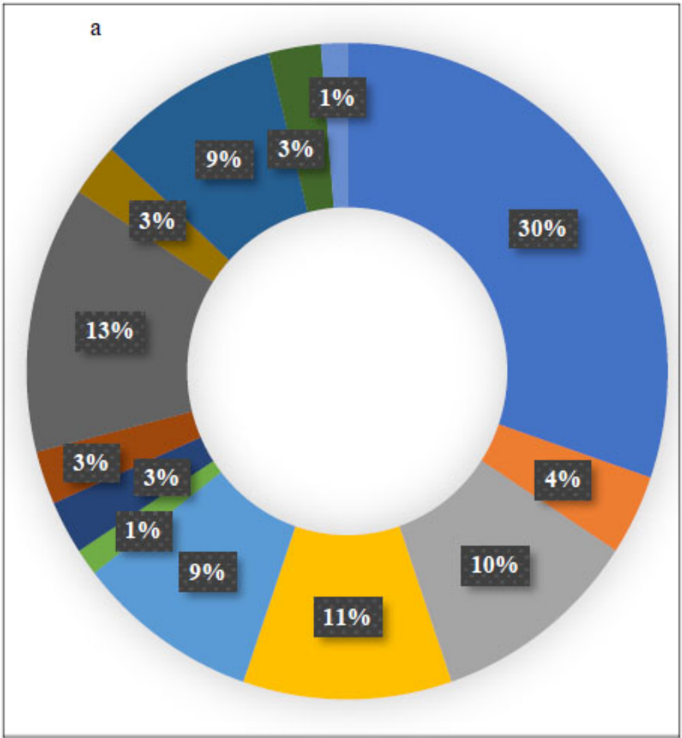
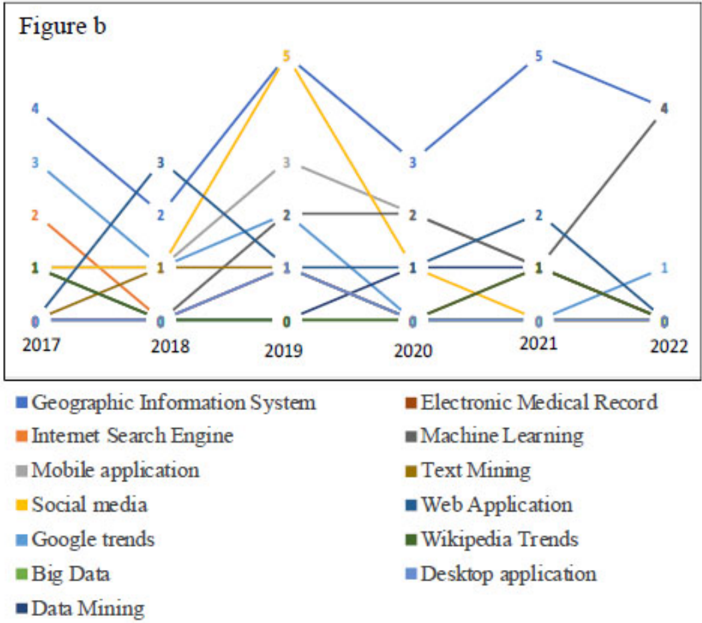
- The review identified 13 main categories of DHIs in dengue surveillance; GIS was the most used (30%), followed by machine learning (13%), social media (11%), mobile applications (10%), Google Trends (9%), and web applications (9%).
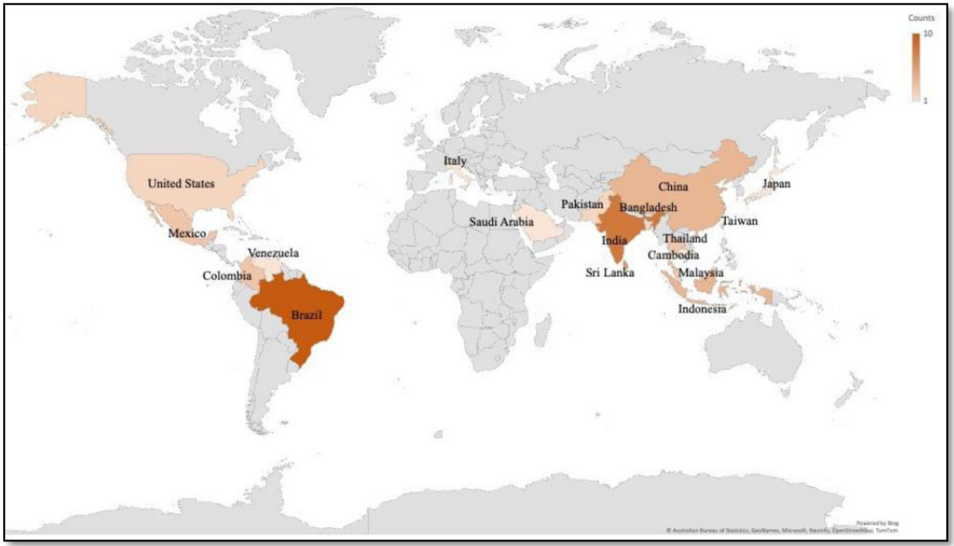
- The top five countries using DHIs in dengue surveillance were Brazil (10 articles), India (8), Sri Lanka (6), China (4), and Indonesia (4).
- The paper states that multiple DHIs are often deployed simultaneously in a single dengue surveillance program, indicating an integrated approach.
## Methods
- The authors conducted a scoping review using the Arksey and O’Malley framework and reported that PRISMA guidelines and methodology were followed.
- They searched PubMed, Scopus, and Google Scholar for English-language studies published between January 2017 and November 2022 that used information technology for dengue surveillance, early detection, prediction, and/or forecasting.
- Screening was done in two stages (titles/abstracts, then full text) by four independent reviewers; the synthesis used descriptive numerical and thematic analyses.
## Limitations
- The paper states that, because the review had a wide scope, the knowledge gap is “not very detailed” and there were no specific categories of DHIs.
- The authors state that neither risk of bias nor study quality were evaluated.
- Evident from the text: the review is limited to English-language studies, 2017–November 2022, and only studies with full text available; it also excluded reviews, editorials, conference proceedings, and entomological-only studies.
Model-written summary. Check it against the paper before relying on it.
Integrity signals
Registry
Cites
Statistics
Figures

Verification
Claims the paper makes
6 Valid · 2 Not valid · 12 Not checked · 47 Own results and interpretations
Every source the paper cites for this claim was checked and supports it.
In the paper
“Mobile phone technology has been applied to improve arbovirus management, prevention, diagnosis, and surveillance over the past ten years [28].”
§ Digital Health Interventions in Dengue Surveillance to Detect and Predict Outbreak: A Scoping Review > 3.1. Characteristic Studies by Trends, Theme, and Categories
What the sources say
- Supportedcites [28] 28. Gluskin RT, Johansson MA, Santillana M, Brownstein JS. Evaluation source
The Conclusions state that, in the last decade, mobile phone technology has been used to enhance surveillance, prevention, diagnosis, and arbovirus management. This directly supports the citing sentence. (LLM, conf=0.95)
plainstates a cause- Asserted: passes — The authors put it forward as true.
- Checkable: passes — It can be checked against evidence.
- Load-bearing: unclear — It is unclear whether the paper’s conclusions depend on it.
- Based: passes — The paper gives a reason why it holds.
- Supported
A result the paper states — it cites no source for it, so there is none to check. The quote shows it is in the paper.
In the paper
“DHIs were integrated, as evidenced by the deployment of many DHIs simultaneously in a single Dengue surveillance program.”
- Also stated in: § 3.2. Digital Health Intervention Categories · hedged
“The interesting thing is that several types of DHIs are used simultaneously to support one Dengue surveillance activity, thus indicating the application of the integrated concept.”
§ Digital Health Interventions in Dengue Surveillance to Detect and Predict Outbreak: A Scoping Review > Abstract
plainstates an association- Asserted: passes — The authors put it forward as true.
- Checkable: passes — It can be checked against evidence.
- Load-bearing: unclear — It is unclear whether the paper’s conclusions depend on it.
- Based: passes — The paper gives a reason why it holds.
- Also stated in: § 3.2. Digital Health Intervention Categories · hedged
A result the paper reports from its own data — it cites no other source for it, so there is none to check. The quote shows it is in the paper.
In the paper
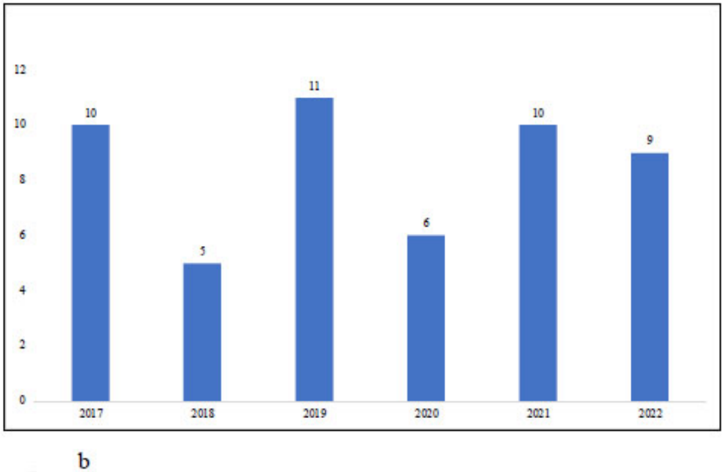
“The study analyzed 13 main categories of DHIs in Dengue surveillance”
- Also stated in: § 3.2. Digital Health Intervention Categories · plain
“This study found 13 different DHIs categories in Dengue surveillance with annual trends (Fig. 3b).”
§ Digital Health Interventions in Dengue Surveillance to Detect and Predict Outbreak: A Scoping Review > Abstract
plain- Asserted: passes — The authors put it forward as true.
- Checkable: passes — It can be checked against evidence.
- Load-bearing: unclear — It is unclear whether the paper’s conclusions depend on it.
- Based: passes — The paper gives a reason why it holds.
- Also stated in: § 3.2. Digital Health Intervention Categories · plain
A result the paper reports from its own data — it cites no other source for it, so there is none to check. The quote shows it is in the paper.
In the paper
“with Brazil, India, Sri Lanka, China, and Indonesia being the top five countries.”
- Also stated in: § 3.3. Geographical Distribution of Digital Health in Dengue Surveillance Studies · plain
“Brazil (10 articles), India (8 articles), Sri Lanka (6 articles), China (4 articles), and Indonesia (4 articles) are the top 5 countries for using DHIs in Dengue surveillance.”
§ Digital Health Interventions in Dengue Surveillance to Detect and Predict Outbreak: A Scoping Review > Abstract
plain- Asserted: passes — The authors put it forward as true.
- Checkable: passes — It can be checked against evidence.
- Load-bearing: unclear — It is unclear whether the paper’s conclusions depend on it.
- Based: passes — The paper gives a reason why it holds.
- Also stated in: § 3.3. Geographical Distribution of Digital Health in Dengue Surveillance Studies · plain
A result the paper reports from its own data — it cites no other source for it, so there is none to check. The quote shows it is in the paper.
In the paper
“After the screening of titles and abstracts, 51 studies remained eligible.”
- Also stated in: § 3. RESULTS AND DISCUSSION · plain
“Following the screening of titles and abstracts, 51 research were found to be eligible (Fig. 1).”
§ Digital Health Interventions in Dengue Surveillance to Detect and Predict Outbreak: A Scoping Review > Abstract
plain- Asserted: passes — The authors put it forward as true.
- Checkable: passes — It can be checked against evidence.
- Load-bearing: unclear — It is unclear whether the paper’s conclusions depend on it.
- Based: passes — The paper gives a reason why it holds.
- Also stated in: § 3. RESULTS AND DISCUSSION · plain
16 more claims
Create a free account to see all 67 claims and to verify the 3 references still open.
- Probably not a substantial claim. 34
- It may state two separate claims as one. 25
- The quote only partly states this claim. 1
Citations
Cites
The One Health Approach—Why Is It So Important?
Mackenzie, J. S., & Jeggo, M. (2019) · Tropical Medicine and Infectious Disease · doi:10.3390/tropicalmed4020088 · Cited by 903
Dengue virus: epidemiology, biology, and disease aetiology
Roy, S. K., & Bhattacharjee, S. (2021) · Canadian Journal of Microbiology · doi:10.1139/cjm-2020-0572 · Cited by 440
Dengue Fever: Causes, Complications, and Vaccine Strategies
Khetarpal, N., & Khanna, I. (2016) · Journal of Immunology Research · doi:10.1155/2016/6803098 · Cited by 363
Social Media– and Internet-Based Disease Surveillance for Public Health
Aiello, A. E., Renson, A., & Zivich, P. N. (2020) · Annual Review of Public Health · doi:10.1146/annurev-publhealth-040119-094402 · Cited by 349
Westphaln, K. K., Regoeczi, W., Masotya, M., Vazquez-Westphaln, B., Lounsbury, K., McDavid, L., Lee, H., Johnson, J., & Ronis, S. D. (2021) · MethodsX · doi:10.1016/j.mex.2021.101375 · Cited by 333
Wang, W.-H., Urbina, A. N., Chang, M. R., Assavalapsakul, W., Lu, P.-L., Chen, Y.-H., & Wang, S.-F. (2020) · Journal of Microbiology, Immunology and Infection · doi:10.1016/j.jmii.2020.03.007 · Cited by 310
Developing a dengue forecast model using machine learning: A case study in China
Guo, P., Liu, T., Zhang, Q., Wang, L., Xiao, J., Zhang, Q., Luo, G., Li, Z., He, J., Zhang, Y., et al. (2017) · PLOS Neglected Tropical Diseases · doi:10.1371/journal.pntd.0005973 · Cited by 263
Dengue infection: Global importance, immunopathology and management
Kularatne, S. A., & Dalugama, C. (2022) · Clinical Medicine · doi:10.7861/clinmed.2021-0791 · Cited by 258
Dengue: knowledge gaps, unmet needs, and research priorities
Katzelnick, L. C., Coloma, J., & Harris, E. (2017) · The Lancet Infectious Diseases · doi:10.1016/s1473-3099(16)30473-x · Cited by 211
What is Digital Health? Review of Definitions
Fatehi, F., Samadbeik, M., & Kazemi, A. (2020) · Studies in Health Technology and Informatics · doi:10.3233/shti200696 · Cited by 179
Application of GIS technology in public health: successes and challenges
Fletcher, S., & Caprarelli, G. (2016) · Parasitology · doi:10.1017/s0031182015001869 · Cited by 169
Using Twitter for Public Health Surveillance from Monitoring and Prediction to Public Response
Jordan, S. E., Hovet, S. E., Fung, I. C.-H., Liang, H., Fu, K.-W., & Tse, Z. T. H. (2018) · Data · doi:10.3390/data4010006 · Cited by 167
Prediction of dengue outbreaks based on disease surveillance, meteorological and socio-economic data
Jain, R., Sontisirikit, S., Iamsirithaworn, S., & Prendinger, H. (2019) · BMC Infectious Diseases · doi:10.1186/s12879-019-3874-x · Cited by 156
Evaluation of internet-based dengue query data: Google dengue trends
Gluskin, R. T., Johansson, M. A., Santillana, M., & Brownstein, J. S. (2014) · PLoS Neglected Tropical Diseases · doi:10.1371/journal.pntd.0002713 · Cited by 125
Advances in using Internet searches to track dengue
Yang, S., Kou, S. C., Lu, F., Brownstein, J. S., Brooke, N. J., & Santillana, M. (2017) · PLoS Computational Biology · doi:10.1371/journal.pcbi.1005607 · Cited by 115
Marques-Toledo, C. D. A., Degener, C. M., Vinhal, L., Coelho, G., Meira, W., Codeço, C. T., & Teixeira, M. M. (2017) · PLOS Neglected Tropical Diseases · doi:10.1371/journal.pntd.0005729 · Cited by 113
Searching for the proverbial needle in a haystack: advances in mosquito-borne arbovirus surveillance
Ramírez, A. L., van den Hurk, A. F., Meyer, D. B., & Ritchie, S. A. (2018) · Parasites & Vectors · doi:10.1186/s13071-018-2901-x · Cited by 108
Correlation between Google Trends on dengue fever and national surveillance report in Indonesia
Husnayain, A., Fuad, A., & Lazuardi, L. (2019) · Global Health Action · doi:10.1080/16549716.2018.1552652 · Cited by 107
Sirisena, P., Noordeen, F., Kurukulasuriya, H., Romesh, T. A., & Fernando, L. (2017) · PLoS ONE · doi:10.1371/journal.pone.0166806 · Cited by 102
Ibarra, A. M. S., Luzadis, V. A., Borbor-Cordova, M. J., Silva, M., Ordoñez, T., Ayala, E. B., & Ryan, S. J. (2014) · BMC Public Health · doi:10.1186/1471-2458-14-1135 · Cited by 102
Sylvestre, E., Joachim, C., Cécilia‐Joseph, E., Bouzillé, G., Campillo‐Gimenez, B., Cuggia, M., & Cabie, A. (2022) · PLoS neglected tropical diseases · doi:10.1371/journal.pntd.0010056 · Cited by 102
Li, Z., Liu, T., Zhu, G., Lin, H., Zhang, Y., He, J., Deng, A., Peng, Z., Xiao, J., Rutherford, S., et al. (2017) · PLoS neglected tropical diseases · doi:10.1371/journal.pntd.0005354 · Cited by 93
Hussain‐Alkhateeb, L., Kroeger, A., Olliaro, P., Rocklöv, J., Sewe, M. O., Tejeda, G. S., Benítez, D., Gill, B. S., Hakim, S. L., Carvalho, R. G., et al. (2018) · PLoS ONE · doi:10.1371/journal.pone.0196811 · Cited by 84
Google dengue trends: An indicator of epidemic behavior. The Venezuelan Case
Strauss, R. A., Castro, J. S., Reintjes, R., & Torres, J. R. (2017) · International Journal of Medical Informatics · doi:10.1016/j.ijmedinf.2017.05.003 · Cited by 84
Comparing machine learning with case-control models to identify confirmed dengue cases
Ho, T., Weng, T.-C., Wang, J., Han, H., Cheng, H., Yang, C.-C., Yu, C.-H., Liu, Y.-J., Hu, C. H., Huang, C.-Y., et al. (2020) · PLoS neglected tropical diseases · doi:10.1371/journal.pntd.0008843 · Cited by 84
Roster, K. I. O., Connaughton, C., & Rodrigues, F. A. (2022) · American Journal of Epidemiology · doi:10.1093/aje/kwac090 · Cited by 65
Amin, S., Uddin, M. I., Hassan, S., Khan, A., Nasser, N., Alharbi, A., & Alyami, H. (2020) · IEEE Access · doi:10.1109/access.2020.3009058 · Cited by 64
The use of mobile phones for the prevention and control of arboviral diseases: a scoping review
Carrillo, M. A., Kroeger, A., Cardenas Sanchez, R., Diaz Monsalve, S., & Runge-Ranzinger, S. (2021) · BMC Public Health · doi:10.1186/s12889-020-10126-4 · Cited by 64
Digital surveillance for enhanced detection and response to outbreaks
Anema, A., Kluberg, S., Wilson, K., Hogg, R. S., Khan, K., Hay, S. I., Tatem, A. J., & Brownstein, J. S. (2014) · The Lancet Infectious Diseases · doi:10.1016/s1473-3099(14)70953-3 · Cited by 54
Spatial Dynamics of Dengue Fever in Mainland China, 2019
(2021) · doi:10.3390/ijerph18062855 · Cited by 51
Lessons From the Implementation of Mo-Buzz, a Mobile Pandemic Surveillance System for Dengue
Lwin, M. O., Jayasundar, K., Sheldenkar, A., Wijayamuni, R., Wimalaratne, P., Ernst, K. C., & Foo, S. (2017) · JMIR Public Health and Surveillance · doi:10.2196/publichealth.7376 · Cited by 50
Guo, P., Zhang, Q., Chen, Y., Xiao, J., He, J., Zhang, Y., Wang, L., Liu, T., & Ma, W. (2018) · The Science of The Total Environment · doi:10.1016/j.scitotenv.2018.08.044 · Cited by 47
Wei, S., Xue, L., & Xie, X. (2017) · Scientific Reports · doi:10.1038/s41598-017-13163-z · Cited by 44
Ramadona, A. L., Tozan, Y., Lazuardi, L., & Rocklöv, J. (2019) · PLOS Neglected Tropical Diseases · doi:10.1371/journal.pntd.0007298 · Cited by 42
Ho, H. T., Carvajal, T. M., Bautista, J. R., Capistrano, J. D. R., Viacrusis, K. M., Hernandez, L. F. T., & Watanabe, K. (2018) · Tropical Medicine and Infectious Disease · doi:10.3390/tropicalmed3040118 · Cited by 41
Rangarajan, P., Mody, S. K., & MARATHE, M. V. (2019) · PLoS Computational Biology · doi:10.1371/journal.pcbi.1007518 · Cited by 41
Herbuela, V. R. D. M., Karita, T., Francisco, M. E., & Watanabe, K. (2019) · JMIR Formative Research · doi:10.2196/16424 · Cited by 39
Sousa, L., de Mello, R., Cedrim, D., Garcia, A., Missier, P., Uchôa, A., Oliveira, A., & Romanovsky, A. (2018) · Information Systems · doi:10.1016/j.is.2018.02.003 · Cited by 39
Ashby, J. L., Moreno-Madriñán, M. J., Yiannoutsos, C. T., & Stanforth, A. (2017) · Remote Sensing · doi:10.3390/rs9040328 · Cited by 38
Babu, A. N., Niehaus, E., Shah, S., Unnithan, C. R., Ramkumar, P. S., Shah, J., Binoy, V. V., Soman, B., Arunan, M. C., & Jose, C. P. (2019) · Environmental Monitoring and Assessment · doi:10.1007/s10661-019-7425-0 · Cited by 38
How heterogeneous is the dengue transmission profile in Brazil? A study in six Brazilian states
de Almeida, I. F., Lana, R. M., & Codeço, C. T. (2022) · PLoS neglected tropical diseases · doi:10.1371/journal.pntd.0010746 · Cited by 37
Spatial and temporal analysis of hospitalized dengue patients in Bandung: demographics and risk
Faridah, L., Jaya, I. G. N. M., Putra, R. E., Fauziah, N., Agustian, D., Natalia, Y. A., & Watanabe, K. (2021) · Tropical Medicine and Health · doi:10.1186/s41182-021-00329-9 · Cited by 32
Where did I get dengue? Detecting spatial clusters of infection risk with social network data
Souza, R. C. S. N. P., Assunção, R., Oliveira, D. M., Neill, D. B., & Meira, W. (2018) · Spatial and Spatio-temporal Epidemiology · doi:10.1016/j.sste.2018.11.005 · Cited by 31
Disease surveillance using online news: Dengue and zika in tropical countries
Zhang, Y., Ibaraki, M., & Schwartz, F. W. (2020) · Journal of Biomedical Informatics · doi:10.1016/j.jbi.2020.103374 · Cited by 30
Trends and Spatial Pattern Analysis of Dengue Cases in Northeast Malaysia
Masrani, A. S., Husain, N. R. N., Musa, K. I., & Yasin, A. S. (2022) · Journal of Preventive Medicine and Public Health · doi:10.3961/jpmph.21.461 · Cited by 28
Withanage, G. P., Gunawardana, M., Viswakula, S., Samaraweera, K., Gunawardena, N. S., & Hapugoda, M. D. (2021) · Scientific Reports · doi:10.1038/s41598-021-83204-1 · Cited by 28
Dengue Fever Surveillance in India Using Text Mining in Public Media
Villanes, A., Griffiths, E., Rappa, M. A., & Healey, C. G. (2017) · American Journal of Tropical Medicine and Hygiene · doi:10.4269/ajtmh.17-0253 · Cited by 27
Dórea, F. C., & Revie, C. W. (2021) · Frontiers in Veterinary Science · doi:10.3389/fvets.2021.633977 · Cited by 27
Rodríguez, S., Sanz, A. M., Llano, G., Andres Navarro, C., Parra‐Lara, L. G., Krystosik, A., & Rosso, F. (2020) · PLoS ONE · doi:10.1371/journal.pone.0233269 · Cited by 26
Temporal and spatial patterns of dengue geographical distribution in Jeddah, Saudi Arabia
Al-Nefaie, H., Alsultan, A., & Abu-Saris, R. (2022) · Journal of Infection and Public Health · doi:10.1016/j.jiph.2022.08.003 · Cited by 26
Harsha, G., Anish, T. S., Rajaneesh, A., Prasad, M. K., Mathew, R., Mammen, P. C., Ajin, R. S., & Kuriakose, S. L. (2022) · GeoJournal · doi:10.1007/s10708-022-10757-7 · Cited by 25
Epihack Sri Lanka: development of a mobile surveillance tool for dengue fever
Lwin, M. O., Sheldenkar, A., Panchapakesan, C., Ng, J. S., Lau, J., Jayasundar, K., Horathalge, K., Rathnayake, V. S., Crawley, A. W., & Wimalaratne, P. (2019) · BMC Medical Informatics and Decision Making · doi:10.1186/s12911-019-0829-5 · Cited by 25
Koplewitz, G., Lu, F., Clemente, L., Buckee, C. O., & Santillana, M. (2022) · PLoS neglected tropical diseases · doi:10.1371/journal.pntd.0010071 · Cited by 23
Ruberto, I., Marques, E. T. A., Burke, D. S., & van Panhuis, W. G. (2015) · PLoS neglected tropical diseases · doi:10.1371/journal.pntd.0003511 · Cited by 22
Herbuela, V. R. D. M., Karita, T., Carvajal, T. M., Ho, H. T., Lorena, J. M. O., Regalado, R. A., Sobrepeña, G. D., & Watanabe, K. (2021) · JMIR Public Health and Surveillance · doi:10.2196/19034 · Cited by 22
Dengue in India: Towards a better understanding of priorities and progress
Shet, A., & Kang, G. (2019) · International Journal of Infectious Diseases · doi:10.1016/j.ijid.2019.03.008 · Cited by 21
Ocampo, C. B., Mina, N. J., Echavarría, M. I., Acuña, M., Caballero, A., Andres Navarro, C., Aguirre, A., Criollo, I., Forero, F., Cortes-Azuero, O., et al. (2019) · Global Health Science and Practice · doi:10.9745/ghsp-d-18-00300 · Cited by 21
Spatio-temporal dynamics of dengue-related deaths and associated factors
Santana, L. M. R., Baquero, O. S., Maeda, A. Y., Nogueira, J. S., & Neto, F. C. (2022) · Revista do Instituto de Medicina Tropical de São Paulo · doi:10.1590/s1678-9946202264030 · Cited by 20
Spatiotemporal clustering of dengue cases in Thiruvananthapuram district, Kerala
Soman, B., & Valson, J. S. (2017) · Indian Journal of Public Health · doi:10.4103/ijph.ijph_26_16 · Cited by 18
Ledien, J., Kimsan, S., Leang, R., Huy, R., Cousien, A., Peas, M., Froehlich, Y., Duboz, R., Ong, S., Duong, V., et al. (2019) · PLoS ONE · doi:10.1371/journal.pone.0212003 · Cited by 18
Disease Surveillance System for Big Climate Data Processing and Dengue Transmission
Manogaran, G., & Lopez, D. (2018) · IGI Global eBooks · doi:10.4018/978-1-5225-5487-5.ch022 · Cited by 17
Baak‐Baak, C. M., Cigarroa-Toledo, N., Pinto-Castillo, J. F., Cetina-Trejo, R. C., Torres-Chable, O. M., Blitvich, B. J., & Garcia-Rejon, J. E. (2022) · American Journal of Tropical Medicine and Hygiene · doi:10.4269/ajtmh.21-0409 · Cited by 15
Spatiotemporal patterns of dengue outbreaks in Sri Lanka
(2020) · doi:10.1080/23744235.2020.1725108 · Cited by 12
Development Innovation to Predict Dengue Affected Area and Alert People with Smartphones
Somboonsak, P. (2020) · International Journal of Online and Biomedical Engineering (iJOE) · doi:10.3991/ijoe.v16i02.12425 · Cited by 12
A joint spatial marked point process model for dengue and severe dengue in Medellin, Colombia
Carabalí, M., Schmidt, A. M., Restrepo, B. N., & Kaufman, J. S. (2022) · Spatial and Spatio-temporal Epidemiology · doi:10.1016/j.sste.2022.100495 · Cited by 8
Purnama, S., Susanna, D., Achmadi, U. F., Krianto, T., & Eryando, T. (2021) · Open Access Macedonian Journal of Medical Sciences · doi:10.3889/oamjms.2021.7653 · Cited by 7
Disease surveillance using online news: an extended study of dengue fever in India
Zhang, Y., Ibaraki, M., & Schwartz, F. W. (2019) · Tropical Medicine and Health · doi:10.1186/s41182-019-0189-y · Cited by 7
Geographical Information Systems for Dengue Surveillance
Duncombe, J., Clements, A., Hu, W., Weinstein, P., Ritchie, S. A., & Espino, F. E. (2012) · American Journal of Tropical Medicine and Hygiene · doi:10.4269/ajtmh.2012.11-0650 · Cited by 7
DenMap: A Dengue Surveillance System for Malaysia
(2018) · doi:10.1088/1742-6596/1123/1/012045 · Cited by 6
Role of radiology in COVID-19 pandemic and post COVID-19 potential effects on radiology practices
Ahmad, W., & Ahmad, U. (2021) · Indian Journal of Radiology and Imaging · doi:10.4103/ijri.ijri_536_20 · Cited by 6
Khalique, F., Shaheen, R., & Khan, S. A. (2020) · IEEE Access · doi:10.1109/access.2020.3027234 · Cited by 5
Parikh, N., Daughton, A. R., Rosenberger, W. E., Aberle, D., Chitanvis, M. E., Altherr, F. M., Velappan, N., Fairchild, G. C., & Deshpande, A. (2021) · JMIR Public Health and Surveillance · doi:10.2196/24132 · Cited by 5
Chang, Y., Chiu, Y.-W., & Chuang, T. (2022) · JMIR Public Health and Surveillance · doi:10.2196/34583 · Cited by 5
A descriptive analysis of dengue in Peace Corps Volunteers, 2000–2019
Gulley, C. T., Murphy, D. E., Poe, S. A., & Petersen, K. (2021) · Travel Medicine and Infectious Disease · doi:10.1016/j.tmaid.2021.102125 · Cited by 4
Ramesh, N., Thimmaiah, V., Mallaiah, S., & Kandaswamy, A. (2021) · Indian Journal of Community Health · doi:10.47203/ijch.2021.v33i01.021 · Cited by 1
Lin, P. (2021) · Statistics in Medicine · doi:10.1002/sim.9227 · Cited by 1
Climate Change and Environmental Concerns
(2018) · IGI Global eBooks · doi:10.4018/978-1-5225-5487-5
Research works printed but not linked: 2
- 7. control 2012-2020. world health organization. 2012. Available from:http://scholar.google.com/scholar?hl=en&btnG=Search&q=intitl e:Global+strategy+for+dengue+prevention+and+control#8
- 21. Snow J. On the mode of communication of cholera. Edinb Med J [19] 1856; 1: 668-70. Esri. Map a historic cholera outbreak Available from:
Cited by
Leveraging geographic information system for dengue surveillance: a scoping review
Nayak, P. P., Jagadeesha Pai, B., & Govindan, S. (2025) · Tropical Medicine and Health · doi:10.1186/s41182-025-00783-9 · Cited by 39
Pham, C. T., Nguyen, H. T., Le, H. H. T. C., Tran, N. Q. L., Quoc, D. K., Bui, V., Phung, H. N., Phung, D. T., & Chu, C. M.-Y. (2025) · Tropical Medicine & International Health · doi:10.1111/tmi.70045 · Cited by 27
Salim, M. F., Satoto, T. B. T., & Danardono, D. (2025) · BMC Public Health · doi:10.1186/s12889-025-22545-2 · Cited by 26
Self-citationFernando, D. B. S., & Rani, K. S. S. (2024) · Journal of Biomedical Nanotechnology · doi:10.1166/jbn.2024.3935 · Cited by 1
Metadata
- Authors
- Salim, M. F., Satoto, T. B. T., ., D., & Daniel, D.
- Affiliations
- Universitas Gadjah Mada (ID)
- Corresponding author
- Salim, Marko Ferdian
- Venue
- The Open Public Health Journal
- Publisher
- Bentham Science Publishers Ltd.
- Published
- 2024-01-19
- Volume
- 17
- Issue
- 1
- ISSN
- 1874-9445 (ISSN-L)
- OpenAlex
- W4391851305
- Cited by
- 13
- References
- 84
- Citations by year
- 2026: 5 · 2025: 4 · 2024: 4
- FWCI
- 3.94
- Type
- journal article
- Language
- en
- Open access
- diamond
- doi.org
- Locations
- The Open Public Health Journal (publishedVersion, cc-by)
- Topics
- Health Sciences › Medicine › Epidemiology › Data-Driven Disease Surveillance
- Health Sciences › Medicine › Public Health, Environmental and Occupational Health › Mosquito-borne diseases and control
- Health Sciences › Medicine › Public Health, Environmental and Occupational Health › Dengue and Mosquito Control Research
- Keywords
- dengue surveillance, digital health interventions, epidemic forecasting, geographic information systems, machine learning, social media, mobile application, Google Trends, web application, integrated surveillance systems
About these checks
Registry, retraction, Cites and statistics results are computed, not judged, with one exception: a printed reference that no index lists is read once by a model before it counts as a citation error. Claims are extracted by a model and kept only when their quote appears verbatim in the text; each cited source is then checked, with a model’s help, for whether it says what the claim relies on. Those verdicts can be wrong — read the claim’s quote and the cited source before relying on one.
The claim verdicts this report counts are experimental: their accuracy is not yet measured.
A language model drew the claims from the paper on 2026-10-10, under version 3 of the claim definition (model deepseek-v4.1-flash, prompt extract-v3).
A second model labelled each claim on 2026-10-10 (model jev-1.13-20260917, definition revision gold-guideline-v0.2).
Cited sources are checked with a language model’s help (gpt-6-sol).
Statistics and arithmetic are recomputed, not judged.
Confidence bands are shown only for fields calibrated on our annotated test set. None is calibrated yet, so no band is shown.
What counts as a claim ›How we measure confidence ›How we check this ›
Are you an author, or do you see a problem with this page? Request a review
Data sources
Bibliographic data: Semantic Scholar, OpenAlex, Crossref.
Contains information from the Semantic Scholar Academic Graph Datasets, made available under the ODC Attribution License (ODC-BY 1.0).
Semantic Scholar’s data is described in: Kinney, R., et al. (2023). The Semantic Scholar Open Data Platform. arXiv:2301.10140.
