

The DOI matches its Crossref record; 63 of the 64 references it cites were found in a registry or an index.
DREADD in Parvalbumin Interneurons of the Dentate Gyrus Modulates Anxiety, Social Interaction and Memory Extinction
Open accessAbstract
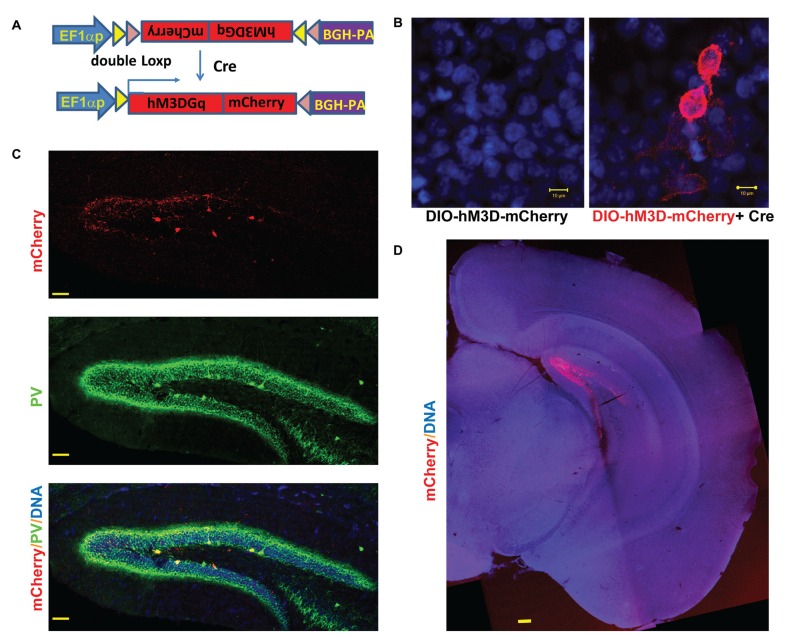
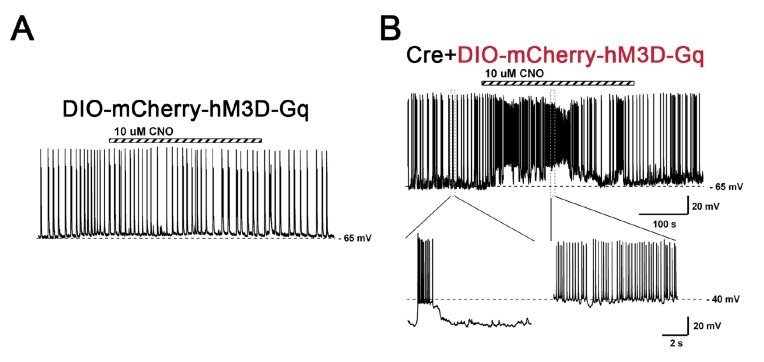
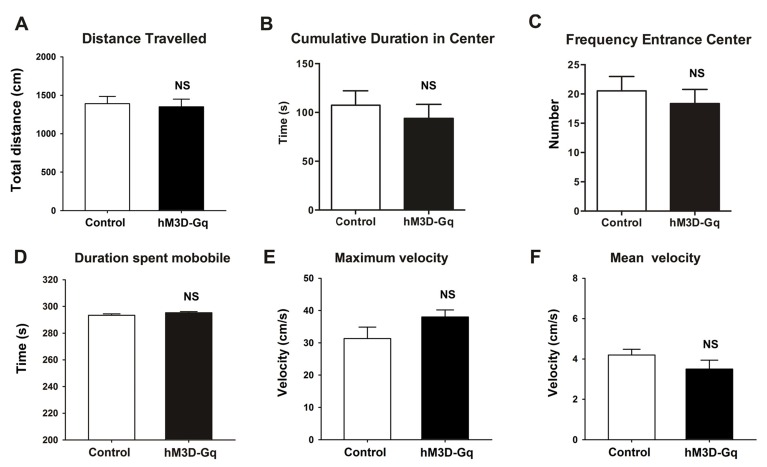
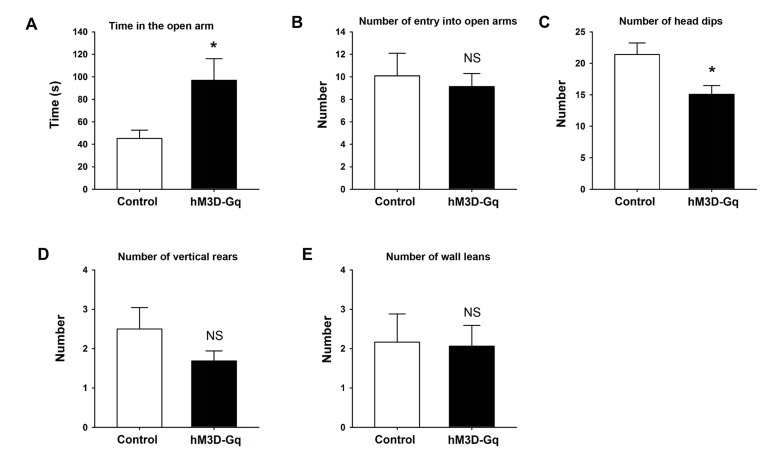
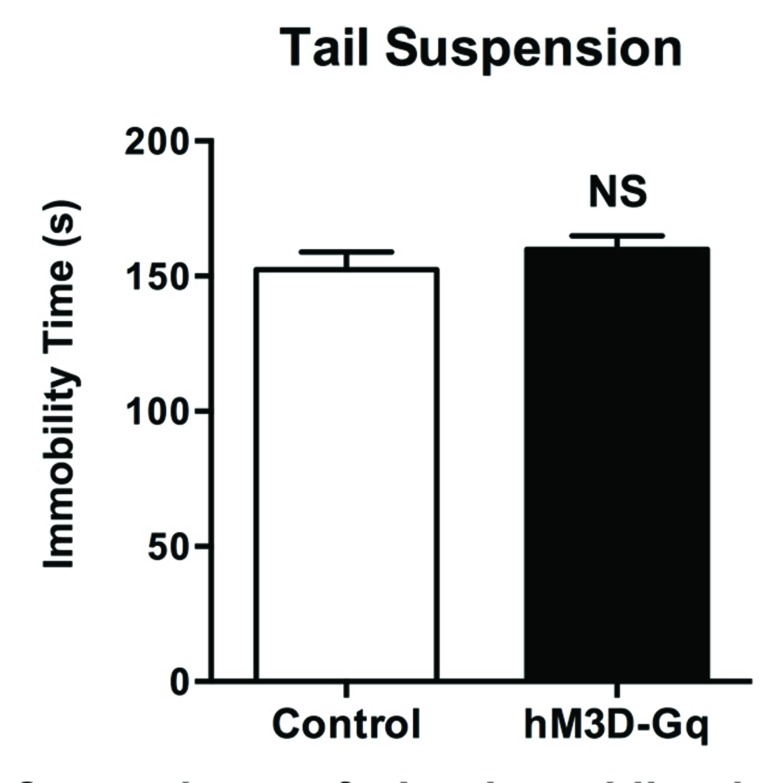
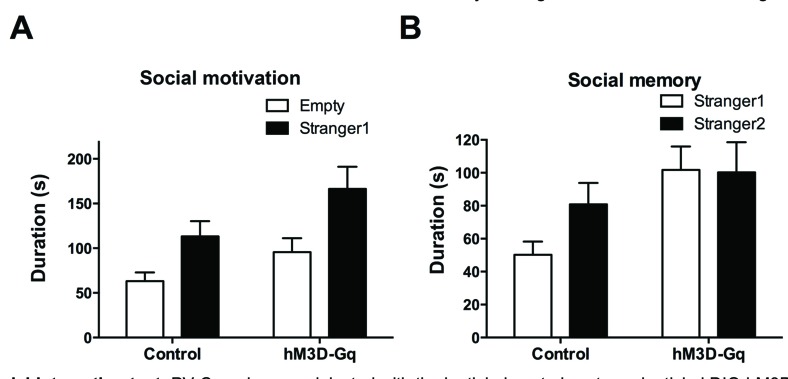
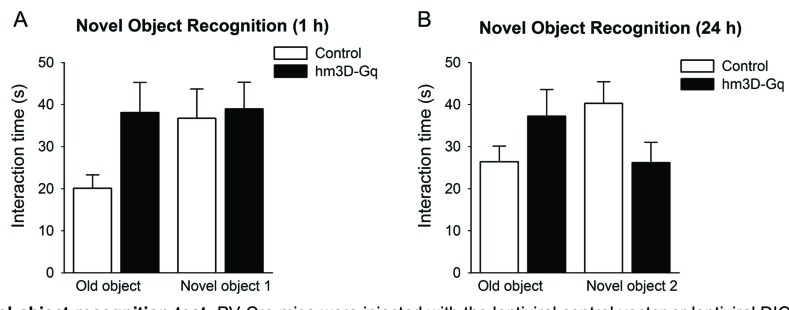
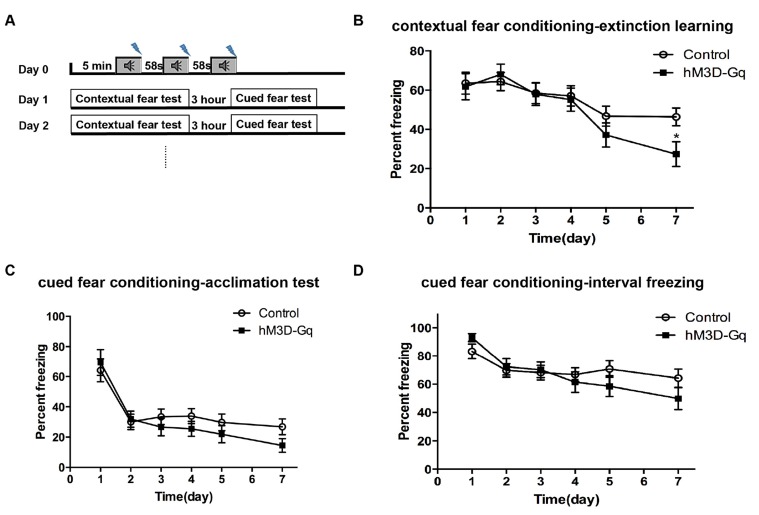
Parvalbumin (PV)-positive interneurons in the hippocampus play a critical role in animal memory, such as spatial working memory. However, how PV-positive interneurons in the subregions of the hippocampus affect animal behaviors remains poorly defined. Here, we achieved specific and reversible activation of PV-positive interneurons using designer receptors exclusively activated by designer drugs (DREADD) technology. Inducible DREADD expression was demonstrated in vitro in cultured neurons, in which co-transfection of the hM3D-Gq-mCherry vector with a Cre plasmid resulted in a cellular response to hM3Dq ligand clozapine-N-oxide (CNO) stimulation. In addition, the dentate gyrus (DG) of PV-Cre mice received bilateral injection of control lentivirus or lentivirus expressing double floxed hM3D-Gq-mCherry. Selective activation of PV-positive interneurons in the DG did not affect locomotor activity or depression-related behavior in mice. Interestingly, stimulation of PV-positive interneurons induced an anxiolytic effect. Activation of PVpositive interneurons appears to impair social interaction to novelty, but has no effect on social motivation. However, this defect is likely due to the anxiolytic effect as the exploratory behavior of mice expressing hM3DGq is significantly increased. Mice expressing hM3D-Gq did not affect novel object recognition. Activation of PV-positive interneurons in the DG maintains intact cued and contextual fear memory but facilitates fear extinction. Collectively, our results demonstrated that proper control of PV interneurons activity in the DG is critical for regulation of the anxiety, social interaction and fear extinction. These results improve our fundamental understanding of the physiological role of PV-positive interneurons in the hippocampus.
Overview
The claims and statistics of this paper haven’t been checked yet.
Run the check — free, no account needed. It reads the open-access text and checks the sources it cites.
Integrity signals
Registry
Cites
Statistics
Figures
Verification
Claims the paper makes
The claims and statistics of this paper haven’t been checked yet.
Run the check — free, no account needed. It reads the open-access text and checks the sources it cites.
Claims other papers make about this one
Each is checked against this paper’s own text: does it say what the citing paper says it does?
In the citing paper
“However, lesions in the dorsal dentate gyrus did not induce NOP/OPP deficits in rats (Beselia et al., 2010), and DREADD activation of GABAergic parvalbumin neurons in the dentate gyrus also showed no effect in the NOP test, but influenced anxiety-like behaviors, social novelty and contextual fear extinction in mice (Zou et al., 2016).”
From The medial prefrontal cortex - hippocampus circuit that integrates information of object, place and time to construct episodic memory in rodents: Behavioral, anatomical and neurochemical properties (2020) · cites this paper as Zou et al., 2016
Self-check
Percentages, sums and reported differences re-computed from the paper’s own numbers.
The self-check needs the paper’s full text.
Citations
Cites
The tail suspension test: A new method for screening antidepressants in mice
Steru, L., Chermat, R., Thierry, B., & Simon, P. (1985) · Psychopharmacology · doi:10.1007/bf00428203 · Cited by 3,534
The use of the elevated plus maze as an assay of anxiety-related behavior in rodents
Walf, A. A., & Frye, C. A. (2007) · Nature Protocols · doi:10.1038/nprot.2007.44 · Cited by 3,035
Synaptic mechanisms of synchronized gamma oscillations in inhibitory interneuron networks
Bartos, M., Vida, I., & Jonas, P. (2007) · Nature Reviews Neuroscience · doi:10.1038/nrn2044 · Cited by 2,070
Armbruster, B. N., Li, X., Pausch, M. H., Herlitze, S., & Roth, B. L. (2007) · Proceedings of the National Academy of Sciences · doi:10.1073/pnas.0700293104 · Cited by 2,046
The development and application of optogenetics
Fenno, L., Yizhar, O., & Deisseroth, K. (2011) · Annual Review of Neuroscience · doi:10.1146/annurev-neuro-061010-113817 · Cited by 1,822
Increasing adult hippocampal neurogenesis is sufficient to improve pattern separation
Sahay, A., Scobie, K. N., Hill, A. S., O'Carroll, C. M., Kheirbek, M. A., Burghardt, N. S., Fenton, A. A., Dranovsky, A., & Hen, R. (2011) · Nature · doi:10.1038/nature09817 · Cited by 1,567
Bevins, R. A., & Besheer, J. (2006) · Nature Protocols · doi:10.1038/nprot.2006.205 · Cited by 1,278
Verret, L., Mann, E. O., Hang, G. B., Barth, A. M. I., Cobos, I., Ho, K., Devidze, N., Masliah, E., Kreitzer, A. C., Mody, I., et al. (2012) · Cell · doi:10.1016/j.cell.2012.02.046 · Cited by 1,216
Fast-spiking, parvalbumin + GABAergic interneurons: From cellular design to microcircuit function
Hu, H., Gan, J., & Jonas, P. (2014) · Science · doi:10.1126/science.1255263 · Cited by 1,197
Interneuron dysfunction in psychiatric disorders
Marín, O. (2012) · Nature Reviews Neuroscience · doi:10.1038/nrn3155 · Cited by 1,190
Cited by
Sorted by citations
Hippocampal GABAergic Inhibitory Interneurons
Pelkey, K. A., Chittajallu, R., Craig, M. T., Tricoire, L., Wester, J. C., & McBain, C. J. (2017) · Physiological Reviews · doi:10.1152/physrev.00007.2017 · Cited by 889
A viral strategy for targeting and manipulating interneurons across vertebrate species
Dimidschstein, J., Chen, Q., Tremblay, R., Rogers, S. L., Saldi, G.-A., Guo, L., Xu, Q., Liu, R., Lu, C., Chu, J., et al. (2016) · Nature Neuroscience · doi:10.1038/nn.4430 · Cited by 541
Cortical GABAergic Dysfunction in Stress and Depression: New Insights for Therapeutic Interventions
Fogaça, M. V., & Duman, R. S. (2019) · Frontiers in Cellular Neuroscience · doi:10.3389/fncel.2019.00087 · Cited by 396
Chao, O. Y., de Souza Silva, M. A., Yang, Y.-M., & Huston, J. P. (2020) · Neuroscience & Biobehavioral Reviews · doi:10.1016/j.neubiorev.2020.04.007 · Cited by 158
Anxiety and hippocampal neuronal activity: Relationship and potential mechanisms
Ghasemi, M., Navidhamidi, M., Rezaei, F., Azizikia, A., & Mehranfard, N. (2021) · Cognitive Affective & Behavioral Neuroscience · doi:10.3758/s13415-021-00973-y · Cited by 175
Metadata
- Authors
- Zou, D., Chen, L., Deng, D., Jiang, D., Dong, F., McSweeney, C., Zhou, Y., Liu, L., Chen, G., Wu, Y., & Mao, Y.
- Affiliations
- Pennsylvania State University (US)
- Guangxi Medical University (CN)
- Corresponding author
- Wu, Y.
- Mao, Y.
- Venue
- Current Molecular Medicine
- Publisher
- Bentham Science Publishers Ltd.
- Published
- 2016-01-08
- Volume
- 16
- Issue
- 1
- Pages
- 91-102
- ISSN
- 1566-5240 (ISSN-L)
- PMC
- PMC4997952
- OpenAlex
- W2202096406
- Cited by
- 112
- References
- 64
- Citations by year
- 2026: 4 · 2025: 8 · 2024: 3 · 2023: 8 · 2022: 22 · 2021: 23 · 2020: 14 · 2019: 14 · 2018: 3 · 2017: 9 · 2016: 4
- FWCI
- 6.36
- Type
- journal article
- Language
- en
- Open access
- bronze
- doi.org
- Locations
- Current Molecular Medicine (publishedVersion)
- PubMed Central (publishedVersion, cc-by-nc)
- PubMed (publishedVersion)
- Funders
- National Alliance for Research on Schizophrenia and Depression
- National Natural Science Foundation of China (81160167, 81360201)
- Topics
- Life Sciences › Neuroscience › Cognitive Neuroscience › Memory and Neural Mechanisms
- Life Sciences › Neuroscience › Cellular and Molecular Neuroscience › Neuroscience and Neuropharmacology Research
- Life Sciences › Neuroscience › Cellular and Molecular Neuroscience › Neurotransmitter Receptor Influence on Behavior
- Keywords
- parvalbumin interneurons, dentate gyrus, DREADD, clozapine-N-oxide, optogenetic stimulation, anxiety, social interaction, fear extinction, fear memory, hippocampus, social motivation, novel object recognition
- MeSH terms
- Animals, Anxiety, Anxiety Disorders, Depression, Fear, Hippocampus, Humans, Interneurons, Interpersonal Relations, Male, Memory, Motor Activity, Parvalbumins, Dentate Gyrus, Mice, HEK293 Cells
About these checks
Registry, retraction, Cites and statistics results are computed, not judged, with one exception: a printed reference that no index lists is read once by a model before it counts as a citation error. Claims are extracted by a model and kept only when their quote appears verbatim in the text; each cited source is then checked, with a model’s help, for whether it says what the claim relies on. Those verdicts can be wrong — read the claim’s quote and the cited source before relying on one.
Statistics and arithmetic are recomputed, not judged.
Confidence bands are shown only for fields calibrated on our annotated test set. None is calibrated yet, so no band is shown.
What counts as a claim ›How we measure confidence ›How we check this ›
Are you an author, or do you see a problem with this page? Request a review
