

Long-Term Response to Galantamine in Relation to Short-Term Efficacy Data: Pooled Analysis in Patients with Mild to Moderate Alzheimers Disease
Open accessThe DOI matches its Crossref record; 19 of the 19 references it cites were found in a registry or an index; none of the 21 sources its claims cite is checked for support yet.
Abstract
BACKGROUND: This analysis aimed to identify an operational, clinically relevant definition of response achieved in short-term clinical trials to support the identification of patients with Alzheimer's disease (AD) who would benefit most from long-term galantamine therapy. METHODS: Data were analyzed from 6 randomized placebo-controlled trials of up to 6 months' duration, which included patients with mild to moderate AD receiving maintenance doses of galantamine 16-24 mg/day, and from 12 open-label extensions (galantamine 24 mg/day maintenance therapy). Assessments included changes from baseline in the 11-item AD Assessment Scale-Cognitive subscale (ADAS-Cog 11). RESULTS: Pooled analysis of the 5-6 month trial data showed that at the trial endpoint (2-5 months after reaching maintenance doses), the proportions of galantamine- (n=1,173) versus placebo-treated patients (n=801) with probable AD categorized according to "improved", "stable" or "non-rapid decline" criteria, were 45.8% versus 27.2%, 59.5% versus 37.1%, and 87.6% versus 69.7%, respectively (observed cases analysis), whilst changes in ADAS-Cog 11 scores versus baseline were -4.9, -4.7 and -2.9 points, respectively, for "improved", "stable" and "non-rapid decline" galantamine-treated patients (-1.5 points for galantamine recipients overall). "Improved" or "stable" galantamine-treated patients displayed mean improvement in ADAS-Cog 11 scores over baseline until 18 months after starting treatment, and attenuated deterioration thereafter; for galantamine-treated patients exhibiting "non-rapid decline", mean ADAS-Cog 11 score returned to baseline after approximately 12 months. CONCLUSIONS: Patients who demonstrate improvement, stability, or limited cognitive decline 2-5 months after reaching maintenance doses of galantamine are more likely to experience continued benefit from long-term galantamine therapy.
Overview
CoChat Summary
TL;DR
In pooled short-term galantamine trials, patients with mild to moderate Alzheimer’s disease who met “improved,” “stable,” or “non-rapid decline” criteria 2–5 months after reaching maintenance doses were more likely to show continued cognitive benefit during long-term open-label treatment. The analysis supports continuing galantamine in patients with stable cognition or limited decline, while rapid decliners are likely long-term non-responders.
Key findings
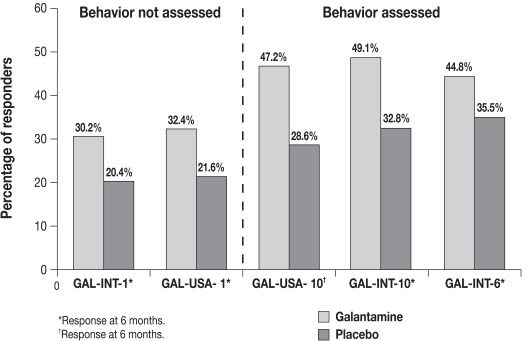
- In pooled probable AD short-term data (observed cases), galantamine- vs placebo-treated patients met responder criteria as follows: “improved” 45.8% vs 27.2%, “stable” 59.5% vs 37.1%, and “non-rapid decline” 87.6% vs 69.7%.
- Mean ADAS-Cog 11 change from baseline at endpoint was −4.9 points for “improved,” −4.7 for “stable,” and −2.9 for “non-rapid decline” galantamine-treated patients, compared with −1.5 points for galantamine recipients overall; placebo deteriorated by 1.8 points, giving an overall treatment benefit of 3.3 points (p<0.001).
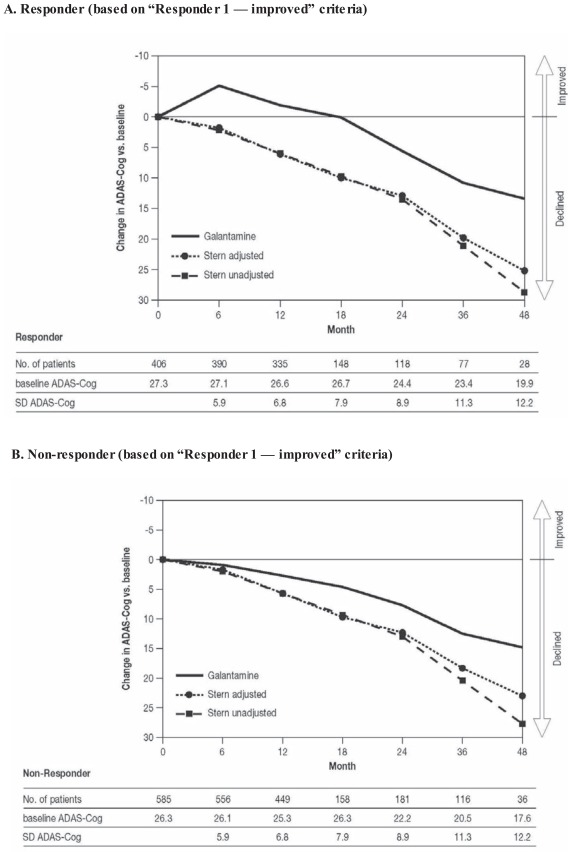
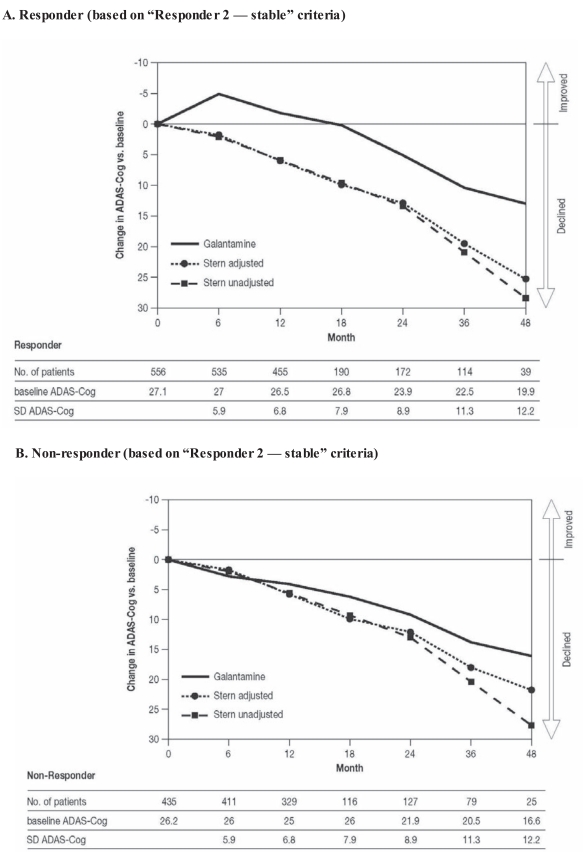
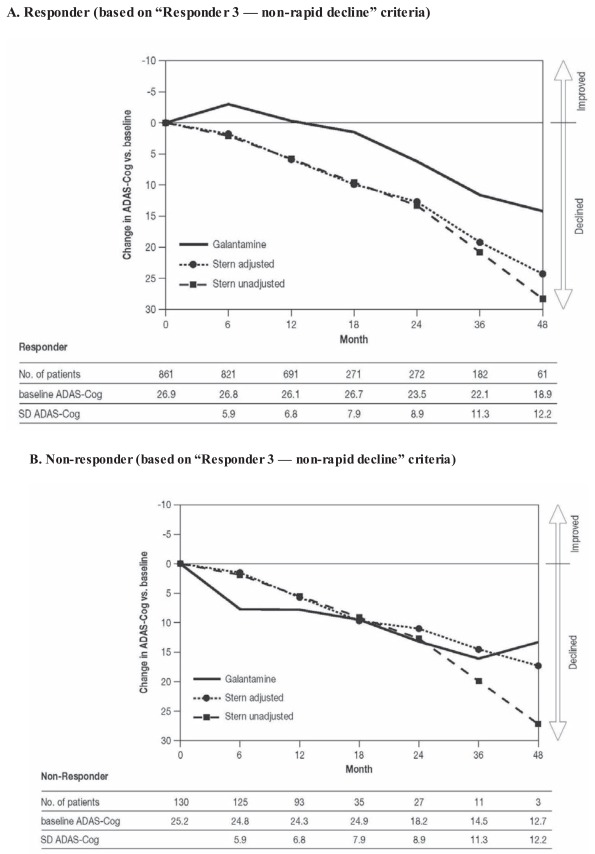
- Long-term, galantamine-treated patients meeting “improved” or “stable” criteria showed mean ADAS-Cog 11 improvement versus baseline until 18 months after starting treatment, with attenuated deterioration thereafter; those meeting “non-rapid decline” returned to baseline after approximately 12 months.
- In patients with possible AD+CVD, overall treatment benefit was 2.8 points on ADAS-Cog 11 (p<0.001), with responder rates of 47.4% vs 35.6% (“improved”), 52.7% vs 39.1% (“stable”), and 82.9% vs 72.4% (“non-rapid decline”) for galantamine vs placebo.
Methods
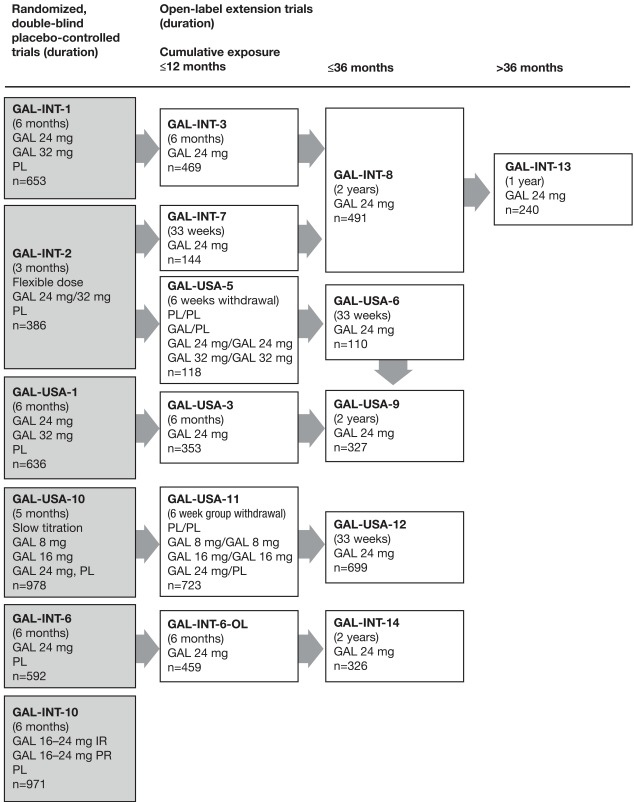
- Pooled analysis of data from 6 randomized placebo-controlled trials of up to 6 months in mild to moderate AD (including an AD+CVD subgroup in GAL-INT-6) with galantamine 16–24 mg/day maintenance, plus 12 open-label extensions using galantamine 24 mg/day maintenance; cognition was assessed with the 11-item ADAS-Cog.
- Three non-mutually exclusive responder definitions were applied: “improved” (ADAS-Cog 11 change ≤0 plus improved global, function, or behavior), “stable” (ADAS-Cog 11 change ≤0 plus stable/improved global, function, or behavior), and “non-rapid decline” (ADAS-Cog 11 change ≤4 points).
- Short-term analyses used observed cases, last observation carried forward, and observed cases plus; long-term ADAS-Cog 11 changes were assessed up to 48 months and compared with Stern equation estimates of untreated decline, including a corrected Stern estimate for dropout.
Limitations
- Stated: no long-term placebo group was available; open-label extensions were originally designed to examine long-term safety rather than efficacy; selection effects from trial withdrawals cannot be precluded; substantial drop in patient numbers occurred after 12 months; Stern equation estimates have limitations, including derivation from relatively small numbers and cautious interpretation in subgroups.
- Stated: retention of elderly and frail patients and their caregivers in long-term trials is challenging; discontinuation due to lack of efficacy was very low in the first 6 months (<1%) and 3% in open-label extensions, but the authors note that hand-searching may not capture all such patients.
- Evident from the text: responder definitions are non-mutually exclusive, and the “non-rapid decline” definition yielded a high placebo responder rate (69.7%), raising potential regression-to-the-mean concerns, although the authors argue that regression to the mean was likely limited.
Model-written summary. Check it against the paper before relying on it.
Integrity signals
Registry
Cites
Statistics
Figures
Verification
Claims the paper makes
0 Valid · 0 Not valid · 12 Not checked · 44 Own results and interpretations
A result the paper reports from its own data — it cites no other source for it, so there is none to check. The quote shows it is in the paper.
In the paper
“The proportion of patients with probable AD who met the “Responder 3 — non-rapid decline” criteria was 87.6% with galantamine versus 69.7% with placebo (OC analysis) (Table 2).”
§ Long-Term Response to Galantamine in Relation to Short-Term Efficacy Data: Pooled Analysis in Patients with Mild to Moderate Alzheimer’s Disease > RESULTS > Proportion of Responders: “Responder 3 —Non-Rapid Decline” Definition
plain- Asserted: passes — The authors put it forward as true.
- Checkable: passes — It can be checked against evidence.
- Load-bearing: passes — The paper’s conclusions depend on it.
- Based: passes — The paper gives a reason why it holds.
A result the paper reports from its own data — it cites no other source for it, so there is none to check. The quote shows it is in the paper.
In the paper
“The other analyses (OC+ and LOCF) showed broadly consistent findings (Table 1).”
§ Long-Term Response to Galantamine in Relation to Short-Term Efficacy Data: Pooled Analysis in Patients with Mild to Moderate Alzheimer’s Disease > RESULTS > Proportion of Responders: “Responder 1 — Improved” Definition
plain- Asserted: passes — The authors put it forward as true.
- Checkable: passes — It can be checked against evidence.
- Load-bearing: unclear — It is unclear whether the paper’s conclusions depend on it.
- Based: passes — The paper gives a reason why it holds.
A result the paper reports from its own data — it cites no other source for it, so there is none to check. The quote shows it is in the paper.
In the paper
“Galantamine-treated patients with probable AD who met the “Responder 1— improved” criteria displayed a mean improvement in ADAS-Cog 11 scores versus baseline until 18 months after initiation of treatment, with an attenuated rate of deterioration thereafter (Fig. 3A).”
§ Long-Term Response to Galantamine in Relation to Short-Term Efficacy Data: Pooled Analysis in Patients with Mild to Moderate Alzheimer’s Disease > RESULTS > Long-Term Effects in Responders and Non-Responders
plainstates a cause- Asserted: passes — The authors put it forward as true.
- Checkable: passes — It can be checked against evidence.
- Load-bearing: passes — The paper’s conclusions depend on it.
- Based: passes — The paper gives a reason why it holds.
- Rests on an assumption not shown here.
A result the paper reports from its own data — it cites no other source for it, so there is none to check. The quote shows it is in the paper.
In the paper
“(In patients with possible AD+CVD, “Responder 3” rates were 82.9% and 72.4% for galantamine and placebo, respectively.)”
§ Long-Term Response to Galantamine in Relation to Short-Term Efficacy Data: Pooled Analysis in Patients with Mild to Moderate Alzheimer’s Disease > RESULTS > Proportion of Responders: “Responder 3 —Non-Rapid Decline” Definition
plain- Asserted: passes — The authors put it forward as true.
- Checkable: passes — It can be checked against evidence.
- Load-bearing: unclear — It is unclear whether the paper’s conclusions depend on it.
- Based: passes — The paper gives a reason why it holds.
A result the paper reports from its own data — it cites no other source for it, so there is none to check. The quote shows it is in the paper.
In the paper
“The magnitude of improvement on the ADAS-Cog 11 scale was greater for patients meeting the “Responder 1 — improved” criteria (4.9 points) compared with the overall galantamine group (1.5 points) (Table 1).”
§ Long-Term Response to Galantamine in Relation to Short-Term Efficacy Data: Pooled Analysis in Patients with Mild to Moderate Alzheimer’s Disease > RESULTS > Proportion of Responders: “Responder 1 — Improved” Definition
plainstates an association- Asserted: passes — The authors put it forward as true.
- Checkable: passes — It can be checked against evidence.
- Load-bearing: passes — The paper’s conclusions depend on it.
- Based: passes — The paper gives a reason why it holds.
31 more claims
Create a free account to see all 56 claims and to verify the 21 references still open.
- It may state two separate claims as one. 16
- Probably not a substantial claim. 7
Citations
Cites
Folstein, M. F., Folstein, S. E., & McHugh, P. R. (1975) · Journal of Psychiatric Research · doi:10.1016/0022-3956(75)90026-6 · Cited by 88,282
McKhann, G., Drachman, D., Folstein, M., Katzman, R., Price, D., & Stadlan, E. M. (1984) · Neurology · doi:10.1212/wnl.34.7.939 · Cited by 27,915
Román, G. C., Tatemichi, T. K., Erkinjuntti, T., Cummings, J. L., Masdeu, J. C., Garcia, J. H., Amaducci, L., Orgogozo, J.-M., Brun, A., Hofman, A., et al. (1993) · Neurology · doi:10.1212/wnl.43.2.250 · Cited by 4,921
A new rating scale for Alzheimer's disease
(1984) · American Journal of Psychiatry · doi:10.1176/ajp.141.11.1356 · Cited by 4,175
A 5-month, randomized, placebo-controlled trial of galantamine in AD
Tariot, P. N., Solomon, P. R., Morris, J. C., Kershaw, P., Lilienfeld, S., Ding, C., & the Galantamine USA- Study Group (2000) · Neurology · doi:10.1212/wnl.54.12.2269 · Cited by 921
(2004) · The Lancet · doi:10.1016/s0140-6736(04)16499-4 · Cited by 892
Raskind (2000) · doi:10.1212/wnl.54.12.2261 · Cited by 870
A phase 2 multiple ascending dose trial of bapineuzumab in mild to moderate Alzheimer disease
Salloway, S., Sperling, R., Gilman, S., Fox, N. C., Blennow, K., Raskind, M., Sabbagh, M., Honig, L. S., Doody, R., van Dyck, C. H., et al. (2009) · Neurology · doi:10.1212/wnl.0b013e3181c67808 · Cited by 753
Erkinjuntti, T., Kurz, A., Gauthier, S., Bullock, R., Lilienfeld, S., & Damaraju, C. V. (2002) · The Lancet · doi:10.1016/s0140-6736(02)08267-3 · Cited by 752
Wilcock, G. K., Lilienfeld, S., & Gaens, E. (2000) · BMJ · doi:10.1136/bmj.321.7274.1445 · Cited by 687
(1994) · American Journal of Psychiatry · doi:10.1176/ajp.151.3.390 · Cited by 408
Effects of a flexible galantamine dose in Alzheimer's disease: a randomised, controlled trial
Rockwood, K. (2001) · Journal of Neurology, Neurosurgery & Psychiatry · doi:10.1136/jnnp.71.5.589 · Cited by 279
Galantamine: a randomized, double‐blind, dose comparison in patients with Alzheimer's disease
Wilkinson, D., Murray, J., & the Galantamine Research Group (2001) · International Journal of Geriatric Psychiatry · doi:10.1002/gps.409 · Cited by 212
Raskind, M. A., Peskind, E. R., Truyen, L., Kershaw, P., & Damaraju, C. V. (2004) · Archives of Neurology · doi:10.1001/archneur.61.2.252 · Cited by 167
Galantamine Prolonged-Release Formulation in the Treatment of Mild to Moderate Alzheimer’s Disease
Brodaty, H., Corey-Bloom, J., Potocnik, F. C. V., Truyen, L., Gold, M., & Damaraju, C. R. V. (2005) · Dementia and Geriatric Cognitive Disorders · doi:10.1159/000086613 · Cited by 122
Feldman, H. H., Van Baelen, B., Kavanagh, S. M., & Torfs, K. E. L. (2005) · Alzheimer Disease & Associated Disorders · doi:10.1097/01.wad.0000157065.43282.bc · Cited by 105
Self-citationPirttilä, T., Wilcock, G., Truyen, L., & Damaraju, C. V. (2004) · European Journal of Neurology · doi:10.1111/j.1468-1331.2004.00885.x · Cited by 92
Feldman, H. H., Pirttila, T., Dartigues, J. F., Everitt, B., Van Baelen, B., Schwalen, S., & Kavanagh, S. (2009) · International Journal of Geriatric Psychiatry · doi:10.1002/gps.2141 · Cited by 67
Self-citationLong-Term Outcomes of Galantamine Treatment in Patients With Alzheimer Disease
Lyketsos, C. G., Reichman, W. E., Kershaw, P. R., & Zhu, Y. (2004) · American Journal of Geriatric Psychiatry · doi:10.1097/00019442-200409000-00005 · Cited by 47
Cited by
Walczak-Nowicka, Ł. J., & Herbet, M. (2021) · International Journal of Molecular Sciences · doi:10.3390/ijms22179290 · Cited by 335
Echeverria, V., Yarkov, A., & Aliev, G. (2016) · Progress in Neurobiology · doi:10.1016/j.pneurobio.2016.01.002 · Cited by 91
Galantamine treatment in outpatients with mild Alzheimer's disease
Richarz, U., Gaudig, M., Rettig, K., & Schäuble, B. (2014) · Acta Neurologica Scandinavica · doi:10.1111/ane.12195 · Cited by 40
Synthesis and antimalarial activity of new haemanthamine-type derivatives
Cedrón, J. C., Gutiérrez, D., Flores, N., Ravelo, Á. G., & Estévez‐Braun, A. (2012) · Bioorganic & Medicinal Chemistry · doi:10.1016/j.bmc.2012.07.036 · Cited by 38
Jia, J., Gauthier, S. G., Pallotta, S., Ji, Y., Wei, W., Xiao, S., Peng, D., Guo, Q., Wu, L., Chen, S., et al. (2017) · Alzheimer s & Dementia · doi:10.1016/j.jalz.2017.01.007 · Cited by 26
Metadata
- Authors
- Kavanagh, S., Howe, I., R. Brashear, H., Wang, D., Van Baelen, B., Todd, M., & Schwalen, S.
- Affiliations
- Janssen Research & Development (United States) (US)
- Corresponding author
- Schwalen, S.
- Venue
- Current Alzheimer Research
- Publisher
- Bentham Science Publishers Ltd.
- Published
- 2011-03-01
- Volume
- 8
- Issue
- 2
- Pages
- 175-186
- ISSN
- 1567-2050 (ISSN-L)
- PMC
- PMC3182415
- OpenAlex
- W2136355102
- Semantic Scholar
- fc3fcb2c745c0c78b9da7122c43efa0613f5ba00
- Cited by
- 15
- References
- 19
- Citations by year
- 2025: 1 · 2021: 1 · 2020: 1 · 2017: 1 · 2016: 1 · 2015: 1 · 2014: 5 · 2013: 1 · 2012: 1
- FWCI
- 0.80
- Type
- journal article
- Language
- en
- Open access
- green
- pmc.ncbi.nlm.nih.gov
- Licence
- cc-by
- Locations
- Current Alzheimer Research (publishedVersion)
- PubMed Central (publishedVersion, cc-by)
- Europe PMC (PubMed Central) (publishedVersion, cc-by)
- PubMed (publishedVersion)
- Funders
- Cilag
- Topics
- Life Sciences › Neuroscience › Cellular and Molecular Neuroscience › Alzheimer's disease research and treatments
- Health Sciences › Medicine › Psychiatry and Mental health › Dementia and Cognitive Impairment Research
- Health Sciences › Medicine › Pharmacology (medical) › Cholinesterase and Neurodegenerative Diseases
- Keywords
- galantamine, Alzheimer's disease, long-term treatment response, short-term efficacy, cognitive decline, maintenance therapy, open-label extension, treatment response prediction, cholinesterase inhibitors
- MeSH terms
- Alzheimer Disease, Cholinesterase Inhibitors, Double-Blind Method, Galantamine, Humans, Randomized Controlled Trials as Topic, Treatment Outcome
About these checks
Registry, retraction, Cites and statistics results are computed, not judged, with one exception: a printed reference that no index lists is read once by a model before it counts as a citation error. Claims are extracted by a model and kept only when their quote appears verbatim in the text; each cited source is then checked, with a model’s help, for whether it says what the claim relies on. Those verdicts can be wrong — read the claim’s quote and the cited source before relying on one.
A language model drew the claims from the paper on 2026-11-27, under version 3 of the claim definition (model deepseek-v4.1-flash, prompt extract-v3).
A second model labelled each claim on 2026-11-27 (model jev-1.13-20260917, definition revision gold-guideline-v0.2).
Statistics and arithmetic are recomputed, not judged.
Confidence bands are shown only for fields calibrated on our annotated test set. None is calibrated yet, so no band is shown.
What counts as a claim ›How we measure confidence ›How we check this ›
Are you an author, or do you see a problem with this page? Request a review
Data sources
Bibliographic data: Semantic Scholar, OpenAlex, Crossref.
Contains information from the Semantic Scholar Academic Graph Datasets, made available under the ODC Attribution License (ODC-BY 1.0).
Semantic Scholar’s data is described in: Kinney, R., et al. (2023). The Semantic Scholar Open Data Platform. arXiv:2301.10140.
