

The DOI matches its Crossref record; 459 of the 461 references it cites were found in a registry or an index.
Multi-Target-Directed Ligands and other Therapeutic Strategies in the Search of a Real Solution for Alzheimer’s Disease
Open accessAbstract
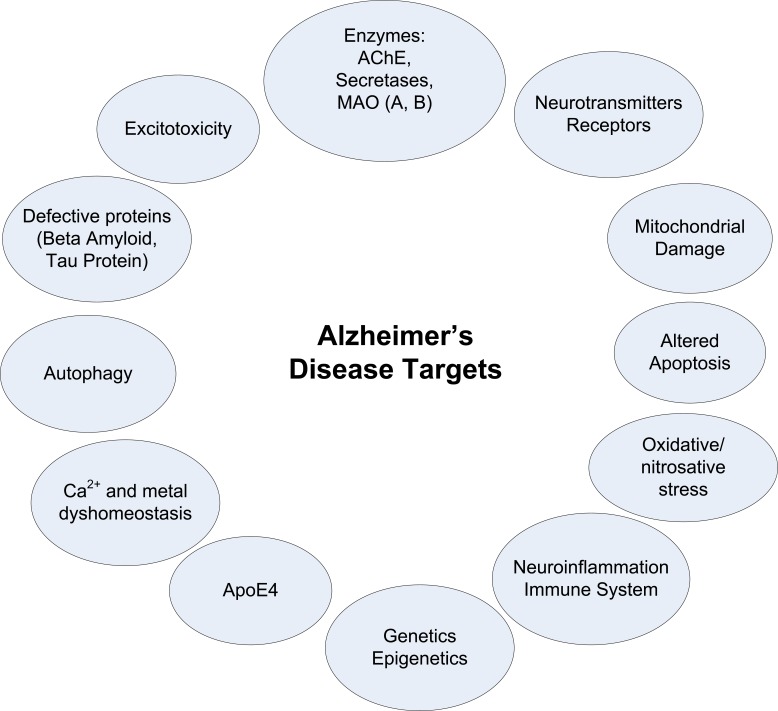
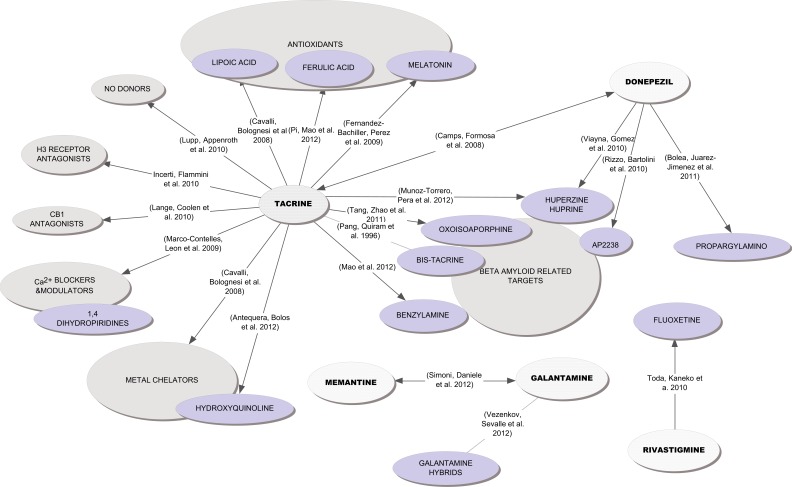
The lack of an adequate therapy for Alzheimer's Disease (AD) contributes greatly to the continuous growing amount of papers and reviews, reflecting the important efforts made by scientists in this field. It is well known that AD is the most common cause of dementia, and up-to-date there is no prevention therapy and no cure for the disease, which contrasts with the enormous efforts put on the task. On the other hand many aspects of AD are currently debated or even unknown. This review offers a view of the current state of knowledge about AD which includes more relevant findings and processes that take part in the disease; it also shows more relevant past, present and future research on therapeutic drugs taking into account the new paradigm "Multi-Target-Directed Ligands" (MTDLs). In our opinion, this paradigm will lead from now on the research toward the discovery of better therapeutic solutions, not only in the case of AD but also in other complex diseases. This review highlights the strategies followed by now, and focuses other emerging targets that should be taken into account for the future development of new MTDLs. Thus, the path followed in this review goes from the pathology and the processes involved in AD to the strategies to consider in on-going and future researches.
Overview
The claims and statistics of this paper haven’t been checked yet.
Run the check — free, no account needed. It reads the open-access text and checks the sources it cites.
Integrity signals
Registry
Cites
Statistics
Figures
Verification
Claims the paper makes
The claims and statistics of this paper haven’t been checked yet.
Run the check — free, no account needed. It reads the open-access text and checks the sources it cites.
Claims other papers make about this one
Each is checked against this paper’s own text: does it say what the citing paper says it does?
In the citing paper
“NTFs contain, as their first component, aggregates of the protein tau (τ) in a hyperphosphorylated state.”
From Multi-Target Mechanisms of Phytochemicals in Alzheimer’s Disease: Effects on Oxidative Stress, Neuroinflammation and Protein Aggregation (2022) · cites this paper as [20]
In the citing paper
“in healthy neuronal cells, following consecutive and reversible enzymatic processes of phosphorylation and dephosphorylation, it has the task of assembling and stabilizing microtubules and determining their binding with other components of the cytoskeleton [19,20].”
From Multi-Target Mechanisms of Phytochemicals in Alzheimer’s Disease: Effects on Oxidative Stress, Neuroinflammation and Protein Aggregation (2022) · cites this paper as [20]
In the citing paper
“a complex and multifactorial disorder, such as AD, must be approached with multitarget-directed ligands (MTDLs) (Agis-Torres et al., 2014).”
From Multi-target neuroprotective effects of herbal medicines for Alzheimer's disease (2022) · cites this paper as Agis-Torres et al., 2014
Self-check
Percentages, sums and reported differences re-computed from the paper’s own numbers.
The self-check needs the paper’s full text.
Citations
Cites
2 retracted
RETRACTED: SIRT1 Suppresses β-Amyloid Production by Activating the α-Secretase Gene ADAM10
Dönmez, G., Wang, D., Cohen, D. E., & Guarente, L. (2010) · Cell · doi:10.1016/j.cell.2010.06.020 · Cited by 443
RetractedRetracted: ‘Clinical trials in Alzheimer’s disease’: immunotherapy approaches
Delrieu, J., Ousset, P., Caillaud, C., & Vellas, B. J. (2011) · Journal of Neurochemistry · doi:10.1111/j.1471-4159.2011.07458.x · Cited by 147
RetractedThe Amyloid Hypothesis of Alzheimer’s Disease: Progress and Problems on the Road to Therapeutics
Hardy, J., & Selkoe, D. J. (2002) · Science · doi:10.1126/science.1072994 · Cited by 13,864
Correspondence - Tranexamic acid for traumatic brain injury
(2005) · London School of Economics and Political Science Theses Online (London School of Economics and Political Science) · doi:10.1016/s0140-6736 · Cited by 11,894
(2023) · doi:10.1126/science · Cited by 6,063
Global prevalence of dementia: a Delphi consensus study
Ferri, C. P., Prince, M. J., Brayne, C., Brodaty, H., Fratiglioni, L., Ganguli, M., Hall, K. S., Hasegawa, K., Hendrie, H. C., Huang, Y., et al. (2005) · The Lancet · doi:10.1016/s0140-6736(05)67889-0 · Cited by 5,336
(2015) · American Journal Of Pathology · doi:10.2353/ajpath · Cited by 4,961
Soluble protein oligomers in neurodegeneration: lessons from the Alzheimer's amyloid β-peptide
Haass, C., & Selkoe, D. J. (2007) · Nature Reviews Molecular Cell Biology · doi:10.1038/nrm2101 · Cited by 4,744
Network pharmacology: the next paradigm in drug discovery
Hopkins, A. L. (2008) · Nature Chemical Biology · doi:10.1038/nchembio.118 · Cited by 4,622
Sussman, J. L., Harel, M., Frolow, F., Oefner, C., Goldman, A., Toker, L., & Silman, I. (1991) · Science · doi:10.1126/science.1678899 · Cited by 2,740
Cited by
Sorted by citations
Items 201–234 of 234
Lahouel, A., Harrouche, K., Oğuz, E., Türkan, F., Çetin, A., & Khelili, S. (2026) · Neuropharmacology · doi:10.1016/j.neuropharm.2026.111199
BindingDB Entry 50045214: Synthesis and cholinesterase inhibition of cativic acid derivatives.
BindingDB (2016) · UC San Diego · doi:10.7270/q2vt1tqc
BindingDB (2017) · UC San Diego · doi:10.7270/q29w0hch
BindingDB (2016) · UC San Diego · doi:10.7270/q2hq41mh
BindingDB Entry 50015539: Histamine H
BindingDB (2023) · UC San Diego · doi:10.7270/q2dr30df
Metadata
- Authors
- Agis-Torres, A., Sollhuber, M., Fernandez, M., & Sanchez-Montero, J. M.
- Affiliations
- Universidad Complutense de Madrid (ES)
- Venue
- Current Neuropharmacology
- Publisher
- Bentham Science Publishers Ltd.
- Published
- 2014-01-31
- Volume
- 12
- Issue
- 1
- Pages
- 2-36
- ISSN
- 1570-159X (ISSN-L)
- PMC
- PMC3915347
- OpenAlex
- W2031507955
- Cited by
- 202
- References
- 461
- Citations by year
- 2026: 10 · 2025: 13 · 2024: 10 · 2023: 12 · 2022: 18 · 2021: 11 · 2020: 18 · 2019: 24 · 2018: 21 · 2017: 25 · 2016: 22 · 2015: 12 · 2014: 6
- FWCI
- 15.81
- Type
- journal article
- Language
- en
- Open access
- bronze
- doi.org
- Locations
- Current Neuropharmacology (publishedVersion)
- PubMed Central (publishedVersion, cc-by-nc)
- PubMed (publishedVersion)
- Topics
- Life Sciences › Neuroscience › Cellular and Molecular Neuroscience › Alzheimer's disease research and treatments
- Health Sciences › Medicine › Pharmacology (medical) › Cholinesterase and Neurodegenerative Diseases
- Health Sciences › Medicine › Psychiatry and Mental health › Dementia and Cognitive Impairment Research
- Keywords
- Alzheimer's disease, multi-target-directed ligands, Alzheimer's disease therapeutics, disease pathology, therapeutic drug development, complex diseases
About these checks
Registry, retraction, Cites and statistics results are computed, not judged, with one exception: a printed reference that no index lists is read once by a model before it counts as a citation error. Claims are extracted by a model and kept only when their quote appears verbatim in the text; each cited source is then checked, with a model’s help, for whether it says what the claim relies on. Those verdicts can be wrong — read the claim’s quote and the cited source before relying on one.
Statistics and arithmetic are recomputed, not judged.
Confidence bands are shown only for fields calibrated on our annotated test set. None is calibrated yet, so no band is shown.
What counts as a claim ›How we measure confidence ›How we check this ›
Are you an author, or do you see a problem with this page? Request a review
