

The DOI matches its Crossref record; 29 of the 29 references it cites were found in a registry or an index; 3 of the 19 sources its claims cite were checked for support.
A 13-Weeks Mindfulness Based Pain Management Program Improves Psychological Distress in Patients with Chronic Pain Compared with Waiting List Controls
Open accessAbstract
Background: Eradication of pain is seldom an option in chronic pain management. Hence, mindfulness meditation has become popular in pain management. Objective: This pilot study compared the effect of a 13-weeks cognitive behavioural therapy program with integrated mindfulness meditation (CBTm) in patients with chronic non-malignant pain with a control condition. It was hypothesised that the CBTm program would reduce pain intensity and psychological distress compared to the control condition and that level of mindfulness and acceptance both would be associated with the reduction in pain intensity and psychological distress. Methods: A case-control design was used and data were collected from a convenience sample of 70 patients with chronic non-malignant pain. Fifty patients were consecutively recruited to the CBTm intervention and 20 patients matched waiting list controls. Assessments of clinical pain and psychological distress were performed in both groups at baseline and after 13 weeks. Results: The CBTm program reduced depression, anxiety and pain-catastrophizing compared with the control group. Increased level of mindfulness and acceptance were associated with change in psychological distress with the exception of depression, which was only associated with change in level of mindfulness. Surprisingly, changes in level of mindfulness did not correlate with changes in acceptance. Conclusions: The results indicate that different mechanisms are targeted with cognitive behavioural therapy and mindfulness. The finding that changes in level of mindfulness did not correlate with changes in acceptance may indicate that acceptance is not a strict prerequisite for coping with pain related distress. © Andersen and Vægter; Licensee Bentham Open.
Overview
CoChat Summary
## TL;DR
This pilot case-control study found that a 13-week cognitive behavioural therapy program with integrated mindfulness meditation reduced psychological distress in patients with chronic non-malignant pain compared with a waiting list control. It did not reduce pain intensity, but it was associated with lower depression, anxiety, and pain catastrophizing and with higher mindfulness/acceptance-related scores.
## Key findings
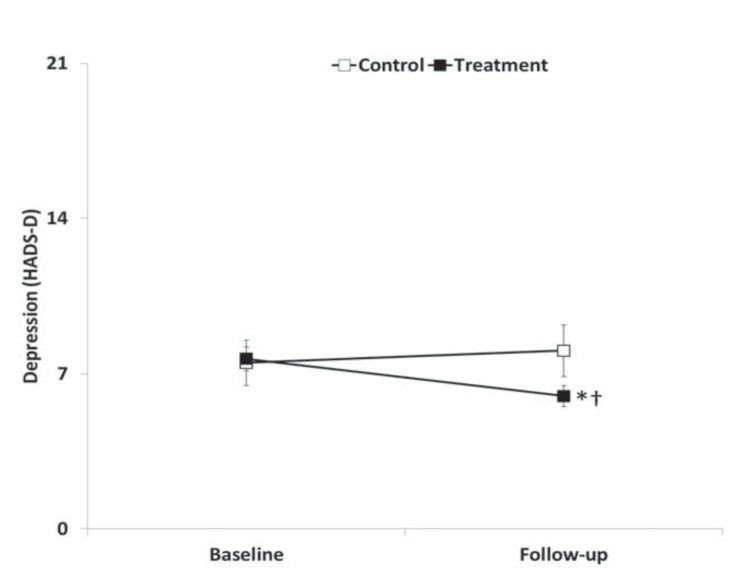
- In the treatment group, depression fell from 7.7 ± 3.8 to 6.0 ± 3.4, while the control group increased from 7.5 ± 4.6 to 8.1 ± 5.2; the group-by-time interaction was significant (F(1,68) = 9.82, P < 0.003), and 30.0% vs 65.0% scored ≥ 8 on HADS depression at follow-up.
- Anxiety decreased in both groups, but fewer patients in the treatment group scored ≥ 8 on HADS anxiety at follow-up (36.0% vs 65.0%; P < 0.03); the main effect of time was significant (F(1,68) = 8.10, P < 0.006).
- Pain catastrophizing decreased more in the treatment group (28.0 ± 8.6 to 21.0 ± 8.9) than in controls (33.1 ± 9.4 to 31.8 ± 10.7), with a significant interaction (F(1,68) = 4.86, P < 0.04).
- Pain intensity did not change significantly: treatment group 5.9 ± 1.3 to 5.9 ± 1.9; control group 6.3 ± 1.8 to 6.6 ± 2.0 (F(1,68) < 0.61, P > 0.43).
## Methods
- Pilot case-control design using a convenience sample of 70 patients with chronic non-malignant pain: 50 consecutively recruited to the CBTm program and 20 matched waiting-list controls.
- Patients were recruited from a multidisciplinary pain centre in Southern Denmark; assessments were done at baseline and after 13 weeks, with usual medical care continued in both groups.
- Outcomes included pain intensity, depression/anxiety (HADS), pain catastrophizing (PCS), mindfulness (MAAS), and acceptance (CPAQ); analyses used two-way repeated-measures ANOVA, chi-square tests, and Pearson correlations, with missing data imputed by Expectation Maximization.
## Limitations
- The paper states it was a pilot study with a small sample size, leading to limited statistical power and risk of false positive results.
- The paper states there was no randomization, a short follow-up time, and high dropout, especially in the control group.
- The paper states the CBTm group had more prior experience with relaxation, which may be a confounder.
- Evident from the text: the study used a waiting-list control and conducted follow-up only at 13 weeks, so the durability of effects beyond that point is not tested.
Model-written summary. Check it against the paper before relying on it.
Integrity signals
Registry
Cites
Statistics
Figures


Verification
Claims the paper makes
3 Valid · 0 Not valid · 7 Not checked · 29 Own results and interpretations
Every source the paper cites for this claim was checked and supports it.
In the paper
“In comparison, the long-term effects of cognitive behavioural therapy for chronic pain are quite modest [13].”
§ A 13-Weeks Mindfulness Based Pain Management Program Improves Psychological Distress in Patients with Chronic Pain Compared with Waiting List Controls > DISCUSSION
What the sources say
- Supportedcites [13] Williams AC, Eccleston C, Morley S. Psychological therapies for the management of chronic pain (excluding headache) in adults. Cochrane Database Syst Rev 2012; 11 : CD007407. source
The Summary of results describes CBT outcomes at six to 12 months: few comparisons remained positive at follow-up, and the effects reported were small. The follow-up analysis versus treatment as usual found no significant effect on pain or disability and only a small effect on mood. This supports the broad characterization of long-term effects as modest. (LLM, conf=0.91)
plain- Asserted: passes — The authors put it forward as true.
- Checkable: passes — It can be checked against evidence.
- Load-bearing: passes — The paper’s conclusions depend on it.
- Based: passes — The paper gives a reason why it holds.
- Supported
The cited sources support only part of this claim — read each source’s verdict below.
In the paper
“Regarding effect sizes, the effect of MBIs in patients with chronic pain is comparable to that of cognitive behavioural therapy programmes with moderate effect sizes reported in relation to pain intensity, anxiety, depression, and physical health [10-13].”
§ A 13-Weeks Mindfulness Based Pain Management Program Improves Psychological Distress in Patients with Chronic Pain Compared with Waiting List Controls > BACKGROUND:
What the sources say
- Not checked — no full text of the sourcecites [10] Chiesa A, Serretti A. Mindfulness-based interventions for chronic pain: a systematic review of the evidence. J Altern Complement Med 2011; 17 (1) : 83-93. source
- Not checked — no full text of the sourcecites [11] Grossman P, Niemann L, Schmidt S, Walach H. Mindfulness-based stress reduction and health benefits. A meta-analysis. J Psychosom Res 2004; 57 (1) : 35-43. source
- Not checked — no full text of the sourcecites [12] Veehof MM, Oskam MJ, Schreurs KM, Bohlmeijer ET. Acceptance-based interventions for the treatment of chronic pain: a systematic review and meta-analysis. Pain 2011; 152 (3) : 533-42. source
- Partly supportedcites [13] Williams AC, Eccleston C, Morley S. Psychological therapies for the management of chronic pain (excluding headache) in adults. Cochrane Database Syst Rev 2012; 11 : CD007407. sourceExperimental — accuracy not yet measured
The Pain outcomes and Mood outcomes sections report that CBT had a small effect on pain and a moderate immediate effect on mood compared with doing nothing; effects differed against active controls and at follow-up (page numbers unavailable). The review does not establish moderate effects for each listed outcome—anxiety and physical health are not reported as separate summary outcomes—or directly compare CBT with MBIs. (LLM, conf=0.88)
plainstates an association- Asserted: passes — The authors put it forward as true.
- Checkable: passes — It can be checked against evidence.
- Load-bearing: unclear — It is unclear whether the paper’s conclusions depend on it.
- Based: passes — The paper gives a reason why it holds.
A result the paper reports from its own data — it cites no other source for it, so there is none to check. The quote shows it is in the paper.
In the paper
“The CBTm program reduced depression, anxiety and pain-catastrophizing compared with the control group.”
- Also stated in: § CONCLUSION · plain
“A 13-weeks CBTm program reduced depression and pain catastrophizing in patients with chronic non-malignant pain compared with the control group.”
§ A 13-Weeks Mindfulness Based Pain Management Program Improves Psychological Distress in Patients with Chronic Pain Compared with Waiting List Controls > Abstract > Results:
plainstates a cause- Asserted: passes — The authors put it forward as true.
- Checkable: passes — It can be checked against evidence.
- Load-bearing: passes — The paper’s conclusions depend on it.
- Based: passes — The paper gives a reason why it holds.
- Also stated in: § CONCLUSION · plain
A result the paper reports from its own data — it cites no other source for it, so there is none to check. The quote shows it is in the paper.
In the paper
“pain catastrophizing scale (r(68) = 0.45, P < 0.001)”
§ A 13-Weeks Mindfulness Based Pain Management Program Improves Psychological Distress in Patients with Chronic Pain Compared with Waiting List Controls > RESULTS > Follow-up
plainstates an association- Asserted: passes — The authors put it forward as true.
- Checkable: passes — It can be checked against evidence.
- Load-bearing: unclear — It is unclear whether the paper’s conclusions depend on it.
- Based: passes — The paper gives a reason why it holds.
A result the paper reports from its own data — it cites no other source for it, so there is none to check. The quote shows it is in the paper.
In the paper
“anxiety score (r(68) = 0.38, P = 0.001)”
§ A 13-Weeks Mindfulness Based Pain Management Program Improves Psychological Distress in Patients with Chronic Pain Compared with Waiting List Controls > RESULTS > Follow-up
plainstates an association- Asserted: passes — The authors put it forward as true.
- Checkable: passes — It can be checked against evidence.
- Load-bearing: unclear — It is unclear whether the paper’s conclusions depend on it.
- Based: passes — The paper gives a reason why it holds.
15 more claims
Create a free account to see all 39 claims and every source verdict.
- Probably not a substantial claim. 12
- It may state two separate claims as one. 11
Statistics recomputed
Every reported test result, recomputed from its test statistic and degrees of freedom. A result shows as not adding up only once an independent check has confirmed it.
- Consistentt(43) < 1.67reported p > .1 · recomputed p = .102
“t(43) < 1.67, p > .1”
- Consistentt(43) = 1.97reported p = .06 · recomputed p = .055
“t(43) = 1.97, p = .06”
- Consistentt(78) < 1.11reported p > .09 · recomputed p = .270
“t(78) < 1.11, p > .09”
- ConsistentF(1, 68) < 0.61reported p > .43 · recomputed p = .437
“F(1,68) < 0.61, p > .43”
- ConsistentF(1, 68) = 9.82reported p < .003 · recomputed p = .003
“F(1,68) = 9.82, p < .003”
14 more recomputed tests
Create a free account to see every test the Stats check recomputed.
Self-check
Percentages, sums and reported differences re-computed from the paper’s own numbers.
Self-check results appear here once an independent check has confirmed them.
Citations
Cites
The Hospital Anxiety and Depression Scale
Zigmond, A. S., & Snaith, R. P. (1983) · Acta Psychiatrica Scandinavica · doi:10.1111/j.1600-0447.1983.tb09716.x · Cited by 47,139
Depression and quality of life in older persons: A review
Sivertsen, H., Bjørkløf, G. H., Engedal, K., Selbæk, G., & Helvik, A.-S. (2015) · Dementia and Geriatric Cognitive Disorders · doi:10.1159/000437299 · Cited by 14,152
The benefits of being present: Mindfulness and its role in psychological well-being
Brown, K. W., & Ryan, R. M. (2003) · Journal of Personality and Social Psychology · doi:10.1037/0022-3514.84.4.822 · Cited by 13,448 · cited 2×
“Although correlations between mindfulness and acceptance and various measures of distress and well-being have been reported [15, 17], few studies have investigated the mechanisms of improved patient functioning in chronic pain [14].”
BackgroundMethodThe Pain Catastrophizing Scale: Development and validation.
Sullivan, M. J. L., Bishop, S. R., & Pivik, J. (1995) · Psychological Assessment · doi:10.1037//1040-3590.7.4.524 · Cited by 8,227 · cited 1×
“Pain Catastrophizing The Pain Catastrophizing Scale (PCS; [20]) was used to measure catastrophic thinking related to pain.”
MethodKabat-Zinn, J. (1982) · General Hospital Psychiatry · doi:10.1016/0163-8343(82)90026-3 · Cited by 4,255 · cited 2×
“Mindfulness meditation aims to teach the patient a state of being attentive to and aware of sensations, emotions and thoughts as they take place in the present, and thereby learning patients to accept the unavoidable pain and to disentangle themselves from their distressful thoughts and emotions [6].”
BackgroundMindfulness-based stress reduction and health benefits
Grossman, P., Niemann, L., Schmidt, S., & Walach, H. (2004) · Journal of Psychosomatic Research · doi:10.1016/s0022-3999(03)00573-7 · Cited by 3,958
(2001) · Cited by 3,666
Mindfulness: Theoretical Foundations and Evidence for its Salutary Effects
Brown, K. W., Ryan, R. M., & Creswell, J. D. (2007) · Psychological Inquiry · doi:10.1080/10478400701598298 · Cited by 3,654 · cited 1×
“The result is in accordance with the theoretical rationale for mindfulness emphasizing that mental flexibility is important in coping with distress [25].”
ResultDepression and Pain Comorbidity: A Literature Review
Bair, M. J., Robinson, R. L., Katon, W., & Kroenke, K. (2003) · Archives of Internal Medicine · doi:10.1001/archinte.163.20.2433 · Cited by 3,463 · cited 1×
“Chronic pain is often associated with psychological distress, which complicates adjustment to chronic pain [3, 4], and since eradication of pain is seldom an option, cognitive behavioral therapy has become part of standard treatment helping patients to cope with chronic pain.”
BackgroundPsychological therapies for the management of chronic pain (excluding headache) in adults
Williams, A. C. D. C., Eccleston, C., & Morley, S. (2012) · Cochrane Database of Systematic Reviews · doi:10.1002/14651858.cd007407.pub3 · Cited by 1,634
Cited by
The anatomy of pain and suffering in the brain and its clinical implications
De Ridder, D., Adhia, D., & Vanneste, S. (2021) · Neuroscience & Biobehavioral Reviews · doi:10.1016/j.neubiorev.2021.08.013 · Cited by 269
“, 2010) and catastrophizing (Gamaiunova et al., 2019; Andersen and Vaegter, 2016), as well as sometimes the painfulness (Zeidan et al.”
BackgroundA review of AAQ variants and other context-specific measures of psychological flexibility
Ong, C. W., Lee, E. B., Levin, M. E., & Twohig, M. P. (2019) · Journal of Contextual Behavioral Science · doi:10.1016/j.jcbs.2019.02.007 · Cited by 142
Rusu, A. C., Gajsar, H., Schlüter, M.-C., & Bremer, Y.-I. (2018) · Clinical Journal of Pain · doi:10.1097/ajp.0000000000000674 · Cited by 36
Sabzevari, F., Samadi, H., Tafti, F. A., & Machado, S. E. D. C. (2023) · Clinical Practice and Epidemiology in Mental Health · doi:10.2174/17450179-v19-e230419-2022-33 · Cited by 34
Ravn, S. L., Vang, M. L., Vægter, H. B., & Andersen, T. E. (2017) · Pain Medicine · doi:10.1093/pm/pnx223 · Cited by 16
Self-citation
Metadata
- Authors
- Andersen, T. E., & Vægter, H. B.
- Affiliations
- University of Southern Denmark (DK)
- Odense University Hospital (DK)
- Corresponding author
- Vægter, Henrik Bjarke
- Venue
- Clinical Practice & Epidemiology in Mental Health
- Publisher
- Bentham Science Publishers Ltd.
- Published
- 2016-06-30
- Volume
- 12
- Issue
- 1
- Pages
- 49-58
- ISSN
- 1745-0179 (ISSN-L)
- PMC
- PMC5037934
- OpenAlex
- W2337232170
- Cited by
- 13
- References
- 29
- Citations by year
- 2026: 1 · 2025: 1 · 2023: 1 · 2022: 1 · 2021: 2 · 2020: 1 · 2019: 2 · 2018: 2 · 2017: 2
- FWCI
- 2.68
- Type
- journal article
- Language
- en
- Open access
- hybrid
- doi.org
- Locations
- Clinical Practice and Epidemiology in Mental Health (publishedVersion, cc-by)
- Europe PMC (PubMed Central) (publishedVersion, cc-by)
- PubMed Central (publishedVersion, cc-by)
- University of Southern Denmark Research Portal (University of Southern Denmark) (publishedVersion, cc-by-nc)
- PubMed (publishedVersion)
- Topics
- Social Sciences › Psychology › Clinical Psychology › Mindfulness and Compassion Interventions
- Health Sciences › Health Professions › Physical Therapy, Sports Therapy and Rehabilitation › Musculoskeletal pain and rehabilitation
- Life Sciences › Neuroscience › Cognitive Neuroscience › Pain Management and Placebo Effect
- Keywords
- chronic non-cancer pain, cognitive behavioral therapy, mindfulness meditation, psychological distress, depression, anxiety, pain catastrophizing, acceptance, pain intensity, waitlist control
About these checks
Registry, retraction, Cites and statistics results are computed, not judged, with one exception: a printed reference that no index lists is read once by a model before it counts as a citation error. Claims are extracted by a model and kept only when their quote appears verbatim in the text; each cited source is then checked, with a model’s help, for whether it says what the claim relies on. Those verdicts can be wrong — read the claim’s quote and the cited source before relying on one.
The claim verdicts this report counts are experimental: their accuracy is not yet measured.
A language model drew the claims from the paper on 2026-10-11, under version 3 of the claim definition (model deepseek-v4.1-flash, prompt extract-v3).
A second model labelled each claim on 2026-10-11 (model jev-1.13-20260917, definition revision gold-guideline-v0.2).
Cited sources are checked with a language model’s help (gpt-6-sol).
Statistics and arithmetic are recomputed, not judged.
Confidence bands are shown only for fields calibrated on our annotated test set. None is calibrated yet, so no band is shown.
What counts as a claim ›How we measure confidence ›How we check this ›
Are you an author, or do you see a problem with this page? Request a review
How to cite
Cite CoChat for the checks on this page, and the paper for its own findings.
- This page
- CoChat. (2026). Citation check: A 13-Weeks Mindfulness Based Pain Management Program Improves Psychological Distress in Patients with Chronic Pain Compared with Waiting List Controls. https://app.cochat.ai/papers/10.2174/1745017901612010049
- The paper
- Andersen, T. E., & Vægter, H. B. (2016). A 13-Weeks Mindfulness Based Pain Management Program Improves Psychological Distress in Patients with Chronic Pain Compared with Waiting List Controls. Clinical Practice & Epidemiology in Mental Health. https://doi.org/10.2174/1745017901612010049
Data sources
Bibliographic data: Semantic Scholar, OpenAlex, Crossref.
Contains information from the Semantic Scholar Academic Graph Datasets, made available under the ODC Attribution License (ODC-BY 1.0).
Semantic Scholar’s data is described in: Kinney, R., et al. (2023). The Semantic Scholar Open Data Platform. arXiv:2301.10140.
