

The DOI matches its Crossref record; 46 of the 47 references it cites were found in a registry or an index, and 1 are not checked yet.
The Korean Pregnancy Outcome Study (KPOS): Study Design and Participants
Open accessAbstract
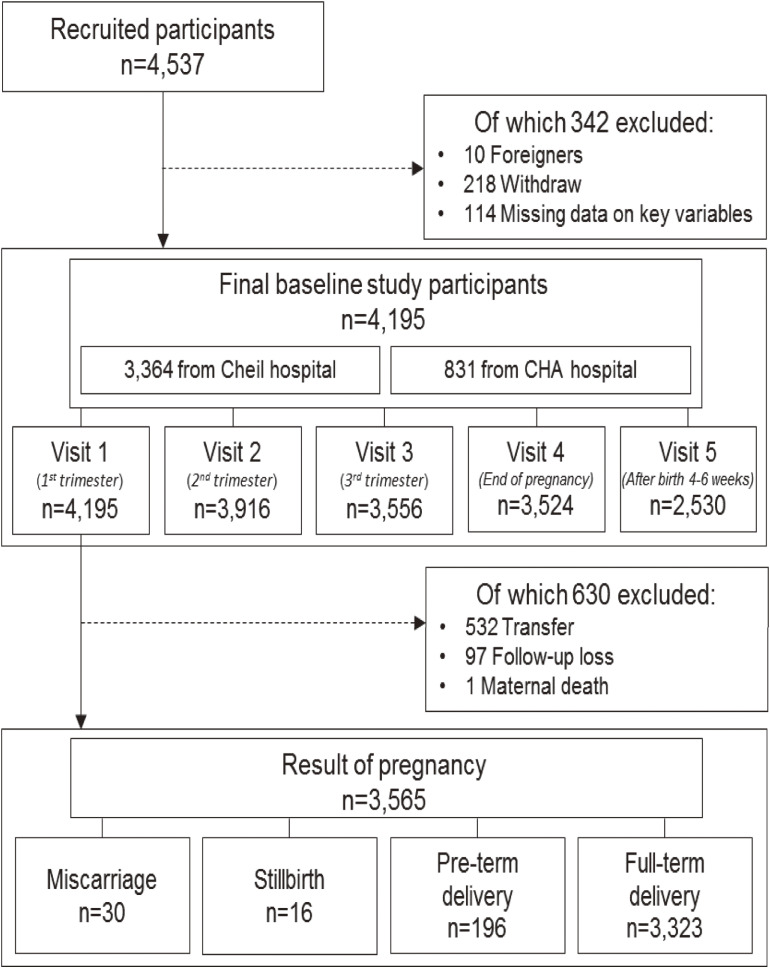
BACKGROUND: The Korean Pregnancy Outcome Study (KPOS) was established to investigate the determinants of adverse pregnancy outcomes among Korean women. METHODS: We recruited 4,537 pregnant women between 2013 and 2017 from two tertiary centers located in Seoul, Korea, and a total of 4,195 Korean women met inclusion criteria in the baseline analysis. A range of data on socio-demographics, past medical histories, reproductive information, health-related behaviors, psychological health and clinical information were obtained using interviewer-based questionnaires and clinical assessment at 12, 24, and 36 gestational weeks (GW), delivery and 6-8 weeks postpartum. Blood samplings were performed at 12, 24 and 36 GW, and placental tissues were obtained after delivery. The main outcome of this study was pregnancy-related complications including gestational diabetes mellitus (GDM), gestational hypertension, and screening positive for peripartum depression. Depression was assessed using the Korean version of the Edinburgh Postnatal Depression Scale, and a score of ≥10 indicated a positive screen for depression. RESULTS: Among 4,195 eligible pregnant women with a median age of 33.0 years, 3,565 (85.0%) pregnancy outcomes were available in this study, including 30 miscarriages, 16 stillbirths, and 3,519 deliveries. Mean gestational age was 38.8 GW, and mean birth weight was 3,236 gram. The prevalence of pregnancy complications of GDM, hypertensive disorders, and screening positive of depression during pregnancy and postpartum was 7.0%, 1.4%, 27.8%, and 16.6%, respectively. CONCLUSIONS: We designed KPOS to identify the determinants of pregnancy-related outcomes, and it may provide effective strategies for the prevention of pregnancy complications in Korean pregnant women.
Overview
The claims and statistics of this paper haven’t been checked yet.
Run the check — free, no account needed. It reads the open-access text and checks the sources it cites.
Integrity signals
Registry
Cites
Statistics
Figures
Verification
Claims the paper makes
The claims and statistics of this paper haven’t been checked yet.
Run the check — free, no account needed. It reads the open-access text and checks the sources it cites.
Claims other papers make about this one
Each is checked against this paper’s own text: does it say what the citing paper says it does?
The check wasn’t confident either way, so it gives no verdict — never disputed.
In the citing paper
“Our previous study further strengthened the evidence supporting the effectiveness of exercise in GDM prevention, demonstrating a significantly lower risk of GDM among women who participated in pre-pregnancy strength training.19”
From Pre-Pregnancy Physical Activity Lowers Risk of Diet-Controlled but Not Insulin-Treated Gestational Diabetes Mellitus: A Korean Prospective Cohort Study (2026) · cites this paper as [19]
Experimental — accuracy not yet measured
Self-check
Percentages, sums and reported differences re-computed from the paper’s own numbers.
The self-check needs the paper’s full text.
Citations
Cites
Detection of Postnatal Depression: Development of the 10-item Edinburgh Postnatal Depression Scale
Cox, J. L., Holden, J. M., & Sagovsky, R. (1987) · British Journal of Psychiatry · doi:10.1192/bjp.150.6.782 · Cited by 14,183
International Association of Diabetes and Pregnancy Study Groups Consensus Panel (2010) · Diabetes Care · doi:10.2337/dc09-1848 · Cited by 5,390
Classification and diagnosis of diabetes mellitus and other categories of glucose intolerance.
National Diabetes Data Group (1979) · Diabetes · doi:10.2337/diab.28.12.1039 · Cited by 4,909
Weight Gain During Pregnancy: Reexamining the Guidelines
Rasmussen, K. M., & Yaktine, A. L. (2009) · Cited by 4,052
(2000) · American Journal of Obstetrics and Gynecology · doi:10.1067/mob.2000.107928 · Cited by 3,278
Metzger, B. E., Gabbe, S. G., Persson, B., Lowe, L. P., Dyer, A. R., Oats, J. J. N., & Buchanan, T. A. (2010) · Diabetes Care · doi:10.2337/dc10-0719 · Cited by 1,888
Population and Housing Census.
Tobago (2011) · Cited by 1,384
Increasing Prevalence of Gestational Diabetes Mellitus
Ferrara, A. (2007) · Diabetes Care · doi:10.2337/dc07-s206 · Cited by 1,171
Preconceptional and maternal obesity: epidemiology and health consequences
Poston, L., Caleyachetty, R., Cnattingius, S., Corvalán, C., Uauy, R., Herring, S., & Gillman, M. W. (2016) · The Lancet Diabetes & Endocrinology · doi:10.1016/s2213-8587(16)30217-0 · Cited by 1,111
Shorey, S., Chee, C. Y. I., Ng, E. D., Chan, Y. H., Tam, W. W. S., & Chong, Y. S. (2018) · Journal of Psychiatric Research · doi:10.1016/j.jpsychires.2018.08.001 · Cited by 1,055
Research works printed but not linked: 2
- 26. Park HJ, Lee SH, Cha DH, et al. Pregnancy outcomes in women aged 35 and older. Korean Society of Obstetrics and Cynecology. 2006;49:2066–2074.
- 28. Kil K, Lee GSR, Kwon JY, et al. Impact of maternal age of 40 years or older on pregnancy outcomes. Korean J Perinatol. 2007;18:125–130.
Cited by
Sorted by citations
Choi, H., Lim, J.-Y., Lim, N.-K., Ryu, H. M., Kwak, D. W., Chung, J. H., Park, H. J., & Park, H. (2021) · International Journal of Obesity · doi:10.1038/s41366-021-00946-8 · Cited by 53
Self-citationShim, S. H., Lee, S. Y., Jung, I., Heo, S., Han, Y. J., Kwak, D. W., Kim, M. H., Park, H. J., Chung, J. H., Lim, J. H., et al. (2024) · Journal of Korean Medical Science · doi:10.3346/jkms.2024.39.e31 · Cited by 31
Self-citationMaternal Anemia during the First Trimester and Its Association with Psychological Health
Kwak, D.-W., Kim, S., Lee, S. Y., Kim, M. H., Park, H.-J., Han, Y. J., Cha, D. H., Kim, M. Y., Chung, J. H., Park, B., et al. (2022) · Nutrients · doi:10.3390/nu14173505 · Cited by 20
Self-citationLim, J. H., Kim, M. H., Han, H.-J., Yang, S. J., Kim, M.-G., Lee, H. J., Han, Y. J., Chung, J. H., Kwak, D. W., Yang, S., et al. (2025) · Diabetes & Metabolism Journal · doi:10.4093/dmj.2024.0280 · Cited by 4
Self-citationKim, O., Kim, B., Kim, S., Cho, E., Lee, H. Y., Cha, C., Bae, N., Kim, M., Lee, D. H., Chavarro, J. E., et al. (2023) · Occupational and Environmental Medicine · doi:10.1136/oemed-2022-108609 · Cited by 4
Self-citation
Metadata
- Authors
- Choi, H., Kwak, D. W., Kim, M. H., Lee, S. Y., Chung, J. H., Han, Y. J., Park, H. J., Kim, M. Y., Cha, D. H., Koo, S., Lim, J.-Y., Ryu, H. M., & Park, H.-Y.
- Affiliations
- Korea National Institute of Health (KR)
- Ajou University (KR)
- MizMedi Hospital (KR)
- Myongji Hospital (KR)
- Asan Medical Center (KR)
- CHA University (KR)
- CHA University Bundang Medical Center (KR)
- ORCID
- Venue
- Journal of Epidemiology
- Publisher
- Japan Epidemiological Association
- Published
- 2021-06-05
- Volume
- 31
- Issue
- 6
- Pages
- 392-400
- ISSN
- 0917-5040 (ISSN-L)
- 1349-9092
- PMC
- PMC8126675
- OpenAlex
- W3037760688
- Cited by
- 15
- References
- 46
- Citations by year
- 2026: 5 · 2025: 3 · 2024: 1 · 2023: 1 · 2022: 3 · 2021: 2
- FWCI
- 1.57
- Type
- journal article
- Language
- en
- Open access
- gold
- doi.org
- Licence
- cc-by
- Locations
- Journal of Epidemiology (publishedVersion, cc-by)
- PubMed Central (publishedVersion, cc-by)
- PubMed (publishedVersion)
- AJOU Open Repository (Ajou University) (submittedVersion)
- DOAJ (DOAJ: Directory of Open Access Journals) (submittedVersion, cc-by-sa)
- Funders
- Centers for Disease Control and Prevention
- Korea Centers for Disease Control and Prevention (2018-NG001-00, 2016-ER6306-01, 2016-ER6306-00, 2013-E63009-00)
- Topics
- Health Sciences › Medicine › Pediatrics, Perinatology and Child Health › Maternal and Neonatal Healthcare
- Health Sciences › Medicine › Obstetrics and Gynecology › Gestational Diabetes Research and Management
- Health Sciences › Medicine › Public Health, Environmental and Occupational Health › Maternal Mental Health During Pregnancy and Postpartum
- Keywords
- adverse pregnancy outcomes, pregnancy complications, gestational diabetes mellitus, gestational hypertension, hypertensive disorders of pregnancy, perinatal depression, postpartum depression screening, miscarriage, stillbirth, Korean pregnant women, birth weight, placental tissue
- MeSH terms
- Adult, Female, Humans, Pregnancy, Pregnancy Complications, Pregnancy Outcome, Risk Factors, Cohort Studies, Young Adult, Republic of Korea
About these checks
Registry, retraction, Cites and statistics results are computed, not judged, with one exception: a printed reference that no index lists is read once by a model before it counts as a citation error. Claims are extracted by a model and kept only when their quote appears verbatim in the text; each cited source is then checked, with a model’s help, for whether it says what the claim relies on. Those verdicts can be wrong — read the claim’s quote and the cited source before relying on one.
Statistics and arithmetic are recomputed, not judged.
Confidence bands are shown only for fields calibrated on our annotated test set. None is calibrated yet, so no band is shown.
What counts as a claim ›How we measure confidence ›How we check this ›
Are you an author, or do you see a problem with this page? Request a review
How to cite
Cite CoChat for the checks on this page, and the paper for its own findings.
- This page
- CoChat. (2026). Citation check: The Korean Pregnancy Outcome Study (KPOS): Study Design and Participants. https://app.cochat.ai/papers/10.2188/jea.je20200055
- The paper
- Choi, H., Kwak, D. W., Kim, M. H., Lee, S. Y., Chung, J. H., Han, Y. J., Park, H. J., Kim, M. Y., Cha, D. H., Koo, S., Lim, J.-Y., Ryu, H. M., & Park, H.-Y. (2021). The Korean Pregnancy Outcome Study (KPOS): Study Design and Participants. Journal of Epidemiology. https://doi.org/10.2188/jea.je20200055
