

Mobile Health for First Nations Populations: Systematic Review
Open accessThe DOI matches its Crossref record; 41 of the 41 references it cites were found in a registry or an index.
Abstract
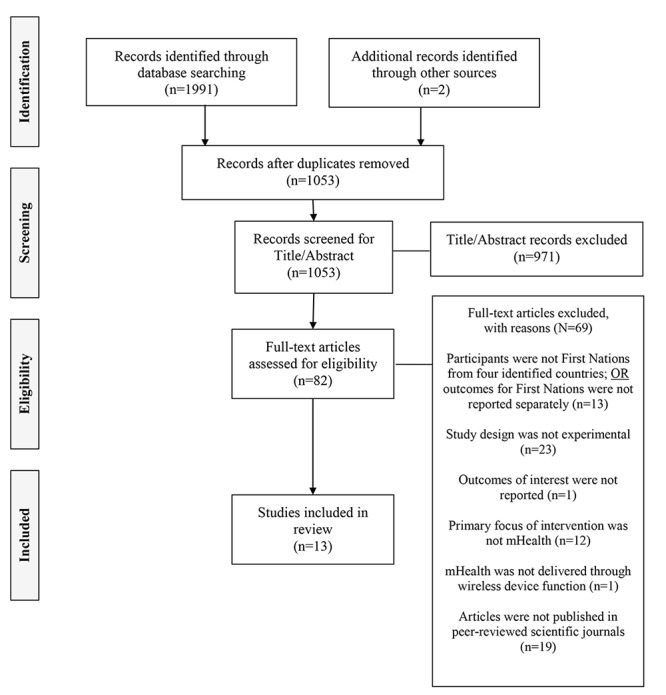
Background: The ubiquitous presence and functionality of mobile devices offers the potential for mobile health (mHealth) to create equitable health opportunities. While mHealth is used among First Nations populations to respond to health challenges, the characteristics, uptake, and effectiveness of these interventions are unclear. Objective: This review aimed to identify the characteristics of mHealth interventions (eg, study locations, health topic, and modality) evaluated with First Nations populations and to summarize the outcomes reported for intervention use, user perspectives including cultural responsiveness, and clinical effectiveness. In addition, the review sought to identify the presence of First Nations expertise in the design and evaluation of mHealth interventions with First Nations populations. Methods: The methods of this systematic review were detailed in a registered protocol with the International Prospective Register of Systematic Reviews (PROSPERO, CRD42019123276). Systematic searches of peer-reviewed, scientific papers were conducted across 7 databases in October 2018. Eligible studies had a primary focus on mHealth interventions with experimental or quasi-experimental design to respond to a health challenge with First Nations people from Canada, Australia, New Zealand, and the United States. Two authors independently screened records for eligibility and assessed risk of bias using the Joanna Briggs Institute checklists. Data were synthesized narratively owing to the mix of study designs, interventions, and outcomes. The review was reported in accordance with the Preferred Reporting Items for Systematic Reviews and Meta-Analyses statement. Results: Searches yielded 1053 unique records, after review and screening, 13 studies (5 randomized controlled trials and 8 quasi-experimental designs) were included in the final analysis. Studies were conducted in Australia (n=9), the United States (n=2), and New Zealand (n=2). The most common health challenge addressed was mental health and suicide (n=5). Intervention modalities included text messaging (n=5), apps (n=4), multimedia messaging (n=1), tablet software (n=1), or a combination of short messaging service (SMS) and apps (n=1). Results showed mixed engagement with the intervention (n=3); favorable user perspectives, including acceptability and cultural appropriateness (n=6); and mixed outcomes for clinical effectiveness (n=10). A diverse range of risks of bias were identified, the most common of which included a lack of clarity about allocation and blinding protocols and group treatment for randomized controlled trials and a lack of control group and single outcome measures for quasi-experimental designs. First Nations expertise informed all mHealth studies, through authorship (n=8), affiliation with First Nations bodies (n=3), participatory study design (n=5), First Nations reference groups (n=5), or a combination of these. Conclusions: mHealth modalities, including SMS and apps, appear favorable for delivery of health interventions with First Nations populations, particularly in the area of mental health and suicide prevention. Importantly, First Nations expertise was strongly embedded within the studies, augmenting favorable use and user engagement. However, evidence of efficacy is limited.
Overview
The claims and statistics of this paper haven’t been checked yet.
Free: it reads the open-access text and checks the first 5 claims that cite a source we can check. Create a free account to check every claim.
Integrity signals
Registry
Cites
Statistics
Figures
Verification
Claims the paper makes
The claims and statistics of this paper haven’t been checked yet.
Free: it reads the open-access text and checks the first 5 claims that cite a source we can check. Create a free account to check every claim.
Claims other papers make about this one
Each is checked against this paper’s own text: does it say what the citing paper says it does?
The cited source doesn’t support the claim as written.
In the citing paper
“most follow a format of conventional psychotherapy via telemedicine [21,24].”
From A Virtual Reality-Assisted Cognitive Behavioral Therapy for and With Inuit in Québec: Protocol for a Proof-of-Concept Randomized Controlled Trial (2023) · cites this paper as [21]
Checked by a reasoning model — may be wrong.
Experimental — accuracy not yet measuredThe cited source says what the claim attributes to it.
In the citing paper
“There is interest in digital technology solutions for Indigenous health and mental well-being”
From A Virtual Reality-Assisted Cognitive Behavioral Therapy for and With Inuit in Québec: Protocol for a Proof-of-Concept Randomized Controlled Trial (2023) · cites this paper as [21]
The check wasn’t confident either way, so it gives no verdict — never disputed.
In the citing paper
“Because of its relatively low cost, flexibility, and immersion, VR has been used in Indigenous contexts, such as in art, storytelling, culture, language, and transferring cultural heritage [20-23].”
From A Virtual Reality-Assisted Cognitive Behavioral Therapy for and With Inuit in Québec: Protocol for a Proof-of-Concept Randomized Controlled Trial (2023) · cites this paper as [21]
Experimental — accuracy not yet measured
Self-check
Percentages, sums and reported differences re-computed from the paper’s own numbers.
The self-check needs the paper’s full text.
Citations
Cites
Preferred Reporting Items for Systematic Reviews and Meta-Analyses: the PRISMA statement
Moher, D., Liberati, A., Tetzlaff, J., Altman, D. G., & for the PRISMA Group (2009) · BMJ · doi:10.1136/bmj.b2535 · Cited by 83,823
Preferred Reporting Items for Systematic Reviews and Meta-Analyses: The PRISMA Statement
Moher, D., Liberati, A., Tetzlaff, J., Altman, D. G., & The PRISMA Group (2009) · PLoS Medicine · doi:10.1371/journal.pmed.1000097 · Cited by 64,042 · cited 2×
“Selection of relevant scientific papers followed the PRISMA flowchart [21].”
Wang, G., Ma, R., Qiao, G., Wada, K., Aizawa, Y., & Satoh, T. (2015) · Integrative Medicine International · doi:10.1159/000368408 · Cited by 18,657
The impact of mHealth interventions: systematic review of systematic reviews
Marcolino, M. S., Oliveira, J. A. Q., D'Agostino, M., Ribeiro, A. L., Alkmim, M. B. M., & Novillo-Ortiz, D. (2018) · JMIR mHealth and uHealth · doi:10.2196/mhealth.8873 · Cited by 1,163 · cited 4×
“The challenges of mHealth research described by Marcolino et al [2] and the present systematic review correspond with broader public health intervention research, where evidence for causality is often constrained by sample size, time, ethical considerations, and costs.”
BackgroundInfluentialCriteria for evaluating evidence on public health interventions
Rychetnik, L., Frommer, M., Hawe, P., & Shiell, A. (2002) · Journal of Epidemiology and Community Health · doi:10.1136/jech.56.2.119 · Cited by 1,042 · cited 2×
“125) [55] to allow authentic evidence within the complex environment in which real-world interventions are trialed.”
BackgroundLabrique, A. B., Vasudevan, L., Kochi, E., Fabricant, R., & Mehl, G. (2013) · Global Health: Science and Practice · doi:10.9745/ghsp-d-13-00031 · Cited by 601 · cited 4×
“Although considered ideal for health interventions [4,6,7], conclusive statements for the clinical efficacy of mHealth are limited.”
BackgroundInfluentialMapping mHealth research: a decade of evolution
Fiordelli, M., Diviani, N., & Schulz, P. J. (2013) · Journal of Medical Internet Research · doi:10.2196/jmir.2430 · Cited by 570 · cited 2×
“problematic given a digital divide shaped by location, network infrastructure, cost of devices, and network access [17,52].”
BackgroundWeb 2.0 for Health Promotion: Reviewing the Current Evidence
Chou, W.-Y. S., Prestin, A., Lyons, C., & Wen, K.-Y. (2013) · American Journal of Public Health · doi:10.2105/ajph.2012.301071 · Cited by 309 · cited 4×
“Although considered ideal for health interventions [4,6,7], conclusive statements for the clinical efficacy of mHealth are limited.”
BackgroundInfluentialSocial Determinants of Indigenous Health
Ward, B. (2007) · The Australian Journal of Indigenous Education · doi:10.1017/s1326011100004567 · Cited by 255
Tighe, J., Shand, F., Ridani, R., Mackinnon, A., De La Mata, N., & Christensen, H. (2017) · BMJ Open · doi:10.1136/bmjopen-2016-013518 · Cited by 227 · cited 25×
“Interventions were aimed at risk reduction, prevention or screening (n=7) [26,27,29-32,34], treatment and disease management (n=3) [28,33,36], or targeted multiple disease phases (n=3) [35,37,38].”
BackgroundMethodInfluentialSmoking cessation using mobile phone text messaging is as effective in Maori as non-Maori.
Bramley, D. M., Riddell, T., Whittaker, R., Corbett, T., Lin, R., Wills, M., Jones, M., & Rodgers, A. (2005) · PubMed · Cited by 178
Auld, G., Snyder, I., & Henderson, M. (2012) · Language and Education · doi:10.1080/09500782.2012.691512 · Cited by 175 · cited 2×
“In particular, mobile devices may be viewed as a shared resource within First Nations communities [18,19,36], thus impacting the potential exposure of an mHealth intervention.”
BackgroundStrategies for mHealth Research: Lessons from 3 Mobile Intervention Studies
Ben-Zeev, D., Schueller, S. M., Begale, M., Duffecy, J., Kane, J. M., & Mohr, D. C. (2015) · Administration and Policy in Mental Health and Mental Health Services Research · doi:10.1007/s10488-014-0556-2 · Cited by 165 · cited 1×
“158) [56], noting that they require realism, collaboration, and flexibility of research teams.”
BackgroundmHealth Assessment: Conceptualization of a Global Framework
Bradway, M., Carrion, C., Vallespin, B., Saadatfard, O., Puigdomènech, E., Espallargues, M., & Kotzeva, A. (2017) · JMIR mHealth and uHealth · doi:10.2196/mhealth.7291 · Cited by 142 · cited 1×
“Mobile phones and other wireless devices have the potential to disrupt traditional health service delivery by enabling consumers to engage with health information, comanage conditions, and gain support for health challenges [1-3].”
BackgroundPutzer, G. J., & Park, Y. (2012) · PubMed · Cited by 127
Brown, E. L., Ruggiano, N., Li, J., Clarke, P. J., Kay, E. S., & Hristidis, V. (2019) · Journal of Applied Gerontology · doi:10.1177/0733464817723088 · Cited by 123 · cited 2×
“Although considered ideal for health interventions [4,6,7], conclusive statements for the clinical efficacy of mHealth are limited.”
BackgroundPovey, J., Mills, P. P. J. R., Dingwall, K. M., Lowell, A., Singer, J., Rotumah, D., Bennett-Levy, J., & Nagel, T. (2016) · Journal of Medical Internet Research · doi:10.2196/jmir.5314 · Cited by 121 · cited 9×
“Interventions were aimed at risk reduction, prevention or screening (n=7) [26,27,29-32,34], treatment and disease management (n=3) [28,33,36], or targeted multiple disease phases (n=3) [35,37,38].”
BackgroundMethodInfluentialNagel, T., Robinson, G., Condon, J., & Trauer, T. (2009) · Australian Journal of Rural Health · doi:10.1111/j.1440-1584.2009.01060.x · Cited by 108 · cited 1×
“For example, while research reports in this review [35,37,38] for the AIMhi Stay Strong App would traditionally be considered low levels of evidence [55], this app is informed by research showing that motivational care planning (MCP) effectively improved measures of well-being, substance misuse, and self-management am…”
Brusse, C., Gardner, K., McAullay, D., & Dowden, M. (2014) · Journal of Medical Internet Research · doi:10.2196/jmir.3614 · Cited by 105 · cited 4×
“The acceptability of mHealth interventions reported here is in line with descriptions by Brusse et al [15], who noted high penetration and rapid uptake of mobile interfaces such as social media, apps, and messaging.”
BackgroundResultInfluentialDevelopment and Use of Health-Related Technologies in Indigenous Communities: Critical Review
Jones, L., Jacklin, K., & O'Connell, M. E. (2017) · Journal of Medical Internet Research · doi:10.2196/jmir.7520 · Cited by 102 · cited 6×
“Jones et al report that alongside other technologies, mHealth is being adopted and adapted for cultural relevance within First Nations communities where meaningful participatory approaches are applied [14,15].”
BackgroundInfluentialYoung People’s Views on Electronic Mental Health Assessment: Prefer to Type than Talk?
Bradford, S., & Rickwood, D. (2015) · Journal of Child and Family Studies · doi:10.1007/s10826-014-9929-0 · Cited by 77
Chamberlain, C., Perlen, S., Brennan, S., Rychetnik, L., Thomas, D., Maddox, R., Alam, N., Banks, E., Wilson, A. J., & Eades, S. (2017) · Systematic Reviews · doi:10.1186/s13643-017-0520-9 · Cited by 77
Maar, M. A., Yeates, K., Toth, Z., Barron, M., Boesch, L., Hua-Stewart, D., Liu, P., Perkins, N., Sleeth, J., Wabano, M. J., et al. (2016) · JMIR mHealth and uHealth · doi:10.2196/mhealth.4994 · Cited by 75 · cited 2×
“Previous studies suggest text messaging is efficacious, relatively easy to use and a low-cost modality [2,3,15,51].”
BackgroundPulver, L. J., Haswell, M., Ring, I. T., Waldon, J., Clark, W., Whetung, V., Kinnon, D., Graham, C., Chino, M., LaValley, J., et al. (2010) · Research Online (University of Wollongong) · Cited by 72
Dingwall, K. M., Puszka, S., Sweet, M., & Nagel, T. (2015) · Australian Psychologist · doi:10.1111/ap.12100 · Cited by 71 · cited 8×
“Interventions were aimed at risk reduction, prevention or screening (n=7) [26,27,29-32,34], treatment and disease management (n=3) [28,33,36], or targeted multiple disease phases (n=3) [35,37,38].”
BackgroundMethodInfluentialMuller, C. J., Robinson, R. F., Smith, J. J., Jernigan, M. A., Hiratsuka, V., Dillard, D. A., & Buchwald, D. (2017) · Cancer · doi:10.1002/cncr.30499 · Cited by 71
Carroll, M., Cullen, T., Ferguson, S., Hogge, N., Horton, M. B., & Kokesh, J. (2011) · PubMed · doi:10.13016/70do-8u6f · Cited by 47
Kowal, E., Anderson, I., & Bailie, R. S. (2005) · Australian and New Zealand Journal of Public Health · doi:10.1111/j.1467-842x.2005.tb00228.x · Cited by 47 · cited 1×
“This is a meaningful finding given that First Nations knowledge is the most valuable asset available to address challenges of First Nations health and community [61].”
BackgroundDavies, J., Bukulatjpi, S., Sharma, S., Caldwell, L., Johnston, V., & Davis, J. S. (2015) · JMIR Research Protocols · doi:10.2196/resprot.4216 · Cited by 45 · cited 3×
“Enthusiasm and engagement with the use of mobile devices in health interventions with a variety of health challenges such as mental health and hepatitis B have been reported [14,16].”
BackgroundPhillips, J. H., Wigger, C., Beissbarth, J., McCallum, G. B., Leach, A. J., & Morris, P. S. (2014) · Journal of Paediatrics and Child Health · doi:10.1111/jpc.12496 · Cited by 43 · cited 9×
“Interventions were aimed at risk reduction, prevention or screening (n=7) [26,27,29-32,34], treatment and disease management (n=3) [28,33,36], or targeted multiple disease phases (n=3) [35,37,38].”
BackgroundMethodInfluentialFletcher, R. J., Hammond, C., Faulkner, D., Turner, N. A., Shipley, L., Read, D. M. Y., & Gwynn, J. (2017) · Australian Journal of Primary Health · doi:10.1071/py16151 · Cited by 36 · cited 9×
“Interventions were aimed at risk reduction, prevention or screening (n=7) [26,27,29-32,34], treatment and disease management (n=3) [28,33,36], or targeted multiple disease phases (n=3) [35,37,38].”
BackgroundInfluentialEvaluation of a culturally adapted training course in Indigenous e-mental health
Dingwall, K. M., Puszka, S., Sweet, M., Mills, P. P. J. R., & Nagel, T. (2015) · Australasian Psychiatry · doi:10.1177/1039856215608282 · Cited by 29 · cited 9×
“Interventions were aimed at risk reduction, prevention or screening (n=7) [26,27,29-32,34], treatment and disease management (n=3) [28,33,36], or targeted multiple disease phases (n=3) [35,37,38].”
BackgroundMethodInfluentialClark, R. A., Fredericks, B. L., Buitendyk, N., Adams, M., Howie‐Esquivel, J., Dracup, K., Berry, N., Atherton, J. J., & Johnson, S. (2015) · Rural and Remote Health · doi:10.22605/rrh3231 · Cited by 25 · cited 9×
“Interventions were aimed at risk reduction, prevention or screening (n=7) [26,27,29-32,34], treatment and disease management (n=3) [28,33,36], or targeted multiple disease phases (n=3) [35,37,38].”
BackgroundInfluentialSharpe, S., Kool, B., Whittaker, R., Lee, A. C.-L., Reid, P., Civil, I. D., Walker, M. J. P., Thornton, V., & Ameratunga, S. N. (2018) · npj Digital Medicine · doi:10.1038/s41746-018-0019-3 · Cited by 24 · cited 10×
“Interventions were aimed at risk reduction, prevention or screening (n=7) [26,27,29-32,34], treatment and disease management (n=3) [28,33,36], or targeted multiple disease phases (n=3) [35,37,38].”
BackgroundInfluentialDingwall, K. M., Nagel, T., Hughes, J. T., Kavanagh, D. J., Cass, A., Howard, K., Sweet, M., Brown, S., Sajiv, C., & Majoni, S. W. (2019) · BMC Psychology · doi:10.1186/s40359-018-0264-x · Cited by 24 · cited 1×
“It is also currently being trialed as a well-being intervention with Aboriginal and Torres Strait Islander people with chronic kidney disease [59].”
BackgroundShand, F., Mackinnon, A. J., O’Moore, K., Ridani, R., Reda, B., Hoy, M., Heard, T. R., Duffy, L., Shanahan, M., Pulver, L. J., et al. (2019) · Trials · doi:10.1186/s13063-019-3262-2 · Cited by 22 · cited 3×
“For example, tablets may facilitate help-seeking behavior for young people who experience concerns about social interaction and moral judgement when accessing mental health support [26,37,38,53,54].”
BackgroundResultLIt.search: fast tracking access to Aboriginal and Torres Strait Islander health literature
Tieman, J., Lawrence, M. A., Damarell, R., Sladek, R., & Nikolof, A. (2014) · Australian Health Review · doi:10.1071/ah14019 · Cited by 20
Overview of Aboriginal and Torres Strait Islander health status 2017
Drew, N., Burns, J., Burrow, S., Elwell, M., Fleay, J. J., Gray, C., Harford-Mills, M., Hoareau, J., Macrae, A., Potter, C., et al. (2018) · Research Online (Edith Cowan University) · Cited by 20
Yao, P., Fu, R., Rushing, S. C., Stephens, D., Ash, J. S., & Eden, K. (2018) · Health Promotion Practice · doi:10.1177/1524839918761872 · Cited by 19 · cited 16×
“Interventions were aimed at risk reduction, prevention or screening (n=7) [26,27,29-32,34], treatment and disease management (n=3) [28,33,36], or targeted multiple disease phases (n=3) [35,37,38].”
BackgroundInfluentialKirkham, R., MacKay, D., Barzi, F., Whitbread, C., Kirkwood, M., Graham, S., Dokkum, P. V., McIntyre, D. H., Shaw, J. E., Brown, A. D. H., et al. (2018) · Australian and New Zealand Journal of Obstetrics and Gynaecology · doi:10.1111/ajo.12894 · Cited by 14
Fredericks, B. (2007) · QUT ePrints (Queensland University of Technology) · Cited by 1
Research works printed but not linked: 5
- World Health Organization Global Diffusion of eHealth - Making Universal Health Coverage Achievable: Report of the Third Global Survey on eHealth 2016 Geneva, Switzerland World Health Organization
- Taylor K Guerin PT Health Care and Indigenous Australians: Cultural Safety in Practice. Second Edition 2014 South Yarra Palgrave Macmillan
- Tatau Kahukura Māori Health Chart Book 2015. Third Edition 2015 Wellington, New Zealand Ministry of Health
- Houston A Laws R Askew D Saldanha T Denney-Wilson E Exploring the cultural appropriateness and usefulness of a mhealth promotion program for infant feeding in an urban Aboriginal health service: a qualitative study Aust Indig Health Bull 2017 17 3 1 10
- Sterne JA Egger M Moher D Higgins JP Green S Addressing reporting biases Cochrane Handbook for Systematic Reviews of Interventions. Version 5.1.0 2011 United Kingdom The Cochrane Collaboration
Cited by
Hilty, D. M., Armstrong, C. M., Luxton, D. D., Gentry, M. T., & Krupinski, E. A. (2021) · Journal of Technology in Behavioral Science · doi:10.1007/s41347-021-00199-2 · Cited by 82
Mobile Health and Cultural Competencies as a Foundation for Telehealth Care: Scoping Review
Hilty, D. M., Crawford, A. S., Teshima, J., Nasatir-Hilty, S. E., Luo, J. S., Chisler, L. S. M., Hilty, Y. S. M. G., Servis, M. E., Godbout, R., Lim, R. F., et al. (2021) · Journal of Technology in Behavioral Science · doi:10.1007/s41347-020-00180-5 · Cited by 47
Moecke, D. P., Holyk, T., Beckett, M., Chopra, S., Petlitsyna, P., Girt, M., Kirkham, A. R., Kamurasi, I., Turner, J., Sneddon, D., et al. (2023) · Journal of Telemedicine and Telecare · doi:10.1177/1357633x231158835 · Cited by 61
Dingwall, K. M., Sweet, M., Cass, A., Hughes, J. T., Kavanagh, D., Howard, K., Barzi, F., Brown, S., Sajiv, C., Majoni, S. W., et al. (2021) · BMC Nephrology · doi:10.1186/s12882-021-02344-8 · Cited by 38
Brown, K., Toombs, M. R., Nasir, B., Kisely, S. R., Ranmuthugala, G., Brennan-Olsen, S. L., Nicholson, G. C., Gill, N., Hayman, N. E., Kondalsamy‐Chennakesavan, S., et al. (2020) · Social Science & Medicine · doi:10.1016/j.socscimed.2020.113015 · Cited by 36
Metadata
- Authors
- Hobson, G. R., Caffery, L. J., Neuhaus, M., & Langbecker, D. H.
- Affiliations
- The University of Queensland (AU)
- Venue
- JMIR mHealth and uHealth
- Publisher
- JMIR Publications Inc.
- Published
- 2019-10-07
- Volume
- 7
- Issue
- 10
- Pages
- e14877
- ISSN
- 2291-5222 (ISSN-L)
- PMC
- PMC6803895
- OpenAlex
- W2980282842
- Cited by
- 55
- References
- 41
- Citations by year
- 2026: 3 · 2025: 4 · 2024: 11 · 2023: 14 · 2022: 8 · 2021: 10 · 2020: 4
- FWCI
- 1.01
- Type
- journal article
- Language
- en
- Open access
- gold
- doi.org
- Licence
- cc-by
- Locations
- JMIR mhealth and uhealth (publishedVersion, cc-by)
- PubMed Central (publishedVersion, cc-by)
- PubMed (publishedVersion)
- DOAJ (DOAJ: Directory of Open Access Journals) (submittedVersion, cc-by-sa)
- Topics
- Health Sciences › Health Professions › General Health Professions › Mobile Health and mHealth Applications
- Social Sciences › Health › Indigenous Health, Education, and Rights
- Physical Sciences › Computer Science › Information Systems › Mobile Learning in Education
- Keywords
- mobile health, Indigenous health, mobile health intervention, text messaging, mobile application, mental health, suicide prevention, cultural responsiveness, intervention engagement, clinical effectiveness, Indigenous health equity, Indigenous health services, Indigenous health workforce
- MeSH terms
- Indigenous Peoples, Humans, Telemedicine, Vulnerable Populations
About these checks
Registry, retraction, Cites and statistics results are computed, not judged, with one exception: a printed reference that no index lists is read once by a model before it counts as a citation error. Claims are extracted by a model and kept only when their quote appears verbatim in the text; each cited source is then checked, with a model’s help, for whether it says what the claim relies on. Those verdicts can be wrong — read the claim’s quote and the cited source before relying on one.
Statistics and arithmetic are recomputed, not judged.
Confidence bands are shown only for fields calibrated on our annotated test set. None is calibrated yet, so no band is shown.
What counts as a claim ›How we measure confidence ›How we check this ›
Are you an author, or do you see a problem with this page? Request a review
Data sources
Bibliographic data: Semantic Scholar, OpenAlex, Crossref.
Contains information from the Semantic Scholar Academic Graph Datasets, made available under the ODC Attribution License (ODC-BY 1.0).
Semantic Scholar’s data is described in: Kinney, R., et al. (2023). The Semantic Scholar Open Data Platform. arXiv:2301.10140.
