

Artificial Intelligence-Based Conversational Agents for Chronic Conditions: Systematic Literature Review
Open accessPublished version of a preprint
The DOI matches its Crossref record; 77 of the 77 references it cites were found in a registry or an index; 25 of the 138 sources its claims cite were checked for support.
Abstract
Background: A rising number of conversational agents or chatbots are equipped with artificial intelligence (AI) architecture. They are increasingly prevalent in health care applications such as those providing education and support to patients with chronic diseases, one of the leading causes of death in the 21st century. AI-based chatbots enable more effective and frequent interactions with such patients. Objective: The goal of this systematic literature review is to review the characteristics, health care conditions, and AI architectures of AI-based conversational agents designed specifically for chronic diseases. Methods: We conducted a systematic literature review using PubMed MEDLINE, EMBASE, PyscInfo, CINAHL, ACM Digital Library, ScienceDirect, and Web of Science. We applied a predefined search strategy using the terms “conversational agent,” “healthcare,” “artificial intelligence,” and their synonyms. We updated the search results using Google alerts, and screened reference lists for other relevant articles. We included primary research studies that involved the prevention, treatment, or rehabilitation of chronic diseases, involved a conversational agent, and included any kind of AI architecture. Two independent reviewers conducted screening and data extraction, and Cohen kappa was used to measure interrater agreement.A narrative approach was applied for data synthesis. Results: The literature search found 2052 articles, out of which 10 papers met the inclusion criteria. The small number of identified studies together with the prevalence of quasi-experimental studies (n=7) and prevailing prototype nature of the chatbots (n=7) revealed the immaturity of the field. The reported chatbots addressed a broad variety of chronic diseases (n=6), showcasing a tendency to develop specialized conversational agents for individual chronic conditions. However, there lacks comparison of these chatbots within and between chronic diseases. In addition, the reported evaluation measures were not standardized, and the addressed health goals showed a large range. Together, these study characteristics complicated comparability and open room for future research. While natural language processing represented the most used AI technique (n=7) and the majority of conversational agents allowed for multimodal interaction (n=6), the identified studies demonstrated broad heterogeneity, lack of depth of reported AI techniques and systems, and inconsistent usage of taxonomy of the underlying AI software, further aggravating comparability and generalizability of study results. Conclusions: The literature on AI-based conversational agents for chronic conditions is scarce and mostly consists of quasi-experimental studies with chatbots in prototype stage that use natural language processing and allow for multimodal user interaction. Future research could profit from evidence-based evaluation of the AI-based conversational agents and comparison thereof within and between different chronic health conditions. Besides increased comparability, the quality of chatbots developed for specific chronic conditions and their subsequent impact on the target patients could be enhanced by more structured development and standardized evaluation processes.
Overview
CoChat Summary
TL;DR
This systematic review identified only 10 studies of AI-based conversational agents for chronic conditions, indicating a scarce and immature field dominated by quasi-experimental studies and prototypes. Natural language processing was the most common AI technique and most agents allowed multimodal interaction, but evaluation measures and AI reporting were heterogeneous.
Key findings
- From 2052 deduplicated citations, 10 papers met inclusion criteria; 7 were quasi-experimental, 2 were RCTs, and 1 was proof-of-concept. Seven chatbots were prototypes and not publicly available.
- Natural language processing was the most used AI technique (n=7), followed by speech recognition (n=5), machine learning (n=3), natural language understanding (n=2), neural networks (n=2), and AIML (n=2). Six studies used multimodal interaction.
- Reported technical performance was high in one study: accuracy 89%, precision 90%, sensitivity 89.9%, specificity 94.9%, F-measure 89.9%; another reported message response rates of 81%-97%. Two RCTs found chatbot interaction reduced symptoms of depression and anxiety compared with controls.
- The agents addressed a broad variety of chronic conditions, including depression/anxiety, heart failure, asthma, Alzheimer disease, Parkinson/dementia, COPD, JIA, diabetes/glaucoma, and psoriasis. Evaluation measures were not standardized, and health goals ranged from self-care and monitoring to diagnosis, education, and coaching.
Methods
- Systematic literature review following PRISMA, searching PubMed MEDLINE, EMBASE, PyscInfo, CINAHL, ACM Digital Library, ScienceDirect, and Web of Science in February 2020, with Google alerts and reference-list screening through April 2020.
- Inclusion required primary research on prevention, treatment, or rehabilitation of chronic diseases; a conversational agent; and any AI architecture. Two independent reviewers screened titles, abstracts, and full texts, calculated Cohen kappa, and resolved disagreements by consensus.
- Data were extracted into a 30-column spreadsheet and synthesized narratively. Risk of methodological bias was assessed with an adapted Maher et al CONSORT-based tool, with Cohen kappa of 79% between raters.
Limitations
- The paper states key limitations: heterogeneity and relatively small number of included studies, prevalence of quasi-experimental studies, and no meta-analysis. It also states that risk of bias varied extensively, reducing trust in findings from high-risk studies, and that a different taxonomy could have led to omission of relevant agents.
- The paper notes that many search results were conference abstracts omitted by eligibility criteria, and that study selection may still omit relevant AI-based conversational agents if another taxonomy were applied.
- Evident from the text: only 10 studies were included, 50% were conducted in North America, none in Africa, and 90% of research locations were in Western cultures, limiting generalizability. The two RCTs both disclosed a relevant conflict of interest, and the review reports broad heterogeneity and lack of depth in reported AI techniques and systems.
Model-written summary. Check it against the paper before relying on it.
Integrity signals
Registry
Cites
Statistics
Figures
Verification
Claims the paper makes
13 Valid · 1 Not valid · 46 Not checked · 85 Own results and interpretations
The sources with a verdict support this claim; the rest weren’t checked yet, have no full text we could read, or their verdicts aren’t rated yet.
In the paper
“Four studies found high levels of engagement with the conversational agent or reported the conversational agent to be engaging [50,52,53,58].”
§ Artificial Intelligence-Based Conversational Agents for Chronic Conditions: Systematic Literature Review > Results > Evaluation Measures and Main Findings
What the sources say
- Not checked yetcites [50] source
- Supportedcites [52] source
The Discussion’s Principal Results section says Woebot was associated with a high level of engagement, with most participants using it nearly every day. The Results’ Use and Acceptability section reports an average of 12.14 check-ins over two weeks. This supports the claim as it applies to this cited study; the four-study count is not attributed to this paper alone. (LLM, conf=0.94)
- Supportedcites [53] source
The Results (Analysis; page not provided) report substantial engagement with Tess: participants exchanged 14,238 messages, averaging 283 and 286 messages in the two test groups. The Discussion (Principal Findings; page not provided) also describes participants as displaying high engagement. This supports the engagement finding attributed to this study, rather than the citing sentence’s count of four studies. (LLM, conf=0.91)
- Supportedcites [58] source
In Results > Workshop 2 (page unavailable), participants described Ava positively, including as “lovely” and potentially helpful; four of eight strongly agreed they would like to use the system frequently. This supports the claim’s alternative that the agent was reported to be engaging, though the workshop assessed reactions to a video rather than measured engagement during live use. (LLM, conf=0.82)
plain- Asserted: passes — The authors put it forward as true.
- Checkable: passes — It can be checked against evidence.
- Load-bearing: unclear — It is unclear whether the paper’s conclusions depend on it.
- Based: passes — The paper gives a reason why it holds.
The sources with a verdict support this claim; the rest weren’t checked yet, have no full text we could read, or their verdicts aren’t rated yet.
In the paper
“The remaining 4 studies use a written format of interaction modality, which means that both input and output were in a written form [51-53,57].”
§ Artificial Intelligence-Based Conversational Agents for Chronic Conditions: Systematic Literature Review > Results > Characteristics of Conversational Agents
What the sources say
- Supportedcites [51] source
The mASMAA-development phase section states the system 'primarily uses a text-messaging modality as a means of interaction with users,' and the study procedure describes adolescents texting responses to six daily diary questions and self-initiated messages (written input) while mASMAA sent reminder/diary texts and automated or wizard replies back to them (written output); parents likewise received written daily reports by email (summary of mASMAA usage). No speech/voice modality appears anywhere in our copy, so the citing paper's classification of this study as a written-format (text in, text out) interaction is supported. (LLM, conf=0.85)
- Supportedcites [52] source
Our copy characterises the trial as text-based throughout: the Introduction states 'this study tested the ability of a commercially developed text-based conversational agent to deliver CBT to college students' and the Discussion (Principal Results) calls it 'the first randomized trial of a nonembodied text-based conversational agent designed for therapeutic use'. Methods (Interventions) confirms both directions of the exchange were written: Woebot 'is used within an instant messenger app', the bot 'sent one personalized message every day or every other day to initiate a conversation' and replied in text ('I'm so sorry you're feeling lonely...'), while user input came through 'a decision tree with suggested responses that also accepted natural language inputs' plus word/emoji mood selections. Minor non-text elements exist in the content (links to short video, animated gifs), but the interaction modality of this study is written input and written output, so it belongs in the citing paper's 'written format' group. (LLM, conf=0.85)
- Supportedcites [53] source
The citation is offered as an exemplar of a study whose interaction modality was entirely written, and our copy of the Tess RCT describes exactly that: Methods > Recruitment states participants were sent 'a direct link to begin chatting with Tess via an instant messenger app', and Methods > Interventions states Tess delivers services 'through existing communication channels such as Facebook messenger, Slack, and short messaging service text messaging' and 'is capable of interpreting free text messages'. Discussion > Limitations confirms the exchange was text-only in this study ('emotion identification was limited to language'), and Results report 14,238 messages exchanged with transcripts of the conversations. The classification as written input and written output is therefore supported. (LLM, conf=0.85)
- Not checked yetcites [57] source
plain- Asserted: passes — The authors put it forward as true.
- Checkable: passes — It can be checked against evidence.
- Load-bearing: unclear — It is unclear whether the paper’s conclusions depend on it.
- Based: passes — The paper gives a reason why it holds.
- Supported
The cited sources support only part of this claim — read each source’s verdict below.
In the paper
“Two RCTs reported on health-related outcomes and found that interaction with the conversational agents led to decreased symptoms of depression and anxiety compared with the control groups [52,53].”
§ Artificial Intelligence-Based Conversational Agents for Chronic Conditions: Systematic Literature Review > Results > Evaluation Measures and Main Findings
What the sources say
- Partly supportedcites [52] sourceExperimental — accuracy not yet measured
In Results > Preliminary Efficacy (page not provided), the Woebot group showed a significant reduction in depression relative to the information control group. The same passage reports no significant between-group difference in anxiety; Discussion > Limitations says the control group had a similar reduction in anxiety. This paper therefore supports the depression finding but not the attributed anxiety comparison. (LLM, conf=0.90)
- Supportedcites [53] source
The Results > Analysis section (page not provided) reports that the Tess group with daily check-ins had significantly reduced depression symptoms compared with the information control group. Both Tess groups had significantly reduced anxiety symptoms compared with control. This paper supports the claim for its own RCT; the other cited RCT is not being judged here. (LLM, conf=0.93)
plainstates a cause- Asserted: passes — The authors put it forward as true.
- Checkable: passes — It can be checked against evidence.
- Load-bearing: passes — The paper’s conclusions depend on it.
- Based: passes — The paper gives a reason why it holds.
- Partly supported
Every source the paper cites for this claim was checked and supports it.
In the paper
“After extensive research in relevant journals, we decided to follow the approach of Maher et al [48], who devised a risk assessment tool based on the Consolidated Standards of Reporting Trials (CONSORT) checklist [49].”
§ Artificial Intelligence-Based Conversational Agents for Chronic Conditions: Systematic Literature Review > Methods > Risk of Methodological Bias
What the sources say
- Supportedcites [48] source
In Methods > Risk of Methodological Bias, Maher et al. state that their team devised a risk-of-bias assessment tool based on the CONSORT checklist. This directly supports the citing sentence’s attribution. (LLM, conf=0.95)
- Supportedcites [49] Schulz, KF, 2010, BMJ source
Citation [49] identifies the CONSORT checklist on which the described tool was based; the claim that Maher et al. devised the tool is attributed separately to [48]. The source’s “Development of CONSORT 2010” and “Changes in CONSORT 2010” sections describe the checklist and its revision. The supplied passages have no page numbers. (LLM, conf=0.93)
plain- Asserted: passes — The authors put it forward as true.
- Checkable: passes — It can be checked against evidence.
- Load-bearing: passes — The paper’s conclusions depend on it.
- Based: passes — The paper gives a reason why it holds.
- Supported
The cited sources support only part of this claim — read each source’s verdict below.
In the paper
“In health care, such AI-based conversational agents have demonstrated multiple benefits for disease diagnosis, monitoring, or treatment support in the last two decades [1,19,27,28].”
§ Artificial Intelligence-Based Conversational Agents for Chronic Conditions: Systematic Literature Review > Introduction
What the sources say
- Partly supportedcites [1] sourceExperimental — accuracy not yet measured
The Results (Description of included studies; page unavailable) describe agents used for diagnosis and telemonitoring, and the Discussion (Main findings; page unavailable) reports acceptable diagnostic performance and one trial showing reduced depression symptoms. But the Conclusion says evidence of efficacy and safety remains limited; use in telemonitoring is not itself a demonstrated benefit. The review also says most included studies were published after 2010, rather than documenting benefits across the last two decades. (LLM, conf=0.87)
- Not checked yetcites [19] source
- Not checked yetcites [27] FadhilAA conversational interface to improve medication adherence: towards AI support in patient’s treatment20182020-08-30https://arxiv.org/pdf/1803.09844
- Not checked yetcites [28] FadhilABeyond patient monitoring: conversational agents role in telemedicine & healthcare support for home-living elderly individuals20182020-08-30https://arxiv.org/pdf/1803.06000
boostedstates a cause- Asserted: passes — The authors put it forward as true.
- Checkable: passes — It can be checked against evidence.
- Load-bearing: passes — The paper’s conclusions depend on it.
- Based: passes — The paper gives a reason why it holds.
- Partly supported
70 more claims · 2 with their cited sources checked
Create a free account to see all 145 claims and to verify the 113 references still open.
- It may state two separate claims as one. 37
- Probably not a substantial claim. 43
Claims other papers make about this one
Each is checked against this paper’s own text: does it say what the citing paper says it does?
The cited source doesn’t support the claim as written.
In the citing paper
“Although they found 2052 articles, only 10 met their inclusion criteria for research on chronic diseases involving an AI-based conversational agent. Of these 10, 2 papers dealt with dementia, but did not include a virtual agent.”
From Voice-Enabled Intelligent Virtual Agents for People With Amnesia: Systematic Review (2022) · cites this paper as [13]
Checked by a reasoning model — may be wrong.
Experimental — accuracy not yet measuredThe source backs part of the claim, not all of it — or backs it for a different population, condition or comparison.
In the citing paper
“On the same note, conversational agents have been proven a valuable tool to deliver digital health interventions [7-9].”
From Voice-Based Conversational Agents for the Prevention and Management of Chronic and Mental Health Conditions: Systematic Literature Review (2021) · cites this paper as [8]
Experimental — accuracy not yet measuredThe source backs part of the claim, not all of it — or backs it for a different population, condition or comparison.
In the citing paper
“These databases were chosen as they cover relevant aspects in the fields of medicine, technology, and interdisciplinary research and have also been used in other systematic reviews covering similar topics [7,8].”
From Voice-Based Conversational Agents for the Prevention and Management of Chronic and Mental Health Conditions: Systematic Literature Review (2021) · cites this paper as [8]
Experimental — accuracy not yet measuredThe cited source says what the claim attributes to it.
In the citing paper
“This is aligned with the findings of the previous systematic reviews of CAs in healthcare [1,27].”
From A systematic review on healthcare artificial intelligent conversational agents for chronic conditions (2022) · cites this paper as [1]
The cited source says what the claim attributes to it.
In the citing paper
“Of the extant systematic reviews on AI chatbots, 6 articles targeted at assessing efficacy of AI-chatbots in enhancing mental health outcomes [1,7,9-12], 2 examined the feasibility of AI-chatbots in health care settings [8,13], and 1 described the technical architectures and characteristics of the AI chatbots used in chronic conditions [14].”
From Artificial Intelligence-Based Chatbots for Promoting Health Behavioral Changes: Systematic Review. (2023) · cites this paper as [14]
4 more claims about this paper
Create a free account to see every claim other papers make about this one.
Self-check
Percentages, sums and reported differences re-computed from the paper’s own numbers.
Each contradiction between two passages listed here was confirmed by an independent check.
Rated minor: it would not touch a result — a value no result rests on, a p-value that stays on the same side of the significance level, or a conflict that is clerical, resolved elsewhere in the paper, or outside its own findings.
In the paper
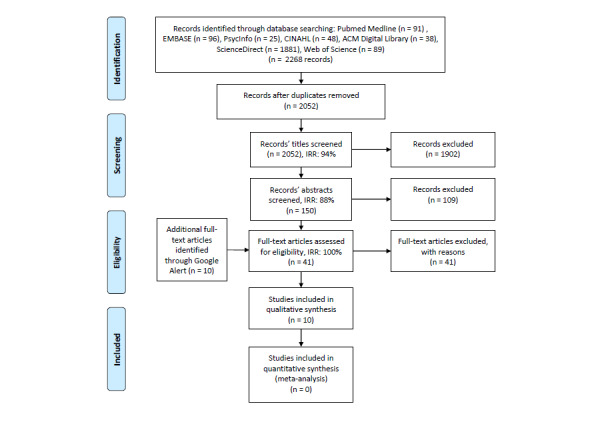
“In all, 2052 deduplicated citations from electronic databases were screened (Figure 1). Of these, 1902 papers were excluded during the title and abstract screening processes, respectively, leaving 41 papers eligible for full-text screening.”
§ Artificial Intelligence-Based Conversational Agents for Chronic Conditions: Systematic Literature Review > Results > Selection and Inclusion of Studies
Reported 41 · recomputed 150
Rated minor: it would not touch a result — a value no result rests on, a p-value that stays on the same side of the significance level, or a conflict that is clerical, resolved elsewhere in the paper, or outside its own findings.
In the paper
§ Artificial Intelligence-Based Conversational Agents for Chronic Conditions: Systematic Literature Review > Results > Artificial Intelligence Characteristics
“artificial intelligence markup language [56,57]”
§ Artificial Intelligence-Based Conversational Agents for Chronic Conditions: Systematic Literature Review > Results > Characteristics of Conversational Agents
“| Rose-Davis et al (2019) | JADE (Juvenile idiopathic Arthritis Dialogue-based Education) | Education | Written | NA (prototype) | NA | Internal | | Roca et al (2020) | NA (Virtual Assistant) | Diagnosis | Multimodal (w, v/w) | NA (prototype) | AIML, NLP | NA |”
Rated minor: it would not touch a result — a value no result rests on, a p-value that stays on the same side of the significance level, or a conflict that is clerical, resolved elsewhere in the paper, or outside its own findings.
In the paper
§ Artificial Intelligence-Based Conversational Agents for Chronic Conditions: Systematic Literature Review > Results > Characteristics of Included Studies
“| Roca et al (2020), Spain, proof of concept | Development and prototype architecture implementation of chatbot | Development of prototype chatbot architecture based on microservices through the use of messaging platforms | Health care professionals (n=NA) | Variety of chronic diseases, specific example of psoriasis | Patients | Disease monitoring |”
§ Artificial Intelligence-Based Conversational Agents for Chronic Conditions: Systematic Literature Review > Results > Characteristics of Conversational Agents
“| Roca et al (2020) | NA (Virtual Assistant) | Diagnosis | Multimodal (w, v/w) | NA (prototype) | AIML, NLP | NA |”
Citations
Cites
Interrater reliability: The kappa statistic
McHugh, M. L. (2012) · Biochemia Medica · doi:10.11613/bm.2012.031 · Cited by 19,877 · cited 1×
“After each of these phases, Cohen kappa was calculated to measure interrater reliability between the researchers and determine the level of agreement [47].”
MethodCONSORT 2010 Statement: updated guidelines for reporting parallel group randomised trials
the CONSORT Group, Schulz, K. F., Altman, D. G., & Moher, D. (2010) · BMC Medicine · doi:10.1186/1741-7015-8-18 · Cited by 13,371
Shamseer, L., Moher, D., Clarke, M., Ghersi, D., Liberati, A., Petticrew, M., Shekelle, P., Stewart, L. A., & the PRISMA-P Group (2015) · BMJ · doi:10.1136/bmj.g7647 · Cited by 13,120 · cited 1×
“It was conducted and reported according to the standardized PRISMA guidelines [46].”
MethodCONSORT 2010 Statement: updated guidelines for reporting parallel group randomised trials
Schulz, K. F., Altman, D. G., Moher, D., & for the CONSORT Group (2010) · BMJ · doi:10.1136/bmj.c332 · Cited by 9,329
Searle, J. R. (1980) · Behavioral and Brain Sciences · doi:10.1017/s0140525x00005756 · Cited by 6,954 · cited 2×
“Strong AI denotes software that truly possesses intelligence without mimicking it [8].”
BackgroundELIZA—a computer program for the study of natural language communication between man and machine
Weizenbaum, J. (1966) · Communications of the ACM · doi:10.1145/365153.365168 · Cited by 4,452 · cited 2×
“The focus on the human-machine relationship was present from the very beginning in the history of chatbots; the rule-based software program ELIZA [20] was designed to take on the role of a psychotherapist in order to mimic a patient-centered Rogerian psychotherapy exchange.”
BackgroundMethodArtificial intelligence in radiology
Hosny, A., Parmar, C., Quackenbush, J., Schwartz, L. H., & Aerts, H. J. W. L. (2018) · Nature Reviews Cancer · doi:10.1038/s41568-018-0016-5 · Cited by 3,803 · cited 1×
“This paper focuses on conversational agents that deploy intelligent software or artificial intelligence (AI), which is increasingly used for applications in credit scoring [2], marketing strategies [3], and medical image analysis in radiology [4].”
BackgroundThe potential for artificial intelligence in healthcare
Davenport, T., & Kalakota, R. (2019) · Future Healthcare Journal · doi:10.7861/futurehosp.6-2-94 · Cited by 3,800 · cited 2×
“This is reflected in the rising number of conversational agents that aim at human-like exchanges [16] in fields such as e-commerce, travel, tourism, and health care [17-19].”
BackgroundPatient Self-management of Chronic Disease in Primary Care
Bodenheimer, T. (2002) · JAMA · doi:10.1001/jama.288.19.2469 · Cited by 3,598 · cited 1×
“In contrast, chronic conditions require challenging lifestyle and behavioral changes, frequent self-care, and ongoing and personalized treatment that go beyond traditional health care sites and reach personal settings [37,42,43].”
BackgroundKaplan, A., & Haenlein, M. (2019) · Business Horizons · doi:10.1016/j.bushor.2018.08.004 · Cited by 3,140 · cited 1×
“Since then, the number of definitions had risen with the growing number of AI applications [6].”
Background
Research works printed but not linked: 4
- RadziwillNBentonMEvaluating quality of chatbots and intelligent conversational agents20172020-08-30https://arxiv.org/pdf/1704.04579
- Masche, J, 2017, Advanced Computational Methods for Knowledge Engineering, 212
- CuiLHuangSWeiFTanCDuanCZhouMSuperAgent: a customer service chatbot for e-commerce websites2020-08-30https://www.aclweb.org/anthology/P17-4017.pdf
- Ireland, D, 2016, Stud Health Technol Inform, 227, 55
Cited by
Artificial Intelligence-Based Chatbots for Promoting Health Behavioral Changes: Systematic Review.
Aggarwal, A., Tam, C. C., Wu, D., Li, X., & Qiao, S. (2023) · Journal of medical Internet research · doi:10.2196/40789 · Cited by 683
“…6 articles targeted at assessing efficacy of AI-chatbots in enhancing mental health outcomes [1,7,9-12], 2 examined the feasibility of AI-chatbots in health care settings [8,13], and 1 described the technical architectures and characteristics of the AI chatbots used in chronic conditions [14].”
InfluentialEsmaeilzadeh, P. (2024) · Artificial Intelligence in Medicine · doi:10.1016/j.artmed.2024.102861 · Cited by 377
Roles, Users, Benefits, and Limitations of Chatbots in Health Care: Rapid Review (Preprint)
Laymouna, M., Ma, Y., Lessard, D., Schuster, T., Engler, K., & Lebouché, B. (2024) · doi:10.2196/preprints.56930 · Cited by 302
Roles, Users, Benefits, and Limitations of Chatbots in Health Care: Rapid Review
Laymouna, M., Ma, Y., Lessard, D., Schuster, T., Engler, K., & Lebouché, B. (2024) · Journal of Medical Internet Research · doi:10.2196/56930 · Cited by 305
“…preconception, pregnancy, and postpartum health [36]; support for smoking cessation [38]; management of weight [39] and chronic conditions [6,9,20,40]; vaccine communication [26]; and broader health care acceptability [27]—these reviews often exhibit significant limitations in scope and depth.”
García-Martínez, I., Fernández-Batanero, J. M., Fernández-Cerero, J., & León, S. P. (2023) · Journal of New Approaches in Educational Research · doi:10.7821/naer.2023.1.1240 · Cited by 257
“…(VR) and augmented reality (AR) (Bower, Dewitt, & Lai, 2020; Kavanagh, Luxton-Reilly, Wuensche, & Plimmer, 2017), intelligent conversational software agents (chatbot) (Schachner, Keller, & Wangenheim, 2020), virtual assistants (Jee, 2019), and online platforms for self-learning (Moreno, 2019).”
Metadata
- Authors
- Schachner, T., Keller, R., & v Wangenheim, F.
- Affiliations
- ETH Zurich (CH)
- Corresponding author
- Schachner, Theresa
- Venue
- Journal of Medical Internet Research
- Publisher
- JMIR Publications Inc.
- Published
- 2020-09-14
- Volume
- 22
- Issue
- 9
- Pages
- e20701
- ISSN
- 1438-8871 (ISSN-L)
- PMC
- PMC7522733
- OpenAlex
- W3046201587
- Cited by
- 267
- References
- 75
- Citations by year
- 2026: 59 · 2025: 60 · 2024: 41 · 2023: 54 · 2022: 30 · 2021: 22 · 2020: 1
- FWCI
- 2.03
- Type
- journal article
- Language
- en
- Open access
- gold
- doi.org
- Licence
- cc-by
- Locations
- Journal of Medical Internet Research (publishedVersion, cc-by)
- PubMed Central (publishedVersion, cc-by)
- PubMed (publishedVersion)
- DOAJ (DOAJ: Directory of Open Access Journals) (submittedVersion, cc-by-sa)
- Repository for Publications and Research Data (ETH Zurich) (submittedVersion, cc-by)
- ETH Zürich Research Collection (cc-by)
- Funders
- National Research Foundation
- Topics
- Health Sciences › Medicine › Health Informatics › Artificial Intelligence in Healthcare and Education
- Health Sciences › Health Professions › General Health Professions › Mobile Health and mHealth Applications
- Social Sciences › Psychology › Applied Psychology › Digital Mental Health Interventions
- Keywords
- chatbots, artificial intelligence, chronic disease, natural language processing, multimodal interaction, patient support, health education, AI architecture, evaluation metrics, digital health interventions, rehabilitation, disease prevention and treatment, research gaps, generalizability of study results
- MeSH terms
- Artificial Intelligence, Chronic Disease, Communication, Humans, Natural Language Processing
About these checks
Registry, retraction, Cites and statistics results are computed, not judged, with one exception: a printed reference that no index lists is read once by a model before it counts as a citation error. Claims are extracted by a model and kept only when their quote appears verbatim in the text; each cited source is then checked, with a model’s help, for whether it says what the claim relies on. Those verdicts can be wrong — read the claim’s quote and the cited source before relying on one.
The claim verdicts this report counts are experimental: their accuracy is not yet measured.
A language model drew the claims from the paper on 2026-10-04, under version 3 of the claim definition (model deepseek-v4.1-flash, prompt extract-v3).
A second model labelled each claim on 2026-10-04 (model jev-1.13-20260917, definition revision gold-guideline-v0.2).
Cited sources are checked with a language model’s help (gpt-6-sol and qwen3.8-omni-flash).
Statistics and arithmetic are recomputed, not judged.
Confidence bands are shown only for fields calibrated on our annotated test set. None is calibrated yet, so no band is shown.
What counts as a claim ›How we measure confidence ›How we check this ›
Are you an author, or do you see a problem with this page? Request a review
Data sources
Bibliographic data: Semantic Scholar, OpenAlex, Crossref.
Contains information from the Semantic Scholar Academic Graph Datasets, made available under the ODC Attribution License (ODC-BY 1.0).
Semantic Scholar’s data is described in: Kinney, R., et al. (2023). The Semantic Scholar Open Data Platform. arXiv:2301.10140.
