

Telemedicine Acceptance Among Older Adult Patients With Cancer: Scoping Review
Open accessPublished version of a preprint
The DOI matches its Crossref record; 52 of the 52 references it cites were found in a registry or an index.
Abstract
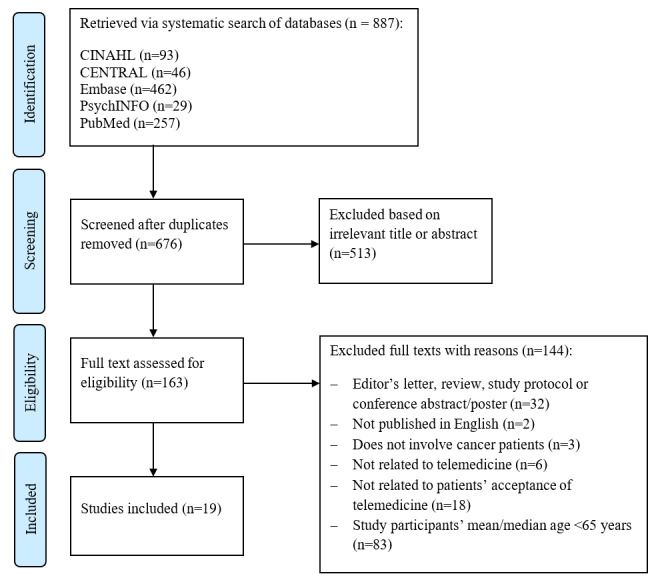
Background: Cancer is likely to remain the most prevalent noncommunicable disease in high-income countries with an older population. Interestingly, no review of attitudes toward telemedicine among older adults has been performed. This is likely to be the group most affected by both cancer and the increasing use of technology in health care. Objective: We aimed to map research on the acceptance of telemedicine among older adults who are cancer patients. Methods: We conducted a scoping review. PubMed, EMBASE, PsycINFO, CINAHL, and the Cochrane Central Register of Controlled Trials were systematically searched from inception to September 2020. Articles were included if the study population had a mean or median age ≥65 years, with cancer diagnoses and if the study assessed patients’ acceptance of a telemedicine intervention. Quantitative, qualitative, and mixed method studies were included. Results: Out of a total of 887 articles that were identified, 19 were included in the review. Interventions were delivered via telephone, videoconference, web portal, mobile app, wearable technology, and text messaging and included teleconsultation, monitoring and follow-up, psychosocial support and nursing care, and prompts. The most often cited facilitating factor was convenience. Other facilitators included an increase in telemedicine care accessibility, previous positive experiences of telemedicine, appropriate technical knowledge and support, decreased cost, physician recommendations, and privacy conferred by the telemedicine intervention. Barriers include a preference for conventional care along with negative perceptions of telemedicine, concerns about technical difficulties, and confidentiality concerns in the adoption of telemedicine. Conclusions: None of the studies explored the ability of tailored interventions to address facilitators and barriers of the acceptance of telemedicine in order to increase its adoption by older adults. Facilitators and barriers will likely differ across different cultural contexts and by type of telemedicine; however, this is a gap in current knowledge. In-depth studies are necessary to determine if interventions could potentially address the barriers identified in this review, to increase acceptability.
Overview
The claims and statistics of this paper haven’t been checked yet.
Free: it reads the open-access text and checks the first 5 claims that cite a source we can check. Create a free account to check every claim.
Integrity signals
Registry
Cites
Statistics
Figures
Verification
Claims the paper makes
The claims and statistics of this paper haven’t been checked yet.
Free: it reads the open-access text and checks the first 5 claims that cite a source we can check. Create a free account to check every claim.
Claims other papers make about this one
Each is checked against this paper’s own text: does it say what the citing paper says it does?
The cited source says what the claim attributes to it.
In the citing paper
“Although our findings suggested that effort expectancy and technology anxiety contributed less significantly to intentions to use teledelivered SCC, it is still noteworthy that facilitators and barriers are likely to differ across different cultural contexts and by types of telemedicine service [52].”
Self-check
Percentages, sums and reported differences re-computed from the paper’s own numbers.
The self-check needs the paper’s full text.
Citations
Cites
Sung, H., Ferlay, J., Siegel, R. L., Laversanne, M., Soerjomataram, I., Jemal, A., & Bray, F. (2021) · CA: A Cancer Journal for Clinicians · doi:10.3322/caac.21660 · Cited by 108,699 · cited 1×
“Cancer is the among the most prevalent of noncommunicable diseases in high-income countries [1], and the general incidence is likely to rise with a greying population.”
BackgroundUser Acceptance of Information Technology: Toward A Unified View1
Venkatesh, V., Morris, M. G., Davis, G. B., & Davis, F. D. (2003) · MIS Quarterly · doi:10.2307/30036540 · Cited by 45,035 · cited 1×
“A comprehensive review [12] illustrated the applicability of technology acceptance models with respect to telemedicine acceptance; one of the most frequently utilized [12,13] theoretical models identified was the Unified Theory of Acceptance and Use of Technology (UTAUT) [11].”
MethodPRISMA Extension for Scoping Reviews (PRISMA-ScR): Checklist and Explanation
Tricco, A. C., Lillie, E., Zarin, W., O'Brien, K. K., Colquhoun, H., Levac, D., Moher, D., Peters, M. D. J., Horsley, T., Weeks, L., et al. (2018) · Annals of Internal Medicine · doi:10.7326/m18-0850 · Cited by 43,565 · cited 2×
“A protocol was developed a priori, and registered on PROSPERO (CRD42021235248); we elected to utilize PRISMA-ScR (Preferred Reporting Items for Systematic Reviews and Meta-analysis for Scoping Reviews [17]) as the framework because the objective was to map existing evidence on telemedicine acceptance among older adult…”
MethodA Coefficient of Agreement for Nominal Scales
Cohen, J. (1960) · Educational and Psychological Measurement · doi:10.1177/001316446002000104 · Cited by 42,398 · cited 1×
“Each full text was independently reviewed by at least 2 of the reviewers: full texts were evenly distributed among reviewers, and a second reviewer was assigned to independently verify each set, with moderate (based on [19]) levels of agreement overall (SYF and NQP: Cohen κ=0.”
MethodEvaluating barriers to adopting telemedicine worldwide: A systematic review
Scott Kruse, C., Karem, P., Shifflett, K., Vegi, L., Ravi, K., & Brooks, M. (2018) · Journal of Telemedicine and Telecare · doi:10.1177/1357633x16674087 · Cited by 1,735 · cited 1×
“Crucially, while telemedicine adoption and use might be more intuitive in younger working adults who are likely to be more technologically savvy, it remains debatable how the incorporation of telemedicine into models of health care would be perceived among older adult patients, especially those with critical illness s…”
BackgroundCOVID-19 transforms health care through telemedicine: Evidence from the field
Mann, D. M., Chen, J., Chunara, R., Testa, P. A., & Nov, O. (2020) · Journal of the American Medical Informatics Association · doi:10.1093/jamia/ocaa072 · Cited by 1,361
Exposing some important barriers to health care access in the rural USA
Douthit, N., Kiv, S., Dwolatzky, T., & Biswas, S. (2015) · Public Health · doi:10.1016/j.puhe.2015.04.001 · Cited by 1,182
Hoque, R., & Sorwar, G. (2017) · International Journal of Medical Informatics · doi:10.1016/j.ijmedinf.2017.02.002 · Cited by 1,004 · cited 1×
“In the adoption of telemedicine to aid in health care, the older adult population faces a whole new distinct set of facilitators and barriers, and an understanding of these is important to increase telemedicine acceptance [39].”
BackgroundUse of Telehealth During the COVID-19 Pandemic: Scoping Review
Doraiswamy, S., Abraham, A., Mamtani, R., & Cheema, S. (2020) · Journal of Medical Internet Research · doi:10.2196/24087 · Cited by 698 · cited 1×
“With the ongoing COVID-19 pandemic, which appears to be accelerating the worldwide adoption of telemedicine, it is inevitable that many patients will face the prospect of having to integrate telemedicine into their care routines—within the 6-month period from January to June 2020, there were 543 articles published on…”
BackgroundGlobal cancer incidence in older adults, 2012 and 2035: A population‐based study
Pilleron, S., Sarfati, D., Janssen‐Heijnen, M., Vignat, J., Ferlay, J., Bray, F., & Soerjomataram, I. (2019) · International Journal of Cancer · doi:10.1002/ijc.31664 · Cited by 670 · cited 1×
“The rapidly rising incidence of cancer among older adults [10] and the high demands of oncology care mean that this group of patients could potentially benefit immensely from the adoption of telemedicine; yet, there is also a risk that, instead, this population will be left behind by advances in technology.”
Background
Cited by
Usability evaluation of mHealth apps for elderly individuals: a scoping review
Wang, Q., Liu, J., Zhou, L., Tian, J., Chen, X., Zhang, W., Wang, H., Zhou, W., & Gao, Y. (2022) · BMC Medical Informatics and Decision Making · doi:10.1186/s12911-022-02064-5 · Cited by 142
“A number of studies have pointed out that due to the decline in working memory, elderly people would frequently forget the operation steps when using mHealth apps, which is also the main reason why they give up using them [109–111].”
BackgroundSteindal, S. A., Nes, A. A. G., Godskesen, T., Holmen, H., Winger, A., Österlind, J., Dihle, A., & Klarare, A. (2023) · Journal of Medical Internet Research · doi:10.2196/43684 · Cited by 130
“Although technical literacy, usability concerns, and lack of technical support seem to be frequent barriers to telehealth use among older adults [83,92], some of the older patients in our systematic mixed studies review experienced no challenges with technology.”
Yang, H. J., Lee, J., & Lee, W. (2025) · Journal of Medical Internet Research · doi:10.2196/65269 · Cited by 125
“This suggests factors such as privacy or trust as identified in other studies [73,74] may be more critical determinants of acceptance.”
The Impact of Cancer on Mental Health and the Importance of Supportive Services
Fereidouni, Z., Abnavi, S. D., Ghanbari, Z., Gashmard, R., Zarepour, F., Samani, N. K., Sharma, A. R., & Ghasemi, A. (2024) · Galen Medical Journal · doi:10.31661/gmj.v13i.3327 · Cited by 93
“Telehealth allows patients to access mental health services remotely, which can be particularly beneficial for individuals who live in rural or remote areas [115].”
BackgroundWoolley, K. E., Bright, D., Ayres, T., Morgan, F. M., Little, K. E., & Davies, A. R. (2023) · Journal of Medical Internet Research · doi:10.2196/44181 · Cited by 79
“The use of digital health technology was observed in 14% (3/22) of reviews [21,36,37], reporting an increased use of patient portals among individuals with high illness burden, depression, moderate-severe asthma,”
Lundereng, E. D., Nes, A. A. G., Holmen, H., Winger, A., Thygesen, H., Jøranson, N., Borge, C. R., Dajani, O. F., Mariussen, K. L., & Steindal, S. A. (2023) · Journal of Medical Internet Research · doi:10.2196/43429 · Cited by 64
“…literature reviews regarding the use of telehealth in palliative care have primarily focused on pediatric palliative care [25,26], older patients with chronic conditions [22,27,28], or patients with cancer [29-31] and have examined patient or caregiver outcomes and experiences [14,17,23,32].”
Giebel, G. D., Abels, C., Plescher, F., Speckemeier, C., Schrader, N. F., Börchers, K., Wasem, J., Neusser, S., & Blase, N. (2024) · Journal of Medical Internet Research · doi:10.2196/49982 · Cited by 61
“This involves supporting them with app use and effectively communicating the benefits of mHealth apps [28,29].”
Cascella, M., Coluccia, S., Grizzuti, M., Romano, M. C., Esposito, G., Crispo, A., & Cuomo, A. (2022) · Current Oncology · doi:10.3390/curroncol29080439 · Cited by 52
“A recent literature analysis demonstrated that there is a gap in current knowledge on personalized approaches to address facilitators and barriers for remote consultations in cancer patients [12].”
BackgroundCoetzer, J. A., Loukili, I., Goedhart, N. S., Ket, J. C. F., Schuitmaker‐Warnaar, T. J., Zuiderent‐Jerak, T., & Dedding, C. W. M. (2024) · Social Science & Medicine · doi:10.1016/j.socscimed.2024.116895 · Cited by 50
Lobo, P. L. S., Morais, P., Murray, P., & Vilaça, J. L. (2024) · Sensors · doi:10.3390/s24247973 · Cited by 53
Digital Health Interventions to Improve Mental Health in Patients With Cancer: Umbrella Review
Zhong, C., Luo, X., Tan, M., Chi, J., Guo, B., Tang, J., Guo, Z., Deng, S., Zhang, Y., & Wu, Y. (2025) · Journal of Medical Internet Research · doi:10.2196/69621 · Cited by 47
“In contrast to the stimulating sensory experiences and diverse games offered by complex interfaces, older adult patients with cancer prefer clear and concise user instructions, which allows those with no prior experience or nonprofessionals to also get started easily [86-88].”
Telehealth adoption in palliative care: a systematic review of patient barriers and facilitators
Kirby, A., Griffin, D., Heavin, C., Drummond, F. J., McGrath, C., & Kiely, F. (2025) · BMC Palliative Care · doi:10.1186/s12904-025-01698-2 · Cited by 35
“Consistent with previous findings the effectiveness of telehealth may vary dependent on the patients’ age [34].”
Personalization in digital health interventions for older adults with cancer: A scoping review
Hwang, M., & Jiang, Y. (2023) · Journal of Geriatric Oncology · doi:10.1016/j.jgo.2023.101652 · Cited by 28
Valencia-Arías, A., Gallegos, A., Bravo, V. D. C. A., Mori, F. L. V., Uribe-Bedoya, H., & Palacios-Moya, L. (2024) · Cogent Social Sciences · doi:10.1080/23311886.2024.2306712 · Cited by 33
“…faced by various communities and populations, including those with disabilities (annaswamy et al., 2020; Graves et al., 2020; luo et al., 2021; Pang et al., 2022). although taM and utaut are widely used, future research could combine these models to include adopters’ beliefs and perceptions…”
Development and validation of the Digital Health Acceptability Questionnaire
Haydon, H. M., Major, T., Kelly, J. T., Catapan, S. D. C., Caffery, L. J., Smith, A. C., Gallegos-Rejas, V. M., Thomas, E. E., Banbury, A., & Snoswell, C. L. (2023) · Journal of Telemedicine and Telecare · doi:10.1177/1357633x231202279 · Cited by 24
Bergschöld, J. M., Gunnes, M., Eide, A. H., & Lassemo, E. I. (2024) · JMIR Aging · doi:10.2196/50286 · Cited by 23
Factors affecting the acceptance of tele-psychiatry: a scoping study
Izadi, R., Bahrami, M. A., Khosravi, M., & Delavari, S. (2023) · Archives of Public Health · doi:10.1186/s13690-023-01146-8 · Cited by 21
Shao, H., Liu, C., Tang, L., Wang, B., Xie, H., & Zhang, Y. (2023) · JMIR Human Factors · doi:10.2196/46624 · Cited by 17
“There are many platforms and modes of telemedicine, such as telephone, videoconference, web portal, mobile app, wearable technology, and SMS text messaging [49].”
BackgroundKomi, L. S., Chianumba, E. C., Forkuo, A. Y., Osamika, D., & Mustapha, A. Y. (2022) · International Journal of Multidisciplinary Research and Growth Evaluation · doi:10.54660/.ijmrge.2022.3.1.1008-1019 · Cited by 23
Yi, M., Hui, Y., Hu, L., Zhang, W., & Wang, Z. (2024) · Telemedicine Journal and e-Health · doi:10.1089/tmj.2024.0211 · Cited by 13
“19,20 In contrast to conventional health care settings, the primary obstacles faced by older adults with multimorbidity when accessing e-Health services include difficulty in using technology, the complexity of online information and data, trust and privacy concerns, and low digital literacy.”
Perspectives of older women with early breast cancer on telemedicine during post-primary treatment
Buse, C. R., O’Hare, E. A., Muss, H. B., & Nyrop, K. A. (2022) · Supportive Care in Cancer · doi:10.1007/s00520-022-07437-0 · Cited by 13
“Eighteen of these studies collected data prior to the COVID-19 pandemic [11].”
BackgroundGallegos-Rejas, V. M., Kelly, J. T., Snoswell, C. L., Haydon, H. M., Banbury, A., Thomas, E. E., Major, T., Caffery, L. J., Smith, A. C., & Catapan, S. D. C. (2023) · Journal of Telemedicine and Telecare · doi:10.1177/1357633x231197945 · Cited by 12
“Trust questions were not validated, more so were designed for hypothesis-generating purposes and so should be interpreted with the caveat that trust has many different domains and contexts, 28 which were not assessed in this study.”
BackgroundChanda, R. C., Zadeh, A. V., Hanifah, H. M., Nikbin, D., & Ahmed, T. (2025) · Aslib Journal of Information Management · doi:10.1108/ajim-07-2024-0542 · Cited by 12
Jiang, Y., Hwang, M., Cho, Y., Friese, C. R., Hawley, S. T., Manojlovich, M., Krauss, J. C., & Gong, Y. (2024) · Journal of Medical Internet Research · doi:10.2196/47685 · Cited by 11
“The willingness of oncology patients to use digital technologies to report medication safety events from home settings has been less studied [23,24].”
Remote monitoring in older adults with cancer, opportunities and challenges: a narrative review
Liuu, É., Battisti, N. M. L., Galvin, A., Compton, S., Kalsi, T., Paccalin, M., Valéro, S., Soubeyran, P., & Welch, C. (2025) · Aging Clinical and Experimental Research · doi:10.1007/s40520-025-03161-x · Cited by 9
Chimonas, S. C., Lipitz‐Snyderman, A., Spiegelhoff, Z., Chakraborty, N., Seier, K., White, C., & Kuperman, G. J. (2023) · Cancers · doi:10.3390/cancers15204961 · Cited by 9
“Taken together, these diverse patterns extend prior findings [7,29–34] by suggesting important department-and visit-specific contexts across the continuum where telemedicine may be suitable.”
BackgroundWerts, S. J., Chen, Z., Bea, J. W., Sokan, A. E., & Thomson, C. A. (2025) · JMIR Cancer · doi:10.2196/66636 · Cited by 8
“%) and there remains a lack of evidence exploring the barriers to digital technology adoption for those who do not access these tools [33,34].”
Stamer, T., Traulsen, P., Rieken, J., Schmahl, T., Menrath, I., & Steinhäuser, J. (2024) · BMC Cancer · doi:10.1186/s12885-024-12910-6 · Cited by 8
“Other studies examined eHealth and telemedicine on specific factors and isolated target groups of oncologic patients, for instance regarding the acceptance of eHealth and telemedicine among older adults with cancer or the use of telehealth in gynecologic cancer care [58, 59].”
BackgroundOche, O., Dobyns, R. C., Lin, C., & Kennelty, K. A. (2022) · Telemedicine Reports · doi:10.1089/tmr.2022.0018 · Cited by 9
“In another study that linked telemedicine acceptance in older adults to facilitating factors, previous positive telemedicine experience, technical knowledge and support, increased access to care, decreased cost, recommendations by physicians, and convenience were reported as telemedicine facilitators.(10) Altogether,…”
BackgroundGuo, M., Prayaga, R. B., Levitz, C. E., Kuo, E., Ruiz, E., Torres-Ozadali, E., & Escaron, A. L. (2023) · JMIR Cancer · doi:10.2196/43024 · Cited by 8
“Reviews have noted that there is a gap in the literature regarding barriers to using mobile health among older adult patients [19], although other studies have found that older adults are open to these text messages [20].”
BackgroundCaliandro, M., Carbonara, R., Surgo, A., Ciliberti, M. P., Guglielmo, F. C. D., Bonaparte, I., Paulicelli, E., Gregucci, F., Turchiano, A., & Fiorentino, A. (2023) · Current Oncology · doi:10.3390/curroncol30050390 · Cited by 8
Endo, Y., Woldesenbet, S., Tsilimigras, D. I., Munir, M. M., Khalil, M., Khan, M. M. M., Altaf, A., Rashid, Z., Catalano, G., Chatzipanagiotou, O. P., et al. (2024) · Journal of Gastrointestinal Surgery · doi:10.1016/j.gassur.2024.06.009 · Cited by 7
Tan, J. Y., Choo, J. S. H., Iyer, S. C., Lim, B. S. Y., Tan, J. J.-R., Ng, J. M. Y., Lian, T. T. Y., & Hilal, S. (2024) · Scientific Reports · doi:10.1038/s41598-024-68410-x · Cited by 8
“In this context, acceptability is a subjective measure of whether telemedicine is considered suitable, appropriate, or satisfactory by patients or providers 15 .”
BackgroundVlachopoulos, N., Kontogiannis, G., Papageorgiou, D. I., Symvoulakis, E. K., Haidich, A., & Smyrnakis, Ε. (2024) · American Journal of Hospice and Palliative Medicine® · doi:10.1177/10499091241277882 · Cited by 7
“11,70 71-73”
Georgescu, I., Dricu, A., Artene, S.-A., Vrăjitoru, N.-R., Barcan, E., Tache, D. E., Giubelan, L.-I., Staicu, G.-A., Manea (Carneluti), E.-V., Pană, C., et al. (2024) · Applied Sciences · doi:10.3390/app14188097 · Cited by 6
Comparing Outcomes: In-Person and Telehealth Oncology Visits
Fridman, I., Neslund-Dudas, C. M., Barrow, L. J., Dunn, M. R., Jones, R. C., Kinlaw, A. C., Smith, A. B., Stein, J. N., Tam, S. H., Wood, W. A., et al. (2026) · JCO Oncology Practice · doi:10.1200/op-25-00616 · Cited by 6
Alfuqhar, I. M. T. D., Khalafalla, A. E. A., Ali, S. H. M., Adam, E. I. A., Osman, H. M., & Alrabie, R. S. (2024) · Cureus · doi:10.7759/cureus.72144 · Cited by 10
The adoption of telemedicine by healthcare practitioners in South Africa
Cullen, M., Calitz, A. P., Boucher, S., & Buddan, P. (2025) · Acta Commercii · doi:10.4102/ac.v25i2.1329 · Cited by 7
“The demographic profile of the respondents is illustrated in Telemedicine is better adopted and understood by younger age groups because they can learn to use the technology more easily than older age groups (Pang et al. 2022).”
Dunn, M. R., Fridman, I., Kinlaw, A. C., Neslund-Dudas, C. M., Tam, S. H., & Lafata, J. E. (2025) · Health Services Research · doi:10.1111/1475-6773.14461 · Cited by 7
Barriers and facilitators of using tele-oncology in cancer care: a scoping review
Nopour, R. (2025) · BMC Health Services Research · doi:10.1186/s12913-025-12731-8 · Cited by 8
Hwang, M., Cho, Y., Gahn, K., Mason, H. L., Manojlovich, M., Gong, Y., & Jiang, Y. (2025) · Supportive Care in Cancer · doi:10.1007/s00520-025-09813-y · Cited by 8
Springer, F., Hambsch, P. K., Mehnert-Theuerkauf, A., & Nicolay, N. H. (2025) · Frontiers in Oncology · doi:10.3389/fonc.2025.1546221 · Cited by 5
“This is supported by a scoping review that identi fi es key facilitators for telemedicine use, such as convenience of use, perceived availability, physicians ’ recommendations, and patients ’ technical knowledge (18).”
Lu, W., Yorke, J., Li, Y., Lam, W., Li, M., Hu, Y., & Ngai, C. S. B. (2025) · Humanities and Social Sciences Communications · doi:10.1057/s41599-025-04758-3 · Cited by 6
“…technologies and online medical services, online medical consultations (OMCs) have emerged as a viable alternative to enable continuous dialogic interactions that transcend geographical barriers and offer cost-ef fi cient follow-up care (Farias et al. 2017; Lu et al. 2024; Pang et al. 2022).”
Transformational Leadership in Telenursing Implementation Towards Hospital Digital Transition
Ariga, R. A., Siahaan, E., Dalimunthe, R. F., & Lumbanraja, P. (2023) · TEM Journal · doi:10.18421/tem124-58 · Cited by 5
Coco, L., Leon, K., Navarro, C., Piper, R., Carvajal, S. C., & Marrone, N. L. (2024) · Ear and Hearing · doi:10.1097/aud.0000000000001507 · Cited by 5
“As in our study, prior research shows that older adults reported that the benefits of telehealth included the convenience of not having to drive long distances (Pang et al. 2022).”
O’Brien, A., Brennan, L. K., O’Neill, L. M., Connolly, D., Guinan, E. M., Reynolds, J. V., & Hussey, J. M. (2023) · European Journal of Cancer Care · doi:10.1155/2023/7998022 · Cited by 9
Wan, S. W., Choe, L., Wong, G. J., Koh, W. L., Ng, J. S., Tan, W. H., Ooi, J. L. X., Melody, J., & Tan, K. (2025) · Health Policy and Technology · doi:10.1016/j.hlpt.2025.101131 · Cited by 5
Self-citationYang, Y., Zhang, W., Liu, C., Zhang, H., Shen, X., Yan, L., Shi, W., & Gui, L. (2026) · The EPMA Journal · doi:10.1007/s13167-026-00441-y · Cited by 4
Wan, S. W., Choe, L., Wong, G. J., Koh, W. L., Ng, J. S., Tan, W. H., Ooi, J. L. X., Melody, J., Lau, J., & Tan, K. (2025) · Health Policy and Technology · doi:10.1016/j.hlpt.2025.101007 · Cited by 4
Self-citationKeshvardoost, S., Bahaadinbeigy, K., Shahidsales, S., Fatehi, F., & Kalhori, S. R. N. (2025) · BMC Medical Informatics and Decision Making · doi:10.1186/s12911-025-03042-3 · Cited by 3
Yao, Y., Zhang, M., Peng, S., Cheng, Z., & Duan, Y. (2026) · Journal of Medical Internet Research · doi:10.2196/84644 · Cited by 4
“Research on online consultation and telemedicine has expanded rapidly in recent years, with a growing focus on use patterns and determinants of adoption [17-19].”
Leong, D., Ng, A., Chang, P. J., Zheng, J. Y., Wilson, R. D., Chen, M., & Vargo, M. M. (2024) · PM&R · doi:10.1002/pmrj.13199 · Cited by 3
“28 No gender-related disparities were seen in our study.”
Delphi Assessment of Home-Based Digital Healthcare for Aging Patients: A Biopsychosocial Perspective
Solinís, M. Á. G., Sánchez-de-Madariaga, R., Carrero, A. M., & Goswami, N. (2025) · Clinical Interventions in Aging · doi:10.2147/cia.s525246 · Cited by 3
“9,32 In general, the new home-based healthcare systems should incorporate elements and strategies to face the resistance and reluctance to implement them.”
Harnik, M. A., Scheidegger, A., Blättler, L. T., Nemecek, Z., Sauter, T. C., Limacher, A., Reisig, F., Holtforth, M. G., & Streitberger, K. (2024) · JMIR Formative Research · doi:10.2196/53154 · Cited by 4
“…comparable to other investigations that have examined acceptance in other collectives: for example, 1 study in patients who were urogynecologic found 87% acceptance [35], while 2 scoping reviews found high acceptance of telemedicine in palliative care [36] and older adult patients with tumors [37].”
Hoffmann, S. M., Hieber, R., Walter, C. B., & Engler, T. (2025) · Archives of Gynecology and Obstetrics · doi:10.1007/s00404-025-08067-7 · Cited by 3
Yeung, N. C. Y., Lau, S. T. Y., Mak, W. W. S., Cheng, C., Chan, E. Y. Y., Siu, J. Y. M., & Cheung, P. S. Y. (2024) · JMIR Cancer · doi:10.2196/51072 · Cited by 2
“…our findings suggested that effort expectancy and technology anxiety contributed less significantly to intentions to use teledelivered SCC, it is still noteworthy that facilitators and barriers are likely to differ across different cultural contexts and by types of telemedicine service [52].”
BackgroundZadegan, M. A., Aromaa, E., Sahlström, R., Montonen, T., Eriksson, P., & Leinonen, V. (2025) · Home Health Care Management & Practice · doi:10.1177/10848223251324598 · Cited by 2
Hong, W., Cheng, G., Ma, Y., Chen, M., Yang, C., & Yin, X. (2025) · BMC Psychiatry · doi:10.1186/s12888-025-07534-4 · Cited by 2
Fridman, I., Neslund-Dudas, C. M., Barrow, L. C. J., Dunn, M. R., Jones, R., Kinlaw, A. C., Smith, A. B., Stein, J. N., Tam, S. H., Wood, W. A., et al. (2024) · JCO Oncology Practice · doi:10.1200/op.24.00307 · Cited by 2
Almatrooshi, H. (2022) · doi:10.46289/cs12lq29 · Cited by 3
Mohamed, N. E., Berry, D. L., McReynolds, J., Korn, T., Kata, H. E., Benn, E. K. T., Scharp, D., Sfakianos, J. P., Mehrazin, R., Wiklund, P. N., et al. (2026) · Cancers · doi:10.3390/cancers18101501 · Cited by 1
“However, studies show that when appropriately designed, older adults can successfully engage with digital interventions [48,49].”
Hwang, M., Cho, Y., Park, S. Y., Veliz, P. T., Friese, C. R., & Jiang, Y. (2026) · International Journal of Nursing Studies · doi:10.1016/j.ijnurstu.2026.105614 · Cited by 1
Frielitz, F., Rademacher, A., Exner, B., Dördelmann, J., & Schewe, D. M. (2026) · Pediatric Hematology and Oncology · doi:10.1080/08880018.2026.2725653 · Cited by 1
“11 Trust remains a key barrier, as many patients and families may view telemedicine as inadequate for life-threatening illnesses, believing virtual visits lack the immediacy, depth, and reassurance of in-person interactions.”
Ng, A., Tennison, J. M., Fu, J. B., Gupta, E., Lu, Z., & Bruera, E. D. (2024) · American Journal of Physical Medicine & Rehabilitation · doi:10.1097/phm.0000000000002501 · Cited by 1
“14 Virtual visits can greatly improve patient access to healthcare for older patients, as they are more likely to have multiple comorbidities and physical limitations.”
Telehealth use by older New Yorkers during the COVID-19 Pandemic
Chan, K., Millington, M., Low, A., Farley, S. M., Hoos, D., El‐Sadr, W., Reyes, M., & Greenleaf, A. R. (2024) · Ageing International · doi:10.1007/s12126-024-09572-x · Cited by 1
“There is a gap in understanding factors influencing telehealth use among older adults (Pang et al., 2022; Sheng et al., 2023).”
Mantziari, D., Plomariti, C. S., Billis, A., & Bamidis, P. D. (2025) · Springer eBooks · doi:10.1007/978-3-031-87158-0_10 · Cited by 3
Terminología en educación médica a distancia
Orellano, C. (2022) · ACTA MEDICA PERUANA · doi:10.35663/amp.2022.394.2391
Wersényi, G., & Tollár, J. (2023) · Springer proceedings in business and economics · doi:10.1007/978-981-19-8485-3_20
AlZabin, A. K., Almajed, E. H., Alqntash, N., Khaytan, S., Alkhodier, A. A., Alhijab, K., & AlMujil, A. S. (2025) · Telemedicine Journal and e-Health · doi:10.1177/15305627251378396
Wearable Robotics for Post-Stroke Motor Rehabilitation: Challenges and Opportunities
Kanetkar, S. R., Gulhane, M., Badjate, S. L., Rakesh, N., Karade, S., & Gupta, A. (2025) · International Conference on Next Generation of Green Information and Emerging Technologies (GIET) · doi:10.1109/giet65294.2025.11234783
“Robot-assisted therapy, on the other hand, is a high-tech way to do high-intensity, repeated, task-specific tasks that are important for healing but hard to do the old-fashioned way [13].”
Stamer, T., Traulsen, P., Rieken, J., Schmahl, T., Menrath, I., & Steinhäuser, J. (2024) · Figshare · doi:10.6084/m9.figshare.27059111
Technology Continuance in Health : Development and Application of New Measurement Models
Ries, T. (2025) · EPub Bayreuth (University of Bayreuth) · doi:10.15495/epub_ubt_00008183 · Cited by 2
Stamer, T., Traulsen, P., Rieken, J., Schmahl, T., Menrath, I., & Steinhäuser, J. (2024) · Figshare · doi:10.6084/m9.figshare.27059108
Stamer, T., Traulsen, P., Rieken, J., Schmahl, T., Menrath, I., & Steinhäuser, J. (2024) · Figshare · doi:10.6084/m9.figshare.27059117
From Constraint to Strategy: A Necessity-Based Perspective on Telemedicine Usage in Japan and China
HANSHU, W., Shinoda, K., & Gu, X. (2026) · Telemedicine Journal and e-Health · doi:10.1177/15305627261421484
“Together with consistency with prior literature, 5,38,39 these results support the construct validity of the eight-factor structure.”
Timurtaş, M. (2024) · Dspace Repository (Marmara Üniversitesi) · Cited by 2
Gotheridge, H. (2026) · Lancaster EPrints (Lancaster University) · doi:10.17635/lancaster/thesis/3275
Telehealth and Electronic Messages in Hematology: The Good, the Bad, and the Ugly
Zhuo, K., & Banerjee, R. K. (2026) · JCO Oncology Practice · doi:10.1200/op-26-00898
Natek, I. (2026) · Repository of the University of Ljubljana (University of Ljubljana)
Cancer Patients' Preferences for Home-Based Digital Health Services: A Scoping Review (Preprint)Preprint
Yuanyuan, L., Zhanyang, W., Zhang, H., Ailiyakbar, A., Wang, Q., Li, T., Zhang, P., & Geng, Z. (2026) · doi:10.2196/preprints.115970
Wong, H., Robinson, T., Strawson-Smith, T., Alhilfi, A., Panes, L., & Wells, T. (2026) · International Journal of Breast Cancer · doi:10.1155/ijbc/6612877
Metadata
- Authors
- Pang, N.-Q., Lau, J., Fong, S.-Y., Wong, C. Y.-H., & Tan, K.-K.
- Affiliations
- National University of Singapore (SG)
- Corresponding author
- Tan, Ker-Kan
- Venue
- Journal of Medical Internet Research
- Publisher
- JMIR Publications Inc.
- Published
- 2022-03-29
- Volume
- 24
- Issue
- 3
- Pages
- e28724
- ISSN
- 1438-8871 (ISSN-L)
- PMC
- PMC9006130
- OpenAlex
- W4220887577
- Cited by
- 75
- References
- 52
- Citations by year
- 2026: 7 · 2025: 23 · 2024: 24 · 2023: 15 · 2022: 6
- FWCI
- 3.38
- Type
- journal article
- Language
- en
- Open access
- gold
- doi.org
- Licence
- cc-by
- Locations
- Journal of Medical Internet Research (publishedVersion, cc-by)
- PubMed Central (publishedVersion, cc-by)
- PubMed (publishedVersion)
- DOAJ (DOAJ: Directory of Open Access Journals) (submittedVersion)
- Topics
- Health Sciences › Medicine › Public Health, Environmental and Occupational Health › Telemedicine and Telehealth Implementation
- Health Sciences › Medicine › Geriatrics and Gerontology › Technology Use by Older Adults
- Health Sciences › Medicine › Geriatrics and Gerontology › Frailty in Older Adults
- Keywords
- telemedicine, older adults, cancer patients, technology acceptance, barriers and facilitators, teleconsultation, psychosocial support, nursing care, wearable devices, mobile health apps, videoconferencing, patient attitudes, confidentiality concerns
- MeSH terms
- Aged, Humans, Neoplasms, Telephone, Telemedicine, Text Messaging, Mobile Applications
About these checks
Registry, retraction, Cites and statistics results are computed, not judged, with one exception: a printed reference that no index lists is read once by a model before it counts as a citation error. Claims are extracted by a model and kept only when their quote appears verbatim in the text; each cited source is then checked, with a model’s help, for whether it says what the claim relies on. Those verdicts can be wrong — read the claim’s quote and the cited source before relying on one.
Statistics and arithmetic are recomputed, not judged.
Confidence bands are shown only for fields calibrated on our annotated test set. None is calibrated yet, so no band is shown.
What counts as a claim ›How we measure confidence ›How we check this ›
Are you an author, or do you see a problem with this page? Request a review
Data sources
Bibliographic data: Semantic Scholar, OpenAlex, Crossref.
Contains information from the Semantic Scholar Academic Graph Datasets, made available under the ODC Attribution License (ODC-BY 1.0).
Semantic Scholar’s data is described in: Kinney, R., et al. (2023). The Semantic Scholar Open Data Platform. arXiv:2301.10140.
