

Telemedicine Acceptance Among Older Adult Patients With Cancer: Scoping Review
Open accessPublished version of a preprint
The DOI matches its Crossref record; 52 of the 52 references it cites were found in a registry or an index.
Abstract
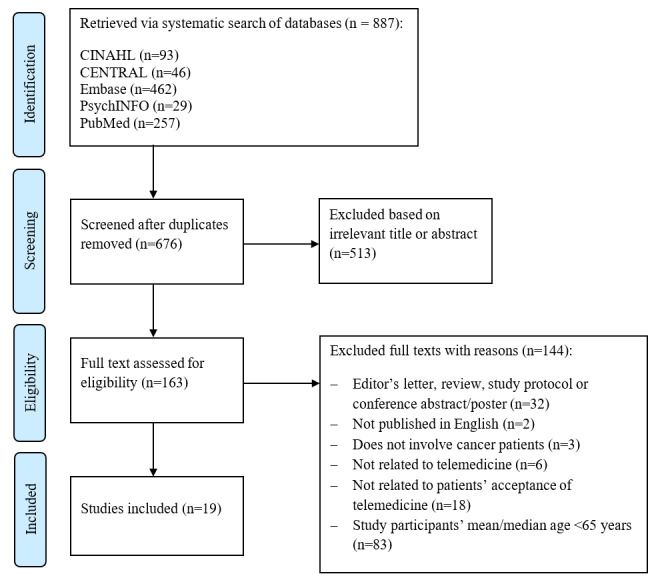
Background: Cancer is likely to remain the most prevalent noncommunicable disease in high-income countries with an older population. Interestingly, no review of attitudes toward telemedicine among older adults has been performed. This is likely to be the group most affected by both cancer and the increasing use of technology in health care. Objective: We aimed to map research on the acceptance of telemedicine among older adults who are cancer patients. Methods: We conducted a scoping review. PubMed, EMBASE, PsycINFO, CINAHL, and the Cochrane Central Register of Controlled Trials were systematically searched from inception to September 2020. Articles were included if the study population had a mean or median age ≥65 years, with cancer diagnoses and if the study assessed patients’ acceptance of a telemedicine intervention. Quantitative, qualitative, and mixed method studies were included. Results: Out of a total of 887 articles that were identified, 19 were included in the review. Interventions were delivered via telephone, videoconference, web portal, mobile app, wearable technology, and text messaging and included teleconsultation, monitoring and follow-up, psychosocial support and nursing care, and prompts. The most often cited facilitating factor was convenience. Other facilitators included an increase in telemedicine care accessibility, previous positive experiences of telemedicine, appropriate technical knowledge and support, decreased cost, physician recommendations, and privacy conferred by the telemedicine intervention. Barriers include a preference for conventional care along with negative perceptions of telemedicine, concerns about technical difficulties, and confidentiality concerns in the adoption of telemedicine. Conclusions: None of the studies explored the ability of tailored interventions to address facilitators and barriers of the acceptance of telemedicine in order to increase its adoption by older adults. Facilitators and barriers will likely differ across different cultural contexts and by type of telemedicine; however, this is a gap in current knowledge. In-depth studies are necessary to determine if interventions could potentially address the barriers identified in this review, to increase acceptability.
Overview
The claims and statistics of this paper haven’t been checked yet.
Free: it reads the open-access text and checks the first 5 claims that cite a source we can check. Create a free account to check every claim.
Integrity signals
Registry
Cites
Statistics
Figures
Verification
Claims the paper makes
The claims and statistics of this paper haven’t been checked yet.
Free: it reads the open-access text and checks the first 5 claims that cite a source we can check. Create a free account to check every claim.
Claims other papers make about this one
Each is checked against this paper’s own text: does it say what the citing paper says it does?
The cited source says what the claim attributes to it.
In the citing paper
“Although our findings suggested that effort expectancy and technology anxiety contributed less significantly to intentions to use teledelivered SCC, it is still noteworthy that facilitators and barriers are likely to differ across different cultural contexts and by types of telemedicine service [52].”
Self-check
Percentages, sums and reported differences re-computed from the paper’s own numbers.
The self-check needs the paper’s full text.
Citations
Cites
Sung, H., Ferlay, J., Siegel, R. L., Laversanne, M., Soerjomataram, I., Jemal, A., & Bray, F. (2021) · CA: A Cancer Journal for Clinicians · doi:10.3322/caac.21660 · Cited by 108,699 · cited 1×
“Cancer is the among the most prevalent of noncommunicable diseases in high-income countries [1], and the general incidence is likely to rise with a greying population.”
BackgroundUser Acceptance of Information Technology: Toward A Unified View1
Venkatesh, V., Morris, M. G., Davis, G. B., & Davis, F. D. (2003) · MIS Quarterly · doi:10.2307/30036540 · Cited by 45,035 · cited 1×
“A comprehensive review [12] illustrated the applicability of technology acceptance models with respect to telemedicine acceptance; one of the most frequently utilized [12,13] theoretical models identified was the Unified Theory of Acceptance and Use of Technology (UTAUT) [11].”
MethodPRISMA Extension for Scoping Reviews (PRISMA-ScR): Checklist and Explanation
Tricco, A. C., Lillie, E., Zarin, W., O'Brien, K. K., Colquhoun, H., Levac, D., Moher, D., Peters, M. D. J., Horsley, T., Weeks, L., et al. (2018) · Annals of Internal Medicine · doi:10.7326/m18-0850 · Cited by 43,565 · cited 2×
“A protocol was developed a priori, and registered on PROSPERO (CRD42021235248); we elected to utilize PRISMA-ScR (Preferred Reporting Items for Systematic Reviews and Meta-analysis for Scoping Reviews [17]) as the framework because the objective was to map existing evidence on telemedicine acceptance among older adult…”
MethodA Coefficient of Agreement for Nominal Scales
Cohen, J. (1960) · Educational and Psychological Measurement · doi:10.1177/001316446002000104 · Cited by 42,398 · cited 1×
“Each full text was independently reviewed by at least 2 of the reviewers: full texts were evenly distributed among reviewers, and a second reviewer was assigned to independently verify each set, with moderate (based on [19]) levels of agreement overall (SYF and NQP: Cohen κ=0.”
MethodEvaluating barriers to adopting telemedicine worldwide: A systematic review
Scott Kruse, C., Karem, P., Shifflett, K., Vegi, L., Ravi, K., & Brooks, M. (2018) · Journal of Telemedicine and Telecare · doi:10.1177/1357633x16674087 · Cited by 1,735 · cited 1×
“Crucially, while telemedicine adoption and use might be more intuitive in younger working adults who are likely to be more technologically savvy, it remains debatable how the incorporation of telemedicine into models of health care would be perceived among older adult patients, especially those with critical illness s…”
BackgroundCOVID-19 transforms health care through telemedicine: Evidence from the field
Mann, D. M., Chen, J., Chunara, R., Testa, P. A., & Nov, O. (2020) · Journal of the American Medical Informatics Association · doi:10.1093/jamia/ocaa072 · Cited by 1,361
Exposing some important barriers to health care access in the rural USA
Douthit, N., Kiv, S., Dwolatzky, T., & Biswas, S. (2015) · Public Health · doi:10.1016/j.puhe.2015.04.001 · Cited by 1,182
Hoque, R., & Sorwar, G. (2017) · International Journal of Medical Informatics · doi:10.1016/j.ijmedinf.2017.02.002 · Cited by 1,004 · cited 1×
“In the adoption of telemedicine to aid in health care, the older adult population faces a whole new distinct set of facilitators and barriers, and an understanding of these is important to increase telemedicine acceptance [39].”
BackgroundUse of Telehealth During the COVID-19 Pandemic: Scoping Review
Doraiswamy, S., Abraham, A., Mamtani, R., & Cheema, S. (2020) · Journal of Medical Internet Research · doi:10.2196/24087 · Cited by 698 · cited 1×
“With the ongoing COVID-19 pandemic, which appears to be accelerating the worldwide adoption of telemedicine, it is inevitable that many patients will face the prospect of having to integrate telemedicine into their care routines—within the 6-month period from January to June 2020, there were 543 articles published on…”
BackgroundGlobal cancer incidence in older adults, 2012 and 2035: A population‐based study
Pilleron, S., Sarfati, D., Janssen‐Heijnen, M., Vignat, J., Ferlay, J., Bray, F., & Soerjomataram, I. (2019) · International Journal of Cancer · doi:10.1002/ijc.31664 · Cited by 670 · cited 1×
“The rapidly rising incidence of cancer among older adults [10] and the high demands of oncology care mean that this group of patients could potentially benefit immensely from the adoption of telemedicine; yet, there is also a risk that, instead, this population will be left behind by advances in technology.”
Background
Cited by
Usability evaluation of mHealth apps for elderly individuals: a scoping review
Wang, Q., Liu, J., Zhou, L., Tian, J., Chen, X., Zhang, W., Wang, H., Zhou, W., & Gao, Y. (2022) · BMC Medical Informatics and Decision Making · doi:10.1186/s12911-022-02064-5 · Cited by 142
“A number of studies have pointed out that due to the decline in working memory, elderly people would frequently forget the operation steps when using mHealth apps, which is also the main reason why they give up using them [109–111].”
BackgroundSteindal, S. A., Nes, A. A. G., Godskesen, T., Holmen, H., Winger, A., Österlind, J., Dihle, A., & Klarare, A. (2023) · Journal of Medical Internet Research · doi:10.2196/43684 · Cited by 130
“Although technical literacy, usability concerns, and lack of technical support seem to be frequent barriers to telehealth use among older adults [83,92], some of the older patients in our systematic mixed studies review experienced no challenges with technology.”
Yang, H. J., Lee, J., & Lee, W. (2025) · Journal of Medical Internet Research · doi:10.2196/65269 · Cited by 125
“This suggests factors such as privacy or trust as identified in other studies [73,74] may be more critical determinants of acceptance.”
The Impact of Cancer on Mental Health and the Importance of Supportive Services
Fereidouni, Z., Abnavi, S. D., Ghanbari, Z., Gashmard, R., Zarepour, F., Samani, N. K., Sharma, A. R., & Ghasemi, A. (2024) · Galen Medical Journal · doi:10.31661/gmj.v13i.3327 · Cited by 93
“Telehealth allows patients to access mental health services remotely, which can be particularly beneficial for individuals who live in rural or remote areas [115].”
BackgroundWoolley, K. E., Bright, D., Ayres, T., Morgan, F. M., Little, K. E., & Davies, A. R. (2023) · Journal of Medical Internet Research · doi:10.2196/44181 · Cited by 79
“The use of digital health technology was observed in 14% (3/22) of reviews [21,36,37], reporting an increased use of patient portals among individuals with high illness burden, depression, moderate-severe asthma,”
Metadata
- Authors
- Pang, N.-Q., Lau, J., Fong, S.-Y., Wong, C. Y.-H., & Tan, K.-K.
- Affiliations
- National University of Singapore (SG)
- Corresponding author
- Tan, Ker-Kan
- Venue
- Journal of Medical Internet Research
- Publisher
- JMIR Publications Inc.
- Published
- 2022-03-29
- Volume
- 24
- Issue
- 3
- Pages
- e28724
- ISSN
- 1438-8871 (ISSN-L)
- PMC
- PMC9006130
- OpenAlex
- W4220887577
- Cited by
- 75
- References
- 52
- Citations by year
- 2026: 7 · 2025: 23 · 2024: 24 · 2023: 15 · 2022: 6
- FWCI
- 3.38
- Type
- journal article
- Language
- en
- Open access
- gold
- doi.org
- Licence
- cc-by
- Locations
- Journal of Medical Internet Research (publishedVersion, cc-by)
- PubMed Central (publishedVersion, cc-by)
- PubMed (publishedVersion)
- DOAJ (DOAJ: Directory of Open Access Journals) (submittedVersion)
- Topics
- Health Sciences › Medicine › Public Health, Environmental and Occupational Health › Telemedicine and Telehealth Implementation
- Health Sciences › Medicine › Geriatrics and Gerontology › Technology Use by Older Adults
- Health Sciences › Medicine › Geriatrics and Gerontology › Frailty in Older Adults
- Keywords
- telemedicine, older adults, cancer patients, technology acceptance, barriers and facilitators, teleconsultation, psychosocial support, nursing care, wearable devices, mobile health apps, videoconferencing, patient attitudes, confidentiality concerns
- MeSH terms
- Aged, Humans, Neoplasms, Telephone, Telemedicine, Text Messaging, Mobile Applications
About these checks
Registry, retraction, Cites and statistics results are computed, not judged, with one exception: a printed reference that no index lists is read once by a model before it counts as a citation error. Claims are extracted by a model and kept only when their quote appears verbatim in the text; each cited source is then checked, with a model’s help, for whether it says what the claim relies on. Those verdicts can be wrong — read the claim’s quote and the cited source before relying on one.
Statistics and arithmetic are recomputed, not judged.
Confidence bands are shown only for fields calibrated on our annotated test set. None is calibrated yet, so no band is shown.
What counts as a claim ›How we measure confidence ›How we check this ›
Are you an author, or do you see a problem with this page? Request a review
Data sources
Bibliographic data: Semantic Scholar, OpenAlex, Crossref.
Contains information from the Semantic Scholar Academic Graph Datasets, made available under the ODC Attribution License (ODC-BY 1.0).
Semantic Scholar’s data is described in: Kinney, R., et al. (2023). The Semantic Scholar Open Data Platform. arXiv:2301.10140.
